On this page
- University Admission Before Visa
- Eligibility and Requirements
- Submitting Your Student Visa
- Part-Time Work Rights
- What Comes Next
- The Study-to-PR Pipeline
- Errors That Cost Students Their Visa
- Tuition and Living Costs
- Settling In as a Student
- What Other Students Experienced
- Visa options for this goal
- Guides for Canada
- Other goals for Canada
University Admission Before Visa
#-
Secure Admission to a Canadian University
Before applying for a study permit, you must first secure admission to a designated learning institution (DLI) in Canada. This is a crucial step since the acceptance letter from a DLI is a mandatory requirement for your study permit application. Ensure the institution you choose is listed as a DLI, as only these institutions can host international students.
-
Receive Your Acceptance Letter
Once you have been accepted by a Canadian university or college, you will receive an official acceptance letter. This document is essential for your study permit application and should clearly state your program’s start date, estimated completion date, and the academic level of your program. Retain this letter carefully, as it will be one of the key documents you need to submit when you apply for a Study Permit.
-
Prepare Financial Proof
Demonstrating financial capacity is another important requirement. You must show that you have enough funds to cover tuition fees, living expenses, and return transportation. This can include bank statements, proof of a Canadian bank account in your name (if funds have been transferred to Canada), or a student loan. For detailed guidance on financial proof, consult the Proof Of Funds guide.
-
Check for Additional Requirements
Some programs may require additional steps, such as medical exams or police certificates, depending on your country of origin. Ensure you understand and prepare for these requirements early to avoid delays. Visit the Medicals And Police Certificates guide for more information on these specific requirements.
Tip: Start your university application process well in advance, as obtaining an acceptance letter can take several weeks or even months. This will give you ample time to prepare all necessary documents for your study permit application.
By securing admission to a Canadian university and gathering all required documents, you set the foundation for a successful study permit application. If you're ready to proceed, the next step involves preparing your application for the study permit with IRCC.
Eligibility and Requirements
#To study in Canada, most foreign nationals need a study permit. This permit is essential for attending a designated learning institution in Canada. While the general rule is to apply for a study permit before arriving in Canada, there are exceptions where you might be eligible to apply from within Canada or at a port of entry. For more guidance, you can explore the Study Permit Guide.
Financial Requirements
Ensuring you have the necessary financial resources is a crucial aspect of your study permit application. You must demonstrate that you have enough funds to cover:
- Tuition fees for your course.
- Living expenses for yourself and any family members accompanying you to Canada.
- Return transportation for yourself and any accompanying family members.
For detailed information on the required amounts, refer to the Proof of Funds.
Health Insurance
Health insurance is mandatory for international students studying in Canada. Since healthcare coverage can vary by province, you should check whether you are eligible for provincial health insurance or need to purchase private health insurance. Verify the latest details on the official website to ensure compliance with local requirements.
Important: Not having adequate health insurance can result in significant medical expenses. Ensure you have coverage from the moment you arrive in Canada.
Language Requirements
Canada requires students to demonstrate proficiency in English or French, depending on the language of instruction at your chosen institution. Commonly accepted tests include the IELTS for English and the TEF for French. Each institution sets its own language requirements, so it's important to confirm with your designated learning institution what scores are necessary.
Summary Table of Key Requirements
| Requirement | Details |
|---|---|
| Financial Proof | Sufficient funds for tuition, living expenses, and return transportation. |
| Health Insurance | Mandatory; coverage varies by province. |
| Language Skills | Proof via IELTS, TEF, or equivalent, as required by your institution. |
For further details on applying for a study permit, you can visit the Study Permit page. Make sure to prepare your application carefully to avoid any processing delays.
Submitting Your Student Visa
#Create Your Online Account
To apply for a student visa in Canada, you need to start by creating an online account on the Immigration, Refugees and Citizenship Canada (IRCC) website. This account is essential for accessing the online application system. If you already have an account, you can simply sign in. This step is crucial because it allows you to track your application status and receive updates directly from IRCC.
Gather Required Documents
Before starting your application, make sure you have all the necessary documents ready. This includes:
- A valid passport or travel document.
- Proof of acceptance from a designated learning institution.
- Financial evidence showing you can support yourself during your studies. For more details, see the Proof Of Funds Guide.
- Any other supporting documents as specified by IRCC. You may need a scanner or camera to create electronic copies.
Tip: Ensure your passport is valid for the entire duration of your study program to avoid processing delays.
Complete the Online Application
Once your documents are ready, you can start your online application. Follow the instructions provided in the Study Permit Guide to complete the application accurately. You will be required to answer questions and upload your documents online. It's important to ensure that all information is correct and complete to avoid delays.
Pay the Application Fees
The next step involves paying the necessary application fees. This typically includes the processing fee for the study permit and, if required, the biometrics fee. Use a valid credit or debit card to make the payment. Check the IRCC website for the most up-to-date fee amounts.
Important: Failing to pay the biometrics fee when submitting your application may result in delays.
Submit Biometrics
After submitting your application, you may be required to provide biometrics (fingerprints and photo) at a designated center. You will receive a notification from IRCC with instructions on how and where to provide your biometrics. For more guidance, refer to the Biometrics Guide.
Track Your Application Status
Once your application is submitted and biometrics are completed, you can track the status of your application through your online account. IRCC will update you on the progress and notify you of any additional steps or documents needed.
By following these steps, you can effectively navigate the process of applying for a student visa in Canada. Ensure all your documents are complete and valid to streamline your application process. For additional resources, explore the Study Permit page for more insights into the requirements and processes involved.
Part-Time Work Rights
#As an international student, your study permit may allow you to work part-time during your studies in Canada. This opportunity not only helps you gain valuable work experience but also supports your financial needs while studying. However, it’s crucial to understand the specific restrictions and conditions tied to this privilege.
How Many Hours Can You Work?
Typically, international students can work up to 20 hours per week during regular academic sessions. This limit is designed to ensure that students maintain a strong focus on their studies while taking advantage of work opportunities. During scheduled breaks, such as winter or summer holidays, students may be eligible to work full-time.
What Are the Restrictions?
While the opportunity to work is beneficial, there are certain restrictions you must be aware of:
- Type of Work: You can work on-campus or off-campus, but ensure your study permit includes a condition allowing you to work off-campus if you choose to do so.
- Academic Status: You must be a full-time student at a designated learning institution (DLI) to qualify for this work privilege.
- Program Duration: The study program must be at least six months long and lead to a degree, diploma, or certificate.
Important: Exceeding the permitted work hours can lead to serious consequences, including the loss of your student status or even removal from Canada. Always adhere to the conditions outlined in your study permit.
What If You Need More Information?
For more details on working while studying in Canada, including the types of jobs you can take and your eligibility, refer to the Work Permits Overview. If you're interested in transitioning from a student visa to permanent residency, explore the Study To PR pathway for guidance on leveraging your Canadian education and work experience towards permanent residency.
Understanding and complying with these work regulations is crucial for maintaining your legal status and making the most of your time in Canada. Make sure to verify specific conditions and any changes on the official IRCC website.
What Comes Next
#After completing your studies in Canada, numerous pathways exist to extend your stay and gain valuable work experience. These options can significantly influence your career and immigration prospects. Here's what you need to know about post-study work visas and other opportunities.
Post-Graduation Work Permit (PGWP)
The Post-Graduation Work Permit is a popular choice for international graduates looking to work in Canada. This permit allows you to gain work experience and is open to graduates of eligible designated learning institutions (DLIs).
- Duration: The PGWP can be valid for up to the length of your study program, with a maximum of three years.
- Eligibility: You must have completed a program of study that lasted at least eight months.
- Application Window: Apply within 180 days of receiving your final marks.
For detailed steps on transitioning from a PGWP to permanent residency, check out the PGWP to PR Roadmap.
Other Work Permit Options
If you do not qualify for a PGWP, or if you're exploring other work opportunities, consider these options:
- Open Work Permit: Useful if you want flexibility in choosing your employer. However, eligibility may depend on specific conditions, such as being a spouse of a skilled worker or international student.
- Employer-Specific Work Permit: Requires a job offer from a Canadian employer and may involve a Labour Market Impact Assessment (LMIA). See the Work Permits Overview for more details.
Pathways to Permanent Residency
Gaining Canadian work experience through a PGWP or other permits can lead to permanent residency (PR) pathways:
- Canadian Experience Class (CEC): A part of the Express Entry system, the CEC is designed for individuals with at least one year of Canadian work experience. Refer to the Express Entry Guide for application details.
- Provincial Nominee Program (PNP): Many provinces have streams targeting international graduates. Each province has unique requirements, so verify specifics on their official sites.
Tip: Stay informed about changes in immigration policies and programs by regularly checking the Study To PR situation page.
Staying Compliant
It's crucial to maintain your status while in Canada:
- Stay Updated: Regularly check your permit expiry dates and apply for extensions if necessary.
- Follow Conditions: Abide by the conditions of your permit to avoid future immigration issues.
Exploring these options can significantly enhance your career prospects in Canada. Remember, each pathway has specific eligibility criteria and application processes, so ensure you have the most current information by visiting the IRCC website.
The Study-to-PR Pipeline
#Navigating the path from studying in Canada to becoming a permanent resident involves understanding several key processes and opportunities. As an international student in Canada, you have multiple pathways to transition from a study permit to permanent residency (PR).
Post-Graduation Work Permit (PGWP)
One popular route for international students is the Post-Graduation Work Permit (PGWP). This permit allows you to gain valuable Canadian work experience after completing your studies at a designated learning institution. The duration of a PGWP can range from eight months to three years, depending on the length of your study program.
- Eligibility Requirements:
- Completion of a program of study that is at least eight months long at an eligible institution.
- Hold a valid study permit when applying for the PGWP.
Tip: Make sure to apply for the PGWP within 180 days of receiving your final marks to ensure eligibility.
Express Entry System
Many international graduates use the work experience gained through a PGWP to apply for permanent residence via the Express Entry system. This system manages applications for three main economic immigration programs: the Canadian Experience Class, the Federal Skilled Worker Program, and the Federal Skilled Trades Program.
- Canadian Experience Class:
- Requires at least one year of skilled work experience in Canada.
- Proficiency in English or French.
You can learn more about this pathway by exploring the Express Entry Guide.
Provincial Nominee Program (PNP)
The Provincial Nominee Program (PNP) offers another route to PR. Provinces and territories in Canada can nominate individuals who wish to immigrate based on specific criteria set by each province. Some provinces have streams specifically for international graduates.
- Key Points:
- Each province sets its own eligibility criteria.
- You may need a job offer in the province.
To understand more about these opportunities, refer to the PNP Guide.
Bridging Open Work Permit
While your PR application is being processed, you might be eligible for a Bridging Open Work Permit (BOWP), which allows you to continue working in Canada.
Important: Applying for a BOWP requires you to have already submitted your PR application through Express Entry or PNP.
Understanding these pathways and preparing your applications carefully can enhance your chances of transitioning from an international student to a permanent resident in Canada. Always check the most current information on the official IRCC website, as policies and requirements can change.
Errors That Cost Students Their Visa
#It's important to be aware of common mistakes that can lead to a refusal or delay in processing. Below are some frequent errors that students make which could cost them their opportunity to study in Canada.
Financial Documentation Errors
- Insufficient Proof of Funds: You must demonstrate that you have enough financial resources to support your stay in Canada. This includes tuition fees, living expenses, and return transportation. For a detailed guide on acceptable proof, consult the Proof of Funds.
- Unverified Financial Sources: Ensure the authenticity of your financial documents. IRCC may verify your financial claims, and any inconsistency can result in application denial.
Genuine Student Intent
- Lack of Clear Study Objective: Clearly articulate your study plans and how they tie into your future goals. This is assessed through your Statement of Purpose, a critical document in the application process. Refer to the Study Permit SOP Guide for more details.
- Previous Academic History: A mismatch between your past academic performance and your chosen course of study in Canada might raise questions about your intent. Ensure your academic path is logical and well-explained.
Application Documentation Errors
- Incomplete Application: An incomplete application can delay processing. Make sure all sections are filled and that you provide all required documents. For a comprehensive checklist, see the Study Permit Checklist.
- Expired or Invalid Passport: Ensure your passport is valid for the entire duration of your study in Canada. An expired passport will render your application ineligible.
Tip: Always apply online and double-check your application for completeness to avoid unnecessary delays.
Biometrics and Medicals
- Not Paying Biometrics Fee: If you forget to pay the biometrics fee, it can lead to significant delays. Ensure this is included when you lodge your application.
- Missing Medical Examinations: Some applicants need to undergo a medical examination. Failing to complete this step when required can result in denial. Review the Medicals and Police Certificates Guide for more information.
By avoiding these common pitfalls, you can increase your chances of a successful application. For further insight into why applications are refused, consult the Study Permit Refusal Reasons Guide.
Tuition and Living Costs
#
Important: Understanding the financial requirements is crucial when planning to study in Canada. Ensuring you have adequate funds for tuition and living expenses can streamline your application process and smoothen your transition.
Tuition Costs
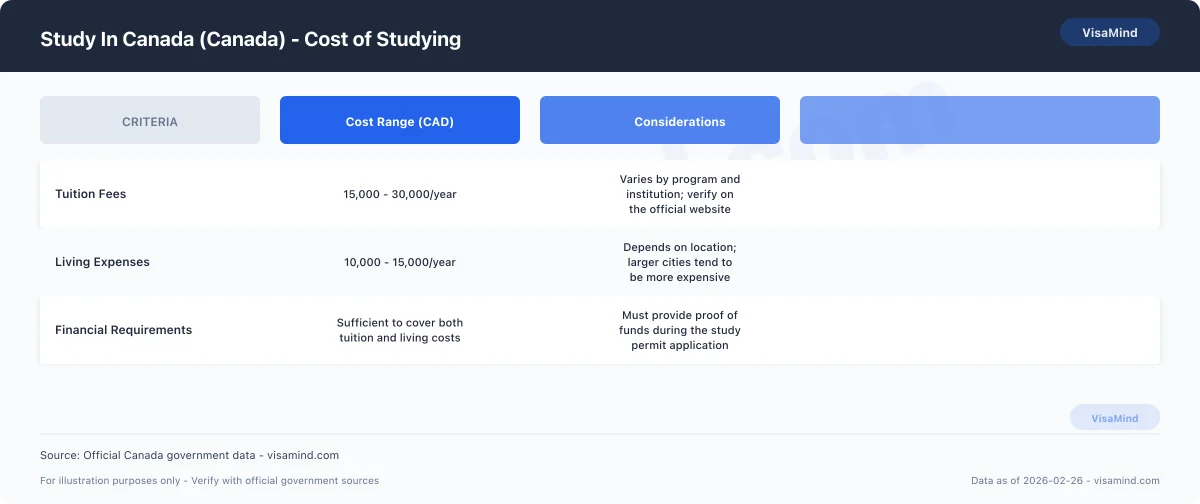
The cost of tuition in Canada can vary significantly depending on the institution and program of study. On average, international students can expect to pay between CAD 15,000 and CAD 30,000 per year for undergraduate programs. Graduate programs may range from CAD 10,000 to CAD 20,000 per year. It's advisable to verify the specific tuition fees on the university's official website as costs may change annually.
Living Costs
Living expenses in Canada also vary based on the city and lifestyle. In general, you should budget for at least CAD 10,000 to CAD 15,000 per year to cover accommodation, food, transportation, and other personal expenses. Major cities like Toronto and Vancouver tend to be more expensive, while smaller cities may offer more affordable living options.
Financial Requirements
To obtain a Study Permit, you must demonstrate that you have sufficient funds to cover your tuition and living expenses while in Canada. This typically includes:
- Proof of tuition payment or ability to pay
- Financial statements or bank letters showing sufficient funds
- Documentation of any scholarships or funding you may receive
Tip: Ensure all financial documents are up-to-date and clearly show your ability to fund your education and stay in Canada.
Cost Comparison
| Item | Estimated Cost (per year) |
|---|---|
| Undergraduate Tuition | CAD 15,000 - CAD 30,000 |
| Graduate Tuition | CAD 10,000 - CAD 20,000 |
| Living Expenses | CAD 10,000 - CAD 15,000 |
For further guidance on the study permit application process, you can refer to the Study Permit Guide and explore pathways like Study to PR for long-term plans. Always check the most recent requirements on the Immigration, Refugees and Citizenship Canada (IRCC) official website to ensure compliance.
Settling In as a Student
#- Provincial Health Coverage: As an international student, you may be eligible for provincial health coverage depending on the province where you study. For example, students in British Columbia can apply for the Medical Services Plan (MSP).
- Private Health Insurance: In provinces where international students are not covered by the public system, you need to purchase private health insurance. Many post-secondary institutions offer group health plans for their students.
- Duration of Coverage: Ensure that your health insurance covers your entire stay in Canada, from arrival to departure.
Important: Without adequate health insurance, medical expenses can be extremely costly in Canada. Ensure you have coverage from the moment you arrive.
Housing Options
- On-Campus Housing: Many universities and colleges offer on-campus accommodation. This can be a convenient option as it allows you to live close to classes and campus facilities.
- Off-Campus Housing: Renting an apartment or house off-campus is another popular option. Websites and student housing services can help find listings.
- Homestay Programs: Living with a Canadian family can be a cultural experience and often includes meals, which can simplify budgeting.
Tip: Start your housing search early, as demand can be high, especially in major cities like Toronto and Vancouver.
Banking in Canada
- Student Bank Accounts: Most Canadian banks offer student accounts with benefits like no monthly fees. Consider opening an account soon after arriving to manage your finances efficiently.
- Required Documents: Typically, you will need your passport, study permit, and proof of enrollment to open a bank account.
- Transferring Funds: Consider international wire transfers or services like Western Union for transferring money from your home country. Some banks also offer international student banking packages that facilitate easier transfers.
For more detailed guidance on settling in as a student in Canada, you might find the Study Permit Checklist and Biometrics Guide helpful. These resources provide further insights into what you need to prepare and complete your application process.
What Other Students Experienced
#Maria, a prospective student from Brazil, faced a common dilemma when applying for a study permit in Canada. After completing her high school education, she took a gap year to work and travel, which created a noticeable break in her academic timeline. This gap raised concerns during her application process. To address this, Maria provided a comprehensive statement of purpose detailing her gap year experiences and how they contributed to her personal growth and preparedness for university studies. She submitted this explanation along with her study permit application through the IRCC portal. Due to her thorough documentation and clear explanation, Maria successfully received her study permit within four weeks, allowing her to start her program on time.
Scenario: Transitioning from High School to University with Conditional Admission
Ajay, an Indian student, was initially concerned about securing his study permit due to his conditional admission offer from a Canadian university. The university required Ajay to complete a language proficiency course before beginning his degree program. Unsure how this might affect his study permit application, Ajay included a letter from the university clarifying the conditional nature of his admission and the requirement to complete the language course. He lodged his application online and ensured all supporting documents, including financial proof and the conditional offer, were uploaded. With this preparation, Ajay's study permit was approved within six weeks, and he was able to enroll in the language course, setting the stage for his full degree program.
Scenario: Applying for a Study Permit at the Port of Entry
Li Wei, a student from China, found herself in a unique situation. She received a last-minute offer from a Canadian college, leaving her with limited time to apply for a study permit before departure. Fortunately, as a Chinese national, she was eligible to apply for her study permit upon arrival in Canada at the port of entry. Equipped with her acceptance letter, proof of funds, and other necessary documents, Li Wei approached the border services upon landing. The Canada Border Services Agency (CBSA) processed her application on the spot, and she received her study permit within an hour, allowing her to begin her studies without delay.
FAQs
Can I work part-time while studying in Canada (Canada) with a Study Permit?
What is the process to switch from a Study Permit to Permanent Residency in Canada (Canada)?
How much does it cost to apply for a Study Permit in Canada (Canada)?
Do I need to provide biometrics for my Study Permit application in Canada (Canada)?
Can I apply for a Study Permit at the port of entry in Canada (Canada)?
What should I do if my Study Permit application for Canada (Canada) is delayed?
How can I prepare my documents for a Study Permit application to Canada (Canada)?
VisaMind provides informational guidance only and is not a government agency. This is not legal advice. Requirements can change and eligibility depends on your specific facts. If your case is complex or high-stakes, consult a licensed immigration attorney.
Next steps
Requirements vary by nationality, purpose, timeline, and case details. Use Find My Visa to get a personalized checklist for Canada with official sources and deadlines.
Find my visa