Official sources referenced
Is This Guide for You?
#Sponsoring a family member to become a permanent resident of Canada is a significant step that allows them to live, study, and work in the country. Family sponsorship covers various categories, including spouses, partners, dependent children, adopted children, and other relatives. This guide is intended for Canadian citizens and permanent residents who wish to bring their family members to Canada.
Are You Eligible to Sponsor?
Before starting the sponsorship process, it is crucial to determine if you are eligible. You must be at least 18 years old and a Canadian citizen or permanent resident. Additionally, you need to show evidence of your relationship to the family member you wish to sponsor. This can include marriage certificates, birth certificates, or adoption papers, as applicable. Financial capability is also a requirement, ensuring you can support your family member upon their arrival in Canada.
When Should You Use This Guide?
This guide is specifically designed for those who are ready to take the steps necessary to bring their family members to Canada under the family sponsorship program. If you are considering sponsoring a spouse or partner, you may also want to explore options related to a Spousal Open Work Permit which allows them to work while their permanent residency application is processed. If you are looking to sponsor parents or grandparents, consider the Parent and Grandparent Sponsorship program.
Important: Failure to provide adequate evidence of your relationship with the family member you are sponsoring can lead to delays or rejection of the application. Be sure to gather all necessary documentation before proceeding.
Related Processes and Considerations
If you're considering multiple pathways for your family members to join you in Canada, you might also explore options like the Express Entry system for skilled workers or the Parent and Grandparent Sponsorship. These alternatives may offer different benefits or timelines depending on your family's circumstances. Always verify the most current details and processes on the official IRCC website to ensure compliance with all requirements.
Overview
#Family sponsorship in Canada is a vital pathway that allows Canadian citizens and permanent residents to bring their family members to live, study, and work in Canada as permanent residents. Managed by Immigration, Refugees and Citizenship Canada (IRCC), this program covers a variety of family member categories, including spouses, partners, dependent children, adopted children, and other eligible relatives.
What Does Family Sponsorship Involve?
The process of family sponsorship involves several key steps and requirements. As a sponsor, you must demonstrate your relationship to the person you wish to sponsor and meet certain eligibility criteria. Here’s a brief overview of who can be sponsored:
- Spouses and Common-law Partners: These are the most commonly sponsored relatives. The Spousal Sponsorship program allows you to sponsor your spouse or common-law partner to join you in Canada.
- Dependent Children: You can sponsor your biological or adopted children who are under the age of 22 and do not have a spouse or partner.
- Parents and Grandparents: This is a popular category, but it operates on a lottery system due to high demand. More details are available under the Parent and Grandparent Sponsorship program.
- Other Relatives: In rare cases, you may sponsor other relatives, such as siblings or orphaned family members, under specific conditions.
Key Requirements for Sponsorship
To sponsor a family member, there are several essential requirements you must meet:
- Proof of Relationship: You need to provide evidence of your familial relationship with the sponsored person. This is a critical part of the application.
- Financial Ability: As a sponsor, you must demonstrate that you have the financial means to support your family members once they arrive in Canada.
- Personal Information: You’ll need to supply various personal details, such as contact information and, in some cases, financial and employment records.
Tip: Ensuring all documentation is complete and accurate is crucial to avoid delays or rejections. Missing evidence of the familial relationship is a common pitfall.
The Application Process
The family sponsorship process involves several stages, starting with determining your eligibility category and gathering the necessary documents. Here’s a simplified breakdown:
- Determine Eligibility: Review the specific eligibility criteria for your family member's category.
- Gather Documents: Collect all required documents, including identity proofs and relationship evidence.
- Submit Application: Applications are lodged with the IRCC. Ensure you have completed all sections and included all necessary documentation.
Important: Always consult the official IRCC website for the most current guidelines and requirements, as these can change.
Benefits of Family Sponsorship
Family sponsorship not only reunites families but also provides sponsored individuals with the opportunity to become permanent residents. This status offers many benefits, such as the ability to work and study in Canada, access to healthcare, and the pathway to Canadian citizenship.
For more detailed guidance on the sponsorship application process, you may consider exploring related resources such as the Visa Application Steps or understanding different pathways through the PR Pathways Overview. Each of these resources provides additional insights into navigating the broader Canadian immigration landscape.
Eligibility and Requirements
#To sponsor a family member for permanent residency in Canada, you must meet specific eligibility criteria and fulfill certain requirements. This section breaks down the key aspects of eligibility and the necessary prerequisites.
Who Can You Sponsor?
- Spouse or Common-law Partner: You can sponsor your spouse, common-law partner, or conjugal partner.
- Dependent Children: Includes your biological or adopted children under the age of 22 who are not married or in a common-law relationship.
- Parents and Grandparents: Eligible under the Parent and Grandparent Sponsorship program, which has separate criteria and application process.
- Other Relatives: In rare cases, you may sponsor a sibling, niece, nephew, or grandchild if they are orphaned, under 18, and not married or in a common-law relationship.
Sponsor Eligibility Requirements
- Canadian Citizenship or Permanent Residency: You must be a Canadian citizen or a permanent resident of Canada.
- Age Requirement: You must be at least 18 years old to sponsor a family member.
- Financial Capability: Demonstrate sufficient income to support the sponsored person. For more details on financial requirements, see the Proof Of Funds.
- No Outstanding Sponsorship Obligations: Ensure you don’t have any previous sponsorship obligations that remain unmet.
Required Documentation
- Proof of Relationship: Provide documents like marriage certificates or birth certificates to establish your relationship with the person you are sponsoring.
- Financial Documents: Include recent tax returns, pay stubs, or employment letters to prove financial eligibility.
- Personal Information: Collect personal details such as phone number, email, and Social Insurance Number (SIN).
- Medical and Police Clearances: The sponsored family member may need to undergo medical examinations and obtain police certificates from each country where they have lived for 6 months or more since turning 18.
Important: Failure to provide adequate evidence of your relationship with the family member you are sponsoring can lead to delays or denials in processing.
Additional Considerations
- Inadmissibility: Ensure that the sponsored family member is not inadmissible to Canada due to health or criminal reasons. Consult the Medicals And Police Certificates guide for more information.
- Application Process: Before you begin the sponsorship application, review the specific instructions related to your eligibility category. This ensures you meet all criteria, avoiding common pitfalls.
By understanding these eligibility requirements and gathering the necessary documentation, you can effectively sponsor your family members to join you in Canada. For further guidance on specific processes, refer to the Visa Application Steps.
Step-by-Step Process
#-
Determine Your Eligibility
Before you begin the family sponsorship process, ensure you meet the eligibility criteria. You must be a Canadian citizen or a permanent resident to sponsor family members. Family members eligible for sponsorship include spouses, partners, dependent children, parents, grandparents, and other relatives under certain conditions. It's important to note that specific requirements may vary depending on the category of family member you wish to sponsor, such as Spousal Sponsorship.
-
Gather Necessary Documents
Compile all the necessary documents to support your application. This includes proof of your relationship to the family member you are sponsoring, such as marriage certificates or birth certificates. Additionally, gather personal information including telephone numbers, email addresses, Social Insurance Numbers (SIN), and financial, medical, or employment details. Missing documentation can delay the process or lead to rejection, so ensure everything is complete.
-
Review Application Instructions
Visit the official IRCC website to access the latest instructions specific to your sponsorship category. Carefully review the guidance provided to understand what is required for your application. The instructions will outline the specific forms, such as IMM-1344, you need to complete and any additional documents you need to include.
-
Lodge Your Application
Complete the necessary forms, ensuring all information is accurate and up-to-date. Each section of the application must be filled thoroughly to avoid errors. Once your forms are ready, submit your application along with the required documents to the IRCC. It is recommended to lodge your application online, as this can expedite the process and provide you with an immediate receipt number, which can be used to track your application status.
Tip: File online to avoid mail delays and get a receipt number immediately.
-
Pay the Required Fees
Pay the sponsorship application fees as specified on the IRCC website. Fees vary depending on the type of sponsorship but typically include a processing fee and a right of permanent residence fee. Ensure you keep the payment receipt as proof of payment, which may be required during the application process.
-
Wait for Processing and Decision
After your application is submitted, it will undergo a review process by the IRCC. The processing time can vary, so it's advisable to check the Processing Times Explained guide on the IRCC website for the most current timeline estimates. During this period, you may be asked to provide additional information or attend an interview.
Important: Keep your contact information up to date with the IRCC to receive all communications regarding your application.
By following these steps, you can successfully navigate the family sponsorship process in Canada. Ensure you stay informed about any updates or changes to the process by regularly checking the IRCC website.
Fees, Timeline, and What to Expect
#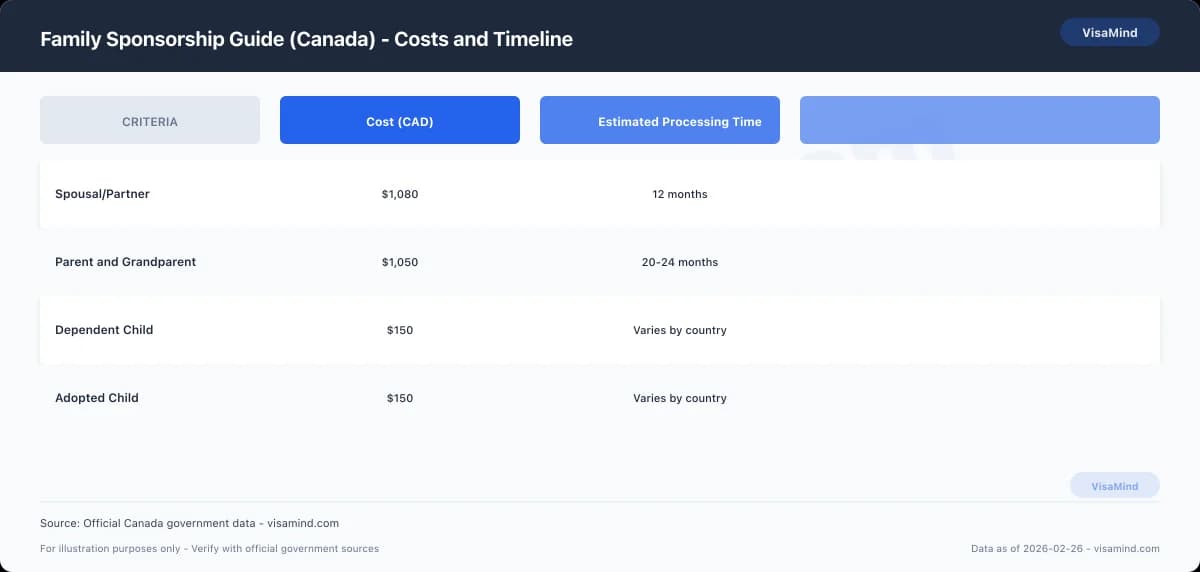
Understanding the associated fees is crucial. As of 2023, the costs can vary depending on the family member you are sponsoring. Here’s a breakdown:
| Type of Sponsorship | Sponsorship Fee | Right of Permanent Residence Fee | Total Cost |
|---|---|---|---|
| Spouse/Partner | $570 | $515 | $1,085 |
| Dependent Child | $155 | N/A | $155 |
| Parent/Grandparent | $490 | $515 | $1,005 |
Important: These fees are subject to change. Always verify the current amounts on the official IRCC website.
Processing Times
Processing times for family sponsorship applications can vary based on several factors, including the type of relationship and the country of the applicant. As of 2023, here are estimated times:
| Sponsorship Type | Average Processing Time |
|---|---|
| Spouse/Partner | 12 months |
| Dependent Child | 12 months |
| Parent/Grandparent | 20-24 months |
Tip: Use the Processing Times Explained guide to understand how processing times are calculated and what might affect them.
What to Expect During the Process
Embarking on the family sponsorship journey involves several stages. Here's a brief overview:
- Application Submission: Ensure all relevant forms and documents, such as evidence of relationship and financial proofs, are included.
- Processing and Review: IRCC will review the application and may request additional information or documentation.
- Decision and Notification: Once reviewed, IRCC will notify you of the decision. If successful, your family member(s) will receive documentation to enter Canada as permanent residents.
For more detailed steps, refer to the Visa Application Steps.
By understanding the fees, timelines, and process expectations, you can better prepare for sponsoring your family members to join you in Canada. Always ensure to consult the latest guidelines on the official IRCC website for the most accurate information.
What Experienced Applicants Recommend
#Tip: Begin your family sponsorship application as early as possible to allow yourself ample time to gather all necessary documents and avoid the pitfalls of rushing.
Importance of Documentation
- Evidence of Relationship: Ensure you have strong evidence of your relationship with the family member you are sponsoring. This is a common area where applicants face issues. Gather documents like marriage certificates, birth certificates, and photos that demonstrate your relationship.
- Financial Requirements: Be prepared to provide detailed financial information, including your Social Insurance Number (SIN) and proof of income. This helps IRCC assess your ability to financially support the sponsored family member.
- Personal Information: Keep all personal information such as telephone numbers and emails up to date. Inaccurate information can lead to delays in processing.
Understanding the Process
- Review Eligibility Requirements: Before you start your application, review the specific eligibility requirements for your category, such as Spousal Sponsorship or Parent and Grandparent Sponsorship. This ensures you meet all criteria and helps avoid unnecessary delays.
- Lodge Application Correctly: Ensure all required sections of your application are complete. Missing information can lead to processing delays or even rejection.
- Use Online Resources: Utilize online tools and guides like the Visa Application Steps to help navigate the application process efficiently.
Common Pitfalls to Avoid
- Incomplete Applications: One of the most common mistakes is submitting an incomplete application. Double-check all sections are filled and all required documents are included before submission.
- Timely Submission: Keep track of deadlines to ensure your application is submitted on time. Late submissions can result in significant delays.
- Overlooking Medical and Police Certificates: If required, make sure to obtain medical exams and police certificates early in the process. For more details, refer to our Medicals and Police Certificates Guide.
Important: Changes in your family situation, such as divorce or marriage, must be reported to IRCC immediately, as they can affect your eligibility to sponsor.
Additional Resources
- Seek Professional Advice: If you're uncertain about any part of the process, consider consulting an immigration consultant or lawyer. They can provide tailored advice based on your specific circumstances.
- Monitor Processing Times: Stay informed about current processing times by checking the Processing Times Explained guide. This can help you manage expectations and plan accordingly.
By adhering to these recommendations, you can better navigate the family sponsorship process in Canada and avoid common obstacles that may arise.
What Goes Wrong Most Often
#Important: Incomplete applications are a leading cause of delays or refusals. Double-check every section and document before submission.
Common Documentation Errors
-
Insufficient Evidence of Relationship: Many applicants fail to provide adequate proof of their relationship to the family members they wish to sponsor. This might include missing marriage certificates, birth certificates, or adoption papers. Always ensure these documents are up-to-date and clearly demonstrate the relationship.
-
Outdated or Incorrect Personal Information: Ensure that all personal information, such as telephone numbers, email addresses, and Social Insurance Numbers (SIN), is current and correctly entered. Inaccuracies can lead to processing delays.
Financial and Eligibility Mistakes
-
Incomplete Financial Information: Sponsors must demonstrate their financial capability to support the family member(s) they intend to sponsor. This includes providing recent tax assessments, pay stubs, and bank statements. Confirm that all required financial documents are included and clearly show your financial situation.
-
Misunderstanding Eligibility Requirements: Each sponsorship category, such as Spousal Sponsorship or Parent and Grandparent Sponsorship, has specific eligibility criteria. Thoroughly review these requirements to ensure you and your family members meet them before proceeding with the application.
Process and Submission Errors
-
Incomplete Sections in Application: Every section of the application must be filled out completely. Double-check each part to ensure nothing is left blank unless explicitly instructed.
-
Missing Signatures: Applications must be signed by both the sponsor and the sponsored family member. Forgetting a signature can result in the application being returned or refused.
Tips for a Smooth Process
-
Review Instructions Carefully: Before starting your application, review the detailed instructions for your specific category. This will help avoid unnecessary mistakes.
-
Track Your Application: Consider applying online to receive immediate confirmation and tracking information, reducing the risk of lost documents in transit.
By addressing these common pitfalls, you can improve the chances of a successful family sponsorship application. For more detailed guidance on the application process, refer to the Visa Application Steps for additional insights.
Real-World Examples
#A software engineer, Priya, recently married her Canadian partner, Daniel, while living in India. They were eager to start their life together in Canada but were concerned about the complexities of the Spousal Sponsorship process. Priya and Daniel diligently gathered all necessary documents, including evidence of their relationship spanning several years, financial statements, and correspondence. They applied through the IRCC portal, submitting a complete application package to ensure no delays. Within six months, Priya received her visa to move to Canada, where she could live and work alongside Daniel. Their proactive approach in following the detailed guidelines and including comprehensive relationship documentation facilitated a smooth transition for Priya.
Scenario: Sponsoring a Dependent Child
Maria, a Canadian permanent resident, wanted to sponsor her 12-year-old daughter, Sofia, from Brazil to join her in Canada. The application required proof of Maria's permanent resident status and Sofia's birth certificate to confirm their familial relationship. Maria ensured all documents were translated into English and submitted via the IRCC online system. Additionally, Maria provided evidence of her financial capacity to support Sofia, as required by IRCC guidelines. After a thorough review process lasting about eight months, Sofia was granted permanent residency, allowing her to live, study, and eventually work in Canada. Maria's careful attention to detail and adherence to IRCC requirements were pivotal in bringing her family together.
Tip: When sponsoring family members, ensure all documents are complete and translated into English or French to avoid processing delays.
FAQs
Can I switch from a spousal sponsorship to a parent sponsorship using the Family Sponsorship Guide (Canada)?
What is the most common pitfall when using the Family Sponsorship Guide (Canada)?
Is financial information required for the Family Sponsorship Guide (Canada)?
Can I combine spousal sponsorship and dependent child sponsorship applications in Canada?
What fees are associated with the Family Sponsorship Guide (Canada) application?
What do experienced applicants recommend when using the Family Sponsorship Guide (Canada)?
How do real-world examples help when filling out the Family Sponsorship Guide (Canada)?
Sources
Last reviewed: March 1, 2026
VisaMind provides informational guidance only and is not a government agency. This is not legal advice. Requirements can change and eligibility depends on your specific facts. If your case is complex or high-stakes, consult a licensed immigration attorney.
Next steps
Requirements vary by nationality, purpose, timeline, and case details. Use Find My Visa to get a personalized checklist for Canada with official sources and deadlines.
Find my visa