Official sources referenced
Is This Comparison for You?
#With a starting fee of $CAN 100, applying for a Visitor Visa or Super Visa is a significant decision, especially given the unique benefits each offers. This comparison is particularly valuable for individuals who need to determine the most suitable option based on their circumstances.
Who Benefits from This Comparison?
This comparison is designed for individuals who plan to visit Canada either temporarily or for extended stays. If you are considering visiting Canada for tourism, business, or to meet family, the Visitor Visa (also known as a Temporary Resident Visa) may be appropriate. Conversely, if you are a parent or grandparent of a Canadian citizen or permanent resident and wish to stay longer, the Super Visa could be the better choice. Understanding these distinctions is crucial for making an informed decision.
Key Differences Between the Visas
While both visas allow entry into Canada, they serve different purposes and have distinct eligibility requirements. The Visitor Visa typically grants stays of up to six months, whereas the Super Visa allows for extended visits of up to two years at a time without the need for extensions. This makes the Super Visa particularly advantageous for family reunification Visit Family.
Why Choose One Over the Other?
The decision between these visas often hinges on the length and purpose of your stay. If your visit is short-term, a Visitor Visa might be sufficient. However, for those looking to spend more time with family without frequent renewals, the Super Visa offers a more convenient solution Super Visa.
Tip: If you are planning to bring your parents or grandparents to Canada for an extended period, consider the Super Visa's long-term benefits.
By assessing your specific needs and understanding the differences between these visa types, you can choose the most appropriate option for your travel plans to Canada.
At a Glance
#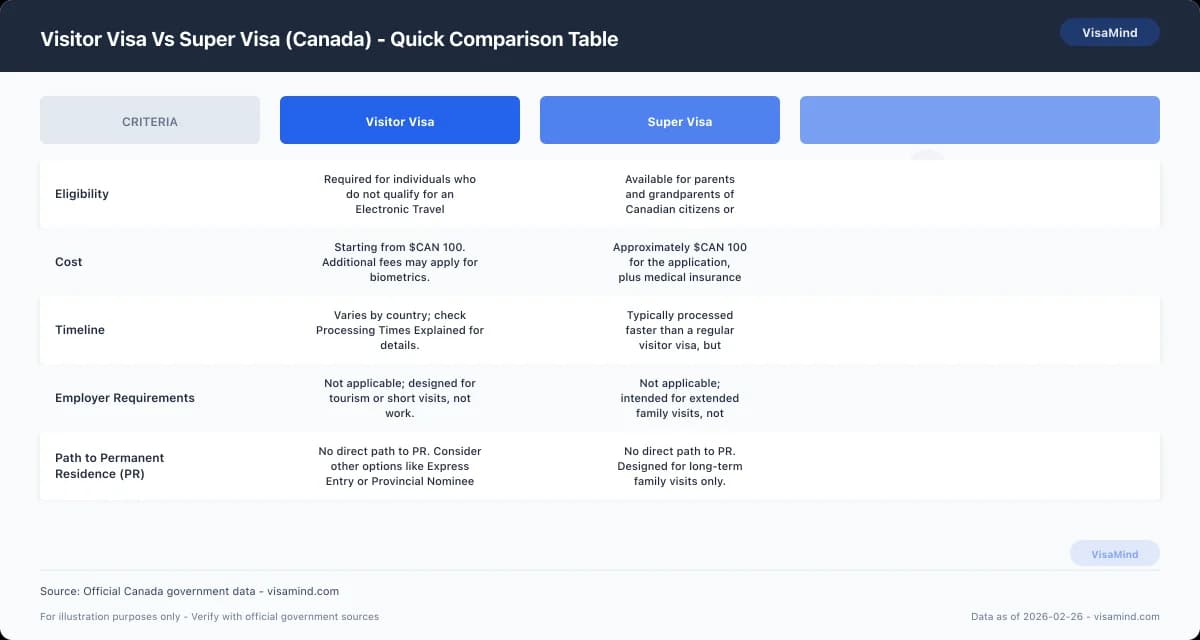
When considering the Visitor Visa and the Super Visa for Canada, it is important to understand their differences in terms of eligibility, cost, and other key dimensions. Below is a quick comparison to help you decide which option best suits your needs.
| Feature | Visitor Visa | Super Visa |
|---|---|---|
| Eligibility | Available to individuals who meet IRCC requirements for temporary residency. | Specifically for parents and grandparents of Canadian citizens or permanent residents. |
| Cost | Starting at $100 CAD as of 2023. Check the official website for updates. | Approximately $100 CAD, but you must also have medical insurance. Verify on the official website. |
| Timeline | Processing times vary; consult the Processing Times Explained guide for the latest details. | Typically longer due to additional requirements like medical exams. Check IRCC for current timelines. |
| Employer Requirements | Not applicable; this visa is intended for tourism or short-term visits. | Not applicable; designed for extended family visits, not employment. |
| Path to PR | Does not directly lead to permanent residency. | Does not provide a direct path to PR, but allows extended stays to support family. |
Eligibility Requirements
The Visitor Visa is for those who meet general IRCC requirements for temporary residence in Canada. This includes having a valid passport, proof of financial support, and ties to your home country. Meanwhile, the Super Visa is tailored for parents and grandparents of Canadian citizens or permanent residents, requiring additional documentation to prove family connection.
Cost Considerations
Both visas have a base application fee starting at $100 CAD. However, the Super Visa applicants must also purchase Canadian medical insurance, which covers at least one year, adding to the overall expense. Always verify the most recent costs on the official IRCC website, as fees can change.
Processing Timeline
Visitor Visa processing times can vary significantly based on several factors, including your country of residence. It's important to check the Processing Times Explained guide for the latest information. The Super Visa typically takes longer to process because it involves more extensive checks, such as medical examinations.
Tip: For quicker processing, consider applying online and ensure all your documents are complete and in order.
Path to Permanent Residency (PR)
Neither the Visitor Visa nor the Super Visa directly leads to permanent residency. However, the Super Visa allows parents and grandparents to stay in Canada for extended periods, which could facilitate future family sponsorship applications. For those interested in pathways to PR, exploring options like the Express Entry Guide may be beneficial.
Understanding these key differences can greatly aid in selecting the right visa type for your visit to Canada. Always ensure to check the latest requirements and updates directly from the official IRCC resources to make an informed decision.
Option A Is Better When...
#Tip: Make sure to assess your personal circumstances and travel goals to determine the most suitable visa option for your visit to Canada.
Scenario: Visiting for a Short, Limited Time
An event planner from Mexico wanted to visit Canada for a two-week business conference. Given her short stay, she opted for a Visitor Visa, which is perfect for temporary visits like attending conferences or exploring business opportunities. She checked the eligibility requirements on the IRCC website and confirmed her application through the Visitor Visa ETA Guide. The process was straightforward due to her clear purpose and limited stay. Within a few weeks, she received her visa and successfully attended the conference.
Scenario: Short, Recurring Family Visits
A retired engineer from India wanted to visit his daughter in Canada twice a year for a month each time. The Visitor Visa suited his needs, allowing him to make short, recurring visits without the extended stay requirements of a Super Visa. He applied through the Visitor Visa application process and provided the necessary documentation, including proof of his retirement income and his daughter's invitation letter. His visa was approved in a timely manner, allowing him to enjoy frequent visits to his family.
Scenario: Budget-Conscious Travelers
A couple from Brazil planned to explore Canada's scenic landscapes for three weeks. Considering their budget and the temporary nature of their trip, the Visitor Visa was a more economical choice compared to the Super Visa. They gathered their travel itinerary, financial proofs, and applied through the IRCC portal. Their application was processed smoothly, and they received their visas in advance of their travel date, enabling them to embark on their Canadian adventure without any financial strain.
Important: Always verify the latest guidelines and requirements on the official IRCC website before applying, as visa policies and processing times can change.
When to Pick the Second Option
#A Canadian permanent resident, Priya, wanted her parents to visit from India and stay for an extended period to assist with her newborn child. With the regular Visitor Visa, her parents would typically be allowed to stay for a maximum of six months. However, Priya required their presence for at least two years.
She decided to apply for the Super Visa, which is specifically designed for parents and grandparents of Canadian citizens or permanent residents. Priya gathered the necessary documents, including proof of her Canadian residency, a written commitment of financial support, and private medical insurance for her parents for at least one year. The application was lodged through the Super Visa process on the IRCC portal. Within a few weeks, Priya's parents were approved for a Super Visa, allowing them to stay in Canada for up to two years on their initial visit. This flexibility was crucial for Priya’s family needs.
Scenario: Long-Term Stay for Grandparents
A Canadian citizen, Michael, wanted his grandparents from Italy to stay with him in Toronto for an extended period to help with family commitments and to explore the possibility of permanently relocating in the future. Michael initially considered a Visitor Visa, but the six-month limit was inadequate for his plans.
Instead, Michael opted for the Super Visa, which allows longer stays. He submitted proof of his citizenship, income verification to demonstrate financial support, and arranged for medical insurance coverage for his grandparents. The IRCC processed the Super Visa application efficiently, and his grandparents were granted the visa, enabling them to remain in Canada for up to two years without the need to renew their status every six months. This solution provided Michael's family the opportunity to spend more meaningful time together without frequent interruptions.
Tip: The Super Visa is an excellent option for families seeking to have parents or grandparents stay in Canada long-term without the need for frequent renewals.
What Really Sets Them Apart
#One of the most significant distinctions between the Visitor Visa and the Super Visa is the duration of stay permitted in Canada. A standard Visitor Visa usually allows you to stay in Canada for up to six months at a time. If you plan to stay longer, you must apply for an extension or leave and re-enter the country, which may not guarantee re-entry each time.
In contrast, the Super Visa is specifically designed for parents and grandparents of Canadian citizens or permanent residents, enabling them to stay in Canada for much longer periods. With a Super Visa, you can stay for up to two years on initial entry without needing to renew your status.
Here's a quick comparison:
| Visa Type | Initial Stay Duration | Renewal Required for Longer Stay? |
|---|---|---|
| Visitor Visa | Up to 6 months | Yes |
| Super Visa | Up to 2 years | No |
Eligibility Criteria
The eligibility criteria for these visas also set them apart. The Visitor Visa is available to a broader audience, as it caters to individuals from around the world who wish to travel to Canada temporarily, whether for tourism, business, or family visits. In contrast, the Super Visa is a specialized option, available only to parents and grandparents of Canadian citizens or permanent residents.
To be eligible for a Super Visa, you must meet additional requirements, such as:
- Providing a letter of invitation from your child or grandchild in Canada.
- Demonstrating financial support from your host in Canada.
- Obtaining a medical insurance policy from a Canadian insurance company, covering at least $100,000 CAD for a minimum of one year.
For more details on eligibility, you can explore the Super Visa and Visitor Visa pages.
Purpose and Use
The intended purpose of each visa also differentiates them. The Visitor Visa serves a range of short-term needs, such as tourism, visiting family, or attending business meetings. It is versatile, allowing for various activities within a six-month timeframe.
Conversely, the Super Visa offers a more focused purpose: facilitating extended family reunification. It provides parents and grandparents with the opportunity to spend significant time with their families in Canada without the need for frequent renewals or re-entry applications. This makes it an excellent choice for families looking to spend more extended periods together.
Tip: Ensure you gather all necessary documents and meet the specific requirements for the visa you are applying for to avoid processing delays. For more information on timelines and processes, see the Processing Times Explained.
These differences underscore the unique advantages and constraints of each visa type, helping you to determine which option best aligns with your travel intentions and family circumstances in Canada.
Common Misconceptions
#-
Visitor Visa and Super Visa Are for Everyone: A common misconception is that both the Visitor Visa and the Super Visa are open to all applicants. In reality, the Super Visa is specifically for parents and grandparents of Canadian citizens or permanent residents. This means it is not an option for other relatives or friends.
-
eTA and Visitor Visa Confusion: Some believe an Electronic Travel Authorization (eTA) is interchangeable with a Visitor Visa. However, an eTA is only applicable to visa-exempt travelers arriving by air and is not a substitute for a Visitor Visa. Furthermore, as of November 25, 2025, citizens of Qatar can apply for an eTA instead of a Visitor Visa, which can lead to confusion about eligibility.
Misunderstandings About Duration and Stay
-
Length of Stay: It is often mistakenly thought that the Visitor Visa allows for an indefinite stay in Canada. In contrast, it typically permits a stay of up to six months. The Super Visa, however, allows for much longer stays, granting entry for up to two years at a time without the need to renew visitor status.
-
Validity Period: Many assume the validity of a Super Visa is the same as a Visitor Visa. While a Visitor Visa can be valid for up to ten years, the Super Visa also allows for multiple entries over ten years, but with the benefit of longer stays per visit.
Misconceptions About Application Processes
-
Application Complexity: There is a belief that both visas have similar application processes. The Super Visa requires additional documentation, such as proof of financial support from the host in Canada and medical insurance. This makes the application process more complex compared to the Visitor Visa.
-
Processing Times: Another misconception is that both visas have similar processing times. In reality, Super Visa applications can take longer due to the additional requirements, such as medical examinations and financial evaluations. For more on processing times, check out our Visitor Visa ETA Guide.
Tip: When considering which visa to apply for, carefully assess your eligibility and the specific documentation requirements. This can save you time and prevent delays in processing.
To explore more about the options for visiting family in Canada, visit the Visit Family page.
Converting Between Options
#If you are in Canada on a Visitor Visa and wish to switch to a Super Visa, it's important to understand the prerequisites and process involved. The Super Visa is designed for parents and grandparents of Canadian citizens or permanent residents, and it allows for longer stays. However, transitioning from a Visitor Visa to a Super Visa isn't a simple conversion.
Important: You cannot directly convert a Visitor Visa into a Super Visa while in Canada. You must apply for the Super Visa from outside Canada.
To apply for a Super Visa:
- Ensure that you meet the eligibility requirements specific to the Super Visa, such as being the parent or grandparent of a Canadian citizen or permanent resident.
- Gather documents proving your relationship, financial support, and medical insurance coverage.
- Apply from your home country or another country where you have legal status.
For more detailed guidance, you can explore the Super Visa page.
Switching from Super Visa to Visitor Visa
If you are currently on a Super Visa and wish to transition to a Visitor Visa for shorter stays or different purposes, you must understand the limitations. The Super Visa allows extended visits, typically up to two years at a time, without needing to renew frequently.
To switch to a Visitor Visa:
- You will need to apply for a new Visitor Visa from outside Canada and meet its specific requirements.
- Consider if a Temporary Resident Permit might better suit your needs if there are exceptional circumstances.
Tip: Evaluate your travel and stay needs carefully before switching visa types, as each has unique benefits and limitations.
Key Differences Between Visitor Visa and Super Visa
| Feature | Visitor Visa | Super Visa |
|---|---|---|
| Purpose | Short-term visits | Long-term visits for parents/grandparents |
| Duration of Stay | Up to 6 months | Up to 2 years per entry |
| Eligibility | General travelers | Parents/grandparents of Canadian citizens/permanent residents |
| Application Location | Can be applied for from within or outside Canada | Must be applied for from outside Canada |
For more on the nuances of Visitor Visas, reference the Visitor Visa ETA Guide.
Be sure to assess your situation in detail, considering all factors such as duration of stay and eligibility, when deciding which visa to apply for.
Real Scenarios
#A software engineer in Toronto, who recently became a permanent resident, wanted his parents from India to visit and help with their newborn. With a Visitor Visa, his parents could only stay for a limited time, which would not suffice for the support needed during the initial months. To address this, he explored the Super Visa option, which allows for an extended stay of up to two years per visit. Through the IRCC's official portal, he applied for the Super Visa, providing proof of his Canadian residency and financial capability to support them. Within a few months, his parents received approval, allowing them to stay in Canada and assist with the baby without the constant need for visa renewals.
Scenario: Retirees Touring Canada
A retired couple from the United Kingdom planned a comprehensive tour of Canada, intending to stay in each province to experience local cultures and attractions. Initially, they considered a Visitor Visa, but realized the standard six-month stay might not be enough for their travel plans. They decided to explore the possibility of the Super Visa, as their daughter is a Canadian citizen residing in Vancouver. They applied through the IRCC's Super Visa process, submitting the required medical insurance and financial documentation to verify support. The Super Visa was granted, allowing them to enjoy an extended stay. They were able to leisurely explore Canada over a two-year period, returning to their daughter’s home base in Vancouver between travels.
Scenario: Long-term Family Visits
An accountant from Calgary planned to bring her aging mother from Brazil to live with her temporarily while recovering from surgery. The Visitor Visa would not provide the duration needed for her mother's recovery and rehabilitation. Therefore, she opted for the Super Visa. She submitted an application through IRCC's online portal, ensuring her mother had the required health insurance and financial support documentation. The process took several months, but once approved, her mother was able to stay in Canada for up to two years, giving her sufficient time for recovery and allowing them to spend meaningful time together during the healing process.
FAQs
Do I need a Visitor Visa if I'm eligible for an eTA in Canada?
What documents are required for a Super Visa compared to a Visitor Visa in Canada?
How does IRCC process times compare for the Visitor Visa Vs Super Visa (Canada)?
Can you apply for both a Visitor Visa and Super Visa (Canada) simultaneously?
Is medical insurance mandatory for the Super Visa compared to the Visitor Visa in Canada?
Does the Super Visa have a yearly application limit in Canada?
What are the benefits of a Super Visa over a Visitor Visa in Canada?
Sources
Last reviewed: March 1, 2026
VisaMind provides informational guidance only and is not a government agency. This is not legal advice. Requirements can change and eligibility depends on your specific facts. If your case is complex or high-stakes, consult a licensed immigration attorney.
Next steps
Requirements vary by nationality, purpose, timeline, and case details. Use Find My Visa to get a personalized checklist for Canada with official sources and deadlines.
Find my visa