Your Work Visa Options
#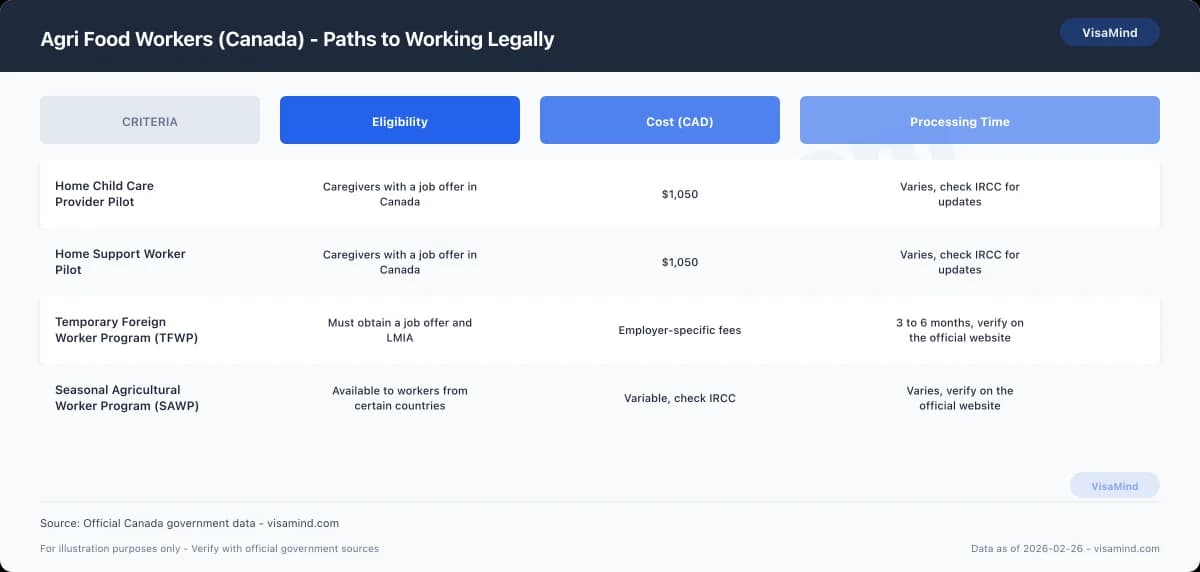
Canada offers a range of work visa options to support its diverse economy and address labor shortages in various sectors, including the agri-food industry. Understanding these options is crucial for prospective workers seeking to contribute to Canada's agricultural sector, whether temporarily or as a pathway to permanent residency.
Overview of Work Visa Options
Here's a comparative view of the main work visa categories available for those interested in working in Canada's agri-food sector:
| Visa Type | Eligibility | Cost (CAD) | Timeline |
|---|---|---|---|
| Agri-Food Immigration Pilot | Must have a job offer in an eligible agricultural occupation | Approximately $1,575 for PR application | Processing time varies; check the official website |
| Seasonal Agricultural Worker Program (SAWP) | Available to workers from participating countries with a job offer | Employer covers most costs; minimal fees for workers | Typically within weeks |
| Temporary Foreign Worker Program (TFWP) | Requires a Labour Market Impact Assessment (LMIA) | Varies; LMIA processing fee is $1,000 | 1-2 months for LMIA; additional time for work permit |
| Open Work Permit | Spouses of skilled workers or international students | $155 for work permit | Processing times vary; verify on the official website |
Understanding Your Options
Tip: Always check the latest eligibility criteria and program updates on the official IRCC website to ensure compliance with current requirements.
Agri-Food Immigration Pilot
This pilot is designed to address labor shortages in the agri-food sector and offers a pathway to permanent residency for eligible workers. Applicants must have a valid job offer and meet specific eligibility criteria, including language and work experience requirements.
Seasonal Agricultural Worker Program (SAWP)
This program facilitates the temporary employment of foreign workers in agriculture. It enables employers to hire workers from specific countries for a maximum of eight months during peak agricultural seasons. Most costs, including transportation and housing, are covered by employers.
Temporary Foreign Worker Program (TFWP)
The TFWP allows Canadian employers to hire foreign nationals to fill temporary labor shortages. This program requires a positive LMIA, which demonstrates that there are no Canadian workers available to fill the position. The process involves several steps, including employer compliance with labor laws.
Open Work Permit
Open work permits allow eligible individuals to work for any employer in Canada. They are typically available to spouses of skilled workers or international students. This flexibility provides opportunities for individuals to gain Canadian work experience, which can be beneficial if pursuing permanent residency.
Key Considerations
When choosing a work visa, consider the following:
- Eligibility Requirements: Ensure you meet all the specific criteria for the chosen visa type.
- Processing Time: Timelines can vary significantly; plan ahead to avoid delays.
- Cost: Be aware of the associated fees and potential employer responsibilities.
For further details on each visa type, including the application process and specific requirements, refer to the Work Permits Overview and LMIA Work Permit guides. Understanding these options can help you navigate the Canadian immigration process effectively and choose the right path for your career in the agri-food sector.
Employer Sponsorship Requirements
#Employers looking to hire agri-food workers in Canada must navigate specific sponsorship requirements set by Immigration, Refugees and Citizenship Canada (IRCC). These requirements ensure that the hiring process aligns with Canadian labor market needs and immigration policies.
What is the Labour Market Impact Assessment (LMIA)?
The Labour Market Impact Assessment (LMIA) is a critical step for employers wanting to hire foreign workers. It is a document that employers may need to obtain before hiring a foreign worker. The LMIA confirms that there is a need for a foreign worker to fill the job and that no Canadian worker is available to do the job.
- Positive LMIA: Indicates a need for foreign talent and supports the worker's application for a work permit.
- Negative LMIA: Suggests that the position can be filled by local talent.
Important: The LMIA process can take several weeks, so plan accordingly. Visit the LMIA Work Permit Guide for more details on the process.
Employer Sponsorship Requirements
To sponsor agri-food workers, employers must meet several criteria:
- Job Offer: Provide a genuine job offer that meets the wage and working conditions set by Canadian standards.
- Proof of Recruitment Efforts: Demonstrate attempts to hire Canadian citizens or permanent residents first.
- Compliance with Program Requirements: Ensure adherence to all program rules, including maintaining records and meeting conditions set by the LMIA or other pathways.
- Financial Capacity: Show the financial ability to pay the worker's salary and meet workplace obligations.
What is a Certificate of Eligibility (COE)?
In certain cases, a Certificate of Eligibility (COE) might be required as part of the process. This certificate confirms the employer's eligibility to participate in specific immigration programs or pilots tailored to the agri-food sector. It's important for employers to understand if their hiring situation necessitates a COE.
Employer Nomination Programs
Some provinces offer nomination programs that allow employers to nominate workers for permanent residency based on provincial labor market needs. This can be an excellent pathway for workers seeking to transition from temporary work permits to permanent residency.
- Provincial Nominee Program (PNP): Designed to address specific labor market needs in different provinces.
- Agri-Food Pilot: Focuses on specific occupations within the agri-food sector and offers a pathway to permanent residency.
Tip: Explore the Provincial Nominee Program Guide to understand how you can leverage these programs for your hiring needs.
By understanding and adhering to these requirements, employers can effectively sponsor agri-food workers, contributing to Canada's agricultural sector while supporting the pathways to temporary or permanent residency for international workers.
How to Apply for a Work Visa
#Determine Your Eligibility
Before applying for a work visa in Canada's agri-food sector, it is crucial to confirm your eligibility. Different programs, such as the Home Child Care Provider Pilot and the Home Support Worker Pilot, have specific criteria and deadlines. For instance, applications for these pilots were accepted until June 17, 2024. Ensure that you meet all requirements for the specific program you are interested in. Additionally, the Live-in Caregiver Program is closed to new applicants unless a work permit was received based on a Labour Market Impact Assessment (LMIA) submitted before December 2014.
Create or Sign In to Your IRCC Account
To begin the application process, you must create an account on the Permanent Residence Portal or sign in if you already have one. This portal is managed by Immigration, Refugees and Citizenship Canada (IRCC) and serves as the primary hub for submitting applications and managing your status. Ensure that your account details are complete and accurate to avoid any issues later in the process.
Gather Required Documents
Collect all necessary documents before starting your application. This includes proof of work experience, identification documents, and any other evidence required by your specific eligibility category. Review the detailed instructions provided for your chosen program to ensure you have all the required documentation. Missing documents can delay processing times, so double-check everything before proceeding.
Tip: Organize your documents in digital format. This will make uploading them to the portal much easier.
Apply Online
Once you have gathered all required documents, proceed to apply online via the Permanent Residence Portal. Carefully complete all sections of the application, ensuring accuracy and consistency with your supporting documents. The IRCC website provides instructions tailored to each eligibility category, so follow these guidelines closely.
Important: Ensure your application is submitted before any program closure dates to avoid automatic rejection.
Pay Application Fees
After submitting your application, you will need to pay the applicable fees. Fees can vary depending on the program and your personal circumstances, so verify the current fee structure on the official IRCC website. Ensure that your payment method is valid and that you receive confirmation of payment to avoid processing delays.
Track Your Application
After submitting your application and payment, you can track the status through your IRCC account. Regularly check for updates or additional requests for information. Keeping an eye on your application status will allow you to respond promptly to any IRCC requests, helping to avoid unnecessary delays.
By following these steps, you can effectively navigate the process of applying for a work visa in Canada’s agri-food sector. For more information on related topics, you may want to explore guides on Work Permits Overview or specific visas like the LMIA Work Permit.
What You Can and Cannot Do
#When working in Canada under the Agri-Food immigration pathways, you may have several questions about your rights and limitations. Here are some key points about what you can and cannot do with this type of work authorization.
Can You Change Employers?
If you are employed under a specific employer through a program involving a Labour Market Impact Assessment (LMIA), your ability to change employers is restricted. You will generally need a new LMIA and work permit to switch to a different employer. However, some programs offer more flexibility:
- Open Work Permits: These allow you to change employers without needing a new LMIA.
- Bridging Open Work Permit: If you are transitioning to permanent residency, you may qualify for this permit, which offers more flexibility in employment.
For more detailed guidance, you can refer to the Bridging Open Work Permit.
Can Family Members Join You?
Family reunification is a significant aspect of Canadian immigration policy. As an agri-food worker, your family may be eligible to accompany you to Canada under certain conditions:
- Spouses or Common-Law Partners: They may be eligible for an open work permit, allowing them to work for any employer in Canada.
- Dependent Children: They can join you and may require a Study Permit if they plan to attend school in Canada.
Can You Study?
While working in Canada, you might consider furthering your education. Depending on your work permit conditions, you may need additional authorization:
- Short-Term Study: You can engage in courses of up to six months without a study permit.
- Longer Courses: For studies exceeding six months, a Study Permit is required.
Tip: If planning to study, apply for a study permit well in advance to avoid any disruptions.
Being aware of these regulations will help you navigate your experience in Canada effectively. For further information on working and studying in Canada, explore our resources on Work in Canada and Study in Canada.
From Work Visa to PR
#Navigating the journey from a work visa to permanent residency (PR) in Canada involves understanding specific pathways and timelines offered by Immigration, Refugees and Citizenship Canada (IRCC). For agri-food workers, this process can be a viable opportunity to settle permanently in Canada, especially through programs tailored to the agricultural sector.
Pathways to Permanent Residency
For those in the agri-food sector, there are several pathways that can lead from holding a work visa to obtaining PR status. These pathways are designed to address the unique needs of the agricultural industry and support Canada's economic growth.
- Agri-Food Immigration Pilot: This pilot program is specifically tailored to address labor shortages in the agriculture and agri-food sectors. It offers a direct route to PR for eligible workers who have gained relevant work experience in Canada.
- Express Entry: Agri-food workers may be eligible under the Federal Skilled Worker Program or the Canadian Experience Class, both of which are managed through the Express Entry system. Having Canadian work experience can significantly boost your Comprehensive Ranking System (CRS) score.
- Provincial Nominee Program (PNP): Several provinces have PNP streams that cater specifically to workers in the agri-food sector. Being nominated by a province can enhance your chances of receiving an invitation to apply for PR.
Timeline and Key Steps
The timeline for transitioning from a work visa to PR can vary depending on the specific program and individual circumstances. However, understanding the general process can help you plan effectively.
- Gain Relevant Work Experience: Typically, you need at least one year of full-time work experience in Canada in a relevant occupation to qualify for many PR pathways.
- Create a Profile: For programs like Express Entry, you need to create an online profile and ensure all information is accurate and up-to-date.
- Receive an Invitation to Apply (ITA): If you meet the eligibility criteria and have a competitive CRS score, you may receive an ITA for PR.
- Submit PR Application: Once you have an ITA, you must submit a complete application for PR within the specified timeframe, generally 60 days.
Important: Missing application deadlines or failing to include all required documents can result in delays or refusals. Always verify current requirements on the official IRCC website.
Additional Considerations
- Language Proficiency: Demonstrating proficiency in English or French is crucial. Consider taking a recognized language test to improve your application.
- Proof of Funds: Depending on the program, you may need to show that you have sufficient funds to support yourself and your family upon settling in Canada.
- Medical and Security Checks: All applicants must undergo medical examinations and security background checks as part of the PR process.
For further guidance on transitioning from a work visa to permanent residency, you can explore resources such as the PR Pathways Overview and Express Entry Guide. Understanding these options can significantly enhance your prospects of successfully obtaining PR status in Canada.
What Goes Wrong
#Navigating the application process for working in Canada's agri-food sector can sometimes lead to challenges and refusals. Here are key reasons for refusals and how you can avoid them:
Missing Deadlines
- Program Closure Dates: Ensure you apply before any program closure dates. For instance, applications for the Home Child Care Provider Pilot and Home Support Worker Pilot are accepted until June 17, 2024. Submitting after deadlines leads to automatic denial.
Important: Always verify the latest program timelines on the IRCC website to avoid missing critical dates.
Incomplete or Incorrect Documentation
- Proof of Work Experience: Your application must include comprehensive evidence of work experience. Missing documents or unclear proof can result in refusal.
- Signatures and Forms: Ensure all required sections are completed and signed. Missing signatures can invalidate your application.
Eligibility Criteria
- Program-Specific Requirements: Each pilot or program may have unique criteria. Confirm that you meet all eligibility requirements before applying.
- Live-in Caregiver Program: This program is closed to new applicants unless you received a work permit based on a labour market impact assessment submitted before December 2014.
Inaccurate Information
- False Information: Providing incorrect or misleading information can lead to refusal. It's vital to ensure all details are accurate and truthful.
Lack of Supporting Documents
- Permanent Residence Portal Account: Creating or signing into a Permanent Residence Portal account is necessary for submitting applications. Failure to do so can prevent the submission.
- Document Gathering: Gather all required documents before lodging your application to avoid delays or rejections.
Tips for a Successful Application
- Review Instructions: Carefully review instructions for your specific eligibility category before starting the application process. This helps you understand unique requirements and avoid common errors.
- Online Submission: Consider submitting your application online to avoid mail delays and receive immediate confirmation.
For more guidance on the process, you can explore related resources such as the Work Permits Overview or details on Work In Canada. Make sure to check the Visa Refusal Reasons guide for additional insights on avoiding common pitfalls.
Salary Thresholds and Fees
#When applying for opportunities in Canada's agri-food sector, it's important to understand the financial aspects involved, including salary thresholds and application fees. Below is a comparison of these elements for individuals seeking to work in this dynamic industry.
Salary Thresholds and Application Fees
| Category | Salary Threshold | Application Fee |
|---|---|---|
| Agri-Food Immigration Pilot | Varies by province and job offer; consult IRCC | CAD 1,040 for permanent residency |
| Temporary Foreign Worker Program | Aligns with provincial minimum wage levels | CAD 155 for work permit |
Understanding Salary Thresholds
The salary thresholds for agri-food workers can vary significantly depending on the province and specific job offer. Typically, salaries must meet or exceed the provincial minimum wage to ensure fair compensation. This consideration is crucial when you're evaluating job offers in different regions. For more information, you might consider checking resources related to the Seasonal Agricultural Worker.
Application Fees Explained
When applying for the Agri-Food Immigration Pilot, you should be prepared to pay an application fee of CAD 1,040 for permanent residency. Meanwhile, if you are applying through the Temporary Foreign Worker Program, the fee for a work permit is CAD 155. These fees are standard and reflect the administrative costs associated with processing applications through IRCC. For those transitioning from a Temporary Resident Permit to a work permit, understanding these fees is essential.
Important: Ensure that you verify any changes to fee structures or salary requirements on the official IRCC website, as these can be subject to updates.
Understanding these financial components is crucial as you prepare for your journey to work in Canada's thriving agri-food sector. For additional guidance on work permits, you may find the Work Permit Checklist helpful.
The LMIA Process
#The Labour Market Impact Assessment (LMIA) process is a crucial step for employers in Canada who wish to hire foreign agri-food workers. This process helps ensure that hiring foreign workers will not negatively impact the Canadian labor market. Here are the key steps involved in obtaining an LMIA for agri-food sector positions:
1. Determine the Need for an LMIA
Before proceeding, employers must verify whether an LMIA is required for their agri-food worker positions. Generally, most temporary foreign worker positions in the agri-food sector require an LMIA, but certain programs, such as the Seasonal Agricultural Worker Program, may have different requirements.
2. Submit a Job Offer
Employers need to create a detailed job offer that outlines the position, including job title, duties, salary, and working conditions. This job offer must comply with Canadian labor laws and standards.
3. Advertise the Job
A critical step in the LMIA process is demonstrating that efforts have been made to hire Canadian citizens or permanent residents first. Employers must advertise the position on various platforms for at least four weeks and must show proof of this advertising when applying for an LMIA.
Important: Failing to provide sufficient evidence of recruitment efforts can lead to delays or refusal of the LMIA application.
4. Apply for the LMIA
Once the recruitment efforts are completed, employers can apply for an LMIA through Employment and Social Development Canada (ESDC). This involves submitting several documents, including the job offer, proof of advertising, and an assessment fee.
Tip: Consider using the LMIA Work Permit Guide for detailed instructions on completing this process.
5. Await LMIA Decision
After submission, the ESDC will assess the application to determine if hiring a foreign worker is justified. This process can take several weeks, so planning ahead is essential.
6. Provide LMIA to the Worker
If approved, employers will receive a positive LMIA, which must be shared with the prospective agri-food worker. This document is necessary for the worker to apply for a Work Permit.
Completing the LMIA process successfully allows employers to support their labor needs while adhering to Canadian immigration regulations. For more detailed guidance on work permits and related processes, refer to the Work Permits Overview.
Tax Rules for Foreign Workers
#Foreign workers in Canada's agri-food sector, like all employees, need to be aware of their tax obligations and social security contributions. Understanding these financial responsibilities is crucial to compliance and successful residency in Canada.
Income Tax Obligations
If you work in Canada, you are generally required to pay Canadian income tax on your earnings. The Canadian tax system operates on a self-assessment basis, meaning you must report your income and calculate your taxes owed at the end of the fiscal year. Foreign workers are typically considered residents for tax purposes if they stay for 183 days or more in a calendar year. You must file an annual tax return with the Canada Revenue Agency (CRA) to report your income and claim any applicable deductions or credits.
Social Security Contributions
In Canada, employees contribute to social security programs through payroll deductions. These include:
- Canada Pension Plan (CPP): Contributions are mandatory for most employees aged 18 to 70, except in Quebec, which has its own Quebec Pension Plan (QPP).
- Employment Insurance (EI): Provides temporary financial support to workers who have lost their jobs through no fault of their own.
Your employer will deduct these contributions directly from your paycheck. It's essential to ensure that these deductions are accurately reflected in your pay stubs.
Double Taxation Treaties
Canada has tax treaties with several countries to prevent double taxation—where the same income is taxed in both Canada and your home country. If your home country has such a treaty with Canada, it might reduce or eliminate your Canadian tax liability on certain income types. To benefit from these treaties, you may need to provide proof of residency in your home country and complete additional forms.
Tip: Consult a tax professional familiar with Canadian tax laws and international treaties to ensure you maximize your benefits and comply with all regulations.
Important Considerations
- Filing Deadlines: The deadline for filing a tax return in Canada is April 30 of the following year. Late filing can result in penalties and interest charges.
- Keep Records: Maintain detailed records of your income, tax slips, and any correspondence with the CRA. This documentation will support your tax return and any claims you make.
For more information on working in Canada and navigating its tax system, you may find resources like the Work Permits Overview and Permanent Residence helpful.
Real Scenarios
#A skilled agricultural technician from the Philippines had been working in Canada under the Seasonal Agricultural Worker Program. She aspired to transition to permanent residency and sought a pathway that recognized her experience in the agri-food sector. Understanding her options, she explored the new Agri-Food Immigration Pilot, designed specifically for workers in her field. She created an account in the Permanent Residence Portal and submitted documents proving her work experience, including pay slips and a letter from her employer. The process was straightforward, and within 12 months, she successfully transitioned to permanent residency, allowing her to continue her career in Canada without the need for seasonal work permits.
Scenario: Navigating the Home Support Worker Pilot
An experienced home support worker from India had been working in Canada under a temporary work permit. She aimed to apply for permanent residency through the Home Support Worker Pilot, a program that accepted applications until June 17, 2024. She ensured her qualifications met the pilot's requirements by reviewing the specific eligibility criteria outlined by IRCC. Using the IRCC website, she submitted her application through the Permanent Residence Portal, including detailed evidence of her employment, such as employer references and job descriptions. After a processing time of approximately 15 months, she received confirmation of her permanent residency status, enabling her to secure a stable future in Canada.
FAQs
What are the salary thresholds for Agri Food Workers (Canada) visas?
When do applications for the Home Child Care Provider Pilot close for Agri Food Workers (Canada)?
What documents are needed to prove work experience for Agri Food Workers (Canada)?
How does the LMIA process work for Agri Food Workers (Canada)?
Can Agri Food Workers in Canada switch to a different visa category?
What are the tax rules for foreign Agri Food Workers in Canada?
What happens if I submit my Agri Food Workers (Canada) application after the program closure date?
Sources
Last reviewed: March 1, 2026
VisaMind provides informational guidance only and is not a government agency. This is not legal advice. Requirements can change and eligibility depends on your specific facts. If your case is complex or high-stakes, consult a licensed immigration attorney.
Next steps
Requirements vary by nationality, purpose, timeline, and case details. Use Find My Visa to get a personalized checklist for Canada with official sources and deadlines.
Find my visa