On this page
- Retirement Visa Options
- Proof of Income for Retirees
- Health Insurance and Hospital Access
- How to Apply for a Retirement Visa
- Tax Implications
- Common Challenges
- Popular Retirement Destinations
- Duration and Renewal
- From Retirement Visa to PR
- Real Scenarios
- Visa options for this goal
- Guides for Indonesia
- Other goals for Indonesia
Retirement Visa Options
#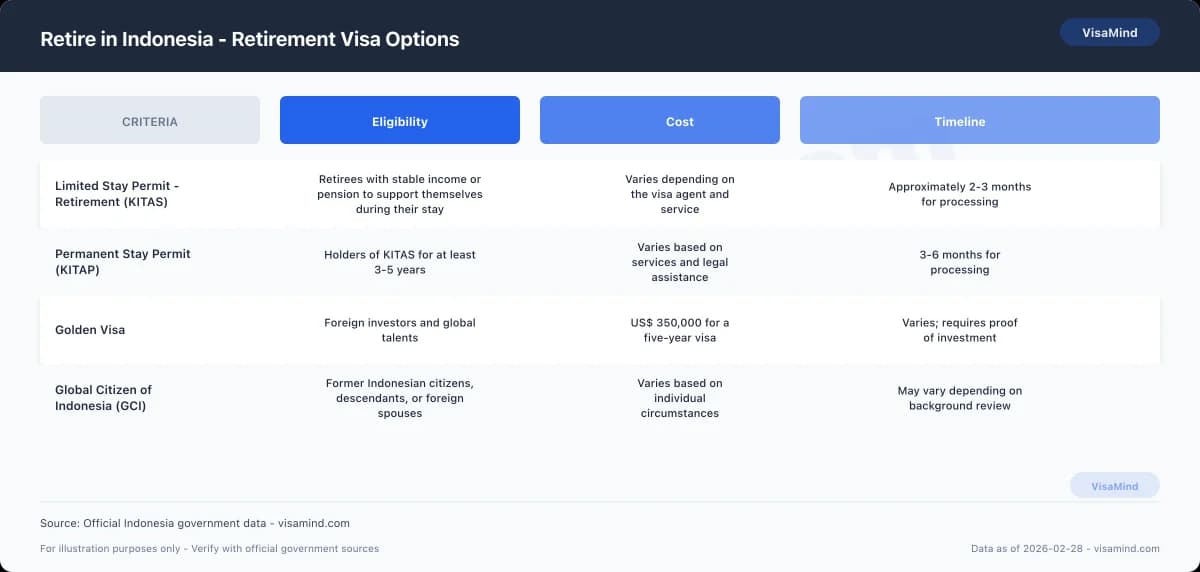
For retirees considering a move to Indonesia, understanding the available visa options is crucial. The Limited Stay Permit - Retirement (KITAS) is the primary visa category for retirees, allowing an extended stay in Indonesia.
Retirement Visa Options
Here is an overview of the key retirement visa options available in Indonesia:
| Visa Type | Eligibility | Cost | Timeline |
|---|---|---|---|
| KITAS Retirement | Foreign nationals aged 55+, proof of pension or income USD 1,500/month | Approx. USD 600 per year | 5 years, renewable |
| Permanent Stay Permit (KITAP) | Holders of KITAS for at least 3 years | Approx. USD 1,500 | Indefinite, with renewals every 5 years |
| Golden Visa | Investors with significant economic contribution | US$ 2,500,000 for 5 years; US$ 5,000,000 for 10 years | 5 or 10 years, depending on investment |
KITAS Retirement
The KITAS Retirement visa is tailored for retirees who wish to enjoy their golden years in Indonesia. Eligibility requires applicants to be at least 55 years old and to present proof of income or pension of USD 1,500 per month. The visa allows for a stay of five years, with the possibility of renewal. For more details on KITAS, refer to the Kitas Retirement page.
Tip: Ensure you meet the financial requirements before applying to avoid delays.
Permanent Stay Permit (KITAP)
For those already residing in Indonesia with a KITAS, the Permanent Stay Permit (KITAP) offers a more permanent solution. This visa is available to KITAS holders who have lived in Indonesia for at least three years. Once obtained, the KITAP permits an indefinite stay, requiring renewals every five years. More information can be found on the Permanent Stay Permit (KITAP) page.
Golden Visa
The Golden Visa is designed for individuals who can contribute significantly to Indonesia's economy through investment. It offers a longer stay option of five or ten years, depending on the investment amount. Individual investors need to invest a minimum of US$ 2,500,000 for a five-year visa or US$ 5,000,000 for ten years. This visa is ideal for those who wish to invest in Indonesia's burgeoning economy while enjoying retirement. Explore more about this option on the Golden Visa page.
Important: Ensure all investments are well-documented to prevent processing delays.
Additional Considerations
When planning your retirement in Indonesia, consider the benefits and requirements of each visa type. The Retirement Guide offers a comprehensive look at the retirement process, helping you choose the best option for your needs. Additionally, familiarize yourself with the Documents Checklist to ensure you have all necessary documents ready.
By selecting the appropriate visa, you can look forward to a fulfilling retirement in Indonesia, taking advantage of its rich culture and beautiful landscapes.
Proof of Income for Retirees
#Meeting the financial requirements set by the Directorate General of Immigration (Ditjen Imigrasi) is crucial for obtaining a retirement visa. This involves proving a stable financial situation through income, savings, and investments. Here’s a detailed breakdown of what's needed for the retirement visa application:
Financial Requirements for Retirees
To demonstrate your financial stability as a retiree in Indonesia, you must meet specific income and investment criteria. Below is a comparison of the essential financial requirements:
| Requirement Type | Details |
|---|---|
| Proof of Income | A minimum regular income of USD 1,500 per month or USD 15,000 per year is required. |
| Investment Commitment | GCI applicants must show investment in bonds, stocks, mutual funds, or property. |
| Bank Deposit | Demonstrating a secure financial position through bank statements or deposit certificates. |
Importance of Proof of Income
The proof of income is a critical component of your application. This ensures that you can support yourself without burdening the Indonesian economy. Regular income can be shown through:
- Pension statements
- Bank statements indicating consistent deposits
- Investment returns or rental income
Investment and Savings Requirements
For applicants under the Global Citizen of Indonesia (GCI) category, showcasing an investment commitment is mandatory. This could include:
- Investments in Indonesian bonds or stocks
- Real estate purchases or long-term leases
- Participation in mutual funds
It’s essential to have documentation ready for any investments or savings, as these will be scrutinized during the application process. For an extensive list of required documents, refer to the Documents Checklist.
Tip: Keep your financial documents well-organized and up-to-date to streamline the application review. Missing or outdated documents can delay the process.
Related Resources
For further details on retirement visa options or to understand the full scope of the application process, visit the Retirement Guide. This guide provides insights on how to effectively prepare your application and what to expect during the process.
Understanding the financial prerequisites is critical, as failing to meet these could result in application delays or denials. To learn more about secure financial arrangements and their implications, visit the Kitas Retirement page for comprehensive information.
Health Insurance and Hospital Access
#It's important to be informed about the country’s healthcare system and the requirements for health insurance. The Indonesian healthcare system is divided into public and private sectors, each with its own characteristics.
Public vs. Private Healthcare
Indonesia offers a mix of public and private healthcare facilities. The public healthcare system, known as BPJS Kesehatan, provides basic health services at an affordable cost. However, it may not meet the expectations of retirees accustomed to higher standards of care due to longer wait times and limited availability of advanced medical treatments.
In contrast, private healthcare facilities are generally more equipped with modern medical technology and offer a higher standard of care, often comparable to international standards. They are predominantly situated in urban areas like Jakarta and Bali. However, private healthcare can be considerably more expensive.
Mandatory Health Insurance
For retirees looking to live in Indonesia, obtaining health insurance is a mandatory requirement. This is to ensure that you have access to necessary medical treatments without financial strain. Many expatriates choose international health insurance plans that cover a wider range of services and allow for treatment in private facilities.
Important: Ensure your health insurance plan covers both inpatient and outpatient care, particularly if you plan to reside in rural areas where facilities may be more limited.
Quality of Medical Facilities
While public hospitals provide essential services, the quality and availability of care can vary significantly. Private hospitals, on the other hand, offer a more consistent quality of care with English-speaking staff, which can be comforting for foreign retirees.
Here's a comparison of the two:
| Feature | Public Healthcare | Private Healthcare |
|---|---|---|
| Cost | Low | High |
| Wait Times | Longer | Shorter |
| Quality of Care | Basic | High |
| Language Support | Limited | Extensive |
| Location | Nationwide | Mostly in urban areas |
When planning your retirement in Indonesia, carefully evaluate your healthcare needs and choose an insurance plan that aligns with your expectations and budget. For more detailed information on retirement visa options and related requirements, refer to the Retirement Guide and Documents Checklist.
Tip: Consider visiting Indonesia as a tourist first to explore healthcare options before committing to a long-term stay. The Visa On Arrival can be a convenient option for such exploratory trips.
How to Apply for a Retirement Visa
#Determine Your Eligibility
Before starting your retirement visa application process, ensure you meet the specific criteria set by the Directorate General of Immigration. Applicants need to be at least 55 years old and demonstrate financial self-sufficiency. This includes proof of a minimum income of USD 1,500 per month or USD 18,000 per year. You may also need to show investment commitments in bonds, stocks, mutual funds, or property if applicable.
Gather Required Documents
Assemble all necessary documents before applying. Essential documents include:
- A valid passport with at least 18 months' validity
- Proof of income or pension
- Evidence of health and life insurance
- A statement of no intention to work in Indonesia
- Rental or ownership agreement for accommodation in Indonesia
Ensure all documents are current and meet the specified requirements. Missing paperwork can lead to delays or rejection of your application.
Tip: Preparing your documents in advance can expedite the process and reduce the likelihood of errors.
Submit Your Application Online
The retirement visa application must be submitted through the electronic visa system. Create an account and follow the guided steps to lodge your application. You will need to upload your documents and complete the necessary information electronically.
Important: Double-check all entries before submission to avoid errors that could delay processing.
Pay Application Fees and Await Processing
After submitting your application, you will be prompted to pay the required fees. As of the latest update, fees can vary, so verify the current rates on the official Directorate General of Immigration website. Processing times can also vary, typically taking several weeks.
Tip: Keep a record of your application reference number for any future inquiries.
Arrival Declaration and Final Steps
Before traveling to Indonesia, you must fill out a declaration of arrival, which is required for all retirees. This is a crucial step to ensure smooth entry into the country. Upon arrival, you will need to finalize your retirement visa process with local immigration offices.
For more detailed guidance, consider reviewing related resources such as the Kitas Retirement and Golden Visa options. Each of these pathways has unique benefits and requirements that may align with your retirement plans. For comprehensive document preparation, see the Documents Checklist.
Tax Implications
#Understanding the tax implications is crucial to ensure compliance and financial readiness. Both local and international tax regulations can impact your global income, pension, and investments.
Tax Obligations for Retirees
Upon obtaining a retirement visa, retirees in Indonesia are subject to certain tax obligations. It is important to distinguish between residents and non-residents, as tax rates and obligations differ.
- Resident Retirees: If you reside in Indonesia for more than 183 days within a 12-month period, you are considered a tax resident. As a tax resident, you are liable to pay taxes on your worldwide income.
- Non-Resident Retirees: Non-residents are taxed only on income sourced within Indonesia.
Important: Ensure you determine your tax residency status accurately to comply with Indonesian tax laws.
Pension Taxation
For retirees, understanding how pensions are taxed is vital. Indonesia does not have specific pension tax relief, meaning pensions received from abroad may be subject to Indonesian income tax if you are a tax resident.
- Foreign Pensions: Often treated as ordinary income and taxed accordingly.
- Local Pensions: If you receive a pension from an Indonesian source, it is subject to local income tax regulations.
Tax Treaties and Worldwide Income
Indonesia has tax treaties with several countries aimed at avoiding double taxation on income. These treaties can significantly affect how your income, including pensions, is taxed.
- Double Taxation Agreements (DTA): Check if your home country has a DTA with Indonesia. These agreements can provide tax credits or exemptions, reducing the risk of being taxed twice on the same income.
- Worldwide Income Reporting: As a tax resident, you are required to declare global income, which includes foreign pensions, rental income, and investment returns.
Tip: Consult with a tax professional familiar with Indonesian tax law and international tax treaties to optimize your tax liabilities.
Key Considerations
- Proof of Income: Ensure you have adequate documentation for any foreign income, as this may be required by Indonesian tax authorities.
- Investment Income: Income from investments, whether in Indonesia or abroad, will likely be taxed if you qualify as a resident.
- Tax Filing: Annual tax returns must be filed with the Directorate General of Taxation. Ensure timely filing to avoid penalties.
For more detailed information on retirement and tax obligations in Indonesia, consider exploring resources like the Retirement Guide or consulting the Kitas Retirement visa specifics.
Understanding and planning for these tax implications will help ensure a seamless and financially sound transition to retirement life in Indonesia. Always verify current tax rates and regulations on the official Directorate General of Immigration website to stay informed.
Common Challenges
#Important: Before retiring in Indonesia, ensure you understand the specific requirements and challenges associated with the retirement visa process.
Financial Proof Challenges
- Proof of Income: You must demonstrate a minimum income of USD 1,500 per month or USD 15,000 per year. This can be challenging if your financial documentation is incomplete or does not meet the standards set by the Directorate General of Immigration.
- Investment Commitments: For those applying under specific categories, proof of investment in bonds, stocks, mutual funds, or property is necessary. Inadequate documentation can lead to delays or denial of your application.
Healthcare and Insurance Gaps
- Healthcare Coverage: Ensure you have comprehensive health insurance that is valid in Indonesia. Many retirees encounter difficulties if their current insurance does not cover them overseas or if they have not arranged for alternative coverage.
Annual Reporting and Renewal
- Annual Reporting: Retirees are often required to report annually to maintain their visa status. Failing to comply with these reporting requirements can lead to complications or penalties.
- Visa Renewal: While the Limited Stay Permit - Retirement (KITAS) is a common choice, it requires periodic renewal. Understanding the renewal timeline and maintaining the necessary documentation is crucial.
Language Barriers
- Communication Issues: Navigating the visa process can be complicated by language barriers. Many official documents and processes are conducted in Indonesian, which may pose a challenge if you are not fluent. Engaging a local advisor or translator can be beneficial.
Tip: Consider taking Indonesian language classes to ease communication and better integrate into the community.
For more detailed information on the visa process and potential pitfalls, refer to the Visa Refusal Reasons guide.
Popular Retirement Destinations
#Indonesia offers a variety of attractive retirement destinations, each with its unique charm and lifestyle offerings. As a retiree, you'll find options that cater to different preferences, whether you seek vibrant city life, serene beaches, or cultural experiences.
Popular Destinations for Retirees
Bali: Known for its stunning beaches and vibrant culture, Bali is a top choice for many retirees. It boasts a large expat community, which can be comforting for newcomers. The cost of living in Bali is relatively low, making it an affordable option for retirees looking to stretch their savings.
Yogyakarta: If you are interested in a culturally rich environment, Yogyakarta offers a blend of traditional arts, historic sites, and a warm community. The cost of living here is typically lower than in Bali, making it a budget-friendly destination.
Jakarta: For those who prefer city life, Jakarta provides a bustling urban environment with modern amenities. The cost of living can be higher compared to other regions, but the city offers conveniences and entertainment options that some retirees might find appealing.
Lombok: For a quieter, more relaxed pace, Lombok offers beautiful beaches and a laid-back lifestyle. It's less crowded than Bali and offers a more tranquil environment for retirees who prefer peace and solitude.
Cost Comparisons
| Destination | Cost of Living Index* | Expat Community Size |
|---|---|---|
| Bali | Medium | Large |
| Yogyakarta | Low | Medium |
| Jakarta | High | Large |
| Lombok | Low | Small |
*As of 2023, verify on the official website for the latest details.
Expat Communities and Support
Retirees in Indonesia can benefit from established expat communities, particularly in Bali and Jakarta, where support networks and social groups are readily available. These communities often host events and gatherings that can help newcomers settle in and make connections.
Tip: Engage with local expat forums and groups online before moving to get insights and advice from those already living in your chosen destination.
For further details on retirement visas, consider exploring options like the Permanent Stay Permit (KITAP) or the Golden Visa if applicable to your situation. Additionally, the How To Apply guide can provide a step-by-step overview of the application process.
Duration and Renewal
#Retirement visas in Indonesia, managed by the Directorate General of Immigration (Ditjen Imigrasi), provide retirees the opportunity to enjoy their golden years in this vibrant country. Understanding the duration and renewal process is crucial for maintaining your stay.
How Long is a Retirement Visa Valid?
The Limited Stay Permit - Retirement (KITAS) is initially issued for a period of one year. You can renew this visa annually, allowing you to continue enjoying your retirement in Indonesia without interruption.
For those looking for a more permanent arrangement, the Permanent Stay Permit (KITAP) offers a longer-term solution. After holding a KITAS for a consecutive period, retirees may be eligible to apply for a KITAP, which is valid for five years and can be renewed indefinitely.
Tip: Ensure your KITAS is renewed before it expires to avoid any disruption in your stay. You can find more details about the KITAP and its requirements on our website.
What is the Renewal Process?
Renewing your retirement visa involves several steps:
- Prepare Your Documents: Gather all necessary documents, including proof of income, a valid passport, and evidence of financial commitments.
- Submit Application: Lodge your application through the electronic visa system at evisa.imigrasi.go.id.
- Attend an Interview: Be prepared to attend an interview if requested by immigration officials.
- Await Approval: Once your application is processed, you will receive notification of approval.
Important: Delays can occur if documentation is incomplete. Refer to our Documents Checklist for detailed guidance.
Are There Annual Reporting Requirements?
Yes, retirees on a KITAS must report annually to the local immigration office. This process ensures that your information is up-to-date and that you continue to meet the visa requirements. During this report, you may need to provide updates on your financial status and any changes in personal circumstances.
For those holding a KITAP, the reporting requirements are less frequent but still essential to comply with Indonesian immigration laws.
For more detailed guidance on the renewal and reporting processes, visit our Visa Extension Guide.
From Retirement Visa to PR
#Obtaining a retirement visa in Indonesia is an exciting opportunity for many. However, understanding how this visa can translate into more permanent residency options is crucial.
Transitioning from Retirement Visa to Permanent Residency
For retirees in Indonesia, the Limited Stay Permit - Retirement (KITAS) is the most common visa option. While this permit allows you to reside in Indonesia temporarily, it does not directly lead to permanent residency or citizenship. However, it does provide a pathway to the Permanent Stay Permit (KITAP), which is a more stable, long-term residency option.
To be eligible for a KITAP, a retiree must have held a KITAS for a continuous period, usually five years. During this time, it is essential to maintain compliance with Indonesian immigration regulations, including renewing the KITAS as required.
KITAP: A Pathway to Long-Term Residency
The KITAP offers several benefits over the KITAS, such as:
- Indefinite stay: The KITAP is valid for five years and can be extended indefinitely.
- Work authorization: While a KITAS Retirement does not allow you to work, the KITAP provides more flexibility in this regard under certain conditions.
- Ease of travel: With a KITAP, you can enter and exit Indonesia more freely.
Steps to Obtain a KITAP
- Maintain a valid KITAS: Ensure your KITAS is renewed and active for at least five years.
- Lodge an application: Apply for a KITAP through the Directorate General of Immigration.
- Submit required documents: This includes proof of your retirement status, financial stability, and any other documents specified by Ditjen Imigrasi.
Tip: Ensure all your documentation is complete and up-to-date to avoid delays in the KITAP application process.
Citizenship Considerations
While the KITAP allows for long-term residency, it does not automatically lead to Indonesian citizenship. Acquiring citizenship in Indonesia involves a separate process with additional requirements, such as demonstrating proficiency in Bahasa Indonesia and renouncing previous citizenships, as Indonesia does not allow dual citizenship for most adults.
For more in-depth guidance on visas and residency permits, consider exploring resources like the How To Apply and Visa Extension Guide.
Understanding the pathway from a retirement visa to permanent residency in Indonesia involves careful planning and adherence to local regulations. By following the outlined steps and keeping abreast of changes in immigration policies, you can enjoy a seamless transition to a life of leisure in this beautiful archipelago.
Real Scenarios
#John, a 65-year-old retiree from Australia, dreamed of spending his golden years on the serene beaches of Bali. However, he was concerned about meeting the proof of income requirement, which stipulates that a retiree must demonstrate a minimum income of USD 1,500 per month. John had a modest pension, and his savings were primarily invested in mutual funds. To address this, he sought assistance from the Directorate General of Immigration's official portal, evisa.imigrasi.go.id. By consulting the Financial Requirements guide, he learned to consolidate his financial documents, including statements from his pension fund and investment accounts, to verify his income. After submitting his application and supporting documents through the e-visa system, John received his retirement visa within three months, allowing him to enjoy his new life in Bali without financial worries.
Scenario: Ex-Indonesian Citizen Navigates Return for Retirement
Maria, a former Indonesian citizen now living in Canada, wished to return to Indonesia to retire. Familiar with her rights under the Global Citizen of Indonesia (GCI) category, she faced the challenge of proving her eligibility as a descendant of Indonesian citizens. Maria gathered her birth certificate, her parents' Indonesian identity documents, and her marriage certificate to a foreign spouse. Using the How To Apply guide, she submitted her application via the Directorate General of Immigration's online system. Despite minor delays due to incomplete financial documentation, she quickly addressed these by submitting additional proof of income from her Canadian pension. After a thorough review, Maria was granted her retirement visa in six weeks, enabling her to reconnect with her heritage and family in Jakarta.
Scenario: Investor Balances Investment Requirements for Retirement Visa
Thomas, a 60-year-old businessman from the UK, planned to retire in Indonesia but was uncertain about meeting the investment commitments required for a Golden Visa. Thomas needed to invest USD 350,000 in Indonesian bonds or property to secure a five-year visa. After consulting with financial advisors familiar with Indonesian regulations, he opted to invest in a beachfront property in Lombok. He submitted evidence of this investment through the Directorate General of Immigration's portal as part of his application. By referencing the Visa Extension Guide, Thomas prepared for future renewals. His application was approved within two months, allowing him to transition smoothly into retirement while enjoying the stunning views of Indonesia's coastlines.
FAQs
What is the proof of investment requirement for retirees in Indonesia?
Can I switch from a Golden Visa to a retirement visa in Indonesia?
What are the healthcare requirements for retirees in Indonesia?
How can I prove my income when retiring in Indonesia?
What are the popular retirement destinations in Indonesia?
Is it necessary to fill out the declaration of arrival before retiring in Indonesia?
What happens if I fail to provide complete financial documents when applying to retire in Indonesia?
Sources
Last reviewed: March 1, 2026
VisaMind provides informational guidance only and is not a government agency. This is not legal advice. Requirements can change and eligibility depends on your specific facts. If your case is complex or high-stakes, consult a licensed immigration attorney.
Next steps
Requirements vary by nationality, purpose, timeline, and case details. Use Find My Visa to get a personalized checklist for Indonesia with official sources and deadlines.
Find my visa