Official sources referenced
Can You Extend Your Visa?
#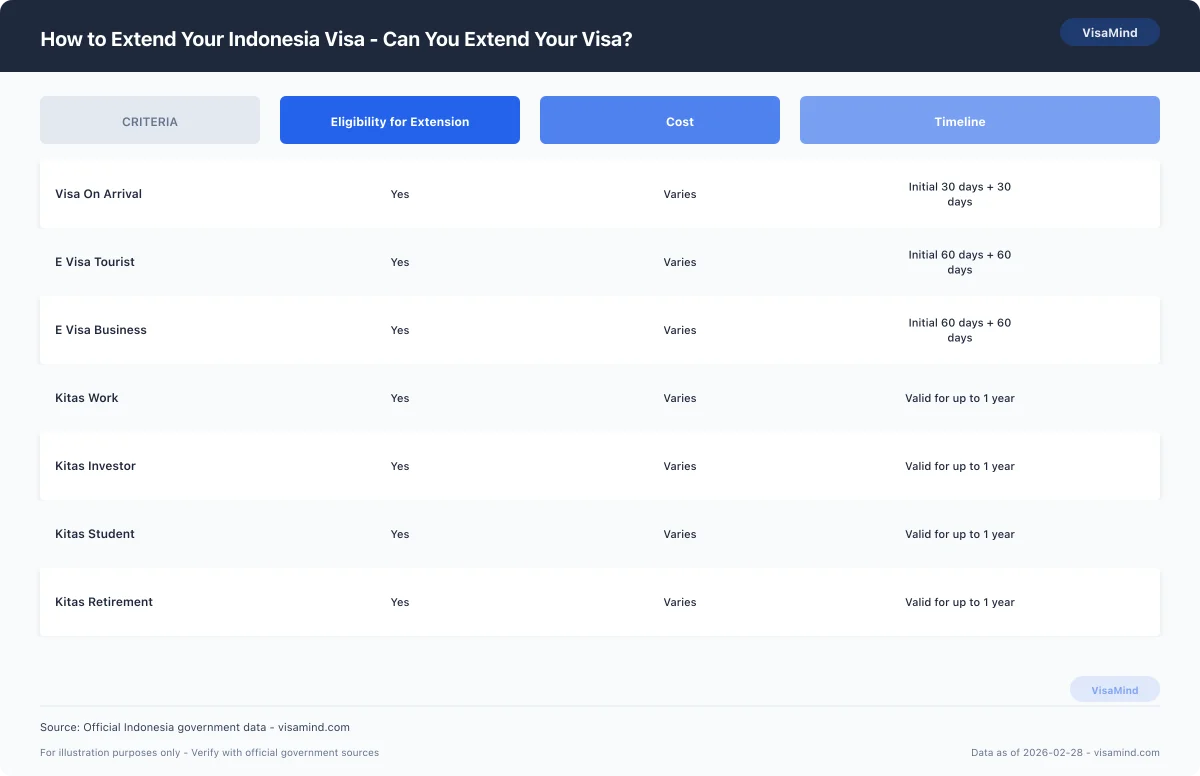
In Indonesia, several visa categories can be extended, while others cannot. Knowing which visas fall into these categories is essential for planning your stay in the country. Here’s a comparison of the visa types and their extendability:
| Visa Type | Extendable | Eligibility | Key Requirements |
|---|---|---|---|
| Visa on Arrival (VOA) | Yes | Tourists from eligible countries | Passport, return ticket |
| E Visa Tourist | Yes | General tourists | Valid passport, proof of funds |
| E Visa Business | Yes | Business travelers | Business invitation, valid passport |
| KITAS Work | Yes | Foreign workers | Employment contract, RPTKA |
| KITAS Investor | Yes | Business investors | Investment proof |
| KITAS Student | Yes | Students enrolled in Indonesian institutions | Acceptance letter |
| KITAS Spouse/Family | Yes | Spouses and family of Indonesian citizens | Marriage certificate |
| Golden Visa | Yes | Investors, professionals, global talents | Investment proof, professional credentials |
| Digital Nomad | No | Remote workers | N/A |
| Social Cultural Visa | Yes | Cultural exchange participants | Sponsorship letter |
Extendable Visas
Most of the visas listed above, such as the Visa on Arrival, E Visa Tourist, and various types of KITAS permits, are extendable. For instance, the Visa on Arrival is typically extendable for an additional 30 days. Similarly, E Visa Tourist and E Visa Business can be extended depending on the length of stay initially granted. The KITAS Work and KITAS Investor visas involve more intricate processes, often requiring the submission of employment or investment documentation.
Important: Ensure you gather all necessary documentation before applying for an extension to avoid delays or rejection.
Non-Extendable Visas
Currently, the Digital Nomad visa is not extendable. This visa type is designed for individuals who wish to work remotely in Indonesia but does not provide the option for extension at this time. Those seeking longer stays should consider alternative visas such as the Second Home or the Golden Visa.
Key Considerations
Before applying for an extension, it is crucial to prepare all required documents specific to your visa type. For example, Golden Visa applicants must provide proof of investment, while those on a Social Cultural visa need a sponsorship letter. Always verify the latest requirements and procedures through the Directorate General of Immigration.
Tip: Consider lodging your application online through Indonesia's electronic visa system to streamline the process and receive prompt confirmation.
Understanding which visas can be extended and preparing accordingly will help ensure a smooth transition for extending your stay in Indonesia. For more detailed information on applying, refer to our How To Apply guide.
Submitting Your Extension Request
#Determine the Appropriate Channel for Application
Your first step in submitting a visa extension request is deciding whether to apply online or in-person. Indonesia's Directorate General of Immigration (Ditjen Imigrasi) offers an electronic visa system for many visa types, allowing you to lodge your application digitally. This option is often more convenient and can expedite the process. However, some applicants may need or prefer to visit a local immigration office, especially if additional documentation or interviews are required.
Tip: Applying online can save time and provide instant confirmation of your submission. Check the How To Apply guide for more details on online applications.
Gather Necessary Documents
Before you submit your extension request, ensure that you have gathered all the necessary documents. The exact requirements may vary based on your visa type and personal circumstances. Commonly required documents include:
- A valid passport with at least six months of remaining validity
- Proof of financial means or investment, particularly for those applying for a Golden Visa or Kitas Investor
- Any specific documentation related to your visa category, such as proof of marriage for a Kitas Spouse
You can find a comprehensive list of required documents in the Documents Checklist.
Submit Your Application
Once you have all the required documents, proceed to submit your application. If you choose the online route, visit the official Ditjen Imigrasi portal to lodge your application through the electronic visa system. Ensure that all information is accurate and complete to avoid delays or rejections.
For in-person submissions, visit the nearest immigration office. It's advisable to book an appointment if possible, to reduce waiting times.
Important: Incomplete or incorrect submissions can lead to delays or rejections. Double-check all entries and documents before submission.
Follow Up on Your Application Status
After submission, you can track the status of your application. For online applications, a receipt number will be provided, which you can use to monitor progress through the Ditjen Imigrasi website. If you applied in person, retain any acknowledgement slips or receipts given by the immigration office.
If any issues arise, or if additional documents are requested, respond promptly to avoid jeopardizing your extension request. Check out the Processing Times guide for an idea of how long extensions typically take to process.
By following these steps, you can efficiently navigate the process of extending your visa in Indonesia. Always refer to the latest guidelines on the Ditjen Imigrasi website to ensure compliance with all regulations.
Extension Document Checklist
#To extend your visa in Indonesia, you'll need to provide several key documents to ensure your application is processed smoothly. Here's a comprehensive checklist to guide you through the requirements set by the Directorate General of Immigration (Ditjen Imigrasi).
General Requirements
- Valid Passport: Ensure your passport is valid for at least six months beyond the intended extension period.
- Current Visa: Provide a copy of your existing visa that you wish to extend.
- Proof of Residence: Include evidence of your current address in Indonesia, such as a rental agreement or a utility bill.
Financial Documentation
- Proof of Financial Means: Demonstrate your ability to financially support yourself during your extended stay. This might include bank statements, income proof, or an investment commitment, especially for those applying for the Golden Visa.
- Investment Proof: If applying for a Golden Visa, you must submit documentation of your investment in Indonesia.
Important: Failing to provide adequate financial documentation can lead to delays or rejection of your extension application.
Visa-Specific Requirements
Visa on Arrival (VOA)
- Extension Request Letter: A letter explaining the reason for your extension.
- Return or Onward Ticket: Show proof of your travel plans after the extended period.
Limited Stay Permits (KITAS)
- Sponsorship Letter: For Kitas Work or Kitas Investor, include a letter from your employer or sponsor.
- Employment Contract: Required specifically for Kitas Work holders.
- Proof of Marriage: If you're applying for a Kitas Spouse, provide a marriage certificate.
Application Submission
- Application Form: The form must be filled out accurately and completely. You can access the application process through the How To Apply guide on the Ditjen Imigrasi website.
- Passport Photos: Include recent passport-sized photos, adhering to Indonesian immigration photo requirements.
Tip: Use the electronic visa system to lodge your application. This method not only speeds up the process but also provides immediate confirmation and a reference number for your application.
By gathering and organizing these documents, you increase the likelihood of a successful visa extension. Always verify the latest requirements on the official Ditjen Imigrasi website, as regulations can change, affecting the necessary documentation.
Fees and Processing Times
#Understanding the fees and processing times is crucial to ensure timely and successful extension. Below is a breakdown of the costs and timelines for different visa types, helping you plan your stay in Indonesia effectively.
Fees and Processing Times Overview
| Visa Type | Extension Fee (IDR) | Processing Time (Days) | Expedited Option |
|---|---|---|---|
| Visa on Arrival (VOA) | 500,000 | 3-5 | Not Available |
| Limited Stay Permit - Work (KITAS) | 1,500,000 | 7-10 | Available |
| Limited Stay Permit - Investor (KITAS) | 1,500,000 | 7-10 | Available |
| Limited Stay Permit - Student (KITAS) | 1,500,000 | 7-10 | Available |
| Golden Visa | 3,000,000 | 10-14 | Available |
Detailed Breakdown
Extension Fees
The extension fees vary depending on the type of visa. For instance, extending a Visa on Arrival costs IDR 500,000, while the Golden Visa extension is more expensive at IDR 3,000,000. It's important to budget accordingly for these fees as they are necessary for processing your application through the Directorate General of Immigration (Ditjen Imigrasi).
Processing Timelines
Processing times also differ by visa type. Generally, a Visa on Arrival extension takes approximately 3-5 days, while Limited Stay Permits (KITAS) and Golden Visas require more time, ranging from 7 to 14 days. It's advisable to apply well in advance of your visa's expiration to avoid any issues.
Important: Always verify the latest processing times and fees on the official Ditjen Imigrasi website, as they are subject to change.
Expedited Options
For certain visas such as the KITAS and Golden Visa, expedited processing options are available, though they may incur additional fees. This can be beneficial if you need to extend your stay urgently. However, note that expedited options are not available for the Visa on Arrival.
Conclusion
Understanding the fees and processing times for your visa extension is essential for a hassle-free experience. For more detailed guidance, you can explore related resources such as the Visa On Arrival and Golden Visa pages, or check the Processing Times guide for additional insights.
What If You Overstay
#Overstaying your visa in Indonesia can have serious consequences. The Directorate General of Immigration (Ditjen Imigrasi) is strict about enforcing penalties for those who exceed their authorized stay. Here's what you need to know about the repercussions of overstaying and how it can impact your future immigration prospects.
Consequences of Overstaying
If you overstay your visa in Indonesia, you will be subject to a daily fine. As of 2023, the fine is IDR 1,000,000 per day. It's important to resolve any overstay issues promptly, as these fines can accumulate quickly and become a significant financial burden.
In addition to fines, overstaying can lead to more severe penalties, such as:
- Deportation: You may be forcibly removed from Indonesia.
- Re-entry Ban: You could be banned from re-entering Indonesia for a specified period, often one year or more.
- Detention: In some cases, overstayers may be detained by immigration officials.
Important: If you find yourself overstaying, report to the nearest immigration office immediately to address the situation and potentially reduce penalties.
Impact on Future Visa Applications
Overstaying your visa can impact your ability to obtain future visas to Indonesia. Immigration authorities may view your previous overstay as a sign of non-compliance with visa conditions, making them less likely to approve your applications. Here's how it can affect different visa types:
- Visa on Arrival: Future applications may be rejected or come with additional scrutiny. Learn more about the Visa On Arrival.
- Limited Stay Permits (KITAS): Overstaying could complicate future applications for Kitas Student or Kitas Spouse permits, requiring more documentation or guarantees.
- Golden Visa: A history of overstaying could diminish your chances of obtaining a Golden Visa, which is already a selective process.
Resolving an Overstay
To address an overstay, you should:
- Visit a local immigration office as soon as possible to discuss your situation and potential penalties.
- Pay any fines accrued during your overstay period.
- Comply with any additional requirements set by Ditjen Imigrasi, such as providing a valid reason for your overstay or securing a sponsor.
Tip: Maintaining clear communication with immigration officials can sometimes help facilitate a more favorable resolution, especially if your overstay was unintentional.
By understanding the implications of overstaying and taking timely action, you can minimize the negative impact on your immigration record and future travel plans to Indonesia. Always ensure your visa status is current to avoid these issues. For more details on visa options, check out our Social Cultural and Second Home visa guides.
Which Visas Are Extendable
#Important: Before applying for a visa extension in Indonesia, ensure that your visa category is eligible for an extension. Misunderstanding eligibility can lead to overstaying penalties.
Which Visas Are Extendable
When planning to extend your stay in Indonesia, understanding which visas are eligible for extensions is crucial. Below, you'll find a detailed breakdown of extendable visas, including tourist, student, work, and family categories. Each visa type comes with its own eligibility criteria, costs, and timeline considerations.
| Visa Type | Eligibility | Cost | Timeline |
|---|---|---|---|
| Visa on Arrival (VOA) | Tourists from eligible countries | Approximately IDR 500,000 | Extension for 30 days |
| E Visa Tourist | Tourists with pre-approved electronic visas | Varies, check official site | Extension for 30 days |
| KITAS Work | Foreigners employed by an Indonesian company | Varies by profession | Extension up to 12 months |
| KITAS Student | Students enrolled in Indonesian institutions | Varies, check official site | Extension matches academic program duration |
| KITAS Spouse | Foreigners married to Indonesian citizens | Varies, check official site | Extension up to 12 months |
How to Determine Eligibility
To determine if your visa is extendable, you must first confirm your current visa status and category. For instance, the Visa on Arrival is extendable for an additional 30 days, provided the initial application was successful. Similarly, E Visa Tourist holders can apply for a 30-day extension.
For more long-term stays, such as those on a KITAS Work or KITAS Student, the extension process will align with the duration of your employment contract or academic program.
Costs and Timelines
Visa extension costs can vary significantly depending on the visa type and individual circumstances. It's important to verify the current fees on the official Directorate General of Immigration website before proceeding. Generally, extensions like the Visa on Arrival require a fee of approximately IDR 500,000.
The timeline for processing visa extensions can also vary. For example, extensions for KITAS Spouse can last up to 12 months, while tourist visas typically allow for a 30-day extension. Always plan ahead, as processing times can affect your stay.
Tip: Start the extension process early to avoid any issues with overstaying. Delays in processing can sometimes occur, so it's best to apply as soon as you confirm your plans to extend your stay.
By understanding which visas are eligible for extensions and the associated requirements, you can better manage your stay in Indonesia. Always consult the Processing Times and Documents Checklist to ensure a smooth application process.
Alternatives to Extension
#If you're considering alternatives to extending your visa in Indonesia, several options might suit your situation. Each alternative has its own set of requirements and processes, so it's important to consider them carefully.
Can You Change Your Visa Type?
Switching to a different visa type can be an effective way to continue your stay in Indonesia without extending your current visa. Options include:
- Limited Stay Permits (KITAS): Depending on your purpose, you could apply for a KITAS Work, KITAS Investor, or KITAS Student. Each permit type has specific eligibility criteria and documentation requirements.
- Golden Visa: This is suitable for individual investors and global talents. You will need to provide proof of investment or financial commitment.
Tip: Ensure you meet the eligibility criteria for your chosen visa type by reviewing the Documents Checklist.
Should You Leave and Re-enter?
If you're nearing the end of your visa validity, another option is to leave Indonesia and re-enter using a different visa. Consider these options:
- Visa on Arrival (VOA): Allows a short-term stay and can be renewed for an additional 30 days.
- E Visa Tourist: Suitable for those planning to explore Indonesia as tourists. It's advisable to check the E Visa Tourist Vs Visa On Arrival guide for a detailed comparison.
Is Voluntary Departure an Option?
Voluntarily departing Indonesia before your visa expires is a straightforward alternative that helps avoid overstaying penalties. You can then apply for a new visa from your home country if you plan to return.
Important: Overstaying can result in fines or bans from re-entering Indonesia. Always ensure your departure is within the visa validity.
How to Change Your Status?
If your circumstances have changed, such as getting married to an Indonesian citizen or receiving a job offer, you might be eligible for a status change. Consult the Directorate General of Immigration to understand the specific requirements and processes involved.
By evaluating these alternatives, you can make an informed decision that best aligns with your plans and circumstances. Always verify the latest information on the official Directorate General of Immigration website to ensure compliance with current regulations.
FAQs
Can you combine goals of investment and residence with a Golden Visa in Indonesia?
What documents are needed for extending a student KITAS in Indonesia?
What happens if you overstay your visa in Indonesia?
Can a spouse on a family KITAS work in Indonesia?
What is the income requirement for extending a GCI visa in Indonesia?
Is it possible to switch from a student KITAS to a work KITAS in Indonesia?
How do you submit a visa extension request in Indonesia?
Sources
Last reviewed: March 1, 2026
VisaMind provides informational guidance only and is not a government agency. This is not legal advice. Requirements can change and eligibility depends on your specific facts. If your case is complex or high-stakes, consult a licensed immigration attorney.
Next steps
Requirements vary by nationality, purpose, timeline, and case details. Use Find My Visa to get a personalized checklist for Indonesia with official sources and deadlines.
Find my visa