On this page
- Your Work Visa Options
- Employer Sponsorship Requirements
- How to Apply for a Work Visa
- What You Can and Cannot Do
- From Work Visa to PR
- What Goes Wrong
- Credential Requirements
- Salary Thresholds and Fees
- Tax Rules for Foreign Workers
- Real Scenarios
- Visa options for this goal
- Guides for Indonesia
- Other goals for Indonesia
Your Work Visa Options
#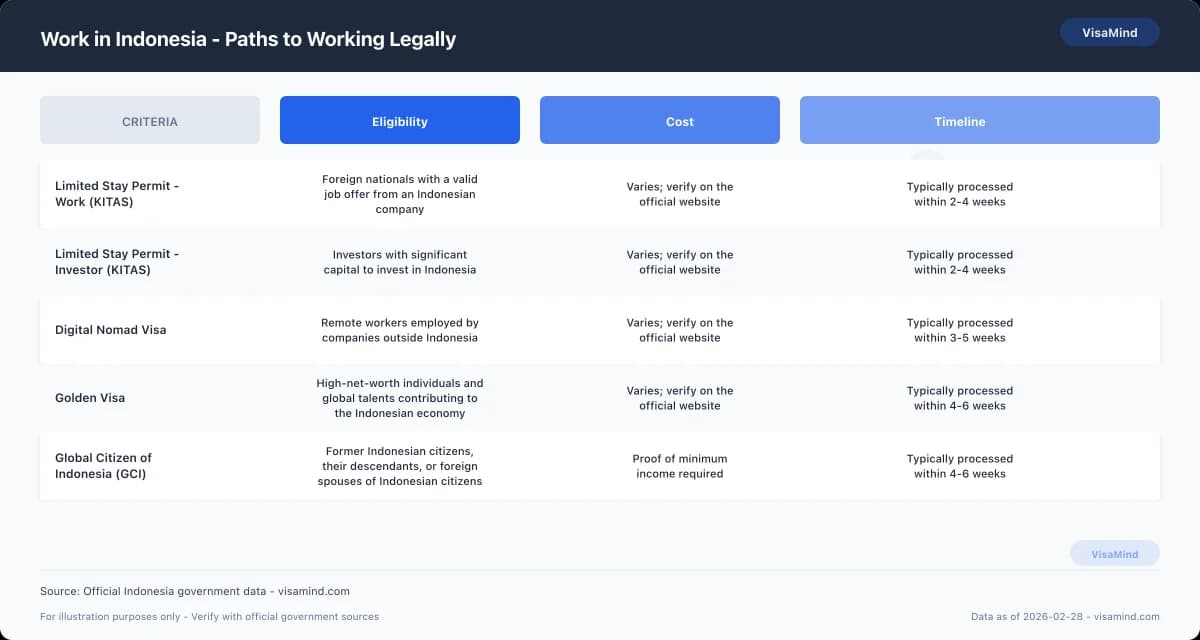
To legally work in Indonesia, foreign nationals must secure the appropriate work visa through the Directorate General of Immigration (Ditjen Imigrasi). The variety of work visa options caters to different employment conditions, such as professional employment, investment purposes, or temporary work. Below is an overview of the main work visa categories available in Indonesia:
Your Work Visa Options
| Visa Type | Eligibility | Cost | Processing Time |
|---|---|---|---|
| Limited Stay Permit - Work (KITAS) | Foreign nationals with an Indonesian employer | Check with DGIM for current fees | Approximately 1-2 months |
| Limited Stay Permit - Investor (KITAS) | Foreign investors with significant capital investment | Varies by investment size | 1-2 months |
| Digital Nomad Visa | Remote workers not employed by an Indonesian entity | Verify on the official website | Processing times vary |
| Global Citizen of Indonesia (GCI) | Ex-Indonesian citizens, their descendants, and foreign spouses of Indonesian citizens | Verify on the official website | Processing times vary |
| Golden Visa | Foreign investors and global talents contributing economically | Based on investment commitment | Generally 2-3 months |
Understanding Eligibility and Requirements
-
Limited Stay Permit - Work (KITAS): This visa is designed for foreign nationals who have secured employment with a company in Indonesia. A primary requirement includes a job offer from an Indonesian entity. For further details, explore Kitas Work.
-
Limited Stay Permit - Investor (KITAS): Tailored for foreign investors, this visa requires a substantial capital commitment in Indonesia. It's crucial to verify specific investment thresholds with Ditjen Imigrasi to ensure compliance. More information can be found under Kitas Investor.
-
Digital Nomad Visa: Ideal for remote workers who wish to live in Indonesia while working for non-Indonesian companies. This visa does not permit local employment.
-
Global Citizen of Indonesia (GCI): This category supports ex-Indonesian citizens and their families in reconnecting with the country. Eligibility demands proof of descent or marital ties to an Indonesian citizen.
-
Golden Visa: This visa targets high-value investors and talents, requiring a proven commitment to economic contributions in Indonesia. Applicants must present documentation of their investment or global talent recognition.
Important: Each visa type has specific requirements and processes. It's crucial to gather all necessary documents and ensure accurate information to avoid delays or rejections.
Preparing Your Application
When preparing your application, make sure to:
-
Gather Required Documents: This includes proof of employment (for KITAS Work), investment documentation (for KITAS Investor and Golden Visa), and any personal identification required by Ditjen Imigrasi.
-
Submit Through the Electronic Visa System: Applications are typically submitted via the online platform managed by Ditjen Imigrasi.
-
Verify Costs and Processing Times: Costs can change, and processing times may vary depending on the visa type and applicant's circumstances. Always check the latest information directly from Ditjen Imigrasi.
For a detailed step-by-step guide on how to apply, refer to our How To Apply guide. Additionally, to understand more about the documents needed, visit the Documents Checklist.
Tip: Thoroughly review the application instructions and eligibility criteria specific to your chosen visa category to minimize errors that could lead to application delays.
By selecting the appropriate visa and preparing a comprehensive application, you can effectively navigate the work visa process in Indonesia through Ditjen Imigrasi.
Employer Sponsorship Requirements
#To work in Indonesia as a foreign national, understanding the employer sponsorship requirements is crucial. The process involves various steps that both the employer and the prospective employee must navigate to ensure compliance with Indonesian immigration laws.
Employer Sponsorship Requirements
Indonesian employers intending to hire foreign workers must adhere to specific sponsorship requirements. These protocols ensure that the employment of foreign nationals aligns with national labor laws and policies.
-
RPTKA Approval: Employers must first obtain the Foreign Manpower Utilization Plan (Rencana Penggunaan Tenaga Kerja Asing, RPTKA) from the Ministry of Manpower. This plan justifies the need for hiring a foreign worker and outlines the roles and responsibilities of the position.
-
IMTA or Work Permit: Once the RPTKA is approved, the employer must secure an IMTA (Izin Mempekerjakan Tenaga Kerja Asing), which is the official work permit for the foreign employee. This permit allows the foreign national to legally work in Indonesia.
-
Proof of Employment Offer: Employers must provide a formal employment offer to the foreign worker, detailing the job position, salary, and other relevant terms of employment.
-
Training for Indonesian Workers: Employers are also required to design and implement a training program for Indonesian workers to ensure knowledge transfer and skill development within the local workforce.
What Documents Are Required?
To facilitate the sponsorship process, employers must gather and submit various documents. Here’s a list of essential documents:
- A comprehensive RPTKA application detailing the need for a foreign worker
- A copy of the employer’s business registration and relevant licenses
- Proof of employer’s tax compliance
- A detailed job description and employment contract for the foreign worker
- Evidence of the employer's commitment to training Indonesian workers
Important: Employers should ensure that all documents are accurate and up-to-date to avoid delays in the approval process.
Can Employers Change a Foreign Worker's Position?
If an employer wishes to change the foreign worker’s position, it may require amendments to the RPTKA and possibly a new IMTA application. This ensures that the foreign worker’s new role complies with the initial approval criteria.
Tips for Employers
-
Electronic Submissions: Utilize the electronic visa system to lodge applications efficiently and track their status.
-
Stay Informed: Regularly check the Directorate General of Immigration's official website for updates on policies and procedures.
-
Consult Professionals: For complex cases, employers may consider consulting with immigration experts to navigate the intricacies of Indonesia’s work permit system.
In conclusion, the employer sponsorship process is a vital step in hiring foreign nationals in Indonesia. Ensuring compliance with these requirements not only facilitates the legal employment of foreign workers but also contributes positively to the Indonesian workforce. For more details on visa options, you can explore the Kitas Work and Kitas Investor.
How to Apply for a Work Visa
#Tip: Use the electronic visa system for a streamlined application process and immediate tracking.
Steps to Apply for a Work Visa in Indonesia
-
Determine Your Eligibility
Before starting your application, ensure you meet the eligibility criteria for the type of work visa you are applying for. The main categories include the Global Citizen of Indonesia (GCI) for ex-Indonesian citizens and their families, and the Golden Visa for foreign investors and global talents. Each option requires specific documentation, such as proof of employment or investment commitment.
-
Prepare Required Documents
Gather all necessary documents, which generally include:
- A valid passport with at least six months of validity.
- A job offer or employment contract from an Indonesian company.
- Proof of minimum income for GCI applicants or investment commitment for Golden Visa applicants.
It is crucial to review the detailed Documents Checklist to ensure you have everything needed.
-
Complete the Indonesia Work Form
Fill out the Indonesia Work form with accurate personal and employment details. This form is a crucial part of your visa application process and must be completed thoroughly to avoid delays.
-
Submit Your Application
Lodge your application through the Directorate General of Immigration's electronic visa system. Ensure all required sections are completed, and all supporting documents are attached. This step involves submitting your application to the Directorate General of Immigration for processing.
-
Pay the Application Fee
Pay the required visa application fee. Check the latest fee schedule on the official website to confirm the amount.
-
Await Decision
Once submitted, your application will be reviewed by the Directorate General of Immigration. Processing times may vary, so regularly check your application status through the online system or consult the Processing Times guide for an estimate.
Important: Providing correct and consistent personal information is essential. Inaccuracies can lead to delays or rejections.
Common Pitfalls to Avoid
- Incomplete Forms: Ensure every section of the form is filled.
- Incorrect Information: Double-check all entries for accuracy.
- Missing Documentation: Attach all relevant evidence, such as proof of income or investment, to support your application.
For more information on visa types and to explore other options, you may refer to Kitas Work or Golden Visa.
What You Can and Cannot Do
#When working in Indonesia, foreign nationals must navigate specific regulations regarding employment, family accompaniment, and education. Understanding these rules is crucial to ensuring compliance with Indonesian immigration laws.
Can You Change Employers?
In Indonesia, changing employers can be a complex process. If you hold a Limited Stay Permit - Work (KITAS), you must obtain a new work permit (IMTA) from the Ministry of Manpower and update your KITAS accordingly. The new employer must sponsor and facilitate this process, which involves submitting new documentation to the Directorate General of Immigration (Ditjen Imigrasi).
Important: Before making any employment changes, ensure your new employer can meet all sponsorship requirements, including providing a valid job offer and complying with local labor laws.
Can Family Join You?
Yes, family members can accompany you to Indonesia. Spouses and dependent children are eligible for a Limited Stay Permit (KITAS Spouse or KITAS Dependent) linked to your work permit. Documentation such as marriage and birth certificates, along with proof of financial capability, is required. It's important to apply for these permits through the Ditjen Imigrasi's electronic visa system to avoid delays.
Explore more about family-related permits on the Kitas Spouse page.
Can You Study While Working?
While holding a work permit in Indonesia, you can engage in part-time studies. However, if you wish to pursue full-time education, you may need to switch to a Kitas Student, which is specifically designed for international students. This transition involves applying for a new visa type and meeting the separate requirements for student permits.
Learn more about studying in Indonesia through our Study guide.
By understanding these key facets of working in Indonesia, you can better plan your stay and ensure compliance with the country's immigration regulations. Always consult directly with Ditjen Imigrasi or a legal expert for personalized guidance.
From Work Visa to PR
#Obtaining a work visa in Indonesia is the first step for many foreign nationals aiming to build a long-term career in the country. However, for those who wish to make Indonesia their permanent home, transitioning from a work visa to permanent residency (PR) is a crucial process. Here’s a closer look at how you can move from a work visa to PR in Indonesia.
Pathways to Permanent Residency
After securing a work visa, such as the Limited Stay Permit - Work (KITAS), you can start planning for your journey towards permanent residency. The process typically involves the following steps:
-
Limited Stay Permit (KITAS): Initially granted to foreign workers, the KITAS is valid for up to 12 months and is renewable. It’s essential to maintain legal employment and renew your permit timely to avoid disruptions.
-
Eligibility for Permanent Stay Permit (KITAP): After holding a KITAS for a continuous period of five years, you may become eligible for a Permanent Stay Permit (KITAP). The KITAP is valid for five years and offers more stability compared to the KITAS.
-
Application for KITAP: To apply for the KITAP, you must demonstrate continued employment and residence in Indonesia. The application is reviewed by the Directorate General of Immigration (Ditjen Imigrasi).
Tip: Maintain a consistent employment record and ensure your employer complies with all regulatory requirements to support your transition to PR.
Timeline for Transition
Understanding the timeline for transitioning from a work visa to PR is crucial for effective planning:
| Step | Duration | Key Requirements |
|---|---|---|
| KITAS | 1 year (renewable) | Employment contract, valid work authorization |
| Transition to KITAP | After 5 years on KITAS | Proof of continuous residence and employment |
| KITAP Validity | 5 years | Long-term employment, residence proof |
Common Pitfalls to Avoid
When navigating the transition from a work visa to PR, there are several common pitfalls to be aware of:
- Incomplete Documentation: Ensure all documentation, including proof of employment and residence, is complete and up-to-date.
- Inconsistent Information: Double-check all personal and employment details to avoid inconsistencies that can delay processing.
- Lapse in Visa Status: Always renew your KITAS on time to maintain eligibility for the KITAP.
For more detailed guidance on the application process and necessary documentation, you can refer to our Documents Checklist.
By understanding these steps and avoiding common pitfalls, you can successfully transition from a work visa to permanent residency in Indonesia. The process requires careful planning and adherence to the rules set by the Directorate General of Immigration, but it sets the foundation for a stable future in Indonesia.
What Goes Wrong
#Navigating the work authorization process in Indonesia can be complex. Understanding common pitfalls that lead to refusal will help you prepare a successful application.
Common Refusal Reasons
-
Incomplete Applications: Ensure all sections of the Indonesia Work application are filled out completely. Missing information is one of the most frequent reasons for delays and refusals.
-
Inconsistent Personal Information: Double-check that your personal details are consistent across all documents submitted. Discrepancies can raise red flags with the Directorate General of Immigration (Ditjen Imigrasi).
Important: Regularly update your information if any personal circumstances change between your application's submission and processing.
Specific Document Issues
-
Proof of Employment Offer: A valid job offer from an Indonesian company is mandatory. Applications lacking this documentation will not be considered. Ensure the job offer letter includes all necessary details such as position, salary, and duration of employment.
-
Income Requirements for GCI Applicants: For those applying under the Global Citizen of Indonesia (GCI) category, failing to demonstrate the required minimum income can lead to rejection. Verify the current income threshold on the official website.
-
Investment Documentation for Golden Visa: If applying for a Golden Visa, it's crucial to provide clear evidence of your investment commitment. Missing or inadequate documentation will result in denial.
Avoiding Common Mistakes
-
Incorrect Submission Method: Applications should be lodged through the electronic visa system. Submitting through incorrect channels can delay the process or result in rejection.
-
Failure to Review Category Instructions: Before applying, review the specific instructions for your eligibility category, whether it's for a Golden Visa or another type. This ensures you meet all specific criteria and gather the necessary documents.
Tip: Use the Visa Refusal Reasons guide to further understand potential pitfalls and how to avoid them.
By addressing these issues proactively, you can significantly improve your chances of a successful application for working in Indonesia. Always verify the latest requirements on the official Ditjen Imigrasi website to ensure compliance.
Credential Requirements
#Understanding the credential requirements is key to a successful application process. The Directorate General of Immigration (Ditjen Imigrasi) oversees the procedures, ensuring that all candidates meet the necessary qualifications and skill assessments. Below, we outline the essential credential requirements for obtaining work authorization in Indonesia.
Skills Assessments
- Professional Skills Verification: Depending on your field, you may need to provide evidence of your professional skills. This could include certifications, licenses, or other proof of expertise.
- Industry-Specific Requirements: Some sectors, such as healthcare and engineering, might require additional credentials or local accreditation. Check with the relevant Indonesian professional bodies.
Qualification Recognition
- Degree Equivalency: Ensure your academic qualifications are recognized in Indonesia. You might need to have your degrees or diplomas assessed for equivalency by Indonesian authorities.
- Verification from Academic Institutions: You may be asked to provide official transcripts or letters of verification from your educational institutions.
Important: Always verify with Ditjen Imigrasi for the most current requirements, as procedures and regulations may update over time.
Degree Requirements
- Minimum Educational Requirements: For most work visas, a bachelor's degree in a relevant field is typically required. Certain roles may demand higher qualifications such as a master's degree or Ph.D.
- Documentation: Gather all necessary documentation, including certified copies of your degrees, to submit with your application.
Special Considerations for Specific Visas
- Global Citizen of Indonesia (GCI): If you're an ex-Indonesian citizen or married to an Indonesian, you may need to provide proof of your previous citizenship or marriage documentation.
- Golden Visa Applicants: Foreign investors or individuals contributing significantly to the Indonesian economy should prepare documents showing their investment commitments.
For more detailed information on visa options, consider exploring the Golden Visa and the Kitas Investor options. Additionally, you may find the Visa Extension Guide useful for understanding long-term stay options.
Tip: Ensure all documents are translated into Indonesian by a certified translator if they are in another language. This will help avoid delays in processing.
Salary Thresholds and Fees
#Important: Ensure you meet the specified salary thresholds and pay any applicable fees to avoid delays in processing your work authorization.
Salary Thresholds for Work Visas
For foreign nationals seeking employment in Indonesia, it's essential to be aware of the specific salary thresholds that may apply to your situation. These thresholds can vary depending on the type of visa you are applying for and your role within the company. Here’s a breakdown of the minimum income requirements for different visa categories:
| Visa Type | Salary Threshold |
|---|---|
| Limited Stay Permit - Work (KITAS Work) | IDR 10,000,000 per month |
| Global Citizen of Indonesia (GCI) | Proof of minimum income, varies by situation |
| Golden Visa | Requires substantial investment, no set salary |
These thresholds are designed to ensure that foreign workers can support themselves while living in Indonesia. For the Golden Visa, the focus is on investment rather than salary, targeting those who contribute significantly to Indonesia's economy.
Application Fees for Work Authorization
When applying for work authorization in Indonesia, be prepared to pay certain fees associated with your visa application. The Directorate General of Immigration (Ditjen Imigrasi) outlines specific costs for each visa type:
| Visa Type | Application Fee |
|---|---|
| KITAS Work | Approximately IDR 1,500,000 |
| GCI | Varies based on individual circumstances |
| Golden Visa | Significant investment required instead of a fee |
These fees are subject to change, so it is advisable to verify the most current amounts on the official website of Ditjen Imigrasi.
Additional Considerations
- Proof of employment offer from an Indonesian company is required for most work visa applications.
- Ensure all documentation, including proof of income or investment, is submitted accurately.
For further guidance on the application process and to access necessary documents, consider exploring resources such as the How To Apply guide or the Financial Requirements.
Tip: Submitting complete and accurate documentation can help expedite your application process and avoid potential pitfalls.
Tax Rules for Foreign Workers
#Foreign workers in Indonesia need to be aware of their income tax obligations and social security contributions. Understanding these requirements is crucial for compliance and avoiding potential penalties.
Income Tax Obligations
As a foreign worker in Indonesia, you are subject to Indonesian income tax laws. Generally, you are considered a tax resident if you reside in Indonesia for more than 183 days within a 12-month period or if you intend to stay indefinitely. Tax residents must report their global income, while non-residents are taxed only on income sourced from Indonesia.
- Tax Rates: Tax rates for residents range from 5% to 30%, depending on income levels.
- Non-Resident Tax: Non-residents are subject to a flat 20% tax rate on Indonesian-sourced income.
Important: Ensure timely tax filing to avoid penalties. Consult with a tax professional if you're unsure about your obligations.
Social Security Contributions
Foreign employees in Indonesia might also be required to contribute to the country's social security system, known as BPJS Ketenagakerjaan. This system covers several aspects, including work accident insurance, old-age savings, pension programs, and death benefits. Your employer typically facilitates these contributions.
- Employer's Role: Employers are responsible for registering employees and deducting contributions from salaries.
- Contribution Rates: Contribution rates vary, but the combined total from employer and employee can be approximately 8% of your salary.
Double Taxation Treaties
Indonesia has entered into double taxation treaties with numerous countries to prevent double taxation of income. These agreements can provide relief by allowing tax credits or exemptions for taxes paid abroad.
- Countries with Agreements: Indonesia has treaties with countries like Australia, Japan, Singapore, and the United States, among others.
- Claiming Relief: To benefit from these treaties, you may need to provide documentation, such as a certificate of residency from your home country.
For more information on work-related visas, consider exploring the Digital Nomad Visa or the Golden Visa. Additionally, you might find the Financial Requirements guide useful when preparing your application.
Real Scenarios
#A freelance graphic designer with a successful career spanning over a decade decided to apply for the Golden Visa to work and contribute to Indonesia's creative economy. With established international clients and a strong portfolio, the designer needed to demonstrate their investment commitment to Indonesian authorities. The process began with gathering documentation showcasing the designer's financial stability and intent to invest in Indonesia. Through the Directorate General of Immigration's electronic visa system, the designer submitted the completed application along with the required investment commitment. Within three months, the application was approved, allowing the designer to legally work and reside in Indonesia, contributing to the burgeoning creative sector.
Scenario: Ex-Indonesian Engineer Returning with a Global Citizen of Indonesia (GCI) Visa
An ex-Indonesian citizen, now a mechanical engineer in a multinational corporation, planned to return to Indonesia to work on a major infrastructure project. As a former citizen, the engineer was eligible for the Global Citizen of Indonesia (GCI) visa. The application process involved providing proof of the employment offer from the Indonesian company and evidence of meeting the minimum income requirement. The engineer consulted the Financial Requirements guide to ensure all necessary documentation was in place. By lodging the application through the Directorate General of Immigration, the engineer received approval within two months, facilitating a smooth transition back to Indonesia.
Scenario: IT Specialist Securing a Work Permit with KITAS
An IT specialist from a leading tech firm was offered a managerial position in Indonesia. To work legally, the specialist needed to secure a Limited Stay Permit - Work (KITAS). The process required a proof of employment offer and a detailed job description aligning with their qualifications. The specialist accessed the How To Apply guide for step-by-step instructions and submitted the application through the Directorate General of Immigration's portal. Despite initial concerns about job title alignment, the application was carefully reviewed and approved within four weeks, allowing the specialist to commence work in Indonesia promptly.
FAQs
What are the salary thresholds for obtaining a work visa in Indonesia?
Is employer sponsorship required for all work visas in Indonesia?
What should I do if my work visa application for Indonesia is rejected?
Can I apply for a Golden Visa and work in Indonesia simultaneously?
What are the tax rules for foreign workers in Indonesia?
What investment commitment is needed for a Golden Visa to work in Indonesia?
What are the pitfalls in applying for a work visa in Indonesia with the Directorate General of Immigration?
VisaMind provides informational guidance only and is not a government agency. This is not legal advice. Requirements can change and eligibility depends on your specific facts. If your case is complex or high-stakes, consult a licensed immigration attorney.
Next steps
Requirements vary by nationality, purpose, timeline, and case details. Use Find My Visa to get a personalized checklist for Indonesia with official sources and deadlines.
Find my visa