On this page
- What This Student Visa Covers
- Student Visa Requirements
- Student Visa Document Checklist
- Application Process
- Fees and Wait Times
- When to Consult an Immigration Professional
- Part-Time Work Rules
- After Graduation
- Staying Longer
- Why Student Visas Get Denied
- Required forms
- Related visa types
- Related guides
- Related goals
- Next steps
Official sources referenced
What This Student Visa Covers
#The Limited Stay Permit - Student (KITAS) is a vital document for international students seeking to study in Indonesia. Administered by the Directorate General of Immigration (Ditjen Imigrasi), this permit allows you to reside in Indonesia while pursuing educational opportunities. As of 2026, the processing time for an e-Visa related to the KITAS student category ranges from 3 to 5 days. It's essential to verify these timelines on the official website to ensure you have the most current information.
What Programs Are Covered?
The KITAS for students is designed to accommodate a variety of educational pursuits. This includes enrollment in degree programs at Indonesian universities, participation in language courses, and involvement in student exchange programs. Whether you're planning to immerse yourself in an undergraduate or postgraduate program, or you're interested in enhancing your language skills through intensive courses, the KITAS provides the legal framework necessary for your stay.
How Does the KITAS Benefit You?
Holding a KITAS student permit allows you to focus fully on your studies without the stress of visa-related interruptions. This permit not only supports your academic endeavors but also facilitates cultural exchanges, enriching your educational experience in Indonesia. If you're considering other visa options due to specific circumstances, you might explore alternatives like the Kitas Work or Kitas Investor for broader engagement in Indonesian society.
Important Considerations
Important: While the KITAS student permit is a crucial step in your educational journey, it does not automatically grant you permission to work part-time. Understanding the specific regulations regarding work is essential, especially if you plan to supplement your income during your stay. For more details on working while studying, refer to the Study and Work sections.
The KITAS student permit is a gateway to a world of learning and cultural exploration in Indonesia. By staying informed and adhering to the guidelines set by Ditjen Imigrasi, you can make the most of your educational experience in this vibrant country. For additional guidance, you might find the Visa Extension Guide useful if you plan to extend your stay beyond the initial period.
Student Visa Requirements
#To successfully apply for a Limited Stay Permit - Student (KITAS) in Indonesia, you must meet a series of specific requirements set by the Directorate General of Immigration (Ditjen Imigrasi). These requirements ensure that you are prepared for both the academic and personal aspects of your stay in Indonesia.
Acceptance Letter
- Proof of Enrollment: You must provide an official acceptance letter from a recognized Indonesian educational institution. This letter should confirm your enrollment in a full-time program.
- Program Details: The acceptance letter should clearly state the name of the course or program, the duration of study, and the start date.
Financial Proof
- Sufficient Funds: You are required to demonstrate that you have adequate financial resources to support yourself during your stay. This can include bank statements, scholarship letters, or sponsorship documents.
- Minimum Amount: While specific amounts can vary, as of 2026, a general guideline is to prove at least IDR 50 million (approximately USD 3,500) to cover living expenses. Verify the exact requirement on the official website.
Language Requirements
- Language Proficiency: Although not always mandatory, some institutions may require proof of proficiency in Bahasa Indonesia or English, depending on the medium of instruction. Check with your institution for specific language requirements.
Health Insurance
- Mandatory Coverage: You are required to have valid health insurance that covers medical expenses in Indonesia for the duration of your stay.
- Insurance Validity: Ensure that your health insurance policy is recognized in Indonesia and includes coverage for emergencies and hospitalization.
Important: Having health insurance is not only a requirement but also a safeguard for unexpected medical issues during your stay.
For detailed guidance on the application process, visit our How To Apply and Documents Checklist pages. You can also explore the Study section for more on educational opportunities in Indonesia.
By ensuring you meet these requirements, you can increase your chances of successfully obtaining a Limited Stay Permit - Student (KITAS) and starting your educational journey in Indonesia.
Student Visa Document Checklist
#To apply for a Limited Stay Permit - Student (KITAS) in Indonesia, you must submit a comprehensive set of documents to the Directorate General of Immigration. Below is a detailed checklist to guide you through the necessary paperwork specific to student applications:
Personal Identification Documents
- Valid Passport: Ensure your passport has at least 18 months of validity from the date of entry into Indonesia.
- Current Visa: If you're applying from within Indonesia, a valid visa (such as a Visit Visa) is required.
- Recent Passport-sized Photos: Typically, two photos are needed. Check specific size and background color requirements on the official website.
Academic and Sponsorship Documents
- Letter of Acceptance: Obtain this from the Indonesian educational institution where you are enrolled.
- Sponsor Letter: This is a formal letter from your educational institution or a designated sponsor, detailing your course and duration of study in Indonesia.
- Proof of Enrollment: Documentation that confirms active enrollment in an Indonesian educational institution.
Financial and Insurance Documents
- Proof of Financial Capability: Bank statements or a letter from your sponsor indicating sufficient funds to cover tuition and living expenses.
- Health Insurance: Evidence of health insurance coverage for the duration of your stay in Indonesia.
Application and Immigration Forms
- Completed KITAS Application: Ensure all sections are filled out and signed. Instructions for completing this form can be found on the official Directorate General of Immigration website.
- Payment Receipt: Keep proof of payment for any application fees. Fee details can be verified in the Visa Extension Guide.
Important: Ensure all documents are translated into Indonesian by a certified translator if they are in another language.
Additional Considerations
- Medical Certificate: Depending on your country of origin, a medical certificate showing you are free from contagious diseases may be required.
- Police Clearance Certificate: This may be necessary to demonstrate a clean criminal record, especially for longer stays.
Tip: To expedite processing, lodge your application through the Directorate General of Immigration's online portal, where you can also track application status.
For more information on the process and to ensure you have the latest requirements, refer to How To Apply and Documents Checklist. Processing times and other details can vary, so always verify the latest information directly with Ditjen Imigrasi.
Application Process
#-
Receive an Offer from an Indonesian Educational Institution
Before you can begin the process of obtaining a Limited Stay Permit - Student (KITAS), you must first secure admission to an educational institution in Indonesia. Ensure that the institution is accredited and recognized by the Indonesian government. This step is crucial as the admission letter will serve as a key document in your visa application process.
-
Gather Required Documentation
After receiving your acceptance letter, the next step is to compile all necessary documentation for your application. This typically includes your passport, a recent passport-sized photograph, and proof of financial capability, among others. It's important to review the Documents Checklist to ensure you have all required materials. Additionally, confirm the specific requirements for your eligibility category as these may vary.
-
Apply for a Visa Approval Letter (VAL)
With your documents prepared, you must apply for a Visa Approval Letter (VAL) through the Directorate General of Immigration (Ditjen Imigrasi). This step involves submitting your documents and application through the Indonesian immigration system. The VAL is an official document that permits you to proceed with your student visa application.
-
Receive Your Visa Approval Letter and Lodge Your Visa Application
Once you have been issued the Visa Approval Letter, you can lodge your visa application for the Limited Stay Permit - Student (KITAS). This is done through the Indonesian Embassy or Consulate in your home country. Ensure you provide all requested documentation, as incomplete submissions may delay processing.
-
Enter Indonesia and Collect Your KITAS
After your visa is approved, you may travel to Indonesia. Upon arrival, you must visit the local immigration office to process and collect your KITAS. Expect to provide biometric data, such as fingerprints, as part of this process. The processing time can vary, so it's a good idea to verify current timelines with Ditjen Imigrasi.
Tip: Apply for your KITAS as soon as possible after entering Indonesia to avoid potential overstays or complications.
-
Complete Registration with Local Authorities
Once your KITAS is issued, you are required to register with local authorities, which may include reporting to the local police station to register your presence and obtain a residency card. This is an important step to ensure your stay in Indonesia is fully compliant with local regulations.
For more information on applying for different types of visas in Indonesia, you can refer to related guides like How To Apply and explore different visa options such as Kitas Work or Kitas Investor.
Fees and Wait Times
#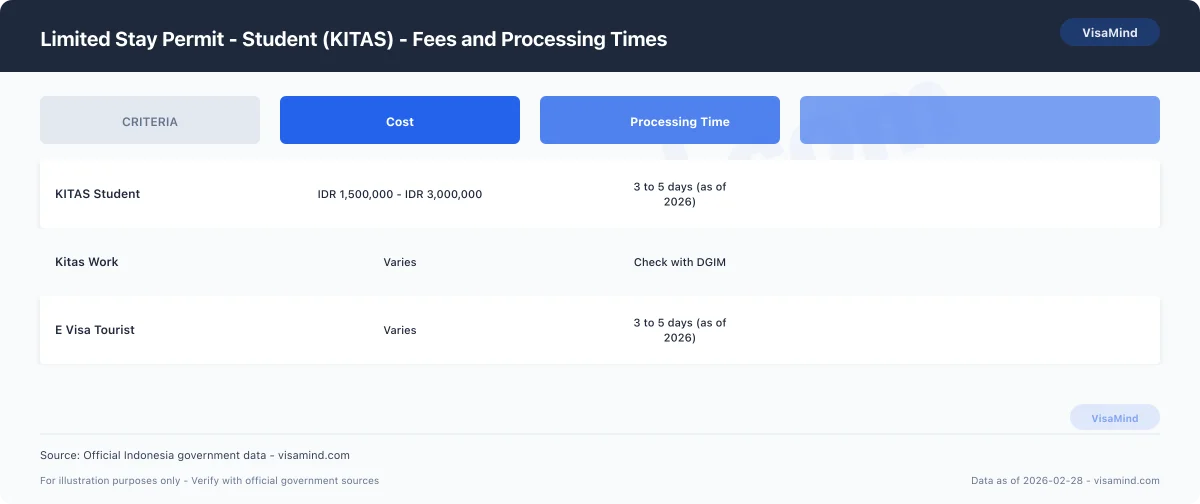
Fees and processing times are important considerations when applying for a Limited Stay Permit - Student (KITAS) in Indonesia. Here’s what you need to know about costs and timelines.
Tuition Requirements
To be eligible for a student KITAS, you must be enrolled in an accredited educational institution in Indonesia. Each institution may have its own tuition requirements, so it's advisable to contact the school directly for details about tuition fees and any additional financial requirements.
Visa Fee
The application fee for a student KITAS varies depending on your nationality and the length of stay. As of 2026, the fee is typically around IDR 2,500,000 (approximately USD 165). This fee is subject to change, so verify the current fee on the Directorate General of Immigration's website.
Processing Timeline
The processing time for a student KITAS can range from 3 to 5 days if you apply through the e-Visa system. However, processing times may vary based on the category and processing location, so it’s crucial to confirm the expected timeline with the Directorate General of Immigration or your local Indonesian consulate.
| Item | Requirement/Cost/Timeline |
|---|---|
| Tuition | Enroll in an accredited institution |
| Visa Fee | IDR 2,500,000 (approximately USD 165) |
| Processing Time | 3 to 5 days (verify current timelines) |
Tip: For faster processing, consider using the e-Visa system to lodge your application online. This can help avoid delays often associated with paper applications.
Related Visas
If you are considering other options, you might want to explore the Visa On Arrival or the E Visa Tourist for shorter stays. Additionally, for those looking to work while studying, the Kitas Work might be relevant depending on your circumstances.
For more detailed guidance, you can also check the Processing Times guide for updates on current timelines and procedures.
When to Consult an Immigration Professional
#If your student visa application is straightforward -- accepted at a recognized school, clear funding, no immigration history issues -- you can likely prepare it yourself for Indonesia immigration. But reach out to an immigration professional if:
- You have significant gaps in your education or employment history
- You want to work or change programs mid-visa
- You have a prior visa denial or refusal
- You have a prior overstay, unlawful presence, or removal order
- You have a criminal record, arrest history, or pending charges
- You have a prior misrepresentation or fraud finding
- You are in removal or deportation proceedings
Part-Time Work Rules
#Indonesia's Limited Stay Permit for Students (KITAS) allows international students to engage in part-time work under certain conditions. Understanding these rules is crucial for maintaining compliance while studying in the country.
Part-Time Work Limits for Students
As a holder of a KITAS Student permit, you are allowed to work part-time while studying in Indonesia. However, specific limitations apply:
- Maximum Hours: You can work up to 20 hours per week during the academic term.
- Type of Work: Employment must not interfere with your studies and should ideally be related to your field of study.
- Employer Requirements: Your employer must be registered and authorized by the Indonesian government to hire foreign students.
Important: Exceeding the 20-hour weekly limit can lead to penalties or revocation of your KITAS.
Co-Op and Internship Rules
Participating in co-op programs or internships can be an integral part of your educational experience in Indonesia. Here’s what you need to know:
- Academic Approval: Internships must be part of your academic program and approved by your educational institution.
- Permitted Duration: The duration should align with your course requirements and not extend beyond your study period.
For more on work-related permits, you may consider reviewing Kitas Work guidelines.
Summer Work Opportunities
During the summer or university break, you may have the opportunity to work more hours:
- Extended Hours: You can work full-time during the official school holidays.
- Documentation: Ensure you have the necessary documentation from your educational institution to verify your enrollment and holiday schedule.
Tip: Utilize summer breaks to gain valuable work experience and enhance your professional skills without the constraint of academic commitments.
For further details on managing your study and work balance, consult resources on Study and Work.
Summary Table: Work Opportunities
| Work Type | Term Time Limit | Break Time Limit | Requirements |
|---|---|---|---|
| Part-Time Work | 20 hours/week | Full-time | Registered employer; related to field of study |
| Co-Op/Internship | As per program | N/A | Academic approval required |
| Summer Work | N/A | Full-time | Enrollment verification required |
Always refer to the official Directorate General of Immigration site for the latest updates and specific conditions related to your KITAS Student permit.
After Graduation
#Upon completing your studies in Indonesia, you might be considering options to extend your stay. One of the most common pathways is to transition from a Limited Stay Permit - Student (KITAS) to another type of permit or visa that allows for post-study opportunities. The Directorate General of Immigration (Ditjen Imigrasi) offers several avenues for students who wish to remain in Indonesia after graduation.
Post-Study Work Permits
Graduates seeking to work in Indonesia can apply for a Limited Stay Permit - Work (KITAS), which is specifically designed for employment. To secure this permit, you will need a job offer from an Indonesian employer who can sponsor your application. Detailed information on requirements and processes can be found in the Kitas Work section. It's crucial to ensure that your potential employer understands the sponsorship obligations and processes.
Stay-Back Options
If you're not immediately transitioning to employment, other visa types may suit your needs. For instance, you might consider the Social Cultural visa, which allows for cultural exchange or tourism, albeit with more limited employment options. Alternatively, the Digital Nomad visa could be a fit if you're planning to work remotely for a non-Indonesian company.
Pathways to Permanent Residency
For those planning a long-term stay, the Permanent Stay Permit (KITAP) is the ultimate goal. Initially, you may need to transition through several types of Limited Stay Permits (KITAS) before becoming eligible for a KITAP. The Kitap page provides comprehensive guidance on eligibility criteria and the application process. Keep in mind that acquiring a KITAP involves meeting specific requirements, including a sustained period of residency in Indonesia.
Important: Always verify the most current processing times and requirements on the official Ditjen Imigrasi website, as these can change without notice.
Exploring these pathways can significantly enhance your experience in Indonesia, allowing you to contribute to its vibrant economy and culture.
Staying Longer
#To extend your Limited Stay Permit - Student (KITAS) in Indonesia, it is vital to follow the proper procedures to maintain your student status. The Directorate General of Immigration (Ditjen Imigrasi) oversees the extension process, which can accommodate changes in your study program or renewal needs.
How to Extend Your Student KITAS
To apply for an extension, gather the necessary documentation and ensure your application aligns with your specific eligibility category. Here’s a typical process:
- Prepare your documents: Include a valid passport, current KITAS, letter of acceptance from your educational institution, and proof of financial means.
- Submit your application to Ditjen Imigrasi: This can often be done through the official e-Visa system.
- Await processing: Processing times can vary, but generally range from 3 to 5 days as of 2026. Ensure you check the Processing Times for the most current information.
Tip: It's advisable to start the extension process well before your current KITAS expires to avoid any legal complications.
Program Changes and Renewals
If your study program changes or you need to renew your KITAS due to an extended study period, inform Ditjen Imigrasi promptly. Here’s what you may need:
- Updated acceptance letter from your new or current institution, detailing your revised study plan.
- New financial proof if your situation has changed.
Maintaining Student Status
Keeping your student status valid involves adhering to the conditions of your KITAS. This includes maintaining enrollment in a recognized educational program and meeting any financial obligations. For more detailed guidance, refer to the Visa Extension Guide.
Important: Failure to maintain valid student status can lead to penalties, including the potential cancellation of your KITAS.
Explore other visa options like the Social Cultural visa if your situation changes, and always verify details on the official Ditjen Imigrasi website to ensure compliance with current regulations.
Why Student Visas Get Denied
#When applying for a Limited Stay Permit - Student (KITAS) in Indonesia, understanding why student visas might be denied can help you better prepare your application. Here are some common reasons for denial:
Insufficient Financial Support
One of the most critical factors for a successful student visa application is demonstrating adequate financial resources to cover tuition, living expenses, and other costs throughout your stay. If there are funding gaps or your financial evidence is not convincing, your application may be rejected.
- Bank Statements: Provide clear, recent bank statements showing sufficient funds.
- Sponsorship Letters: If applicable, include a detailed letter from your sponsor outlining their commitment to support you financially.
Program-Background Mismatch
Your educational background should align with the program you intend to study. A mismatch between past studies and the chosen course can lead to doubts about your genuine academic intent.
- Course Relevance: Ensure the program you are applying for is a logical progression from your previous education or career path.
- Supporting Documents: Include transcripts and certificates to demonstrate your qualifications and readiness for the program.
Immigration Intent Signals
Authorities may deny a student visa if there are indications that your primary intent is not to study. It's important to convey a clear academic purpose and intent to return to your home country after completing your studies.
- Statement of Purpose: Write a compelling statement explaining why you chose the particular course and institution.
- Ties to Home Country: Provide evidence of strong ties that will motivate you to return after your studies, such as family connections or property ownership.
Important: Always verify your visa application against the latest requirements from the Directorate General of Immigration to ensure compliance.
For further understanding of visa denial reasons, consider reviewing the Visa Refusal Reasons guide.
Next steps
#Use Find My Visa to build a sequenced plan with official sources and deadlines.
VisaMind provides informational guidance only and is not a government agency. This is not legal advice. Requirements can change and eligibility depends on your specific facts. If your case is complex or high-stakes, consult a licensed immigration attorney.
Next steps
Requirements vary by nationality, purpose, timeline, and case details. Use Find My Visa to get a personalized checklist for Indonesia with official sources and deadlines.
Find my visa