Official sources referenced
Who This Helps
#For travelers planning a visit to Indonesia, understanding the difference between the e-Visa Tourist and Visa on Arrival (VoA) is crucial. Both options offer entry for tourism purposes, but they cater to different needs and preferences.
Who Benefits from This Comparison?
This comparison is particularly helpful for tourists who need clarity on visa options before traveling to Indonesia. The e-Visa Tourist is ideal for those who prefer to have their travel documents sorted before arrival. It allows you to apply online and receive your visa via email, which is convenient for travelers who appreciate certainty and time management. On the other hand, the Visa on Arrival is suitable for spontaneous travelers who decide to visit Indonesia at the last minute. This option allows you to obtain a visa at the airport upon arrival, eliminating the need for prior online application.
What Are the Key Considerations?
Choosing between these two options depends on several factors such as your nationality, as some countries may require an e-Visa while others can opt for a VoA. The process for obtaining an e-Visa Tourist involves submitting an online application and receiving approval before you depart. In contrast, the Visa on Arrival requires payment and paperwork to be completed after landing at an Indonesian entry point.
Tip: If you're traveling during peak seasons or have a tight schedule, opting for an e-Visa Tourist can save you from potential delays at the airport.
For more detailed guidance, you can explore the specific processes for the E Visa Tourist and Visa on Arrival options.
Quick Comparison Table
#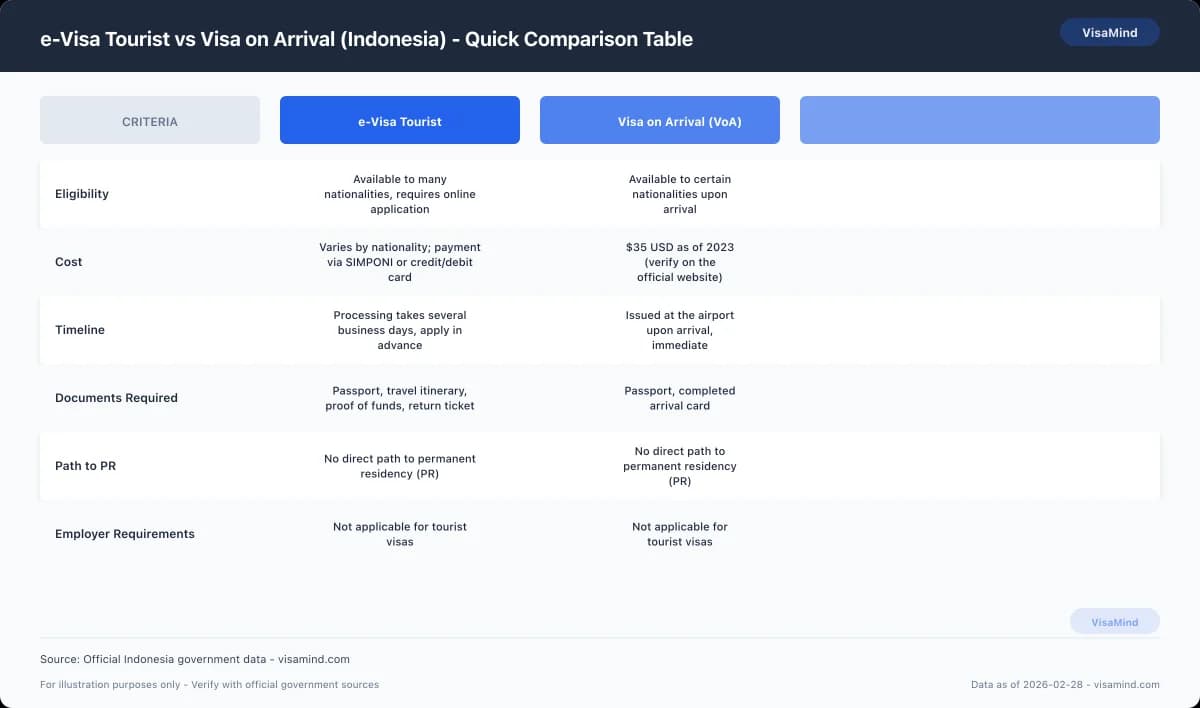
You have two primary visa options: the e-Visa Tourist and the Visa on Arrival (VoA). Both visas are managed by the Directorate General of Immigration (Ditjen Imigrasi) and cater to tourists, but they differ in several key aspects. Below is a quick comparison table to help you understand these differences:
| Criteria | e-Visa Tourist | Visa on Arrival (VoA) |
|---|---|---|
| Eligibility | Available to citizens from selected countries; check eligibility on the E Visa Tourist page | Available to citizens from specific countries; see Visa On Arrival page |
| Cost | Typically around $50 USD; verify on the official website | Approximately $35 USD; verify on the official website |
| Application Timeline | Must be applied for before entering Indonesia; processing time is usually a few business days | Obtained upon arrival at Indonesian airports or seaports |
| Validity | Up to 60 days | 30 days, extendable for another 30 days |
| Application Process | Online application; requires internet access and payment through SIMPONI or credit card | In-person process at the port of entry; payment via cash or card |
| Employer Requirements | Not applicable | Not applicable |
| Path to Permanent Residency (PR) | Does not directly lead to PR; separate application required | Does not directly lead to PR; separate application required |
Eligibility
Eligibility for both the e-Visa Tourist and Visa on Arrival (VoA) is determined based on your nationality. While both options cover a wide range of countries, it's important to verify if your country is included. The E Visa Tourist is often preferred for those who wish to ease the arrival process by securing their visa in advance.
Cost and Payment
The cost for each visa option varies slightly. The e-Visa Tourist generally costs around $50 USD, whereas the Visa on Arrival (VoA) is approximately $35 USD. Payments for the e-Visa are made online using SIMPONI or credit/debit cards like Mastercard, Visa, or JCB. For the VoA, you can pay upon arrival at the airport or seaport.
Application Timeline and Process
The e-Visa Tourist requires you to apply before traveling to Indonesia. The processing time is usually a few business days, and once approved, you will receive a link to download the visa via email. On the other hand, the Visa on Arrival (VoA) is obtained upon arrival in Indonesia. This makes it a convenient option for last-minute travelers, provided their nationality is eligible.
Path to Permanent Residency
Neither the e-Visa Tourist nor the Visa on Arrival (VoA) directly leads to permanent residency in Indonesia. If you intend to reside in Indonesia long-term, consider exploring other visa types such as the Kitas Work or Kitas Investor, which may offer pathways to residency.
Important: Ensure you have all required documents prepared before applying or arriving, as missing documentation can cause delays or denial of entry. Always verify the latest requirements and fees on the official Ditjen Imigrasi website.
Choose Option A If...
#A software engineer from India, planning a two-week holiday in Bali, wanted a straightforward and speedy visa application process. She decided to use the e-Visa Tourist option offered by the Directorate General of Immigration (Ditjen Imigrasi) because it allowed her to apply before leaving her home country. She accessed the official portal, provided her passport details and travel itinerary, and made the payment using her Mastercard. Within a few days, she received an email with a link to download her approved e-Visa. This streamlined process saved her time at the airport in Indonesia, allowing her to head straight to her accommodation after a long flight.
Scenario: Frequent Business Traveler Opts for Visa on Arrival
A Singaporean business consultant frequently travels to Indonesia for short client meetings. To maintain flexibility in his travel plans, he often chooses the Visa on Arrival (VoA) option. On his recent trip, he landed at Soekarno-Hatta International Airport, where he quickly followed the VoA process. Upon arrival, he proceeded to the designated VoA counter, presented his passport, paid the fee, and received his visa within minutes. This option was ideal for his last-minute travel plans, giving him the ability to enter Indonesia multiple times a year without the need to pre-apply online.
Scenario: Digital Nomad Seeks Extended Stay
A digital marketing freelancer, originally from Australia, planned an extended stay in Indonesia to explore various islands while working remotely. Knowing he would be in the country longer than the typical tourist, he opted for the e-Visa Tourist to manage his stay more flexibly. He applied through the Directorate General of Immigration's online portal, ensuring all required documents were prepared and submitted. After receiving his e-Visa approval via email, he entered Indonesia and later extended his stay by applying for a Visa Extension online. This approach allowed him to work and explore without needing to exit and re-enter the country frequently.
Option B Is Better When...
#A frequent traveler who often visits Indonesia for short business meetings and leisure activities prefers flexibility in their travel plans. They appreciate the convenience of the Visa on Arrival (VoA) option since it allows them to decide on travel dates without the need for prior visa arrangements. Upon landing at Soekarno-Hatta International Airport, they proceed to the VoA counter managed by the Directorate General of Immigration (Ditjen Imigrasi) to pay the required fee using their Mastercard. This straightforward process enables them to obtain a visa valid for 30 days, which can be extended if needed. This approach allows them to adjust their itinerary without the constraints of pre-planned submissions, providing peace of mind.
Scenario: Last-Minute Trip for Special Event
A professional photographer receives a last-minute opportunity to cover a cultural festival in Bali. Given the short notice, applying for an E Visa Tourist would be impractical due to the lead time required for processing. Instead, they opt for the Visa on Arrival (VoA), which is readily available at major entry points in Indonesia. Upon arriving at Ngurah Rai International Airport, they quickly proceed through the VoA process, enabling them to start their assignment with minimal delay. This option proves beneficial for spontaneous travel plans, where immediate entry is crucial.
Scenario: Unexpected Family Gathering
An expatriate working in Singapore learns of a family gathering in Jakarta planned at short notice. Without the time to apply for an E Visa Tourist, they choose the Visa on Arrival (VoA) option. Upon arriving at Jakarta's Soekarno-Hatta International Airport, they complete the VoA process efficiently by preparing the necessary documents and fee in advance. This choice allows them to participate in the gathering without missing any part of the family event. The VoA option serves as a reliable solution for urgent travel needs, facilitating seamless entry into Indonesia.
The Critical Differences
#One of the most significant differences between the e-Visa Tourist and the Visa on Arrival (VoA) is the processing method and time. The e-Visa Tourist is applied for online, allowing you to complete the process before you arrive in Indonesia. This can be beneficial if you prefer to have your visa ready prior to departure, helping to avoid potential delays upon arrival. The process typically involves submitting an application through the Directorate General of Immigration's online portal, paying the visa fee via SIMPONI or a credit/debit card, and waiting for approval, which can take several days.
In contrast, the Visa on Arrival is issued at designated entry points in Indonesia. This means you must wait until your arrival in the country to apply and pay for the visa. While this can be convenient for last-minute travel plans, it can also result in longer wait times at immigration counters, particularly during peak travel seasons.
Tip: If you're planning to arrive during a busy travel period, consider applying for the e-Visa Tourist to avoid long queues at the airport.
Eligibility and Documentation
Eligibility criteria and required documentation also differ between the two visa types. For the e-Visa Tourist, all nationalities eligible under Indonesia's visa policy can apply, provided they have the necessary documentation. This includes a valid passport, proof of return or onward travel, and possibly hotel reservations or a travel itinerary. The e-Visa is particularly beneficial for travelers who can gather and submit these documents digitally well in advance of travel.
For the Visa on Arrival, eligibility is limited to citizens of certain countries. It requires you to have a valid passport with at least six months of validity and the ability to show proof of onward travel. While the documentation required for the VoA is generally less intensive, it necessitates having these documents ready for inspection upon arrival.
Here’s a quick comparison:
| Aspect | e-Visa Tourist | Visa on Arrival (VoA) |
|---|---|---|
| Application | Online before travel | At port of entry |
| Processing Time | Several days before travel | Immediate upon arrival |
| Eligibility | Broader, per Indonesia's visa policy | Limited to certain nationalities |
Cost and Duration of Stay
The cost and duration of stay permitted under each visa type can also be a determining factor. The e-Visa Tourist fee is typically paid online and can vary depending on your nationality and the duration of the visa. It allows for a longer stay compared to the Visa on Arrival, which is generally valid for a 30-day period with the possibility of a single 30-day extension.
The Visa on Arrival, while often less expensive initially, might incur additional costs if you plan to extend your stay. The initial fee is paid at the port of entry, and if you wish to extend, you must apply at the local immigration office and pay an additional fee.
Important: Failure to submit an arrival card within three days prior to arrival in Indonesia can lead to entry delays or complications, particularly for those using the Visa on Arrival option. Always ensure this requirement is met to facilitate a smooth entry process.
For further details on these visas, check out the Visa On Arrival and E Visa Tourist pages.
Myths and Misunderstandings
#-
Visa Exemption Confusion: Many visitors mistakenly believe that all tourists need either an e-Visa Tourist or a Visa on Arrival (VoA). However, travelers from ASEAN countries can enter Indonesia without a visa for short stays due to visa exemption agreements.
-
Document Requirements: Some applicants assume that minimal documentation is needed for both e-Visa Tourist and VoA. In reality, you need to prepare specific documents regardless of the visa type, such as a valid passport and return flight tickets.
Misconceptions About Processes
-
Payment Methods: A common myth is that the visa fee can only be paid in cash upon arrival. For e-Visa Tourist applications, you can pay the fee online using SIMPONI or international credit/debit cards like Mastercard, Visa, or JCB.
-
Timing and Submission: There is often confusion about when and how to submit an arrival card. You must submit your arrival card within three days prior to your arrival in Indonesia, regardless of whether you have an e-Visa Tourist or a VoA.
Important: Failing to submit the arrival card within the required timeframe can lead to entry issues.
Myths About Convenience and Speed
-
Perception of Speed: Some believe that obtaining a Visa on Arrival is quicker than the e-Visa process. While a VoA might seem immediate, waiting in line at the airport can be time-consuming. The e-Visa Tourist, on the other hand, allows you to apply and receive approval before traveling.
-
Online Application Misunderstanding: It's a misconception that the e-Visa Tourist application process is complicated. In fact, it can be more convenient as it is entirely online, helping you avoid potential delays at the point of entry.
Clarifications on Use and Limitations
-
Use Beyond Tourism: Both the e-Visa Tourist and VoA are strictly for tourism purposes. Some travelers mistakenly believe they can be used for business or work-related activities. For business purposes, consider options like the E Visa Business.
-
Extension Possibilities: Many assume these visas are non-extendable. While the VoA can be extended once for an additional 30 days, the e-Visa Tourist is usually fixed, so planning your stay accordingly is crucial.
Tip: To avoid surprises, always verify the latest guidelines and processes on the Directorate General of Immigration's official website before planning your trip.
Changing Your Mind After Applying
#When considering a change from an e-Visa Tourist to a Visa on Arrival (VoA), or vice versa, in Indonesia, it is important to understand the flexibility and limitations of each option under the purview of the Directorate General of Immigration (Ditjen Imigrasi).
Can You Switch from e-Visa Tourist to Visa on Arrival?
If you've initially applied for an e-Visa Tourist, you cannot convert it to a Visa on Arrival once you arrive in Indonesia. The e-Visa Tourist is a pre-arrival requirement, allowing you to enter Indonesia with pre-approved clearance. Therefore, if you wish to switch to a VoA after receiving an e-Visa, you would need to first exit Indonesia and then re-enter, applying for a VoA at the point of entry.
Important: The e-Visa Tourist must be utilized as planned. Switching to a VoA requires exiting Indonesia and reapplying upon reentry.
Transitioning from Visa on Arrival to e-Visa Tourist
For travelers who entered Indonesia on a Visa on Arrival and wish to switch to an e-Visa Tourist for an extended stay, it's crucial to note that such a change cannot be made within the country. You must exit Indonesia and apply for the e-Visa Tourist from abroad.
Considerations for Changing Your Visa Type
Before deciding to switch your visa type, consider the following:
- Duration of Stay: An e-Visa Tourist may offer longer stay options compared to a VoA, which is typically valid for 30 days and can be extended once.
- Ease of Process: Applying for an e-Visa Tourist requires online application and preparation of documents before arrival, while a VoA can be obtained at the airport.
Tip: For longer visits, consider applying for an E Visa Tourist in advance to avoid the limitations of a VoA.
Steps to Take
- Assess Your Needs: Determine if your travel plans require a longer stay or multiple entries.
- Plan Exits and Entries: If switching visa types, plan your exit from Indonesia appropriately.
- Prepare Documentation: Ensure you have all necessary documents ready for the type of visa you intend to apply for next.
For complete guidance on visa processes and eligibility, refer to the How To Apply and Documents Checklist for more details.
Decision Scenarios
#A digital nomad from Australia decided to embark on a spontaneous trip to Bali, Indonesia, and faced a choice between applying for an e-Visa Tourist in advance or obtaining a Visa on Arrival (VoA) upon landing. Due to the short notice of the trip, the traveler opted for the Visa on Arrival, which allowed for a swift entry without pre-trip formalities. Upon arrival at Ngurah Rai International Airport, they proceeded to the designated visa counters managed by the Directorate General of Immigration (Ditjen Imigrasi). Here, they paid the required fee using a credit card, a straightforward process that took less than 30 minutes. This decision enabled the traveler to enjoy an immediate stay in Indonesia, with the option to extend the visa if needed. The entire process was efficient and suited the digital nomad’s flexible travel lifestyle.
Scenario: Family Choosing E-Visa Tourist
A family of four from Japan planned a month-long holiday in Indonesia to explore the cultural and natural wonders of Java and Sumatra. To ensure a smooth entry process, they decided to apply for the e-Visa Tourist well in advance. The application was submitted through the official Directorate General of Immigration portal, where they uploaded the necessary documents, including proof of onward travel and accommodation bookings. The family received a confirmation email with the approved visas within ten working days, allowing them to print the visas before departure. This proactive approach provided peace of mind and a seamless arrival experience, as they bypassed queues at the airport and proceeded directly to immigration control. This planning ensured that their holiday commenced without any logistical hiccups, allowing them to enjoy their itinerary from day one.
FAQs
Can you apply for an e-Visa Tourist and then decide to use a Visa on Arrival (Indonesia) instead?
What happens if I don't submit an arrival card for e-Visa Tourist vs Visa on Arrival (Indonesia)?
How long does it take to process an e-Visa Tourist vs Visa on Arrival (Indonesia) through DGIM?
What documents are required for e-Visa Tourist vs Visa on Arrival (Indonesia)?
Can ASEAN citizens choose between e-Visa Tourist vs Visa on Arrival (Indonesia)?
Is it necessary to download instructions for e-Visa Tourist vs Visa on Arrival (Indonesia) from DGIM?
Are there common myths about e-Visa Tourist vs Visa on Arrival (Indonesia)?
Sources
Last reviewed: March 1, 2026
VisaMind provides informational guidance only and is not a government agency. This is not legal advice. Requirements can change and eligibility depends on your specific facts. If your case is complex or high-stakes, consult a licensed immigration attorney.
Next steps
Requirements vary by nationality, purpose, timeline, and case details. Use Find My Visa to get a personalized checklist for Indonesia with official sources and deadlines.
Find my visa