Official sources referenced
Is This Comparison for You?
#New Zealand offers two distinct pathways for temporary work opportunities: the Working Holiday Visa and the Post-Study Work Visa. These options cater to different life stages and objectives, providing flexibility for young travelers and recent graduates alike.
Who Benefits from This Comparison?
This comparison is particularly relevant for young individuals aged 18 to 30 who are considering a Working Holiday Visa, which allows them to work and travel in New Zealand for up to 12 months. It's also crucial for graduates who have recently completed an approved qualification in New Zealand and are contemplating a Post-Study Work Visa. This visa permits them to remain in the country and gain valuable work experience related to their field of study.
Key Considerations for Each Visa
For those opting for a Working Holiday, the primary requirements include being from a country that has a working holiday agreement with New Zealand and meeting health and character prerequisites, like potentially undergoing a chest X-ray. You should also consider the Working Holiday Guide to navigate the application process effectively.
On the other hand, the Post-Study Work Visa necessitates proof of your New Zealand qualification, making it ideal for graduates looking to begin their professional careers in New Zealand. Ensure you have all necessary documents, such as academic transcripts and police certificates, as outlined in the Documents Checklist.
Tip: Always verify your eligibility and gather all required documents before applying, as missing information can delay your application process.
When to Consider Each Visa
If your goal is to explore New Zealand while earning money to support your travels, the Working Holiday Visa is a great fit. Conversely, if you aim to build a career post-graduation and potentially transition to a more permanent visa, the Post-Study Work Visa is tailored for you. For more detailed timelines and application steps, consult the Processing Times guide to plan your next steps efficiently.
At a Glance
#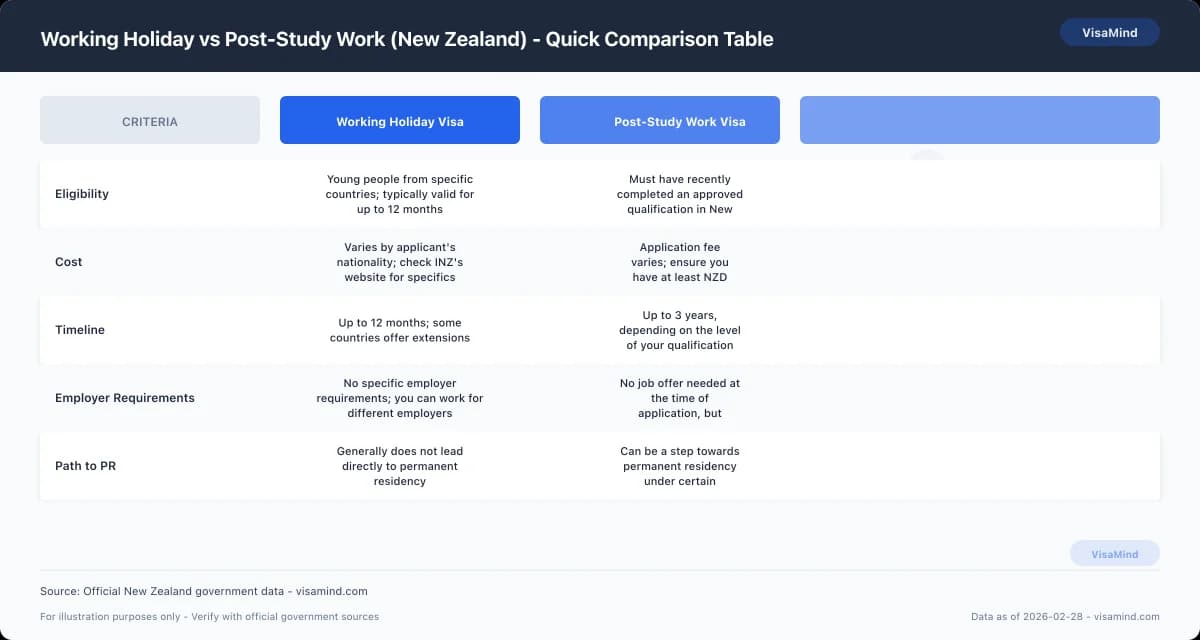
| Visa Type | Eligibility | Cost | Timeline | Employer Requirements | Path to PR |
|---|---|---|---|---|---|
| Working Holiday Visa | For young people from recognised countries, typically aged 18-30 or 18-35. | Varies by country. | Up to 12 months for most countries. | No job offer required. | Not directly a path to PR. |
| Post-Study Work Visa | Must have completed an approved qualification in New Zealand. | Application fee applies. | Up to 3 years depending on qualification level. | No job offer required initially. | Can lead to PR through work experience. |
Eligibility
The Working Holiday Visa is designed for young individuals, generally between 18 and 30 years old (or 35 for some countries), who wish to work and travel in New Zealand for up to 12 months. In contrast, the Post-Study Work Visa is available to international students who have completed an approved qualification in New Zealand, allowing them to gain practical work experience.
Cost
The cost of a Working Holiday Visa varies depending on the applicant's country of origin. For the Post-Study Work Visa, an application fee is required, and the exact amount can be confirmed on the Immigration New Zealand website.
Timeline
The Working Holiday Visa typically allows stays of up to 12 months, although this may vary slightly based on reciprocal agreements with specific countries. The Post-Study Work Visa can be granted for up to three years, depending on the level of the qualification completed. For more details on processing times, visit the Processing Times page.
Employer Requirements
Neither visa type initially requires a job offer. However, securing employment is a common goal for Post-Study Work Visa holders to potentially transition to permanent residency. The Working Holiday Guide provides useful tips for maximizing employment opportunities during your stay.
Path to Permanent Residency (PR)
While the Working Holiday Visa does not directly lead to permanent residency, it can be a stepping stone for gaining work experience that may contribute to future applications. The Post-Study Work Visa offers a more direct path to PR as it allows graduates to gain relevant work experience in New Zealand, which can be crucial for eligibility under the Skilled Migrant Category or other PR pathways. For further guidance on pathways to PR, check the PR Pathway Guide.
Tip: Always ensure that your police certificates are less than 6 months old when applying, as older certificates may lead to application delays or issues.
Option A Is Better When...
#Tip: Consider the Working Holiday Visa if you wish to explore New Zealand while gaining work experience. It is ideal for young travelers from specific countries looking to work and travel simultaneously.
Scenario: Graduate Seeking Short-Term Adventure
A recent graduate from Canada wanted to experience New Zealand’s culture while deciding on a future career path. Given their desire for a temporary yet enriching experience, they opted for the Working Holiday Visa. This choice allowed them to work in various short-term jobs across the country while exploring the scenic landscapes and vibrant cities New Zealand has to offer.
They began their application by visiting the Working Holiday Visa page on the Immigration New Zealand (INZ) website, ensuring they met all health and character requirements, including providing a recent police certificate. Once approved, they spent 12 months working in different hospitality and retail roles. This not only funded their travels but also enriched their resume with international work experience. The flexibility of the Working Holiday Visa was perfect for their short-term plans, offering both adventure and professional growth.
Scenario: Recent Graduate Needing Post-Study Work Experience
A marketing graduate from India completed their studies at a New Zealand university and was eager to gain relevant work experience in the country. They decided to apply for the Post Study Work Visa, which is tailored for graduates seeking to work in their field of study after completing an approved qualification in New Zealand.
They gathered the necessary documents, including their academic transcript and a letter from their university confirming the completion of their degree. Logging into the INZ online portal, they submitted their application along with the required fee. Within a few months, they secured a role in a local marketing firm, allowing them to apply their knowledge in a real-world setting. This visa provided a straightforward pathway to gaining valuable work experience relevant to their field, with the potential to transition to a more permanent visa in the future.
Important: Ensure all your documents, such as police certificates and proof of health, are up-to-date and meet the INZ requirements to avoid delays in your application process.
When to Pick the Second Option
#A recent university graduate in New Zealand, who completed a Bachelor's degree in Information Technology, was eager to gain work experience in their field. After successfully finishing their studies, they considered the Post-Study Work Visa as a viable option to stay and work in New Zealand. The graduate gathered necessary documents, including their academic transcript and a letter from their tertiary provider confirming the completion of their degree, to meet the requirements set by Immigration New Zealand (INZ).
They applied online through the INZ portal, ensuring their police certificates were current and all documents were in English. By securing a Post-Study Work Visa, they gained the opportunity to work in New Zealand for up to three years, allowing them to gain valuable industry experience and potentially transition to a Skilled Migrant Visa in the future. The entire process, from application to approval, took approximately six weeks.
Scenario: Transitioning from Study to Work Without a Gap
An engineering master's student in New Zealand was nearing the end of their course and wanted to continue living and working in the country without any interruption. They were concerned about the timing of their visa application and ensuring they maintained a valid status. Aware of the pitfall of not applying within the specified time after their student visa expiration, they planned well in advance.
Before their student visa expired, they gathered all required documents, including their qualification transcript and police certificates, and applied for a Post-Study Work Visa. They used the Documents Checklist to ensure they had everything needed. By doing so, they seamlessly transitioned to a work visa without a gap, allowing them to start their job search immediately. The outcome was positive, with their visa granted within four weeks, enabling them to remain in New Zealand and look for employment aligned with their qualifications.
Tip: Always check the Visa Extension Guide to ensure you maintain a valid visa and avoid any legal issues.
Scenario: Exploring Career Opportunities with Flexibility
A graduate from a New Zealand polytechnic, with a diploma in hospitality management, sought to explore various career opportunities across the country post-graduation. They chose the Post-Study Work Visa, which provided the flexibility to work for different employers. Understanding the importance of a valid visa, they ensured all documents were in order and submitted their application through the INZ online portal.
They also explored resources such as the Working Holiday Guide to understand how this visa compared to other options like the Working Holiday Visa. The Post-Study Work Visa allowed them to work in any part of New Zealand, offering diverse experiences in the hospitality industry. This strategic choice facilitated not only personal growth but also professional advancement, setting the foundation for a potential Skilled Migrant Visa application in the future.
What Really Sets Them Apart
#Working Holiday Visa: This visa allows young people, typically aged 18-30, from specific countries to work and travel in New Zealand for up to 12 months. Some countries may offer a 23-month option. Applicants must meet certain health and character requirements, which could include a medical examination or chest X-ray.
Post-Study Work Visa: To qualify, you must have completed a recognized qualification in New Zealand. This visa allows you to work in New Zealand for up to three years, depending on the level of your qualification. The application requires proof of your qualification, such as an academic transcript or a letter from your education provider.
Purpose and Benefits
The Working Holiday Visa is designed for those who want a temporary experience in New Zealand, combining work with travel. It offers flexibility to explore the country while earning money to support your stay. This visa doesn't require a job offer before arriving in New Zealand, making it an appealing option for those seeking adventure.
On the other hand, the Post-Study Work Visa is tailored for graduates who wish to gain work experience in their field of study. This visa can be a stepping stone to long-term employment or residency in New Zealand, as it allows you to work for any employer in a job related to your qualification.
Documentation and Application Process
Both visas require specific documentation, but the Post-Study Work Visa tends to have more stringent requirements. For this visa, you need to gather:
- Proof of your qualification from a New Zealand institution
- Police certificates less than six months old if applicable
- Certified translations of documents not in English
- A supplementary form detailing your background and intentions
For the Working Holiday Visa, the documentation is generally less intensive, focusing on health certifications and proof of funds to support your initial stay.
Important: Ensure that all documents, especially police certificates, meet the age and translation requirements to avoid delays.
Duration and Flexibility
Here’s a comparison of the duration and flexibility of each visa:
| Visa Type | Duration | Flexibility |
|---|---|---|
| Working Holiday | Up to 12 or 23 months | Work and travel; job offers not required |
| Post-Study Work | Up to 3 years | Work in a field related to your qualification |
Each visa serves different goals, whether you’re looking for a short-term cultural experience or a pathway to further your career in New Zealand.
Key Differences
-
Objective: The Working Holiday Visa is ideal for short-term work and travel, while the Post-Study Work Visa is focused on long-term career development related to your field of study.
-
Eligibility: Age and nationality restrictions apply more strictly to the Working Holiday Visa, whereas the Post-Study Work Visa depends on your educational achievements in New Zealand.
-
Long-term Opportunities: While both visas allow work, the Post-Study Work Visa offers more potential for residency pathways, especially if your job is related to your qualification.
For more detailed information on the application process, visit How To Apply and Documents Checklist. Also, check for specific requirements for each visa at Working Holiday and Post Study Work.
Common Misconceptions
#-
Working Holiday Visa is for Everyone: Many believe that the Working Holiday Visa is available to all international applicants. In reality, it is limited to young people from specific partner countries. Additionally, there are age restrictions, usually between 18 and 30 or 35, depending on your nationality.
-
Post-Study Work Visa Requires No Further Study: A common misconception is that you can apply for a Post-Study Work Visa without having completed a qualification in New Zealand. You must have successfully completed an approved qualification to be eligible for this visa.
Misunderstandings about Duration and Conditions
-
Unlimited Work Opportunities on a Working Holiday Visa: Some assume that the Working Holiday Visa allows them to work indefinitely in New Zealand. However, this visa generally permits work for up to 12 months, with some restrictions on the types of employment and length of stay with a single employer.
-
Post-Study Work Visa Offers Permanent Residency: It is often misunderstood that obtaining a Post-Study Work Visa automatically leads to permanent residency. While it provides a pathway to gain local work experience, it is not a guarantee of residency. For residency options, you might explore pathways like the Skilled Migrant Visa.
Confusions about Documentation
-
No Need for Police Certificates: Some believe police certificates are unnecessary for these visas. In contrast, police certificates are required for both visas if you've lived in New Zealand or another country for a certain period. They must be less than 6 months old at the time of application.
-
English Translations Aren't Mandatory: It is a common mistake to think that documents in a foreign language don't need translation. All documents not in English must be accompanied by certified English translations. Failing to provide translations can lead to application delays or denials.
Tip: Ensure your police certificates and translations are up-to-date to avoid processing delays. Check the Visa Refusal Reasons guide for more insights.
For more detailed guidance on each visa type, you can explore the Working Holiday Guide and Post Study Work Visa resources.
Converting Between Options
#Converting between a Working Holiday Visa and a Post-Study Work Visa in New Zealand can open up different opportunities for work and travel. Understanding the eligibility and application processes for each visa type is key to making a seamless transition.
Transitioning from a Working Holiday Visa to a Post-Study Work Visa
If you are currently on a Working Holiday Visa and have completed an approved qualification in New Zealand, you may consider applying for a Post-Study Work Visa. This visa allows you to stay and work in New Zealand after completing your studies.
-
Eligibility Requirements:
- Successfully complete a recognized qualification in New Zealand.
- Obtain supporting documents such as proof of qualification and police certificates.
-
Application Steps:
- Gather necessary documents, including your qualification and academic transcript.
- Ensure police certificates are less than 6 months old if needed.
- Lodge your application with Immigration New Zealand (INZ) and pay the required fee.
Important: Ensure you apply for the Post-Study Work Visa before your Working Holiday Visa expires to maintain legal status in New Zealand.
Moving from a Post-Study Work Visa to a Working Holiday Visa
Switching from a Post-Study Work Visa to a Working Holiday Visa is less common, as Working Holiday Visas are typically for individuals who have not yet established a work history in New Zealand. However, if eligible, here are the steps:
-
Eligibility Requirements:
- Be a young person (usually aged 18-30) from a country with a working holiday agreement with New Zealand.
-
Application Steps:
- Prepare necessary documents, including medical certificates if required.
- Apply online through INZ's platform.
Tip: Check the specific country agreements and quota availability for Working Holiday Visas to ensure eligibility.
For more details on each visa type, visit the Working Holiday Visa and Post-Study Work Visa pages, or consult the Visa Extension Guide if looking to extend your stay.
Real Scenarios
#Emma, a recent graduate from a New Zealand university, completed her qualification in environmental science and wanted to remain in New Zealand to gain work experience. She decided to apply for the Post-Study Work Visa. Emma logged into the Immigration New Zealand (INZ) portal to check the requirements specific to her situation. She gathered her academic transcripts and a letter from her university confirming her qualification completion. Emma also ensured her police certificate was less than six months old. After submitting her application online, she paid the necessary fee and regularly checked her application status through the INZ portal. Within six weeks, her visa was approved, allowing her to work in New Zealand for up to three years, depending on her qualification level.
Scenario: Young Traveler Explores New Zealand on a Working Holiday Visa
Lucas, a 24-year-old from Germany, wanted to explore New Zealand while working to support his travels. He applied for the Working Holiday Visa through the INZ website. Lucas checked that his country was part of New Zealand's working holiday scheme and noted the medical requirements, which included a chest X-ray to confirm good health. He prepared documents proving sufficient funds to support himself and a return ticket. Lucas submitted his application, paid the fee, and was notified within a month of his successful visa grant. This visa allowed him to work and travel in New Zealand for up to 12 months, giving him the freedom to explore the country while earning money to fund his journey.
Tip: For both visas, ensure all documents are translated into English if they are not originally in that language to avoid processing delays.
FAQs
How does Immigration New Zealand (INZ) define eligibility for a Working Holiday Visa?
Is it possible to combine goals with a Working Holiday and Post-Study Work Visa in New Zealand?
What are the common misconceptions about Working Holiday vs Post-Study Work Visas in New Zealand?
What documents are required for a Working Holiday Visa in New Zealand?
Can I extend my stay in New Zealand with a Post-Study Work Visa after a Working Holiday?
What are the eligibility criteria for a Post-Study Work Visa in New Zealand?
What pitfalls should I avoid when applying for a Working Holiday vs Post-Study Work Visa in New Zealand?
Sources
Last reviewed: March 1, 2026
VisaMind provides informational guidance only and is not a government agency. This is not legal advice. Requirements can change and eligibility depends on your specific facts. If your case is complex or high-stakes, consult a licensed immigration attorney.
Next steps
Requirements vary by nationality, purpose, timeline, and case details. Use Find My Visa to get a personalized checklist for New Zealand with official sources and deadlines.
Find my visa