On this page
- Is This Program for You?
- Eligibility Criteria
- Step-by-Step Application
- Supporting Documents Checklist
- Timeline and Processing
- Where Applicants Go Wrong
- How It Compares to Alternatives
- Fees and Financial Requirements
- What You Can and Cannot Do
- Real-World Examples
- Visa options for this goal
- Guides for New Zealand
- Other goals for New Zealand
Is This Program for You?
#The Accredited Employer Work Visa (AEWV) is a key pathway for skilled migration to New Zealand, allowing eligible individuals to work in the country for up to five years. This visa can also lead to a resident visa, making it an attractive option for those seeking to establish themselves in New Zealand.
Who Qualifies for the AEWV?
To be eligible for the AEWV, you must meet several criteria:
- Job Offer: You must have a valid offer of full-time work from an accredited employer in New Zealand.
- Qualifications and Experience: Depending on the job, you may need to meet specific work experience and/or qualification requirements.
- English Language Proficiency: If your job is on the ANZSCO skill level 4 or 5 list and not exempt, you must demonstrate the ability to speak and understand English.
- Previous Visa Conditions: If you've previously stayed in New Zealand under the AEWV for the maximum allowed time, ensure you have spent the required period outside the country before applying again.
Is the Skilled Migrant Category Resident Visa for You?
The Skilled Migrant Category Resident Visa might be suitable if:
- You have a job or job offer from an accredited employer.
- You qualify for at least 6 points based on your skills and work in New Zealand.
- You can submit an Expression of Interest (EOI) and are invited to apply.
Additional Considerations
- Changing Employers or Jobs: If your job situation changes and you wish to change your employer, job, location, or a combination of these, you must apply to vary the conditions of your visa or apply for a Job Change, or apply for a new visa.
Important: Your employer must send you a link to the online application form. This link is essential for lodging your application with Immigration New Zealand (INZ).
For more detailed guidance on applying, consider referring to the How To Apply guide or review the Documents Checklist to ensure you have all necessary documentation. If you're comparing the AEWV with other options, the AEWV Vs Essential Skills guide can provide valuable insights.
Tip: Ensure your employment agreement complies with New Zealand employment law to avoid processing delays.
Eligibility Criteria
#Skilled migration to New Zealand offers various pathways for individuals seeking to work and potentially reside in the country. To be eligible, specific criteria must be met, tailored to the type of visa you are applying for. Here’s what you need to know about the eligibility criteria for skilled migration:
Job Offer and Employer Requirements
- Job Offer: You must have a full-time job offer from an accredited employer in New Zealand. This is essential for visas like the Accredited Employer Work Visa (AEWV).
- Employer Accreditation: The employer offering you a job must be accredited by Immigration New Zealand (INZ). This ensures they meet specific standards and obligations.
Qualifications and Experience
- Relevant Qualifications: Depending on your job, you might need to demonstrate specific qualifications. Ensure your credentials are relevant to the position offered.
- Work Experience: You must provide evidence of relevant work experience. This could include previous job roles, responsibilities, and duration.
Language Proficiency
- English Language Requirement: If your job falls under the ANZSCO skill level 4 or 5 list and is not exempt, you must prove your ability to speak and understand English. This is crucial for effective communication in your work environment.
Age and Points System
- Points Threshold: For the Skilled Migrant Category Resident Visa, you need to submit an Expression of Interest (EOI) and qualify for at least 6 points based on your skills and work in New Zealand. Points are calculated based on factors like age, employment offer, work experience, and qualifications.
Tip: Use the Documents Checklist to ensure you have all necessary documents before lodging your application.
Additional Requirements
- Police Certificates: Proof of good character is a requirement. Police certificates must be provided if required, and any non-English certificates must be accompanied by an English translation.
- Medical Information: You may need to submit medical information, which INZ will review as part of the application process.
- Previous Visa Restrictions: If you have previously stayed in New Zealand under the AEWV, ensure you have spent the required time outside New Zealand before applying again.
Expression of Interest and Job Change
- Expression of Interest (EOI): For some visas, such as the Skilled Migrant Category Resident Visa, you must submit an EOI. If accepted, you will be invited to apply.
- Varying Visa Conditions: If you need to change your employer, job, or location, you must apply to vary your visa conditions or apply for a Job Change or a new visa.
Navigating the eligibility criteria for skilled migration requires careful attention to detail. Ensure that all necessary documents are prepared and that you understand the requirements specific to your situation. For more information on the differences between visas, you can refer to the AEWV vs Essential Skills guide.
Step-by-Step Application
#Confirm Your Eligibility
Before beginning the application process for the Accredited Employer Work Visa (AEWV), ensure you meet all the eligibility requirements. You must have a full-time job offer from a New Zealand employer who is accredited by Immigration New Zealand (INZ). Depending on your job, you may need to demonstrate relevant work experience and qualifications. Additionally, if your job is listed under ANZSCO skill levels 4 or 5 and is not exempt, you must prove your English language proficiency.
Receive the Application Link
Once you have confirmed your eligibility and secured a job offer, your employer will provide you with a link to the online application form. This link is essential as it directs you to the specific application portal for your visa type. Ensure you have all necessary documents ready as listed in the Documents Checklist.
Gather Required Documents
It's important to compile all required documentation carefully. This includes:
- A signed copy of your job offer and employment agreement.
- Proof of relevant job experience and qualifications.
- Police certificates if required, and ensure they are translated into English if not already.
- Medical information, if applicable.
Failure to provide a complete set of documents can delay the processing of your application.
Submit Your Online Application
Using the link provided by your employer, submit your application through the INZ online portal. This step involves:
- Completing all sections of the application form.
- Uploading the required documents.
- Paying the applicable fees as part of the submission process.
Tip: File online to avoid mail delays and get a receipt number immediately, which you can use to track your application status.
Check Application Status
After submission, you can monitor the status of your application by logging into your INZ account. Stay proactive by checking regularly for any updates or additional document requests from INZ.
Expression of Interest for Permanent Residency
If you are considering a pathway to permanent residency, ensure you understand the process for submitting an Expression of Interest (EOI) for the Skilled Migrant Category Resident Visa. You need to have a job or a job offer from an accredited employer and meet the points threshold for your skills and work experience in New Zealand. For more guidance, refer to the Skilled Migrant visa page.
Important: Missing any document or providing incorrect information can result in delays or rejection of your application. Always double-check your submissions against the INZ requirements.
By following these steps meticulously, you increase your chances of a successful application outcome. For more detailed instructions, visit the How to Apply guide.
Supporting Documents Checklist
#Important: Ensure all your documents are complete and accurate before lodging your application. Incomplete or unverifiable documents may delay processing or result in a refusal.
Essential Documents
When applying for skilled migration to New Zealand, you'll need to prepare a comprehensive set of documents to support your application:
-
Job Offer and Employment Details
- A signed copy of a New Zealand job offer from an accredited employer.
- The employment agreement and a detailed job description.
-
Proof of Qualifications and Experience
- Evidence of job experience, skills, and relevant qualifications.
- A work book or other records as evidence of your work experience.
- If applicable, evidence of work experience in a European country, including your right to work there.
-
Identity and Character Documents
- A copy of your current passport.
- Police certificates as proof of good character. If previously submitted within the last 24 months, ensure they are still valid.
- An English translation of any police certificate not originally in English.
Additional Requirements
Depending on your specific situation, additional documents may be necessary:
-
If Applying with Certain Passports
- A completed supplementary form if you hold a passport from Hong Kong, Macao, or a Hong Kong British National Overseas passport.
-
If Changing Jobs or Employers
- You must apply to vary the conditions of your visa or apply for a Job Change if you wish to change your employer, job, or location.
-
Language Proficiency
- Proof of English language ability if your job is on the ANZSCO skill level 4 or 5 list and not exempt.
Tips for a Successful Application
Tip: Double-check that your employment agreement aligns with New Zealand employment law to avoid application pitfalls.
- Gather all your documents, ensuring they are up-to-date and meet the specific requirements outlined by Immigration New Zealand.
- For more information on the visa application process, visit the How To Apply guide.
- Pay attention to deadlines and ensure you submit your application within the given timeframe to avoid any delays or complications.
By meticulously preparing your documentation and understanding the specific requirements, you enhance your chances of a successful skilled migration application. For further assistance, consider consulting the Aewv Vs Essential Skills guide to understand different work visa options.
Timeline and Processing
#Navigating the timeline for skilled migration to New Zealand involves understanding expected processing times, potential expedited options, and factors that can affect the speed of your application. Here's an overview to help you plan your journey.
Expected Processing Times
The processing time for applications under the Accredited Employer Work Visa (AEWV) and the Skilled Migrant Category Resident Visa can vary. As of the latest updates, processing times for the AEWV typically range between 2 to 4 months. For the Skilled Migrant Category, it might take longer, often between 6 to 12 months. It's important to regularly check the Processing Times guide on the INZ website for the most current estimates.
Factors Affecting Processing Speed
Several elements can influence how quickly your application is processed:
-
Completeness of Application: Ensure all required documents, such as work experience evidence and police certificates, are submitted correctly. Missing or incomplete information can delay processing.
-
Verification Needs: Applications requiring additional checks, like verifying international qualifications or conducting character assessments, may take longer.
-
Current INZ Workload: The number of applications INZ is handling at any given time can affect processing speed. High volumes may lead to longer wait times.
-
Changes in Personal Circumstances: If you need to vary your visa conditions or change your employer, this can add to the processing time.
Important: Submitting incomplete or unverifiable employment certificates can significantly delay your application. Ensure all documents are accurate and meet New Zealand employment law standards.
Expedited Processing Options
While there are limited options for expedited processing, certain circumstances may allow you to request faster handling:
-
Critical Purpose Visitor Visa: If your skills are urgently needed in New Zealand, you might qualify for this visa, which can be processed more quickly.
-
Employer Requests: In some cases, an accredited employer might be able to expedite your application by providing a compelling case to INZ.
For more detailed guidance on these options, consult the How To Apply page on the INZ website.
Tips for Efficient Processing
-
Apply Online: Utilize the online application system to avoid postal delays and receive a receipt number immediately.
-
Regularly Check Status: Log in to your INZ account to monitor your application's progress and respond promptly to any requests for additional information.
By understanding these timelines and potential delays, you can better prepare for your skilled migration journey to New Zealand.
Where Applicants Go Wrong
#Important: Ensure all documents are complete and current before lodging your application with Immigration New Zealand (INZ). Missing or outdated documents can result in delays or refusals.
Common Documentation Errors
- Incomplete Employment Certificates: Applicants often submit employment certificates that lack necessary details or verification. Always check that your certificates are complete and verifiable.
- Missing Police Certificates: If a police certificate is required, ensure that it is valid and translated into English if necessary. Submitting without these could lead to refusal.
- Lack of English Proficiency Evidence: For jobs listed under ANZSCO skill levels 4 or 5, evidence of English proficiency is essential unless exempt. Failing to provide this can result in application rejection.
Errors in Job Offers and Employment Agreements
- Non-Compliant Employment Agreements: An employment agreement must comply with New Zealand employment law. Double-check the legal requirements to ensure your agreement is valid.
- Invalid Job Offers: Job offers must be from an accredited employer. Submitting a job offer from a non-accredited employer will lead to immediate refusal.
Changes in Employment Conditions
- Changing Job Conditions Without Approval: If your employment situation changes (e.g., employer, job, or location), you must apply to vary the conditions of your visa or apply for a Job Change. Failing to do so can jeopardize your stay in New Zealand.
- Not Following Proper Procedures for Changing Employers: Switching employers requires specific procedures. Ensure you follow the proper protocol to avoid complications with your visa status.
For more guidance on the specific requirements and processes involved, visit our comprehensive guides on Visa Refusal Reasons and PR Pathway Guide.
Expression of Interest (EOI) Pitfalls
- Insufficient Points in EOI: Make sure you can claim enough points before submitting your Expression of Interest. Use the Skilled Migrant Category Resident Visa guidelines to check your eligibility.
- Failure to Update EOI Information: If your circumstances change after submitting your EOI, update your information promptly. Failure to do this can lead to inaccurate assessments and potential refusal.
Understanding and avoiding these common pitfalls can significantly enhance your chances of a successful skilled migration application to New Zealand. Always refer to official resources and INZ guidelines for the most accurate and up-to-date information.
How It Compares to Alternatives
#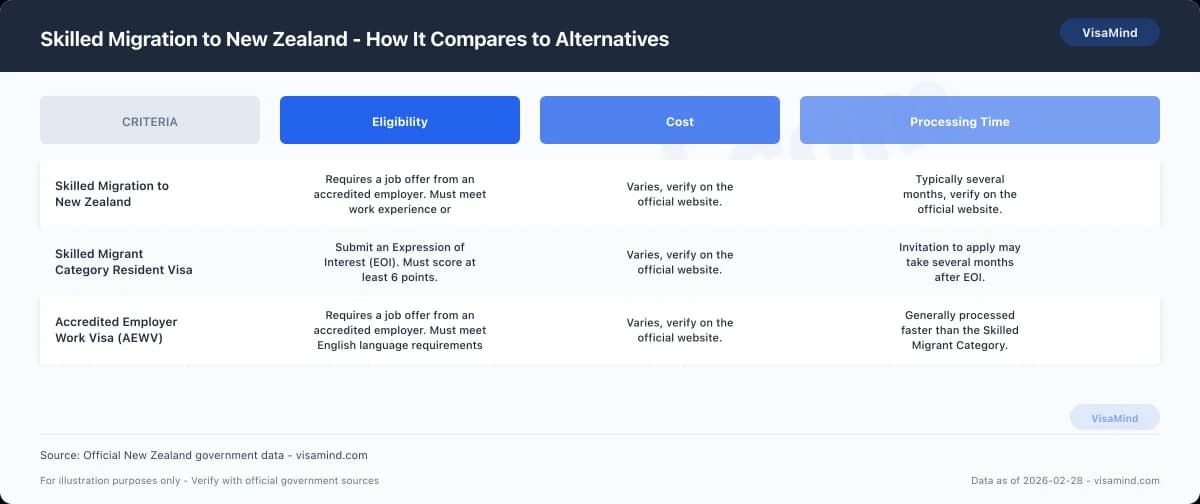
It's crucial to understand how the Skilled Migrant Category Resident Visa compares to other visa options, such as the Accredited Employer Work Visa (AEWV) and the Essential Skills Work Visa. Below is a comparison to help you distinguish between these options:
| Visa Type | Eligibility Criteria | Cost | Duration | Pathway to Residence |
|---|---|---|---|---|
| Skilled Migrant Category Resident Visa | Must submit an Expression of Interest (EOI) and receive an invitation to apply. Requires a job offer from an accredited employer and qualification for at least 6 points. | Fees vary; verify on the official website. | Indefinite, as it grants residency. | Direct pathway to permanent residence. |
| Accredited Employer Work Visa (AEWV) | Requires a job offer from an accredited employer. Must meet specific work experience and/or qualification requirements. English proficiency needed for certain skill levels. | As of 2023, starting from NZD $700; verify on the official website. | Up to 5 years, depending on job and skill level. | May lead to a resident visa. |
| Essential Skills Work Visa | Requires a job offer in an occupation listed on the Essential Skills in Demand list. Must meet specific skill and experience requirements. | Cost varies; check the official website for current fees. | Up to 3 years, depending on skill level and employment. | Limited pathway to residency; primarily for temporary work. |
Key Differences Between Visa Options
Each visa type has its own set of eligibility criteria, costs, and pathways to residency, which can significantly impact your decision. The Skilled Migrant Category Resident Visa offers a direct route to permanent residency, which is ideal if your long-term goal is to settle in New Zealand. However, it requires an invitation to apply after submission of an Expression of Interest.
On the other hand, the Accredited Employer Work Visa (AEWV) and the Essential Skills Work Visa provide opportunities for temporary work in New Zealand, with the possibility of transitioning to residency under specific conditions. The AEWV is particularly attractive for those with a job offer from an accredited employer, as it can lead to a resident visa over time.
Important: Ensure that you meet all eligibility requirements for your chosen visa type to avoid application delays or refusals. For detailed guidance, refer to the Visa Refusal Reasons guide.
Can You Change Employers on a Work Visa?
If your circumstances change while holding a work visa, such as the AEWV or Essential Skills Work Visa, you may need to apply to vary the conditions of your visa or apply for a new visa altogether. This might be necessary if you wish to change your employer, job, or location within New Zealand.
For those considering the Skilled Migrant Category Resident Visa, keep in mind that this visa is less about the specific employer and more about your overall qualifications and points scored in the EOI process.
Tip: Regularly check your application status online to stay informed of any updates or additional requirements that may arise.
Each of these visas offers unique advantages and challenges, so evaluate your personal situation and career goals to determine the best fit for your migration journey to New Zealand.
Fees and Financial Requirements
#This section outlines the fees and financial proof necessary for some of the primary visa categories available through Immigration New Zealand (INZ).
Visa Application Fees
When applying for a work visa or residency through the skilled migration route, it's essential to be aware of the associated costs. Below is a comparison of key visa options:
| Visa Type | Application Fee (NZD) | Salary Threshold | Investment Minimum |
|---|---|---|---|
| Accredited Employer Work Visa | $750 | Job offer required from an accredited employer | N/A |
| Skilled Migrant Category Resident Visa | $3,310 | 160 points minimum, including points for skilled employment | N/A |
| Essential Skills Work Visa | $495 | Depends on job skill level | N/A |
Important: Fees are subject to change. Verify the latest fees on the official website.
Financial Proof and Salary Requirements
For skilled migration, demonstrating financial stability is a critical component of the application process. Here are the primary considerations:
-
Salary Thresholds: For work visas like the Accredited Employer Work Visa, you must have a job offer that meets salary and skill level requirements. The salary must align with the market rate for the role in New Zealand.
-
Investment Minimums: While not directly applicable to all skilled migration paths, other visas, such as the Investor 1 and Investor 2, require specific investment amounts in New Zealand.
-
Financial Proof: You may need to provide proof of funds to support yourself and any dependents. This includes bank statements or other financial documents to demonstrate sufficient means.
Key Considerations
-
Police Certificates: Ensure you have valid police certificates as proof of good character. These may need to be translated into English if originally issued in another language.
-
English Language Requirements: If your job is on the ANZSCO skill level 4 or 5 list, you must demonstrate English proficiency unless exempt.
-
Changing Employment Conditions: If you wish to change your employer, job, or location, you must apply to vary the conditions of your visa.
For more details on the specific financial requirements for each visa type, consult the Financial Requirements Guide.
Tip: Keep track of your application status by logging into your INZ account regularly.
What You Can and Cannot Do
#It is important to understand what the Accredited Employer Work Visa (AEWV) allows you to do, as well as what it restricts. This visa is specifically designed for individuals who have a job offer from an accredited employer in New Zealand.
Work Rights
With the AEWV, you are authorized to work in New Zealand for the duration specified on your visa, which can be up to 5 years depending on your job and skill level. This visa can also be a pathway to obtaining a resident visa. However, your work rights are closely tied to the job offer you received. If you wish to change your employer, job role, or location, you must apply to vary the conditions of your visa or lodge a new application.
Important: Ensure any employment agreements meet New Zealand employment laws to avoid application pitfalls.
Travel and Residency
The AEWV allows you to travel in and out of New Zealand during its validity. However, to transition from this visa to a resident visa, you need to meet specific criteria and submit an expression of interest (EOI) under the Skilled Migrant Category.
Family Members
Family members, such as partners and children, can apply for visas based on your AEWV. Your partner may be eligible for a Partner of Worker visa, which permits them to work in New Zealand. Children can apply for student or visitor visas, allowing them to study or visit New Zealand.
Restrictions
- Employer and Job Specific: Your visa is specific to the employer and job outlined in your application. Any change requires you to apply for a Job Change or a new visa.
- Skill Level Requirements: You must meet the skill and qualification requirements for your job, especially if it falls under the ANZSCO skill level 4 or 5 list.
- English Language Proficiency: Evidence of English language proficiency is required unless exempt.
Tip: Check your application status regularly to ensure you meet deadlines and provide any additional information requested by Immigration New Zealand (INZ).
Understanding these key aspects can help you navigate the skilled migration process to New Zealand more effectively. For more detailed information, consider consulting the PR Pathway Guide or exploring other visa options such as the Essential Skills Work Visa.
Real-World Examples
#An IT professional received an enticing job offer from a New Zealand tech firm eager to tap into her software development expertise. She was thrilled but unsure about navigating the Accredited Employer Work Visa (AEWV) process. With the help of her employer, who provided a link to the INZ online application portal, she began gathering necessary documents like her signed job offer and evidence of her prior work experience. As English was not her first language, she also needed to provide proof of her English language ability due to her job being on the ANZSCO skill level 4 list. After submitting her application and paying the required fees, she monitored her application's progress through the INZ portal. Within several weeks, her visa was approved, allowing her to relocate to New Zealand confidently.
Scenario: Engineer Transitioning to Permanent Residency
An engineer working on an AEWV for a New Zealand infrastructure company had been in the country for four years. With aspirations for long-term residency, he decided to transition to the Skilled Migrant Category Resident Visa. He first submitted an Expression of Interest (EOI) through the INZ system, as he had gained sufficient points for his skills and work experience in New Zealand. Upon receiving an invitation to apply, he compiled documents such as his New Zealand job offer, police certificates, and proof of employment history. Following the submission and fee payment, he awaited the outcome. After a few months, he was delighted to receive his resident visa, making his long-term stay in New Zealand official.
FAQs
What supporting documents are required for skilled migration to New Zealand?
How many points are needed for the Skilled Migrant Category Resident Visa in New Zealand?
Can I apply for a Job Change if I have an Accredited Employer Work Visa in New Zealand?
What police certificate requirements exist for skilled migration to New Zealand?
Is work experience required for the Accredited Employer Work Visa in New Zealand?
What should I do if my New Zealand employment agreement does not meet legal standards?
Can I combine a Skilled Migrant Category Resident Visa application with a family member's visa in New Zealand?
VisaMind provides informational guidance only and is not a government agency. This is not legal advice. Requirements can change and eligibility depends on your specific facts. If your case is complex or high-stakes, consult a licensed immigration attorney.
Next steps
Requirements vary by nationality, purpose, timeline, and case details. Use Find My Visa to get a personalized checklist for New Zealand with official sources and deadlines.
Find my visa