Official sources referenced
Overview of Financial Requirements
#
To apply for many types of visas in New Zealand, you must demonstrate that you meet specific financial requirements. For instance, applicants for the Accredited Employer Work Visa (AEWV) need to ensure that their job offers pay at least the market rate. This is a crucial step in the application process, as failing to meet these wage thresholds can result in a denied visa application.
Understanding Wage Thresholds
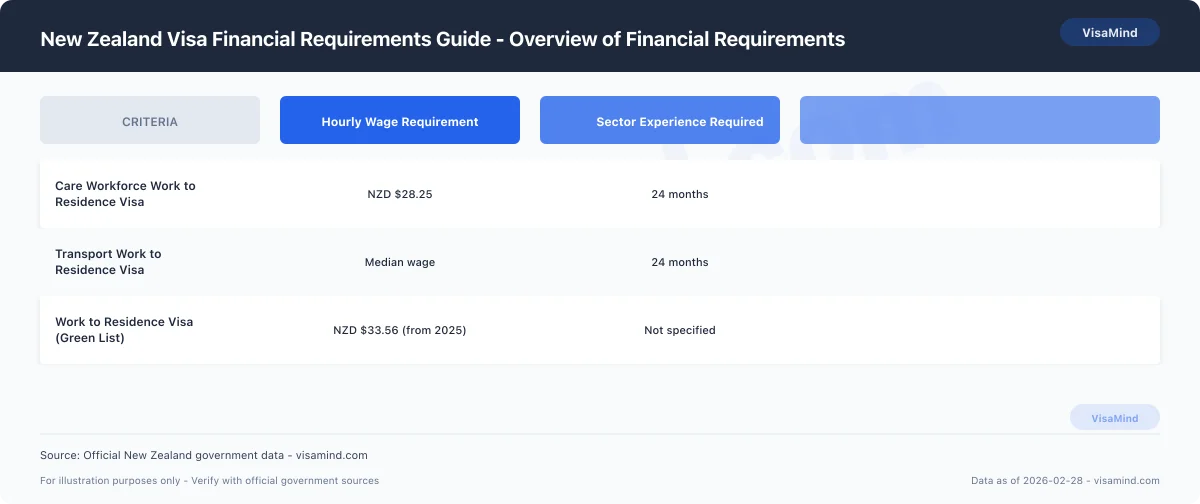
Different visas have varied wage requirements. For the Care Workforce Work to Residence Visa, applicants need to be paid at least NZD $28.25 per hour and must have worked in the sector for 24 months. Similarly, those applying for a Transport Work to Residence Visa need to meet the median wage or the specific bus drivers wage rate, if applicable. For the Straight to Residence Visa and jobs on the Green List, the pay rate should be at least NZD $33.56 as of 2024. These thresholds are set to ensure that workers receive fair compensation and that jobs meet New Zealand's labor market standards.
Importance of Financial Documentation
Providing evidence of your pay rate and job offer is a mandatory part of your visa application. This is not merely a recommendation but a requirement enforced by Immigration New Zealand (INZ). Without this evidence, your application is incomplete and likely to be rejected. Ensure you gather all necessary documentation before you lodge your application to avoid delays.
Important: Failing to provide proper evidence of your pay rate can result in an automatic denial of your visa application. Always verify that your documents align with INZ's requirements before submission.
Common Visa Types and Financial Criteria
Here's a quick overview of some common work visas and their financial requirements:
| Visa Type | Wage Threshold |
|---|---|
| Accredited Employer Work Visa | Market rate for the job |
| Care Workforce Work to Residence Visa | NZD $28.25 per hour |
| Transport Work to Residence Visa | Median wage or bus drivers wage rate |
| Straight to Residence Visa | NZD $33.56 per hour (2024 median wage) |
Each visa type has distinct requirements, and understanding these is essential for your application process. For students, New Zealand offers the Student Visa, which has its own set of financial requirements, such as proving that you can support yourself during your studies.
In conclusion, meeting the financial requirements for a New Zealand visa is a critical factor that can determine the success of your application. Whether you're applying for a work visa like the Essential Skills Work Visa or a Working Holiday Visa, understanding and fulfilling these requirements is key. Always check the latest guidelines on the official INZ website to ensure you have the most current information.
Proof of Funds by Visa Type
#Understanding the financial requirements specific to each visa type is critical. Below, find a comparison of financial requirements for various visa categories such as visitor, student, work, family, and permanent residence (PR) visas. This will help you identify the necessary financial documentation and thresholds needed for your visa application.
Financial Requirements by Visa Type
| Visa Type | Proof of Funds Required | Details |
|---|---|---|
| Visitor Visa | NZD $1,000 (verify the current fee on the official website) per month of stay | If accommodation is pre-paid, NZD $400 (verify the current fee on the official website) per month is sufficient. |
| Student Visa | NZD $20,000 (verify the current fee on the official website) per year | Must show evidence of tuition fees plus living costs. |
| Accredited Employer Work Visa (AEWV) | Market rate for the job | Wage must meet or exceed the market rate in New Zealand. Learn more about the AEWV. |
| Care Workforce Work to Residence Visa | NZD $28.25 per hour | Requires evidence of 24 months of sector work. |
| Transport Work to Residence Visa | Median wage or bus drivers wage rate | Check specific wage rate applicable. |
| Work to Residence Visa | NZD $33.56 per hour | Applies to Green List jobs starting from 18 August 2025. |
| Straight to Residence Visa | NZD $33.56 per hour | Based on the 2024 median wage. |
| Family Visa | Sufficient funds to support family | Must show ability to financially support family members. |
| Permanent Residence (PR) Visa | Varies by category | Detailed proof required based on specific PR pathways. Explore the PR Pathway Guide. |
What Evidence is Needed?
For each visa type, you must provide evidence that you meet the financial requirements. This could include:
- Bank statements showing available funds.
- Job offers that confirm your wage meets the required threshold.
- Scholarship letters for student visas.
- Sponsorship forms if someone else is financially supporting you.
Common Pitfalls
Important: Not meeting the wage threshold or failing to provide adequate evidence of your pay rate and job offer are common reasons for visa application rejection.
Ensure that all your documentation is up-to-date and clearly shows that you meet the financial requirements. For more detailed steps, refer to our How To Apply guide.
Final Tips
When gathering your documents, be meticulous. Any discrepancies or missing information could delay your application or result in refusal. Always verify the most current financial requirements on the official Immigration New Zealand (INZ) website as these can change over time.
For more information related to specific processes and documentation, refer to the Documents Checklist to ensure all necessary paperwork is in order before lodging your application.
Bank Statement Rules
#Meeting the financial requirements is a key aspect. One critical component of this is providing bank statements to demonstrate your financial stability. Below, we break down the essential rules regarding bank statements for your visa application.
Minimum Duration and Balance Requirements
-
Minimum Duration: You need to provide bank statements for a minimum of three months. This is a common requirement across various visa categories to demonstrate consistent financial activity.
-
Balance Requirements: Immigration New Zealand (INZ) may require you to show either a minimum balance or an average balance over the given period. The specific type of balance required can depend on the visa type:
- Minimum Balance: Some visas may stipulate a fixed minimum amount that must be maintained in your account at all times during the specified period.
- Average Balance: Others might require you to show an average balance, which provides a broader view of your financial health over time.
Eligible Accounts
-
Account Types: Typically, only statements from savings or checking accounts are accepted. These accounts should be in your name or, when applicable, a joint account you hold.
-
Joint Accounts: If you are using a joint account, ensure that you have authorization from the other account holder to use the account as part of your application. INZ may require a letter of consent from the joint account holder.
Special Considerations
-
Different Visa Types: Visa-specific requirements may apply, so it is important to check the financial requirements for the visa you are applying for. For instance, the Student Visa may have different financial thresholds compared to a Working Holiday Visa.
-
Currency and Conversion: If your bank statements are in a currency other than New Zealand dollars, ensure you provide a conversion to NZD. Use a reliable source for conversion rates and include this information with your statements.
Tip: Always verify the latest bank statement requirements specific to your visa type on the official Immigration New Zealand website, as criteria can change.
Providing accurate and complete financial documentation is crucial for your visa application. For more detailed information on the visa types and requirements, you may explore the Accredited Employer Work Visa (AEWV) or the Essential Skills Work Visa based on your eligibility and professional goals.
What Qualifies as Proof
#Demonstrating financial capability is a critical aspect. Immigration New Zealand (INZ) requires applicants to provide proof of sufficient funds to support themselves during their stay. Below are the types of proof that are typically accepted and those that are not.
Accepted Forms of Financial Proof
-
Cash Savings
- Present evidence of personal savings in a bank account. This includes recent bank statements showing enough money to cover your expenses.
-
Investments
- Stocks, bonds, and other investment portfolios can be used as proof, provided they can be liquidated into cash if necessary.
-
Property
- Ownership of property in New Zealand or elsewhere can be considered, especially if it's generating rental income. Documentation of ownership and income generated should be provided.
-
Loans
- Personal loans specifically acquired for the purpose of funding your stay in New Zealand are accepted. Ensure you have official letters from your bank confirming the loan details.
-
Scholarships
- If you have received a scholarship, include official documentation that outlines the scholarship amount and terms, especially for Student Visas.
What Does Not Count as Proof
-
Unsecured Promises
- Letters from friends or family promising financial support without legal binding or documentation are not accepted.
-
Credit Card Limits
- The available credit on your credit card is not considered valid proof of funds.
-
Future Income
- Anticipated wages or income from potential employment in New Zealand cannot be used as evidence unless you have a valid job offer that meets the wage requirements, such as those for the Accredited Employer Work Visa (AEWV).
Important: Ensure that all financial documents are up-to-date and clearly demonstrate your ability to support yourself during your stay. Missing or outdated financial evidence can delay or jeopardize your visa application.
For more details about specific financial requirements for various visa types, refer to the Documents Checklist or the How To Apply guide. Always verify the most current requirements on the official INZ website before lodging your application.
Money Mistakes That Sink Applications
#Important: Missteps in your financial documentation can lead to a declined visa application. Ensure your financial history meets Immigration New Zealand's (INZ) requirements.
Last-Minute Deposits
- Unexplained Large Deposits: Adding large sums to your account shortly before applying can raise red flags. INZ may view these as attempts to artificially inflate your financial standing.
- Lack of Consistency: Aim for a stable account balance over several months. Sudden spikes or fluctuations without a clear source can be problematic.
Insufficient Financial History
- Short Account History: INZ typically requires a continuous record of your financial stability. If your account history is brief, it may not adequately demonstrate your ability to support yourself.
- Frequent Account Changes: Switching accounts often can make it difficult for INZ to assess your financial stability. Maintain a consistent primary account for visa purposes.
Wrong Currency
- Non-NZD Balances: INZ expects financial evidence in New Zealand Dollars (NZD). If your funds are in another currency, convert them to NZD and provide documentation of the conversion rate used.
- Currency Fluctuations: Be aware of exchange rate volatility. Ensure the converted amount meets the required thresholds even after potential currency changes.
Missing Explanations
- Unexplained Transactions: For any significant transactions, provide explanations and supporting documents. This includes large deposits, withdrawals, or transfers.
- Lack of Supporting Documents: Include all necessary paperwork, such as employment contracts or bank statements, to substantiate your financial claims.
Tip: To minimize issues, review INZ's Visa Refusal Reasons before applying to understand common pitfalls.
By avoiding these common financial mistakes, you'll strengthen your application and improve your chances of successfully obtaining a New Zealand visa. For those interested in work-related visas, such as the Essential Skills Work Visa, ensure you meet specific wage thresholds and provide clear evidence of your pay rate and job offer.
Sponsor Financial Evidence
#Providing financial evidence as a sponsor is a critical part of supporting a visa application to New Zealand. Whether you're backing a family member or an employee, demonstrating your financial capability is essential. This section provides guidance on the types of financial evidence that can be provided, including income proofs, affidavits, and tax returns.
What Financial Evidence Can a Sponsor Provide?
When acting as a sponsor, you must demonstrate that you can financially support the visa applicant. Immigration New Zealand (INZ) requires sponsors to provide several forms of evidence:
- Proof of Income: This could include recent payslips, bank statements showing regular income deposits, or a letter from your employer confirming your income and employment status.
- Affidavit of Support: An affidavit is a sworn statement that confirms your commitment to financially support the visa applicant. This document should clearly outline your financial responsibilities.
- Tax Returns: Providing copies of recent tax returns can demonstrate your financial history and stability. These documents should align with the income details provided in other evidence.
How Much Support is Needed?
The level of financial support required varies depending on the visa type. For example, sponsors of a Student Visa might need to prove they can cover tuition and living expenses, while a sponsor for an Investor 1 Resident Visa might need to show substantial assets.
Important: Ensure that all documents are up to date and accurately reflect your current financial situation. Discrepancies or outdated information can lead to application delays or denials.
Common Pitfalls and How to Avoid Them
When gathering and submitting financial evidence, sponsors often encounter several common pitfalls. Here are a few to be mindful of:
- Inadequate Documentation: Failing to provide comprehensive financial documents can hinder the application process. It's crucial to supply detailed and consistent evidence.
- Outdated or Inconsistent Information: Ensure all financial documents are current and consistent across all forms of evidence.
- Ignoring Wage Thresholds: For certain visas, like the Accredited Employer Work Visa, meeting specific wage thresholds is mandatory. Verify these thresholds and ensure your financial support aligns with them.
How to Submit Financial Evidence
While the exact process for submitting financial evidence will depend on the specific visa application process, generally, you should:
- Gather All Required Documents: Ensure you have comprehensive and up-to-date evidence.
- Review for Consistency: Double-check that all documents align in terms of financial details and personal information.
- Lodge the Application: Submit the evidence as part of the visa application process, ensuring that all documents are included.
For detailed guidance on how to apply, consider reviewing our How To Apply guide, which provides step-by-step instructions for various New Zealand visas.
Tip: Use the Documents Checklist to ensure all necessary financial documents are included in your application. This can help prevent delays and potential refusals.
Getting Your Finances Application-Ready
#- Start Planning Early
To ensure your finances are ready for your New Zealand visa application, begin planning as soon as you decide to apply. Different visas have distinct financial requirements, such as specific wage thresholds for work visas. For example, if you're applying for the Accredited Employer Work Visa, your job must pay at least the market rate. By understanding these requirements early, you can align your financial records accordingly.
- Maintain Consistent Financial Records
Keeping a consistent and transparent financial history is crucial. Regularly update and maintain clear records of your income, savings, and any other necessary financial documentation. This is particularly important if you're applying for a visa with specific pay rate requirements, such as the Work to Residence Visa, where certain roles must meet specific hourly wage rates. Consistent records can help prove you meet these criteria and support your overall application.
- Address Unusual Financial Patterns
If there are any unusual patterns in your financial history, such as large deposits or withdrawals, prepare a cover letter to explain these transactions. This can help clarify your financial situation to Immigration New Zealand (INZ) and demonstrate transparency. For instance, if you're applying for a Post-Study Work Visa and have received a significant financial gift or inheritance, explaining this in a cover letter can prevent misunderstandings during the financial review process.
Tip: Keep copies of all financial documents and explanations ready before you lodge your application. This will help in case INZ requests further information.
By following these steps, you'll be better prepared to meet the financial requirements for your New Zealand visa application. Be sure to verify all current requirements on the official INZ website.
FAQs
Can I switch from a Working Holiday Visa to an Essential Skills Work Visa in New Zealand, and what financial requirements apply?
What are the wage threshold requirements for a New Zealand Accredited Employer Work Visa (AEWV)?
How can a sponsor provide financial evidence for a New Zealand visa application?
Is it possible to combine goals by applying for a Post-Study Work Visa and then a Resident Visa in New Zealand?
What financial mistakes should applicants avoid for New Zealand visa applications?
How does Immigration New Zealand assess proof of funds for a Working Holiday Visa?
What is the hourly pay rate requirement for the Transport Work to Residence Visa in New Zealand?
Sources
Last reviewed: March 1, 2026
VisaMind provides informational guidance only and is not a government agency. This is not legal advice. Requirements can change and eligibility depends on your specific facts. If your case is complex or high-stakes, consult a licensed immigration attorney.
Next steps
Requirements vary by nationality, purpose, timeline, and case details. Use Find My Visa to get a personalized checklist for New Zealand with official sources and deadlines.
Find my visa