On this page
- How to Work in This Country Legally
- What Your Employer Must Provide
- Step-by-Step Work Visa Application
- Worker Rights and Restrictions
- The Long-Term Path
- Common Refusal Reasons for Work Visas
- Getting Your Qualifications Recognized
- The Financial Side of Working Abroad
- Tax Obligations for Workers
- What Other Workers Experienced
- Visa options for this goal
- Guides for New Zealand
- Other goals for New Zealand
How to Work in This Country Legally
#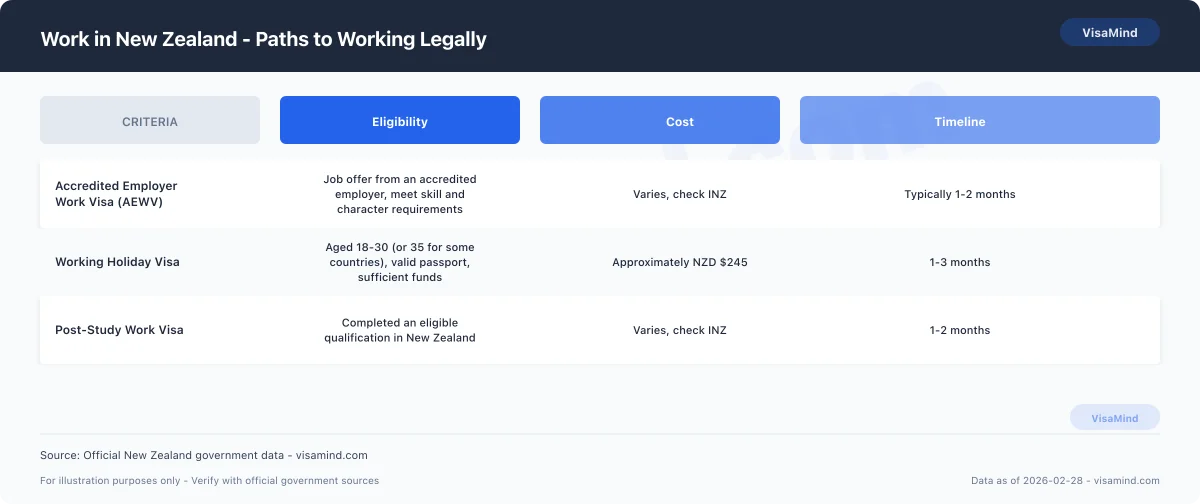
New Zealand offers various work visa options to facilitate legal employment in the country. One of the most prominent is the Accredited Employer Work Visa (AEWV), which requires you to have a job offer from a New Zealand employer accredited by Immigration New Zealand (INZ). Each visa category has specific eligibility criteria, costs, and timelines. Below is a structured table providing an overview of the main work visa categories available in New Zealand.
| Visa Type | Eligibility | Cost | Timeline |
|---|---|---|---|
| Accredited Employer Work Visa (AEWV) | Job offer from an accredited employer, meet skill and character requirements, adhere to health requirements | NZD 750 (as of 2023) | 20-25 days |
| Working Holiday Visa | Age 18-30 (or 35 for select countries), sufficient funds, valid return ticket | NZD 245 (as of 2023) | 15-20 days |
| Post-Study Work Visa | Completed eligible qualification in New Zealand, qualification must be Level 7 or above | NZD 495 (as of 2023) | 30-40 days |
Accredited Employer Work Visa (AEWV)
The Accredited Employer Work Visa (AEWV) is designed for individuals who have secured a job offer from an accredited employer in New Zealand. To qualify, you must meet specific skill, health, and character requirements. Your employer must also comply with New Zealand's employment and immigration laws and offer at least 30 hours of work per week. This visa restricts you to working only in the job, for the employer, and in the location specified on your visa. If you wish to change any of these conditions, you must apply for a Job Change or a new visa.
Tip: Ensure your job offer is from an accredited employer to avoid delays in your application process.
Working Holiday Visa
The Working Holiday Visa is an excellent option if you are between 18 and 30 years old (or 35 for select countries) and wish to experience New Zealand while working to support your travels. This visa allows you to work temporarily and explore the country. You may be required to undergo a medical examination, including a chest X-ray, to prove good health. This visa generally has a quicker processing time, making it ideal for those looking for a more immediate start.
Post-Study Work Visa
If you've completed an eligible qualification in New Zealand, the Post-Study Work Visa might be your pathway to gain valuable work experience in the country. This visa allows you to work for any employer in almost any job. The qualification must be Level 7 or above, and the duration of the visa is typically aligned with the length of your study. This visa is a stepping-stone for those considering long-term residency in New Zealand.
Important: Ensure that all your documents are complete and up-to-date when applying to avoid any processing delays.
For more detailed information on each visa type, you can visit the pages for the Accredited Employer Work Visa (AEWV), Working Holiday Visa, and Post-Study Work Visa. Always verify the latest requirements and costs on the official INZ website, as these can change.
What Your Employer Must Provide
#When working in New Zealand under the Accredited Employer Work Visa (AEWV), your employer plays a crucial role in your immigration journey. Here’s what your employer needs to provide and ensure to support your work visa application.
Employer Requirements
To employ someone on an AEWV, your employer must be accredited by Immigration New Zealand (INZ). This means they have met certain standards and are recognized as a trusted employer. Here are the key requirements:
- Accreditation Status: Your employer must hold current accreditation with INZ, ensuring they comply with New Zealand employment and immigration laws.
- Job Offer: The job offer must be full-time, providing at least 30 hours of work per week.
- Compliance: Employers must adhere to New Zealand's employment standards, including fair wages and safe working conditions.
Tip: Ensure your employer’s accreditation is up-to-date to avoid any delays in your visa process.
What Employers Must Provide
Your employer is responsible for providing several crucial documents and information to support your application:
- Job Offer and Employment Agreement: A signed copy of your job offer and employment agreement is essential. This document outlines your job title, duties, and remuneration.
- Link to Online Application: Your employer must send you a unique link to the online application form for your work visa.
- Proof of Accreditation: Evidence of the employer's accreditation with INZ is required to demonstrate their eligibility to hire foreign workers.
Additionally, your job must be aligned with the conditions specified in your visa, meaning you must work in the role, for the employer, and at the location stated.
Can You Change Employers?
While on an AEWV, if circumstances change and you wish to switch employers, modify your job role, or relocate, you’ll need to address these changes through official channels:
- Apply for a Job Change: You must apply to vary the conditions of your visa or apply for a new visa if you change your employer, job, or location.
- Re-accreditation: Ensure that your new employer is accredited by INZ before making the switch.
Important: Failing to update your visa conditions when changing job circumstances can lead to visa non-compliance.
For further details, you might explore the How To Apply guide or the Visa Extension Guide. Knowing the necessary steps and requirements ensures that both you and your employer are aligned with New Zealand’s immigration protocol.
Step-by-Step Work Visa Application
#-
Receive a Job Offer from an Accredited Employer
To begin your application for the Accredited Employer Work Visa (AEWV), you must first secure a full-time job offer from an accredited employer in New Zealand. Your employer must comply with New Zealand employment and immigration laws and offer you at least 30 hours of work per week.
-
Gather Required Documents
Collect all necessary documents before starting the application process. This includes:
- A signed New Zealand job offer and employment agreement.
- Evidence of job experience, skills, and qualifications.
- Police certificates to confirm your good character.
- Evidence of your ability to speak and understand English, especially if your job is on the ANZSCO skill level 4 or 5 list.
- Certified English translations of any documents not originally in English.
Tip: Ensure all documents meet the requirements outlined by Immigration New Zealand (INZ) to avoid delays.
-
Complete the Online Application
Your employer will provide you with a unique link to the online application form. Use this link to access the form, where you will need to upload your documents and provide all required information. Ensure that:
- You have a reliable internet connection to prevent disruptions.
- All information entered is accurate and matches the supporting documents.
-
Pay the Application Fee
Once your online application is complete, you will be prompted to pay the applicable fees. Make sure to have a valid payment method ready.
-
Submit Your Application
After payment, submit your application to INZ for processing. You will receive a confirmation email with a reference number that you can use to track your application status.
Important: Keep this reference number handy for any future correspondence with INZ.
-
Wait for a Decision
The processing time can vary, so regularly check your application status online using your INZ account. Ensure your contact information is current in case INZ needs further details.
If your situation changes, such as a need to change your employer, job, or location, you must apply to vary the conditions of your visa or submit a new application for a Job Change.
For more detailed information on working in New Zealand, you may find the How To Apply guide helpful.
By following these steps, you can ensure that your application is complete and ready for submission to Immigration New Zealand.
Worker Rights and Restrictions
#If you're in New Zealand on an Accredited Employer Work Visa (AEWV), your ability to switch employers is subject to certain conditions. You are required to work only in the job, for the employer, and in the location stated on your visa. If your circumstances change and you wish to change employers, jobs, or locations, you must apply to vary the conditions of your visa or apply for a Job Change. Alternatively, you may need to apply for a new visa altogether. For more details, refer to the Accredited Employer Work Visa (AEWV).
Important: Ensure that your prospective new employer is accredited under New Zealand's employment and immigration laws before making any changes.
Can Your Family Join You?
The ability for your family to join you in New Zealand while you hold an AEWV depends on various factors. Family members such as partners and dependent children may be eligible to apply for visas to accompany or join you. Your partner may be eligible for a Partner of Worker Visa, allowing them to work in New Zealand, while dependent children may apply for student or visitor visas.
Tip: Consider the Partner Visa options to understand the best pathway for your partner.
Can You Study?
While holding a work visa like the AEWV, you may be able to undertake some study, but this is typically restricted to short courses lasting no more than three months. If you wish to pursue longer-term education, you may need to apply for a Student Visa.
For those interested in blending work and study, options like the Post-Study Work Visa could be worth exploring after completing eligible qualifications in New Zealand.
The Long-Term Path
#Working in New Zealand on a visa can be a pathway to permanent residency (PR), providing opportunities for those who wish to make New Zealand their long-term home. Here's how the process generally unfolds, including timelines and key requirements.
From Work Visa to Permanent Residency
If you are working in New Zealand under the Accredited Employer Work Visa (AEWV), you may be eligible to eventually apply for PR. The AEWV is designed for skilled workers and requires a job offer from a New Zealand employer that is accredited by Immigration New Zealand (INZ). Here are the typical steps to transition from a work visa to PR:
-
Work and Gain Experience
- Hold an AEWV and work for your accredited employer.
- Gain relevant work experience in your field, which is crucial for meeting PR eligibility.
-
Meet the Residence Requirements
- Typically, applicants must have lived and worked in New Zealand for at least two years under a skilled work visa. Verify the latest requirements on the official INZ website.
-
Check Eligibility for the Skilled Migrant Category
- The Skilled Migrant Category is a common pathway to PR. You need to meet points-based criteria, which consider age, experience, qualifications, and job offer.
Eligibility Criteria for Permanent Residency
To be granted PR, you must meet several requirements:
- Work Experience and Skills: You need to demonstrate substantial work experience in New Zealand, often aligning with your skilled job category.
- English Language Proficiency: Evidence of your ability to communicate effectively in English is usually required.
- Health and Character: Applicants must undergo health checks and submit police certificates to prove good character.
- Settlement Funds: You may need to show you have sufficient funds to support yourself in New Zealand.
Important: Ensure your work experience and job offer align with the skills in demand in New Zealand, as this significantly impacts your PR application under the Skilled Migrant Category.
Timeline for Transitioning to Permanent Residency
The timeline to transition from a work visa to PR can vary, but here are some general guidelines:
| Stage | Duration (Approximate) |
|---|---|
| Working under AEWV | 2 years |
| Preparing PR application | 6-12 months |
| Processing PR application | 6-12 months |
Tip: Regularly check the PR Pathway Guide for updates on processing times and requirements.
Can You Change Employers?
While on an AEWV, you can only work for the employer specified in your visa. If you wish to change employers, jobs, or locations, you must:
- Apply for a Job Change: Lodge an application with INZ to vary the conditions of your visa or apply for a new AEWV.
- Ensure New Employer is Accredited: The new employer must also be accredited by INZ.
For more detailed information on work visas and pathways to residency, consider exploring related options like the Working Holiday Visa or the Post-Study Work Visa.
Transitioning from a work visa to permanent residency in New Zealand requires careful planning and adherence to INZ's regulations. Stay informed and proactive to navigate this journey successfully.
Common Refusal Reasons for Work Visas
#Important: Ensure all your documentation is up to date and complete when lodging a work visa application. Missing or outdated documents can lead to delays or refusals.
Common Reasons for Work Visa Refusals
Securing a work visa in New Zealand involves meeting strict requirements set by Immigration New Zealand (INZ). Here are common reasons applications may be refused and how to avoid them:
Job Offer and Employer Accreditation
- Non-compliant Job Offer: Ensure your job offer is from an accredited employer and meets the minimum requirement of 30 hours of work per week. If your offer does not meet these criteria, your application will be rejected.
- Employer Accreditation: Applications are often refused if the employer is not accredited. Verify your employer's accreditation status before applying.
Documentation and Evidence
- Incomplete Documentation: Submit all required documents, including a signed job offer and employment agreement. Incomplete or missing documents are a frequent cause of refusals.
- Unverified Job Experience: Provide verifiable evidence of your work experience and qualifications. This includes job references and any required occupational registrations.
- Outdated Police Certificates: Police certificates must be current, usually less than six months old. Ensure they are translated into English if necessary.
Health and Character Requirements
- Health Examination Failures: If applying for a Working Holiday Visa, you may need a chest X-ray or medical examination. Ensure your health documentation meets INZ standards.
- Character Concerns: Failing to provide valid police certificates or evidence of good character can lead to refusal. Be thorough in obtaining and submitting these documents.
Language Proficiency
- English Language Requirements: If your job is on the ANZSCO skill level 4 or 5 list and not exempt, you must demonstrate English language proficiency. Use recognized tests to provide proof of your abilities.
For more detailed guidance on document preparation and language requirements, check the Documents Checklist. If your application is refused, consult the Visa Refusal Reasons guide for steps to address the issues.
Getting Your Qualifications Recognized
#Getting your qualifications recognized is a crucial step. This process ensures that your skills and educational achievements are valid and meet New Zealand's standards.
Skills Assessments
- Identify Your Occupation's Requirements: Different occupations have varying requirements for skills assessments. Check if your occupation is listed on the Skilled Migrant category or another relevant visa category.
- Engage with Relevant Bodies: Some professions require registration with specific New Zealand bodies. For example, healthcare professionals may need to be registered with the Medical Council of New Zealand.
- Provide Evidence: You must supply evidence of your qualifications and any relevant work experience. This could be through diplomas, certificates, or letters of reference.
Qualification Recognition
- NZQA Recognition: The New Zealand Qualifications Authority (NZQA) is responsible for evaluating and recognizing overseas qualifications. You may need to apply for an International Qualifications Assessment (IQA) to verify your qualifications.
- Certified Translations: If your documents are not in English, you’ll need certified translations. These documents should accompany your application to Immigration New Zealand (INZ).
- Additional Requirements: Some qualifications might require additional verification steps. Always confirm on the official website what is needed for your specific situation.
Tip: Ensure all translations and documents are up to date to avoid delays in processing your application.
Degree Requirements
- Understand Degree Equivalence: If your job requires a specific degree, ensure it is equivalent to New Zealand's standards. Use the Documents Checklist to verify what documents are needed.
- Meet Language Proficiency: English proficiency is required for many roles, especially if your job is on the ANZSCO skill level 4 or 5 list. You may need to provide evidence of this through tests like IELTS or TOEFL.
- Comply with Specific Program Conditions: Some work visas, such as the Working Holiday Visa, have specific educational requirements. Make sure to check these to ensure eligibility.
By following these steps, you can ensure that your qualifications are recognized, paving the way for a successful application to work in New Zealand. For more detailed guidance, consider reviewing the How to Apply guide or consulting directly with INZ.
The Financial Side of Working Abroad
#Important: Before applying for a work visa in New Zealand, ensure that your job offer meets the salary and employment conditions required by Immigration New Zealand (INZ).
Salary Thresholds and Minimum Income Requirements
When considering employment in New Zealand, it's essential to understand the financial requirements set by INZ. For the Accredited Employer Work Visa (AEWV), the job offer must meet specific salary thresholds to ensure you can support yourself while living in New Zealand. The minimum salary requirement for AEWV is NZD 29.66 per hour as of 2023. This translates to an annual salary of at least NZD 61,692 for a 40-hour work week.
Application Fees
Applying for a work visa in New Zealand incurs certain fees that vary depending on the visa type. Below is a comparison of the application fees for different visas:
| Visa Type | Application Fee (NZD) |
|---|---|
| Accredited Employer Work Visa (AEWV) | 750 |
| Working Holiday Visa | 245 |
| Post-Study Work Visa | 495 |
It's vital to review the official INZ website to confirm the latest fees, as these can be subject to change.
Processing Timelines
The time it takes for INZ to process work visa applications can vary. Generally, the AEWV processing time is around 25 working days, but it's advisable to apply well in advance of your intended start date. The Processing Times guide provides more details on what to expect.
Tips for Financial Preparation
- Ensure that your job offer meets the minimum salary requirement to avoid delays in your visa application.
- Budget for both the application fee and any additional costs such as medical examinations or police certificates.
- Consider the cost of living in New Zealand when negotiating your salary. Resources like the Financial Requirements guide can help you plan effectively.
For detailed information on visa options, consult the Skilled Migrant and Specific Purpose Work visas to explore alternatives that may suit your situation.
Tax Obligations for Workers
#Navigating tax obligations is an important aspect of working in New Zealand. As a worker, you'll need to be aware of your income tax responsibilities, social security contributions, and potential implications of double taxation treaties.
Income Tax Obligations
In New Zealand, income tax is deducted from your salary by your employer and paid to the Inland Revenue Department (IRD). You will need to obtain an IRD number to ensure you are taxed at the correct rate. The tax rates are progressive, meaning they increase as your income increases.
- IRD Number: Apply for this as soon as possible to avoid being taxed at the highest rate.
- Tax Rates: As of 2023, New Zealand's personal income tax rates range from 10.5% to 39%, depending on your income bracket. Verify these rates on the IRD website.
- End of Year Tax Return: While most employees do not need to file a tax return if their income is correctly taxed, you might need to if you have other sources of income or wish to claim certain expenses.
Social Security Contributions
New Zealand has a system called KiwiSaver, a voluntary retirement savings scheme that both you and your employer can contribute to.
- Employee Contribution: Typically, you contribute 3%, 4%, 6%, 8%, or 10% of your gross salary, as you choose.
- Employer Contribution: Employers are required to contribute at least 3% of their employee's gross salary to KiwiSaver.
- Opting-Out: New employees are automatically enrolled but can opt out within a specific period.
Double Taxation Treaties
New Zealand has agreements with several countries to prevent double taxation. These treaties ensure that you do not pay tax on the same income in both New Zealand and another country.
- Countries with Treaties: As of 2023, New Zealand has treaties with over 40 countries, including Australia, the UK, and the USA. Check the IRD website for a full list.
- Tax Residency: Your tax obligations may vary depending on whether you are considered a resident for tax purposes in New Zealand.
- Navigating Treaties: Consider seeking advice from a tax professional to understand your specific situation if you have income from another country.
Tip: Keep detailed records of your income and any tax paid both in New Zealand and overseas to simplify any tax treaty claims.
Understanding these tax aspects is crucial for ensuring compliance while working under a visa such as the Accredited Employer Work Visa or a Working Holiday Visa. For further guidance, consider using resources such as the Visa Refusal Reasons guide to avoid common pitfalls in your application process.
What Other Workers Experienced
#A software engineer from Brazil received a job offer from an accredited employer in New Zealand for a position on the Accredited Employer Work Visa (AEWV) program. The engineer faced a particular challenge: the job was categorized under the ANZSCO skill level 4, requiring proof of English language proficiency. To address this, the engineer took a recognized English language test and submitted the results as part of their application to Immigration New Zealand (INZ). After ensuring all additional requirements were met, including a valid police certificate, the engineer lodged the application through the INZ online portal. The application was processed within three months, allowing them to start their new role in New Zealand.
Scenario: Changing Employers Under AEWV
An IT specialist working in Auckland under the Accredited Employer Work Visa (AEWV) found a new job opportunity with another accredited employer in Wellington. Wanting to proceed legally, the specialist consulted the Immigration New Zealand (INZ) guidelines, which indicated they needed to apply for a Job Change or vary the conditions of their current visa. They gathered the necessary documents, including the new job offer, and submitted the application through the INZ portal. Within two months, the variation was approved, allowing them to transition to the new position without disrupting their work status in New Zealand.
Scenario: Overcoming Character Requirement Challenges
A marketing manager from South Africa encountered a situation when applying for the AEWV where their police certificate was older than six months. Realizing this could be a potential pitfall, the manager promptly obtained an updated certificate to meet the character requirements set by Immigration New Zealand (INZ). After uploading the new certificate and other necessary documents, the application process continued smoothly. The manager received their visa approval within four months, highlighting the importance of adhering to all document validity requirements.
FAQs
How do I get my qualifications recognized to work in New Zealand?
What must my New Zealand employer provide for my work visa application?
Can I work a second job on a New Zealand Accredited Employer Work Visa?
What is the process for applying for a Post-Study Work Visa in New Zealand?
What are the financial requirements for working in New Zealand?
How does Immigration New Zealand handle tax obligations for workers?
Can I combine a Working Holiday Visa with another visa type in New Zealand?
VisaMind provides informational guidance only and is not a government agency. This is not legal advice. Requirements can change and eligibility depends on your specific facts. If your case is complex or high-stakes, consult a licensed immigration attorney.
Next steps
Requirements vary by nationality, purpose, timeline, and case details. Use Find My Visa to get a personalized checklist for New Zealand with official sources and deadlines.
Find my visa