Official sources referenced
Who This Helps
#For those seeking employment in New Zealand, understanding the differences between the Accredited Employer Work Visa (AEWV) and the Essential Skills Visa is crucial. As of the latest guidelines, both visas require applicants to have a valid job offer from a New Zealand employer, but there are distinct conditions and eligibility criteria that set them apart.
Who Should Consider This Comparison?
This comparison is particularly beneficial for individuals who have been offered a full-time job in New Zealand and need to determine which visa pathway best aligns with their professional goals and personal circumstances. If you are weighing your options between these two visa types, understanding the specific eligibility requirements and employment conditions will help you make an informed decision.
Key Eligibility Requirements
Both visas require a job offer from a New Zealand employer, but the AEWV mandates that the employer be accredited. Additionally, the AEWV has specific requirements around the number of working hours (at least 30 hours per week), while the Essential Skills Visa may vary based on the skill level of the job offered.
-
AEWV Requirements:
- Job offer from an accredited employer.
- At least 30 hours of work per week.
- Compliance with New Zealand employment laws.
-
Essential Skills Visa Requirements:
- Job offer in line with skill levels defined by ANZSCO.
- May require evidence of qualifications and experience based on the job's skill level.
Why Compare These Visas?
Choosing the correct visa can significantly impact your work rights and potential pathways to permanent residency in New Zealand. For instance, the AEWV might offer more streamlined processes for employers who are already accredited, potentially providing a faster route to employment. Conversely, the Essential Skills Visa might be more suitable for roles not covered by accredited employers but still in demand in New Zealand.
Important: Ensure that you meet all eligibility requirements and gather necessary documents before applying. Incomplete applications can lead to delays or refusals.
For detailed guidance on the visa application process, consider exploring related resources such as the How To Apply and Documents Checklist. If you're looking to understand more about work-related visas, the Skilled Migrant and Post Study Work pathways may also be of interest.
Quick Comparison Table
#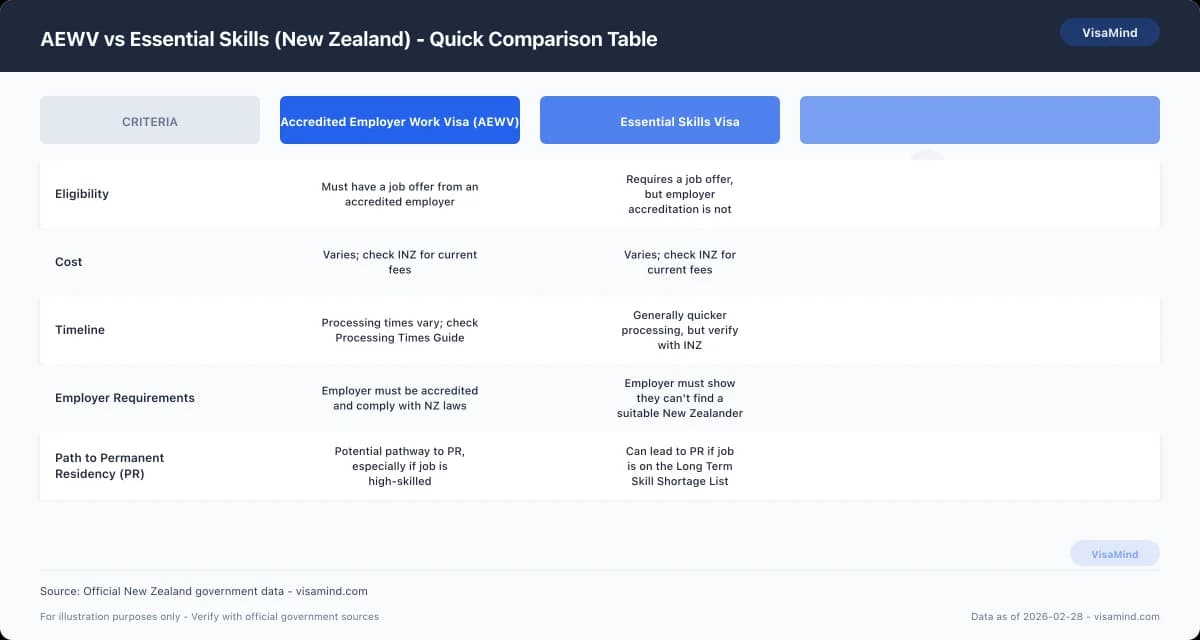
To help you navigate the differences between the Accredited Employer Work Visa (AEWV) and the Essential Skills Visa in New Zealand, this quick comparison table outlines key aspects such as eligibility, cost, and employer requirements. Understanding these differences can guide your decision on which visa to pursue.
| Dimension | Accredited Employer Work Visa (AEWV) | Essential Skills Visa |
|---|---|---|
| Eligibility | Full-time job offer from an accredited employer; meet work experience/qualification requirements; English proficiency for certain jobs. | Job offer in a skill-shortage area or from an employer unable to find a suitable New Zealand candidate. |
| Cost | Application fee varies; check INZ current fees for details. | Similar application fee structure; verify on the official website for specifics. |
| Timeline | Processing times can vary; generally faster for online applications. | Processing times depend on demand and completeness of applications. |
| Employer Requirements | Must be accredited by INZ, offer at least 30 hours of work per week, and comply with employment laws. | Must demonstrate a genuine attempt to recruit New Zealanders before hiring a foreign worker. |
| Path to Permanent Residency (PR) | Offers a potential pathway to PR if certain conditions are met. | May lead to PR through the Skilled Migrant category after meeting specific criteria. |
Employer Requirements
Employers play a crucial role in the visa application process. For the AEWV, they must be accredited by Immigration New Zealand and comply with all employment laws, ensuring fair treatment and appropriate working conditions. This accreditation demonstrates their commitment to supporting the settlement of foreign workers in New Zealand. In contrast, employers seeking to hire under the Essential Skills Visa must show efforts to hire locally, highlighting their need for overseas talent.
Can You Change Employers?
Yes, but with specific conditions. If you're on an AEWV and wish to change employers, jobs, or locations, you must apply to vary your visa conditions or apply for a new visa. The Essential Skills Visa also requires a new application if you change employers, as the visa is tied to the specific job and employer.
Important: Always ensure your job offer and employment agreement meet New Zealand's employment standards to avoid processing delays.
Path to Permanent Residency
Both visas can be stepping stones to permanent residency, but pathways differ. The AEWV can lead to permanent residency if you meet certain conditions, such as duration of employment and income thresholds. The Essential Skills Visa may allow you to transition to residency through the Skilled Migrant category, provided you meet age, health, and character requirements alongside your skilled employment.
For those considering a long-term stay, evaluating these differences is vital. For more detailed guidance, visit the PR Pathway Guide to understand the residency process better.
Choose Option A If...
#A software engineer named Alex received a lucrative job offer from a New Zealand-based tech company. The offer was contingent upon obtaining an Accredited Employer Work Visa (AEWV). Alex's primary concern was ensuring the company was accredited to employ international workers, a requirement for the AEWV.
Alex confirmed the company's accreditation status through the Immigration New Zealand (INZ) website and proceeded to apply for the AEWV. Alex gathered all necessary documents, including proof of qualifications and work experience. After submitting the application online using the link provided by the employer, Alex monitored the application status through the INZ portal.
Within three months, Alex received an approval for the AEWV, allowing them to start work in New Zealand. This timely decision enabled Alex to relocate smoothly and begin the new role without unnecessary delays.
Scenario: Hospitality Manager Switching from Essential Skills Visa
Emma, a hospitality manager on an Essential Skills visa, decided to explore new opportunities as her current visa was nearing expiration. She received an offer from a different employer who was accredited, making her eligible for the AEWV.
Emma's challenge was transitioning from her existing visa to the AEWV without a gap in her work authorization. She coordinated with her new employer to ensure all job details met INZ requirements, such as minimum hours and salary. Emma submitted her AEWV application online and included the necessary documents like police and medical certificates.
While waiting for the AEWV approval, Emma's Essential Skills visa remained valid, allowing her to continue working. The application process took about two months, after which she received the AEWV. This successful transition enabled Emma to advance her career in New Zealand's vibrant hospitality sector.
Important: If you wish to change employers or job locations while on an AEWV, you must apply for a Job Change or vary the conditions of your visa through INZ's official channels.
Option B Is Better When...
#A recent university graduate in New Zealand received a full-time job offer from a company that was not yet an accredited employer. The graduate was eager to start working but needed a visa to allow them to do so. After consulting the Essential Skills visa option, they learned that the employer did not meet the requirements for accreditation needed for the Accredited Employer Work Visa (AEWV).
To address the situation, the graduate and the employer worked together to ensure the job offer aligned with the Essential Skills visa requirements. The employer agreed to support the application by providing a detailed job description that matched the graduate's qualifications and skills. They also ensured compliance with New Zealand employment laws by offering a contract that met the minimum wage and working hours stipulated by INZ.
Once the correct documentation was gathered, the graduate submitted their application through the INZ portal. Within eight weeks, the application was approved, allowing the graduate to commence employment and gain valuable work experience in New Zealand.
Scenario: Skilled Worker in a Small Business
A skilled technician from abroad received a job offer from a small New Zealand engineering firm. The firm was accredited to hire on an AEWV, but the technician had concerns about job security and the possibility of needing to change employers in the future.
To address these concerns, the technician reviewed the AEWV conditions, which required them to work exclusively for the accredited employer and at the specified location. Knowing that any changes would require a variation of visa conditions or a new application, they decided to apply for the AEWV.
The employer provided a robust support package, including relocation assistance and settlement information. Both parties ensured all contractual agreements complied with New Zealand's legal standards, easing the technician’s transition. The AEWV application was processed swiftly, with approval granted within four weeks, allowing the technician to start work with confidence.
Tip: If your job situation changes, you must apply to vary the conditions of your visa or for a Job Change through INZ to keep your work status legal.
Scenario: Experienced Worker Seeking Flexibility
An experienced IT professional wanted to move to New Zealand but was unsure about committing to a single employer due to the dynamic nature of their industry. After researching their options, they realized the Essential Skills visa offered more flexibility in changing employers compared to the AEWV.
The IT professional secured a job offer from a company that was not accredited but had a strong reputation and offered a role aligning with their skills. They decided to apply for the Essential Skills visa, as it allowed them to work for any employer who met the INZ standards without needing accreditation.
The professional successfully lodged their application, including proof of their qualifications and experience. Within six weeks, they received visa approval, granting them the flexibility to work with any compliant employer in New Zealand, thereby aligning their career needs with the available visa options.
The Critical Differences
#The Accredited Employer Work Visa (AEWV) and the Essential Skills visa are two distinct pathways for individuals seeking work opportunities in New Zealand. Understanding the critical differences between these visas is essential for making an informed decision about which visa aligns best with your employment goals.
Employer Accreditation
One of the primary differences between the AEWV and the Essential Skills visa is the requirement for employer accreditation.
-
AEWV: To apply for an AEWV, you must have a job offer from an employer who is accredited by Immigration New Zealand (INZ). This accreditation ensures that the employer complies with New Zealand employment and immigration laws and is committed to supporting overseas employees. This process involves the employer demonstrating their capability to meet obligations such as paying the employees at least the median wage and offering settlement support.
-
Essential Skills Visa: In contrast, the Essential Skills visa does not require employer accreditation. Instead, the focus is on the job offer meeting certain skill levels and wage thresholds as stipulated by INZ. The employer does not undergo an accreditation process, but must still provide a valid job offer that meets the relevant criteria.
Important: If you wish to apply for the AEWV, ensure your employer has completed the accreditation process with INZ before proceeding with your application.
Work Conditions and Limitations
The conditions under which you can work in New Zealand differ significantly between these two visa types.
-
AEWV: This visa is highly specific regarding job conditions. You are allowed to work only in the role, for the employer, and at the location specified on your visa. If any of these conditions change, you must apply for a Job Change or a variation of conditions, or even a new visa.
-
Essential Skills Visa: While it also ties you to a specific job, the Essential Skills visa may offer more flexibility in certain cases. Depending on the skill level and demand for your role, there might be more leeway in changing employers or roles without needing to reapply for a new visa, provided that the new position meets the same criteria.
English Language Requirements
The English language requirements are another key differentiator between these two visas.
-
AEWV: If your role falls under ANZSCO skill level 4 or 5 and is not exempt, you must demonstrate proficiency in English. This often involves providing evidence of English language ability, such as test scores from recognised examinations.
-
Essential Skills Visa: English language requirements can vary more significantly. While some roles may require proof of English proficiency, others might not, depending on the skill level and other factors specified by INZ.
Summary Table
Here is a quick comparison of some of these critical differences:
| Factor | AEWV | Essential Skills Visa |
|---|---|---|
| Employer Accreditation | Required | Not required |
| Work Conditions | Tied to specific job, employer, and location | Some flexibility depending on role |
| English Language Requirements | Required for skill level 4 or 5 roles | Varies; dependent on role and skill level |
Tip: For more detailed guidance on visa requirements, consider checking the Documents Checklist to ensure you have the necessary documentation ready for your application.
Understanding these differences can significantly impact your visa choice and subsequent employment in New Zealand. Always verify the latest requirements and processes on the Immigration New Zealand website before proceeding with any application.
Myths and Misunderstandings
#Understanding the distinctions between the Accredited Employer Work Visa (AEWV) and the Essential Skills Visa in New Zealand can be clouded by several common myths and misconceptions. Here's what you need to know to better navigate these options.
Misconceptions About Eligibility
-
Myth: Any Job Offer is Sufficient
For both AEWV and Essential Skills visas, you need a valid job offer. However, for an AEWV, the employer must be accredited by Immigration New Zealand (INZ). This is not a requirement for the Essential Skills Visa. -
Myth: All Employers Can Hire Under AEWV
This is incorrect. Only employers who have been accredited by INZ can hire under the AEWV. This ensures that they comply with New Zealand's employment and immigration laws.
Misunderstandings Regarding Employment Conditions
-
Myth: You Can Work Multiple Jobs
With an AEWV, you can only work in the job, for the employer, and in the location specified on your visa. This restriction may not apply under the Essential Skills Visa, depending on the terms of your visa. -
Myth: Changing Jobs is Simple
If you wish to change your employer, job, or location under the AEWV, you must apply for a variation of conditions or a new visa. This process can be complex and requires you to meet specific criteria set by INZ.
Language and Documentation Myths
-
Myth: English Proficiency is Optional
If your role is classified under the ANZSCO skill level 4 or 5, demonstrating English proficiency is generally required unless an exemption applies. This is crucial for both types of visas to ensure effective workplace communication. -
Myth: Any Document Format is Acceptable
All documents, including police and medical certificates, must be in English or accompanied by certified translations. Failing to provide these in the correct format could result in application delays or refusals.
Tip: Always verify the current requirements and processes on the official Immigration New Zealand website as policies and criteria can change.
For more detailed information, you can explore specific guides such as the Documents Checklist or the Visa Refusal Reasons to ensure your application is as strong as possible.
Changing Your Mind After Applying
#Changing your mind after applying for a visa in New Zealand can be a complex process, especially when considering switching between the Accredited Employer Work Visa (AEWV) and the Essential Skills Visa. Here’s how you can navigate this change.
Can You Switch Between AEWV and Essential Skills?
Yes, it is possible to switch between these two visa types, but it requires careful consideration and meeting the specific eligibility criteria of the new visa you wish to apply for.
-
Accredited Employer Work Visa (AEWV):
- Requires a job offer from an accredited employer.
- Must meet work experience and/or qualification requirements.
- Cannot work a second job under this visa.
-
Essential Skills Visa:
- Requires a job offer matching the skill level of the job.
- Must meet the required salary threshold and skill level for the job.
- Allows for more flexibility compared to AEWV in terms of job switching.
Steps to Change Your Visa Type
-
Assess Eligibility: Ensure you meet the eligibility criteria for the new visa. This includes having a valid job offer and meeting any experience or qualification requirements.
-
Gather Documents: Collect necessary documents such as a new job offer, employment agreement, and proof of qualifications. Verify these documents meet New Zealand employment laws.
-
Lodge a New Application: Submit a new application for the visa you wish to switch to. Use the online platform provided by your potential new employer.
-
Pay Fees: Be prepared to pay the application fees associated with the new visa type.
-
Await Decision: Monitor your application status through the Immigration New Zealand (INZ) portal.
Important: If your job details change, such as employer or location, you may need to apply for a variation of conditions or a Job Change application.
Key Considerations
-
Timing: Ensure your current visa remains valid during the transition. If your visa is about to expire, you may need to apply for a Visitor Visa to extend your stay while your new application is processed.
-
Employer Accreditation: If switching to an AEWV, your employer must be accredited. Confirm their status with INZ.
By understanding these steps and requirements, you can navigate the process of changing your visa type efficiently. For more details on eligibility and application processes, refer to the How To Apply Guide.
Decision Scenarios
#A software engineer named Sam was working in New Zealand on an Accredited Employer Work Visa (AEWV). Halfway through his contract, he received a more attractive job offer from another accredited employer based in Auckland. Sam was concerned about the process of switching jobs and whether his visa conditions would allow it. To address this, he consulted Immigration New Zealand (INZ) and learned that he needed to apply for a Job Change. This involved submitting a new application that included his new job offer and proof that his prospective employer was accredited. After lodging the necessary documents and paying the required fees through the INZ online portal, Sam's application was processed within a month, allowing him to start his new role seamlessly.
Scenario: Navigating Visa Conditions for an Essential Skills Visa Holder
Maria, a chef from the Philippines, was working in Christchurch under an Essential Skills Visa. She was offered a part-time opportunity at a local culinary school to teach cooking classes. However, her visa conditions restricted her to the job, employer, and location specified in her current visa. Maria reached out to INZ to explore her options. She was advised to apply for a variation of conditions on her visa to include this secondary job. Maria promptly gathered the necessary documentation, including the job offer and a revised employment agreement, and submitted her request through the INZ platform. Her application was approved in three weeks, allowing her to legally take on the additional teaching role while continuing her primary job.
Scenario: Reapplying for an AEWV After Maximum Stay
Thomas, a construction project manager from the UK, had been working in New Zealand on an AEWV for three years and had reached the maximum stay allowed under his visa. He was eager to continue his work and life in New Zealand and thus needed to apply for a new AEWV. Thomas ensured he complied with the requirement of spending the necessary time outside New Zealand before reapplying. He collected a fresh job offer from his employer, who was still accredited, and prepared all the required documents, such as his police and medical certificates. Once the mandatory time outside the country was completed, he submitted his application online through the INZ portal. Within two months, Thomas received approval for his new visa, allowing him to return and resume his career in New Zealand.
FAQs
How does Immigration New Zealand (INZ) process AEWV vs Essential Skills applications?
Can I work a second job on an AEWV vs Essential Skills (New Zealand)?
Is there an English language requirement for AEWV vs Essential Skills (New Zealand)?
What should I do if my job details change under AEWV vs Essential Skills (New Zealand)?
What are the police certificate requirements for AEWV vs Essential Skills (New Zealand)?
How does AEWV vs Essential Skills (New Zealand) handle job offers?
What are the limits on changing location with AEWV vs Essential Skills (New Zealand)?
Sources
Last reviewed: March 1, 2026
VisaMind provides informational guidance only and is not a government agency. This is not legal advice. Requirements can change and eligibility depends on your specific facts. If your case is complex or high-stakes, consult a licensed immigration attorney.
Next steps
Requirements vary by nationality, purpose, timeline, and case details. Use Find My Visa to get a personalized checklist for New Zealand with official sources and deadlines.
Find my visa