On this page
Who Moves Here and Why
#In 2022, Spain attracted over 500,000 new residents through various immigration pathways, highlighting its popularity as a destination for individuals seeking new opportunities. People move to Spain for several compelling reasons, ranging from the pursuit of professional growth to the allure of a vibrant cultural scene and favorable climate.
Skilled Professionals: Opportunities and Visas
Spain's economy offers numerous opportunities for skilled professionals, particularly in sectors such as technology, engineering, and healthcare. To work in Spain, you can apply for a National Work Visa if you have a job offer from a Spanish employer. Alternatively, the EU Blue Card provides a pathway for highly qualified non-EU citizens to live and work in Spain, offering benefits such as the ability to move within EU member states.
Family Connections: Reunification and Relocation
Family ties are another significant reason for moving to Spain. The Family Reunification Visa allows non-EU nationals to join family members who are legally residing in Spain. This visa is an essential tool for maintaining family unity, enabling spouses, children, and dependent relatives to relocate to Spain.
Tip: Ensure you have all the necessary documents, such as marriage and birth certificates, translated into Spanish to support your family reunification application.
Investment and Entrepreneurship: The Golden Visa
For those with the means to invest, Spain offers the Golden Visa, which grants residency in exchange for significant investments in Spanish real estate, businesses, or government bonds. This visa not only facilitates residency for investors but also offers a straightforward path to long-term residency and citizenship.
Retirement: A Haven for Retirees
Spain’s Mediterranean climate and high quality of life make it an attractive destination for retirees. The Non-Lucrative Residence Visa is ideal for non-EU retirees who wish to live in Spain without engaging in any professional activity. This visa requires proof of sufficient financial means to support yourself.
Whether you are drawn to Spain for its career opportunities, family connections, investment potential, or retirement lifestyle, understanding the specific pathways and requirements for each category is crucial. For detailed guidance on financial requirements and application processes, refer to the Financial Requirements Guide and How To Apply.
Joining Family Members
#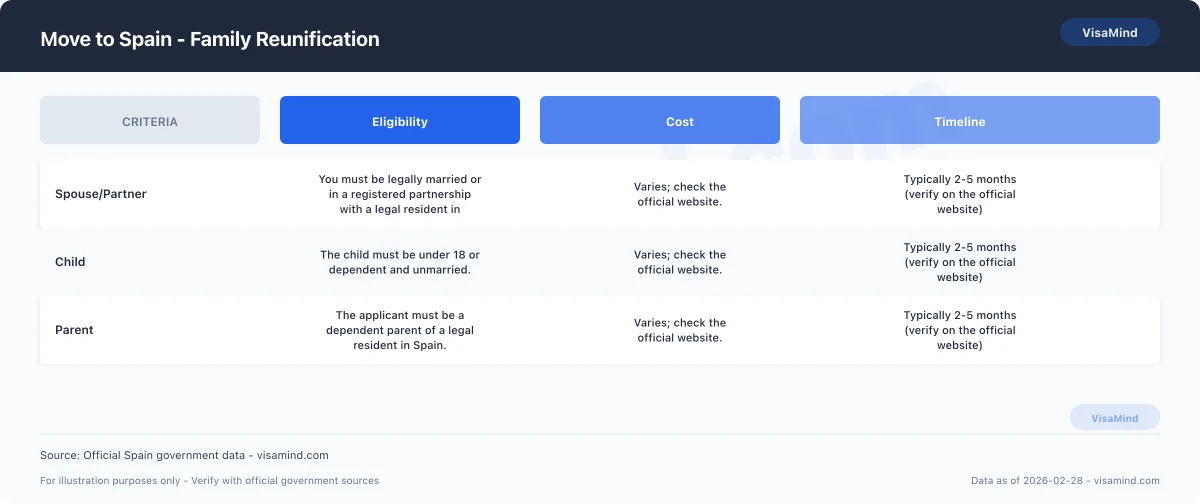
Depending on your relationship with the person you intend to join. Each pathway has specific eligibility criteria, costs, and timelines. It's important to understand these differences to choose the right option for your situation.
Visa Options for Joining Family Members
| Visa Type | Eligibility | Cost | Timeline |
|---|---|---|---|
| Family Reunification Visa | Spouses, partners, dependent children, and parents of Spanish citizens or residents. | Varies by consulate, generally around €80 as of 2023. Verify on the official website. | Typically 1-3 months for processing. |
| Non-Lucrative Residence Visa | Family members who do not intend to work in Spain, requiring proof of financial stability. | Approximately €60-€80 as of 2023. Verify on the official website. | Processing can take up to 3 months. |
| Long-Term Residence Permit | For family members already in Spain with a temporary residence, looking to extend their stay. | Fees vary; check with local authorities. | Decision usually within 3 months. |
How to Apply for a Family Reunification Visa
To apply for a Family Reunification Visa, start by ensuring that your family member in Spain has the necessary residence permit. The application process involves several steps:
- Gather Required Documents: These typically include proof of relationship, financial means, and health insurance. Check the Documents Checklist for a comprehensive list.
- Submit Your Application: This is done at the Spanish consulate in your home country. Ensure all documents are translated into Spanish if necessary.
- Attend an Interview: You may be required to attend an interview at the consulate.
Important: Ensure that all documents are up-to-date and meet the specific requirements outlined by the State Secretariat for Migration (SEM).
Understanding Non-Lucrative and Long-Term Residence Visas
The Non-Lucrative Residence Visa is ideal if you're financially independent and do not plan to work in Spain. It allows you to live in Spain while joining family members. However, it's crucial to demonstrate sufficient financial resources and comprehensive health insurance coverage.
For those already residing in Spain, the Long-Term Residence Permit offers a path to extend your stay. This permit is available for individuals who have legally resided in Spain for a significant period and wish to continue living with their family members.
Tip: Check the Financial Requirements guide to ensure you meet the necessary criteria for these visa pathways.
Navigating these pathways can be complex, so consider consulting with immigration experts or legal professionals for personalized advice. For more details on the application process, visit the How To Apply guide.
Skilled Migration Pathways
#Spain offers a variety of skilled migration pathways for those seeking permanent residency (PR). These pathways cater to professionals with varying skills and qualifications, allowing them to contribute to the Spanish economy. Here's a comparison of the points-based, employer-sponsored, and independent routes:
| Pathway | Eligibility | Cost | Timeline |
|---|---|---|---|
| EU Blue Card | Highly qualified professionals with a job offer in Spain | Fees vary; verify on the official website | 2-3 months for processing, as of 2023 |
| Highly Qualified Professional Visa | Individuals with advanced degrees or specialized skills | Fees vary; verify on the official website | 1-2 months for processing, as of 2023 |
| Entrepreneur Visa | Individuals who plan to start a business in Spain | Fees vary; verify on the official website | 2-3 months for processing, as of 2023 |
Points-Based Pathway
Spain's EU Blue Card is an attractive option for highly skilled professionals. To be eligible, you must have a job offer with a salary at least 1.5 times the average gross annual salary in Spain. This pathway not only facilitates working in Spain but also provides a streamlined route to permanent residency. For more details, you may refer to the EU Blue Card.
Employer-Sponsored Pathway
The Highly Qualified Professional Visa is designed for individuals with specialized skills or advanced degrees. This visa requires sponsorship from a Spanish employer who must demonstrate the need for your expertise. It is particularly suited for sectors like technology, engineering, and finance. You can explore more about this visa on our National Work page.
Tip: Ensure your qualifications are recognized in Spain to enhance your application's success rate.
Independent Pathway
For those interested in starting their own business, the Entrepreneur Visa offers a viable path. Applicants must present a viable business plan that demonstrates innovation and the potential to create jobs in Spain. This visa aligns with Spain's focus on fostering entrepreneurship and innovation. More information can be found on the Entrepreneur Visa page.
Important: A comprehensive business plan is crucial for the Entrepreneur Visa. Consult experts to ensure your proposal meets all requirements.
Each of these pathways has its own requirements and benefits, tailored to different professional profiles. By choosing the right route, you can effectively transition to living and working in Spain. For further guidance, check our PR Pathway Guide to understand each option's intricacies better.
Getting PR Step by Step
#Determine Your Eligibility
To apply for Permanent Residency (PR) in Spain, you must first ensure that you qualify under one of the specific categories. Common pathways include holding a Long-Term Residence permit or having lived continuously in Spain under certain visa types. For instance, if you have resided in Spain for five years on a Non-Lucrative Residence Visa or as a family member of an EU citizen, you may be eligible to apply for PR. It's advisable to review the specific requirements and conditions for your eligibility category.
Collect Necessary Documents
Gathering the necessary documentation is a crucial step in the process. You will need to provide proof of your residency in Spain, such as a valid residence permit, and evidence of financial stability. Additionally, you must submit a clean criminal record certificate from Spain and your home country. For a detailed checklist of required documents, refer to the Documents Checklist.
Important: Ensure that all documents are translated into Spanish and, if necessary, legalized according to Spanish requirements.
Submit Your Application
Once you have all the required documents, you can lodge your application for Permanent Residency with the State Secretariat for Migration (SEM). This process involves submitting your application form along with the gathered documents. During this step, you may need to pay a fee, which varies depending on your specific circumstances. Make sure to verify the most current fees on the official SEM website.
Await Decision and Attend Interview
After submission, the SEM will review your application. The processing time can vary, but typically takes several months. In some cases, you may be asked to attend an interview to further assess your eligibility. Prepare for the interview by reviewing common questions and having clear, concise answers ready. For guidance, consult the Interview Prep.
Tip: Apply well before your current residence permit expires to avoid any legal issues.
Receive Your Permanent Residency Card
If your application is approved, you will be issued a Permanent Residency Card. This card allows you to live and work in Spain indefinitely, with conditions similar to those of Spanish nationals. You will need to register with the local authorities and obtain a Tarjeta de Identidad de Extranjero (TIE) from the National Police. Remember that maintaining PR status requires compliance with residency and other legal obligations in Spain.
For more detailed information on navigating the PR pathway, visit the PR Pathway Guide.
Becoming a Citizen
#To become a citizen of Spain, you'll need to meet certain residency and legal requirements. The path to Spanish citizenship offers different timelines depending on your circumstances. Here's what you need to know:
How Long Must You Reside in Spain?
To apply for Spanish citizenship through residency, you generally need to have lived in Spain for 10 uninterrupted years. However, there are exceptions:
- 5 years for refugees.
- 2 years for nationals of Ibero-American countries, Andorra, the Philippines, Equatorial Guinea, and Portugal.
- 1 year for those born in Spain, married to a Spanish citizen, or widows/widowers of Spanish citizens.
Tip: Ensure your residency is continuous, as gaps can affect your eligibility.
What Tests Are Required?
Applicants must pass two key tests to demonstrate integration into Spanish society:
- Spanish Language Test (DELE A2 or higher): This is required for non-native Spanish speakers.
- Cultural Knowledge Test (CCSE): Covers Spanish constitution, society, geography, and culture.
Important: These tests are conducted by the Instituto Cervantes. Passing these is crucial for your citizenship application.
Can You Hold Dual Citizenship?
Spain has specific rules regarding dual citizenship. Spanish law generally requires new citizens to renounce their previous nationality. However, there are exceptions:
- Citizens of Ibero-American countries, Andorra, the Philippines, Equatorial Guinea, and Portugal can retain their original nationality.
Steps to Apply for Citizenship
- Verify Residency Requirements: Ensure you meet the residency duration for your category.
- Prepare for Tests: Register and study for the DELE and CCSE exams.
- Lodge Your Application: Submit all required documentation to the State Secretariat for Migration.
For more details on citizenship, you can explore the Spanish Citizenship page, and for guidance on the application process, refer to the How To Apply guide.
Obstacles to Watch For
#It is important to anticipate several potential obstacles that may affect your immigration process. Below are some of the main challenges you might face:
Processing Times
-
Extended Waiting Periods: Immigration procedures in Spain can vary significantly in terms of processing times. The timeline for obtaining residence permits or visas like the Non-Lucrative Residence Visa or Family Reunification Visa can take several months. As of 2023, processing times can range from 3 to 6 months depending on the type of application and the individual circumstances. Always verify the current timelines on the official website.
-
Delays in Appointments: Securing an appointment for document submission or interviews at consulates or the State Secretariat for Migration (SEM) offices may also take time. It is advisable to book appointments as early as possible.
Financial Requirements
-
Proof of Financial Means: Many visa types, such as the Digital Nomad Visa, require demonstrable financial stability. This means you must prove you have sufficient funds to support yourself without needing employment in Spain.
-
Income Thresholds: For instance, as of 2023, applicants for the Non-Lucrative Residence Visa need to show a monthly income of at least €2,316, with an additional €579 per family member. Ensure you have up-to-date financial documentation ready to meet these thresholds.
Important: Incomplete financial documents or failure to meet the set thresholds can lead to application refusal. Check the Financial Requirements Guide for detailed information.
Language Tests
-
Language Proficiency: Some visa categories may require proof of Spanish language proficiency, especially those that lead to long-term residency or citizenship. While basic proficiency might suffice for initial visas, more advanced skills could be necessary later.
-
Certification: Ensure you have certified proof of language proficiency, such as DELE (Diploma de Español como Lengua Extranjera) certificates, if applicable.
Navigating these obstacles effectively requires careful planning and adherence to the requirements set by the Spanish authorities. Always consult the latest guidelines and resources, such as the Visa Refusal Reasons Guide, to mitigate risks and enhance your chances of a successful application.
Moving Through Investment
#Spain offers various pathways for investors seeking to relocate through investment, each providing unique advantages to facilitate your move. Whether you aim to invest in real estate, launch a business, or simply reside in the country, Spain provides options tailored to different investor profiles.
What is the Golden Visa?
The Golden Visa is an attractive option for investors who wish to acquire residency through significant financial investment. To qualify, you must invest a minimum of €500,000 in real estate or meet other investment criteria, such as €1,000,000 in shares of Spanish companies or a bank deposit. This visa offers several benefits, including the ability to live and work in Spain and travel within the Schengen Area.
Important: The Golden Visa does not require you to reside in Spain for a minimum number of days each year, making it an excellent choice for those with international commitments.
Business and Entrepreneur Visas
If you're interested in launching a business, consider the Entrepreneur Visa, designed for individuals with innovative projects that generate employment and have a positive socio-economic impact. Applications are assessed on the business plan's viability and the potential to contribute to the Spanish economy.
For those not starting a new enterprise but participating in business activities, the Schengen Business Visa allows short-term stays for business meetings and related activities.
How to Apply for an Investor Visa
The application process requires careful preparation and submission of necessary documents. Here's a basic overview:
- Gather Required Documents: Ensure you have valid identification, proof of investment, and financial resources.
- Submit Your Application: Applications must be lodged through the relevant Spanish consulate or embassy in your current country of residence.
- Await Approval: The processing time can vary, so it’s advisable to check the Processing Times for your specific situation.
Tip: Consulting with a legal expert familiar with Spanish immigration can smooth the application process and help navigate any complexities.
By understanding these options and processes, you can effectively plan your move to Spain through investment. For more detailed guidance, consider comparing the Golden Visa Vs Entrepreneur options to determine the best fit for your goals.
Options for Retirees
#Spain offers a variety of options for retirees looking to enjoy its sunny climate and rich cultural heritage. One popular choice is the Non-Lucrative Residence Visa, which allows you to reside in Spain without engaging in any professional or lucrative activities. This visa is ideal for retirees who have sufficient financial resources to support themselves without working. To be eligible, you'll need to demonstrate adequate financial means, typically through savings, pensions, or other income streams. You will also need comprehensive health insurance.
What Is the Non-Lucrative Residence Visa?
The Non-Lucrative Residence Visa is designed for individuals who wish to live in Spain without the need to work. It is particularly suitable for retirees who can sustain themselves financially. This visa initially grants you a one-year stay, with the possibility of renewal for up to five years, after which you may apply for Long-Term Residence.
How to Apply for the Non-Lucrative Residence Visa
To apply for this visa, you will need to submit your application through the Spanish consulate in your home country. Key documents generally include proof of financial means, a medical certificate, and a valid passport. You can find a detailed Documents Checklist to prepare your application thoroughly.
Tip: Ensure your financial documents clearly demonstrate your ability to cover living expenses in Spain, as this is a critical part of the application process.
Additional Considerations for Retiring in Spain
While the Non-Lucrative Residence Visa is a favored route for retirees, Spain also offers options like the Golden Visa for those investing in property or other significant economic activities. Each pathway comes with its own set of requirements and benefits, so it's advisable to assess your personal circumstances and long-term goals before deciding.
For a deeper understanding of retirement options in Spain, you can explore the Retirement Guide to help make an informed decision.
The Financial Side of Moving
#Tip: It's important to verify financial requirements on the official website of the Secretaría de Estado de Migraciones, as they can change periodically.
Financial Requirements for Different Visa Types
When planning your move to Spain, understanding the financial requirements for various visa types is crucial. Each visa category has distinct conditions regarding settlement funds, income thresholds, and investments. Here is a comparison of some common visa types you might consider:
| Visa Type | Settlement Funds/Income Threshold | Investment Amount |
|---|---|---|
| Non-Lucrative Residence Visa | Must demonstrate sufficient financial means to cover living expenses without working in Spain. Typically, €27,115 annually for the main applicant (as of 2026). | Not applicable |
| Golden Visa | Not required as long as investment conditions are met. | Minimum €500,000 investment in real estate or other qualifying investments |
| Entrepreneur Visa | Must prove financial capacity to support business venture and personal living expenses. | No minimum specified, but must be sufficient to start and sustain the business |
| Family Reunification Visa | Must meet minimum income requirements to support family members. Generally, 150% of the IPREM for the first family member and 50% of IPREM for each additional member. | Not applicable |
Income Thresholds and Settlement Funds
For several visas, such as the Non-Lucrative Residence Visa, you must demonstrate that you have sufficient funds to sustain yourself without employment in Spain. This is typically calculated based on the IPREM (Indicador Público de Renta de Efectos Múltiples), a government index used to determine eligibility for financial aid and subsidies. As of 2026, you should aim to prove at least €27,115 per year for a single applicant.
Investment Amounts
Certain visas, like the Golden Visa, require a substantial financial investment. This visa is designed for individuals who can invest at least €500,000 in Spanish real estate or other qualifying assets. The Entrepreneur Visa focuses more on your capacity to launch and sustain a business, without a specified minimum investment, but you must convincingly demonstrate the viability of your business plan and financial resources.
Important: Ensure you have the necessary documents to substantiate your financial capacity, such as bank statements, investment certificates, or income statements, when lodging your visa application.
For detailed guidance on financial requirements, you might consider checking the Financial Requirements section on our website.
Real Migration Journeys
#A freelance graphic designer from Canada wanted to experience life in Spain while continuing her remote work. She decided to apply for the Digital Nomad Visa, which allows remote workers to reside in Spain while working for non-Spanish companies. To start, she gathered necessary documents like proof of employment and income, ensuring they met the State Secretariat for Migration (SEM) requirements. She then accessed the SEM portal to lodge her application, carefully following the guidelines outlined for digital nomads. After submitting her application online, she received confirmation of receipt. Within three months, her visa was approved, allowing her to live and work remotely from the vibrant city of Barcelona.
Scenario: Retiree Seeking Long-Term Residence in Spain
A retired couple from the United States, looking to enjoy their golden years in Spain, opted for the Non-Lucrative Residence Visa. They were attracted by the pleasant climate and rich culture of the Costa del Sol. The couple needed to demonstrate sufficient financial resources to support themselves without working in Spain, as required by the State Secretariat for Migration. They prepared financial statements and health insurance documentation and submitted their application through the Spanish consulate in their home state. After a thorough review process that lasted about four months, they received their visas and relocated to Spain, where they later applied for a Long-Term Residence permit to extend their stay indefinitely.
Scenario: Entrepreneur Establishing a Business in Spain
An entrepreneur from India was keen to launch a tech startup in Madrid. He applied for the Entrepreneur Visa, which required him to present a comprehensive business plan demonstrating innovation and economic benefit to Spain. He engaged with the Spanish Economic and Commercial Office to refine his proposal and ensure it met the criteria set by the State Secretariat for Migration. His application included detailed financial projections and proof of capital investment. After a six-month evaluation period, his visa was granted, allowing him to establish his business in Spain. His startup has since thrived in Madrid's dynamic tech ecosystem.
FAQs
What is required to apply for a Family Reunification Visa in Spain?
Can I work in Spain on a Family Reunification Visa?
What are the requirements for moving to Spain through investment?
Is it possible to combine skilled migration and investment pathways to move to Spain?
What financial proof is needed for a Non-Lucrative Residence Visa to move to Spain?
What steps are involved in getting permanent residency in Spain?
Can retirees apply for a Non-Lucrative Residence Visa to move to Spain?
Sources
Last reviewed: March 1, 2026
VisaMind provides informational guidance only and is not a government agency. This is not legal advice. Requirements can change and eligibility depends on your specific facts. If your case is complex or high-stakes, consult a licensed immigration attorney.
Next steps
Requirements vary by nationality, purpose, timeline, and case details. Use Find My Visa to get a personalized checklist for Spain with official sources and deadlines.
Find my visa