Official sources referenced
The Document Review Process
#The Spanish Visa Documents Checklist is a vital tool used by the Secretaría de Estado de Migraciones (SEM) to ensure that applicants gather all necessary documents for their visa applications. This checklist is essential in streamlining the application process, allowing applicants to confidently lodge their visa applications knowing they have met the document requirements. The philosophy behind these document requirements is to maintain a structured and efficient process that aligns with Spain's immigration standards, ultimately facilitating smoother entry for qualified individuals.
Why Are Document Requirements Necessary?
Document requirements serve several crucial functions in the Spanish visa application process. Firstly, they provide a standardized framework that applicants must adhere to, which helps reduce processing times and minimizes errors. By clearly defining what documents are needed, the SEM can process applications more efficiently, ensuring that only those who meet the necessary criteria are granted entry. This approach supports the management of Spain's immigration flow, balancing national security with the country's economic and social needs.
How Does the Document Review Process Work?
The document review process typically begins when you lodge your application with the appropriate Spanish consulate or embassy. Each document is meticulously reviewed to ensure it meets the criteria specified for your visa category, whether it's a Schengen Tourist, National Work, or Digital Nomad Visa. The SEM uses this thorough review to verify your eligibility and the authenticity of your documents.
Important: Incomplete or incorrect documentation can lead to delays or even visa refusal. For guidance on avoiding common pitfalls, consult our Visa Refusal Reasons guide.
What Key Documents Are Typically Required?
While requirements vary by visa type, several core documents are commonly required across most categories:
- A valid passport with at least six months of validity beyond your planned stay.
- Proof of sufficient financial means, such as bank statements or a financial guarantee.
- Evidence of accommodation arrangements in Spain.
- Travel insurance covering medical emergencies.
Each visa type may have additional specific requirements, so it is crucial to refer to the specific eligibility category instructions. For example, a National Student Visa might require enrollment confirmation from a Spanish educational institution.
In summary, the document review process is a critical component of the Spanish visa application. By adhering to the structured requirements set by the SEM, applicants can optimize their chances of a successful application. Always verify the latest requirements on the official SEM website or consult directly with the Spanish consulate handling your application.
Identity Documents
#Important: Ensure your passport has adequate validity before beginning your visa application for Spain. This can prevent delays or issues during the process.
Passport Requirements
- Minimum Validity: Your passport must be valid for at least three months beyond your intended departure date from Spain. This rule applies to all visa types, including the Schengen Tourist and National Work visas.
- Issued Within the Last Ten Years: Ensure that your passport was issued no more than ten years before your visa application date. Older passports may not be accepted for visa processing.
- Blank Pages: Your passport should have at least two consecutive blank pages for visa stamps. This is necessary for the visa endorsement and any additional entry or exit stamps.
Identity Documentation
- National Identity Card: If you are a citizen of a European Union member state, you may use your national identity card instead of a passport when applying for certain visa categories. However, always verify the specific requirements for your visa type.
- Photocopies: Provide clear copies of the photo page of your passport and any pages containing visas or entry/exit stamps from previous trips to Spain or other Schengen Area countries. This documentation supports your travel and identity history.
Additional Considerations
- Name Changes: If your name has changed since your passport was issued (e.g., due to marriage), include a certified copy of your marriage certificate or other legal documentation supporting the change.
- Lost or Stolen Passports: If your passport has been lost or stolen and reissued, include a police report or official documentation detailing the circumstances. This can be crucial if there are discrepancies in your travel history.
For more detailed guidance on the visa process and identity documentation, refer to resources like Visa Refusal Reasons and How To Apply.
Photographs
#You must include photographs that meet specific criteria as part of your application. These photos are crucial for identification purposes and must adhere to the standards set by the State Secretariat for Migration (SEM).
Photo Specifications
Ensuring your photographs meet the following specifications is vital for a successful application. Incorrect photo submissions can lead to delays in processing your visa. Here is a detailed comparison of the necessary photo requirements:
| Specification | Details |
|---|---|
| Dimensions | Photos must be 35mm wide and 45mm high. Ensure the size is exact for proper identification. |
| Background Color | Use a plain white background. Avoid patterns, colors, or any objects in the background. |
| Format | Photos should be in color and printed on high-quality photo paper. Ensure the photo is clear and free of any marks or creases. |
| Facial Position | Your face must take up 70-80% of the photo. The head should be centered, and eyes open and visible. |
| Expression | Maintain a neutral expression. Smiling or frowning is not permitted. |
| Accessories | Glasses are allowed if they do not obscure the eyes. Avoid heavy frames. No hats or head coverings unless for religious reasons. |
Important: Non-compliance with these photo specifications can result in the rejection of your visa application. Double-check your photos before submission.
These specifications apply to various visa types, including the Schengen Tourist and National Student Visa. For more detailed information on photo requirements for specific visas, you can refer to our How To Apply guide.
Tip: When getting your photos taken, instruct the photographer about these requirements to ensure compliance with SEM standards.
Financial Evidence
#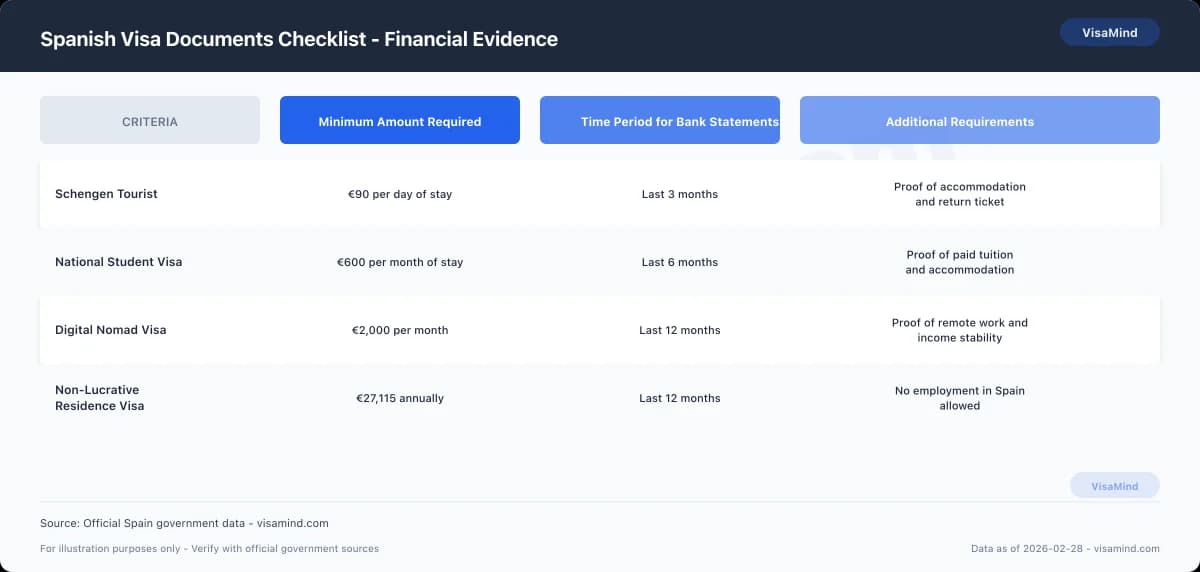
Demonstrating your financial stability is a crucial part of the process. The State Secretariat for Migration (SEM) requires specific financial documentation to prove that you can support yourself during your stay. Below is a detailed comparison of the financial evidence needed for different types of visas.
Financial Evidence Requirements
To ensure you meet the financial requirements for your visa application, here is a breakdown of what is typically required:
| Visa Type | Bank Statement Requirements | Minimum Amount | Time Period |
|---|---|---|---|
| Schengen Tourist | Recent bank statements | €90 per day of stay | Last 3 months |
| National Work | Bank statements showing regular income | At least €2,000 monthly | Last 6 months |
| National Student | Proof of financial resources or scholarship | Minimum €7,000 annually | Last 3 months |
| Digital Nomad | Statements showing stable income | At least €2,400 monthly | Last 6 months |
| Non-Lucrative Residence | Consistent savings or income | €27,115 annually | Last 12 months |
Understanding Bank Statement Requirements
For most visas, you will need to submit bank statements as proof of your financial capacity. These statements should clearly show your name, account details, and financial transactions. The purpose is to demonstrate your ability to cover living expenses throughout your stay in Spain.
Important: Always ensure that the bank statements are from a reputable financial institution and are recent, as specified in the table above.
Minimum Financial Thresholds
The minimum amounts required can vary significantly depending on the visa type. For instance, if you're applying for a Schengen Tourist Visa, you need to show that you have at least €90 for each day of your intended stay. On the other hand, the Non-Lucrative Residence Visa requires a much higher annual income or savings threshold.
Time Period for Financial Documents
The time period for which you should provide financial documentation also varies. For example, the National Student Visa requires bank statements from the last three months, whereas the Digital Nomad Visa requires documentation from the past six months. This ensures that applicants have a consistent and reliable income stream.
Tip: Regular income evidence, such as salary deposits, can strengthen your application and demonstrate financial stability, particularly for longer-term visas like the National Work Visa.
Before applying, double-check the specific financial requirements for your visa category on the official SEM website, as requirements can change. For further guidance, explore our Financial Requirements Guide to ensure you meet all necessary criteria.
Documents for Your Visa Type
#Having the correct documents is essential. The State Secretariat for Migration (SEM) requires specific paperwork based on the type of visa you are applying for. Let’s explore some of the essential documents you may need.
Employment-Based Visas
If you are applying for a National Work Visa or a similar category, you must demonstrate a concrete job offer or employment arrangement in Spain.
- Work Contract: A signed contract from your Spanish employer. It should clearly state your job title, salary, and terms of employment.
- Employer’s Registration: Proof that the employer is registered and authorized to hire foreign workers.
- Authorization of Work: In some cases, you may need a work authorization approval, which your employer must obtain from the relevant Spanish authorities.
For further details on working in Spain, you might find the National Work Visa page useful.
Student Visas
For those pursuing education in Spain, a National Student Visa is required, alongside documentation proving acceptance into an educational institution.
- Acceptance Letter: An official letter from the university or educational institution confirming your admission and the duration of your studies.
- Course Details: Information about the course, including the curriculum and schedule.
- Proof of Tuition Payment: Receipts or confirmation of payment for tuition fees, if applicable.
Further guidance on studying in Spain can be found on the National Student Visa page.
Family Reunification
For those seeking to join family members in Spain, documentation establishing the familial relationship is crucial.
- Marriage Certificate: If joining a spouse, a certified copy of your marriage certificate is required.
- Birth Certificates: For children, their birth certificates must be provided to establish the parental link.
- Proof of Residency: Documents showing that your family member legally resides in Spain.
Explore more about family reunification on the Family Reunification page.
Tip: Ensure all documents are translated into Spanish by a certified translator, as required by SEM. This can prevent delays in processing your application.
Digital Nomad and Non-Lucrative Visas
For those applying for the Digital Nomad Visa or the Non-Lucrative Residence Visa, specific documents proving financial independence and remote work are necessary.
- Remote Work Contract: If you're a digital nomad, provide proof of remote employment or freelance contracts.
- Financial Statements: Bank statements showing sufficient funds to support yourself in Spain without engaging in local employment.
- Health Insurance: Comprehensive health coverage that is valid in Spain.
For more insights on digital nomad requirements, see the Digital Nomad Guide.
Important: Always verify the latest requirements on the SEM website, as document requirements can change.
By gathering these documents carefully, you can ensure a smoother application process for your Spanish visa.
What to Double-Check
#Important: Double-checking your documents before submitting them to the State Secretariat for Migration (SEM) can prevent unnecessary delays and ensure a smoother visa application process.
Photographs
- Ensure that your visa application photographs meet the specific requirements set by Spain. This usually includes a recent photo with a light background, with your face clearly visible and without any coverings unless religious or health-related.
- Verify the size specifications, which commonly require a passport-sized photo.
- Check that your photos are less than six months old to avoid rejection.
Financial Documents
- Confirm that your bank statements and other financial evidence are current, typically not older than three months from the date of your application.
- Make sure all financial documents are translated into Spanish by an official translator if they are originally in another language.
- Review the Financial Requirements to ensure your documentation meets the necessary thresholds for your specific visa type, such as the Non-Lucrative Residence Visa.
Translations and Apostilles
- Verify that all documents not originally in Spanish are translated by a sworn translator accredited by the Spanish Ministry of Foreign Affairs.
- Ensure that critical documents, such as birth or marriage certificates, carry the apostille seal if they are from countries that are part of the Hague Convention. This seal authenticates the document for international use.
Expiry Dates and Validity
- Check the expiration dates on your passport and any other identification documents. Your passport should be valid for at least six months beyond your intended stay in Spain.
- For medical and police certificates, ensure they are within the validity period, often no more than three months old at the time of submission.
By meticulously reviewing each aspect of your application, you can minimize the risk of errors and enhance the likelihood of a successful visa process. For further guidance, consult the Visa Refusal Reasons to understand common pitfalls and how to avoid them.
Medical and Police Certificates
#When applying for a visa to Spain through the State Secretariat for Migration (SEM), certain medical and police certificates are required to ensure you meet health and security standards. These documents are crucial for various visa types, such as the Digital Nomad Visa or Non-Lucrative Residence Visa.
Medical Certificates
-
Tuberculosis (TB) Test:
- Required for long-term visas.
- Must be conducted by a certified medical practitioner and issued no more than three months before your application.
- Ensure the certificate states your test results, confirming that you are free from TB.
-
General Medical Examination:
- Required for certain visa categories, like the Family Reunification.
- Obtain a certificate from a licensed doctor that confirms you do not suffer from any diseases that could pose a risk to public health in Spain.
- The certificate should be recent, typically issued within three months of your application.
Important: Always verify the latest medical requirements on the How To Apply guide to ensure compliance with current standards.
Police Certificates
-
Criminal Record Check:
- Obtain from every country where you have resided for more than six months in the last five years.
- The certificate should be issued within three months before your application.
- It must confirm that you have no criminal record.
-
Apostille and Translation:
- If the criminal record certificate is not in Spanish, it must be translated by a sworn translator.
- Ensure the document is apostilled if required, which authenticates the certificate for international use.
Tip: Request your police certificates well in advance, as processing times can vary. This will help prevent delays in your visa application process.
These certificates form part of the broader visa documentation process, ensuring you meet Spain's health and security standards. Before lodging your application, review the specific requirements for your chosen visa type to ensure all documents are prepared correctly. If you're planning a long-term stay, understanding the processing times can also help you manage your application timeline effectively.
Special Requirements
#It's important to consider the specific requirements associated with certain visa types. For instance, applicants for the Digital Nomad Visa must demonstrate that they have been employed or have worked as a freelancer for at least one year prior to the application. Additionally, you must prove that you can work remotely for a company located outside of Spain. For more information on this visa type, refer to the Digital Nomad Guide.
Another example is the Family Reunification Visa, which requires you to provide documents proving the family relationship, such as marriage or birth certificates. It's crucial to ensure these documents are translated into Spanish and apostilled if issued abroad. You can explore more about this visa type in the Family Reunification section.
Language Requirements
For certain visa types, you may need to demonstrate proficiency in Spanish. This is particularly relevant for visas like the Arraigo Social, which requires integration into Spanish society. You might need to show proof of language courses or proficiency exams. Consult the Arraigo Guide for detailed information.
Additional Documentation for Entrepreneurs
If you are applying for the Entrepreneur Visa, you'll need to present a detailed business plan that outlines the viability and potential economic impact of your proposed business in Spain. This includes financial projections, market analysis, and the business structure. The Golden Visa Vs Entrepreneur guide provides further insights into these requirements.
Special Permissions and Timelines
Certain visas, like the Seasonal Work Visa, have specific timelines and permissions. The application process often includes agreements with Spanish employers and is subject to seasonal demand. Ensure that your application is submitted well in advance, as processing times can vary significantly. For a comprehensive understanding of processing timelines, check the Processing Times guide.
Tip: Always verify the latest requirements and processes on the official website of the Secretaría de Estado de Migraciones before starting your application, as these can change frequently.
FAQs
Can I switch from a Schengen Visa to a National Student Visa using the Spanish Visa Documents Checklist?
Are medical certificates always required on the Spanish Visa Documents Checklist?
Do I need police certificates for a Digital Nomad Visa on the Spanish Visa Documents Checklist?
What financial evidence is needed for a Non-Lucrative Residence Visa on the Spanish Visa Documents Checklist?
Can I combine a National Work Visa with a Non-Lucrative Residence Visa using the Spanish Visa Documents Checklist?
What should I double-check before submitting the Spanish Visa Documents Checklist?
Is the Spanish Visa Documents Checklist different for each visa type?
Sources
Last reviewed: March 2, 2026
VisaMind provides informational guidance only and is not a government agency. This is not legal advice. Requirements can change and eligibility depends on your specific facts. If your case is complex or high-stakes, consult a licensed immigration attorney.
Next steps
Requirements vary by nationality, purpose, timeline, and case details. Use Find My Visa to get a personalized checklist for Spain with official sources and deadlines.
Find my visa