On this page
- Visa Options for Remote Workers
- Do You Qualify?
- Getting Your Digital Nomad Visa
- Tax Rules for Remote Workers
- How Long Can You Stay?
- What Remote Workers Get Wrong
- Cost of Living and Coworking
- Connectivity and Logistics
- Beyond the Nomad Visa
- Digital Nomad Experiences
- Visa options for this goal
- Guides for Spain
- Other goals for Spain
Visa Options for Remote Workers
#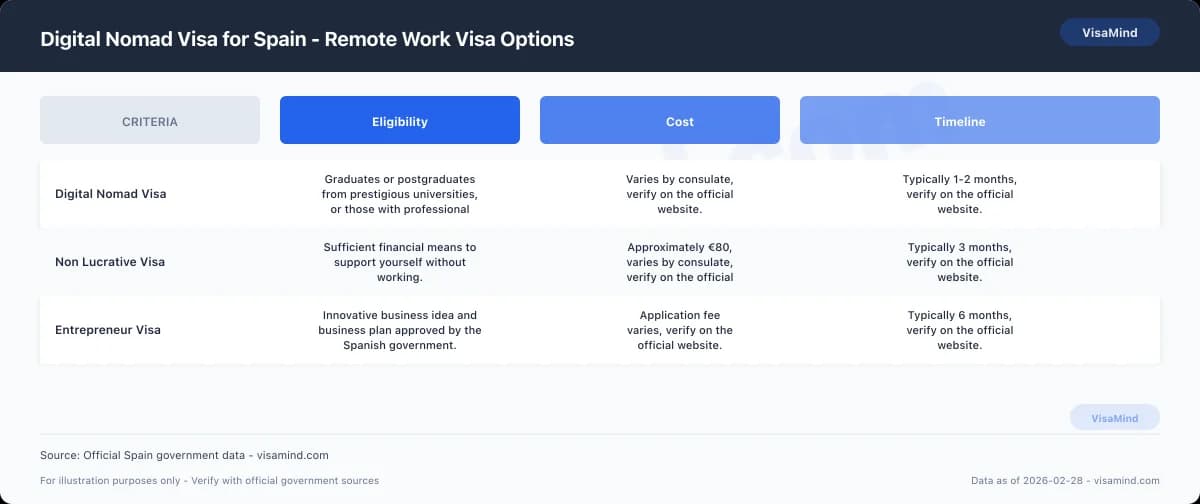
In Spain, remote workers and digital nomads have several visa options to choose from, each catering to a different set of needs and requirements. These visas offer a pathway for international professionals to live and work in Spain legally. Below is an overview of the main visa categories available for remote workers:
| Visa Type | Eligibility | Cost | Timeline |
|---|---|---|---|
| Digital Nomad Visa | Graduates/postgraduates from prestigious universities or with 3+ years of experience | Varies, verify on the official website | Processing times vary, check for updates |
| Schengen Business Visa | Short-term business visits, meetings, conferences | Approximately €80 | Up to 15 days |
| National Work Visa | Employment contract with a Spanish employer | Varies, typically €60-€80 | 1 to 3 months |
| Entrepreneur Visa | Innovative business projects recognized by Spain | Varies, verify on the official website | Typically 1 to 3 months |
Understanding the Digital Nomad Visa
The Digital Nomad Visa is specifically designed for remote workers who want to reside and work in Spain. This visa is ideal for professionals employed by foreign companies or those who have a solid track record of self-employment. To qualify, you must:
- Be a graduate or postgraduate from a prestigious university
- Have completed professional training
- Possess at least three years of professional experience
Applicants need to provide several documents, including a copy of their passport, proof of fee payment, and evidence of a minimum three-month professional relationship with a foreign company.
Tip: Ensure you have all the required documents ready to streamline your application process.
Other Visa Options for Remote Work
While the Digital Nomad Visa is a popular choice, other visas might also suit your situation:
-
Schengen Business Visa: Suitable for short-term business activities such as meetings or conferences. This visa allows you to stay in Spain and other Schengen countries for up to 90 days within a 180-day period.
-
National Work Visa: If you have secured a job with a Spanish employer, this visa allows you to work in Spain for an extended period. It requires an employment contract and can lead to long-term residency.
-
Entrepreneur Visa: Designed for those who wish to start an innovative business in Spain. This visa requires a detailed business plan and proof that the project will contribute to the Spanish economy.
For more detailed guidance on these options, you may want to explore our Digital Nomad Guide or compare the Digital Nomad Vs Non Lucrative visas to see which best fits your needs.
Key Considerations for Remote Work Visas
Choosing the right visa depends on your specific circumstances, including the nature of your work, your professional background, and your long-term plans. Some options like the Golden Visa may also be of interest if you are considering investment as part of your move to Spain. Always verify the most current information on costs and timelines on the official website to ensure you are making informed decisions.
Do You Qualify?
#To determine your eligibility for the Digital Nomad Visa for Spain, you must meet several important criteria. Below is a breakdown of the key requirements you need to satisfy to apply for this visa.
Eligibility Criteria
| Criteria | Description |
|---|---|
| Educational Qualifications | You must be a graduate or postgraduate from a prestigious university, or possess professional training. Alternatively, a minimum of three years of professional experience is required. |
| Remote Employment | Applicants must demonstrate a professional relationship with a foreign company for at least three months. This can be shown through contracts or proof of employment. |
| Minimum Income | You need to meet specific income thresholds to ensure financial self-sufficiency while residing in Spain. These amounts can vary, so verify on the official website. |
| Health Insurance | Comprehensive health insurance coverage is mandatory. It should be valid throughout your stay in Spain and cover any potential medical expenses. |
| Passport and Fees | A complete copy of your passport and proof of payment of the visa fee must be provided. |
Important: Ensure that all documentation is in order and accurately reflects your eligibility. Missing or incorrect documentation can delay the process or lead to a denial.
Can You Apply Without a Degree?
While having a degree from a prestigious university is one way to qualify, it's not the only path. Applicants with significant professional experience or specialized training can also qualify. Specifically, three years of professional experience in a relevant field can fulfill the educational requirement.
Financial Requirements
To demonstrate financial viability, you may need to provide bank statements or other evidence of income. The specific amount required can change, so it is advisable to check the financial requirements regularly.
Why Health Insurance is Essential
Health insurance is not just a formality; it is a crucial requirement for residency in Spain. The policy must cover all medical expenses, including emergencies, without any exceptions. This ensures that you are protected against unforeseen medical issues during your stay.
For more detailed guidance on the steps involved in applying for the Digital Nomad Visa, consider reviewing the Digital Nomad Guide for comprehensive instructions and tips. Additionally, comparing this visa to other options like the Non Lucrative Visa can help you decide which path is best suited for your circumstances.
By ensuring you meet these criteria, you'll be well-prepared to lodge your application with confidence and begin your journey as a digital nomad in Spain.
Getting Your Digital Nomad Visa
#-
Prepare Your Documents
Before starting your application for the Digital Nomad Visa for Spain, you'll need to gather several essential documents. These include:
- A complete copy of your passport
- Proof of payment of the visa fee
- Documentation verifying a minimum of a three-month professional relationship with a foreign company
- Evidence of your graduate or postgraduate degree from a prestigious university, or proof of professional training or three years of professional experience
Important: Ensure all documents are current and translated into Spanish if necessary. Missing documents can delay your application.
-
Review Eligibility and Instructions
Visit the official website of the State Secretariat for Migration (SEM) to download the instructions for the Digital Nomad Visa. Carefully review the eligibility criteria and specific instructions for your category before proceeding. This will help in understanding the necessary steps and ensure you meet all requirements. For further details on eligibility, you can also refer to the Digital Nomad Guide.
-
Submit Your Application
Applications for the Digital Nomad Visa can typically be lodged through Spanish consulates abroad. It's crucial to complete all required sections of the application and attach all supporting documents. Ensure that you have signed the application wherever necessary. Submissions can often be done in person; however, it's advisable to check with your local consulate for specific submission methods and any additional local requirements.
Tip: Applying in person at the consulate may allow you to clarify any doubts directly with a consular officer, potentially speeding up the process.
-
Await Processing and Notification
After submission, the processing time for the Digital Nomad Visa can vary. It's important to follow up with the consulate where you applied to get updates on the status of your application. For typical processing times, consult the Processing Times guide.
-
Enter Spain and Register
Once your visa is approved, you can travel to Spain. Upon arrival, you will need to register with the local authorities and obtain a Foreigner Identity Number (NIE) and a Foreigner Identity Card (TIE) through the National Police. This registration is mandatory and should be completed within the first 30 days of arriving in Spain.
For more details on other visa options that might be relevant, consider reviewing the Non Lucrative Visa comparison to understand the differences and benefits of each type.
By following these steps, you can successfully apply for and obtain your Digital Nomad Visa for Spain, allowing you to enjoy the benefits of living and working remotely in this vibrant country.
Tax Rules for Remote Workers
#Navigating the tax landscape is an important aspect of planning your stay in Spain under the Digital Nomad Visa. Understanding how tax residency works and whether you'll be subject to local income taxes can help you make informed decisions during your time as an international teleworker in Spain.
Tax Residency in Spain
In Spain, tax residency is determined by specific criteria. You are considered a tax resident if you spend more than 183 days in the country within a calendar year. Alternatively, if your main professional activities or economic interests are located in Spain, you might also be deemed a tax resident.
- 183-Day Rule: Spending more than half a year in Spain typically triggers tax residency.
- Economic Interests: Having significant business or economic ties can establish residency.
Important: Becoming a tax resident in Spain means you are liable for Spanish income taxes on your worldwide income. Assess your situation to understand the implications this may have on your finances.
Local Income Tax Obligations
Once you are a tax resident, Spanish tax regulations apply to your global earnings. The income tax rates in Spain are progressive, ranging from approximately 19% to 47% as of 2023, depending on your income bracket. It's essential to prepare for these rates and consider their impact compared to your home country's tax system.
- Progressive Tax Rates: Ranging from 19% to 47% based on your income level.
- Worldwide Income: Includes salary, dividends, and other global income sources.
Double Taxation Treaties
Spain has double taxation treaties with many countries to prevent the same income from being taxed twice. These treaties can provide relief by allowing you to claim tax credits or exemptions on your foreign income.
- Claim Relief: Use treaties to avoid double taxation on income earned abroad.
- Consult Treaties: Check specific agreements between Spain and your home country.
Tip: Consult a tax advisor familiar with Spanish and international tax laws to navigate these treaties effectively.
Related Resources
Understanding the tax implications of your move to Spain is crucial. For more information on how this visa compares with others, consider exploring the Digital Nomad Vs Non Lucrative guide. Additionally, if you plan to extend your stay, the Visa Extension Guide provides valuable insights. For those interested in starting a business in Spain, the Entrepreneur Visa might also be worth considering.
This comprehensive understanding of Spain's tax rules will help you manage your finances and ensure compliance during your time as a digital nomad. Be sure to verify specifics on the official website as tax laws can evolve.
How Long Can You Stay?
#A Digital Nomad Visa for Spain initially allows you to reside in the country for up to one year. This visa is specifically designed for remote workers who wish to live and telework from Spain while maintaining employment with a foreign company. Here's what you need to know about your stay duration and renewal possibilities.
Duration and Renewal Options
- Initial Duration: The visa is granted for a period of up to one year.
- Renewal: You have the option to renew your visa. The renewal can extend your stay for an additional two years, provided you continue to meet the visa conditions.
- Maximum Total Stay: After the initial term and renewal, you can reside in Spain for a total of three years under this visa. Further renewals may be possible, subject to meeting eligibility criteria.
Important: Maintaining compliance with the visa conditions is crucial for successful renewal. Ensure you continue to meet the requirements set by the State Secretariat for Migration.
Transitioning to Other Residency
After your initial three-year residency under the Digital Nomad Visa, you may consider transitioning to a more permanent residency option. Options like the Long Term Residence permit may be available if you wish to extend your stay beyond the digital nomad framework.
Extending Your Stay
- Application for Renewal: It's advisable to start the renewal process well before your current visa expires. Consult the Visa Extension Guide for detailed steps and required documentation.
- Switching Visa Types: If your circumstances or professional situation changes, you might explore other visa types such as the Entrepreneur or Non Lucrative.
Tip: Plan your renewal or transition early to avoid any interruptions in your ability to reside and work in Spain. Always verify the latest requirements on the official State Secretariat for Migration website.
What Remote Workers Get Wrong
#Important: Ensure you thoroughly understand the conditions of your Digital Nomad Visa to avoid common pitfalls that could affect your residency status.
Working for Local Clients
- Prohibited Activities: Many remote workers mistakenly believe they can take on local clients in Spain while on a Digital Nomad Visa. However, this visa is specifically for international teleworking. Engaging in local business activities without the appropriate permit, such as a Self Employment Visa, can lead to visa violations.
- Alternatives for Local Work: If you wish to work with Spanish companies, consider applying for a National Work Visa or other relevant permits that allow local employment.
Tax Misunderstandings
- Resident vs. Non-Resident Taxation: Remote workers often misunderstand their tax obligations. Spain considers you a tax resident if you spend more than 183 days in the country within a calendar year. As a tax resident, you are subject to Spanish income tax on worldwide income.
- Seek Professional Advice: It's recommended to consult with a tax professional to understand your obligations and avoid unexpected liabilities. Resources like the Financial Requirements Guide can also provide useful insights.
Overstaying Your Visa
- Consequences of Overstaying: Exceeding your visa duration can result in penalties, including fines and future entry bans. The Digital Nomad Visa typically allows for stays up to one year, with potential for renewal.
- Monitor Your Stay: Keep track of your stay duration and apply for renewals or extensions in a timely manner, as outlined in the Visa Extension Guide.
Insufficient Proof of Income
- Income Requirements: Applicants must demonstrate sufficient income to support themselves while living in Spain. This often requires documentation of a stable, ongoing income from a foreign source.
- Common Mistake: Failing to provide adequate proof can lead to visa denial. Ensure you have detailed financial records ready, showing at least a three-month professional relationship with a foreign company, as specified by the State Secretariat for Migration (SEM).
By understanding these common pitfalls and proactively addressing them, you can better secure your position as a digital nomad in Spain.
Cost of Living and Coworking
#Spain, with its rich cultural heritage, vibrant cities, and affordable cost of living, is an attractive destination for digital nomads. Understanding the cost of living and coworking options can help you plan your move and make the most of your time in Spain.
Monthly Budget Expectations
The cost of living in Spain can vary significantly depending on the city you choose to reside in. Here are some general monthly budget estimates:
- Madrid: As the capital city, Madrid tends to be more expensive, with monthly living costs ranging from €1,500 to €2,500.
- Barcelona: Known for its beaches and architecture, Barcelona's costs are similar to Madrid, averaging €1,500 to €2,500.
- Valencia: A more affordable option, Valencia offers a more relaxed lifestyle with estimated costs between €1,200 to €2,000.
- Seville: Known for its culture and history, Seville is one of the more budget-friendly cities, with costs ranging from €1,000 to €1,800.
These estimates include rent, utilities, groceries, transportation, and leisure activities. Always verify the latest costs as they can fluctuate with inflation and exchange rates.
Coworking Spaces and Popular Hubs
Spain's cities offer a wide variety of coworking spaces that cater to digital nomads and remote workers. These spaces provide essential amenities such as high-speed internet, meeting rooms, and networking opportunities. Here are some popular cities and their coworking options:
-
Madrid: Known for its bustling business district, Madrid offers numerous coworking spaces in areas like Malasaña and Chueca. Look for spaces such as Impact Hub and Utopicus.
-
Barcelona: The city's entrepreneurial spirit is evident in its vibrant coworking scene. Notable spaces include Betahaus and OneCoWork.
-
Valencia: With its growing digital community, Valencia offers coworking spaces like Wayco and Vortex Coworking, ideal for those seeking a collaborative environment.
-
Malaga: A rising star for digital nomads, Malaga provides affordable coworking options such as The Living Room and Innovation Campus.
Choosing the Right City
When deciding where to settle in Spain, consider the lifestyle and amenities most important to you. For instance, if you prioritize a lively urban environment with a rich cultural scene, Madrid or Barcelona might be ideal. Alternatively, if you seek a relaxed pace and lower cost of living, cities like Valencia or Seville could be more suitable.
Tip: Before finalizing your move, visit potential cities to experience the local culture and community firsthand. This can help ensure you choose a location that aligns with your work-life balance preferences.
By understanding the cost of living and exploring coworking options, you can make informed decisions about your digital nomad journey in Spain. For more detailed guidance on financial planning, consider reviewing the Financial Requirements for digital nomads.
Connectivity and Logistics
#Important: Spain offers robust infrastructure for digital nomads, ensuring you can maintain productivity while enjoying a vibrant lifestyle.
Internet Connectivity
- High-Speed Internet: Spain boasts excellent internet connectivity, with speeds usually ranging from 100 to 600 Mbps in urban areas. Fiber optic connections are widely available, ensuring smooth remote work operations.
- Coworking Spaces: Numerous coworking spaces, particularly in cities like Barcelona and Madrid, provide reliable Wi-Fi and professional environments conducive to productivity.
Mobile and SIM Cards
- Local SIM Cards: Upon arrival, you can purchase a SIM card from providers like Movistar, Vodafone, or Orange. They offer a variety of prepaid plans, typically ranging from €10 to €30 per month, depending on data needs.
- Coverage: These providers ensure extensive coverage across Spain, so you can stay connected even in more remote areas.
Banking and Financial Management
- Opening a Bank Account: As a digital nomad, opening a bank account in Spain can simplify financial transactions. Banks such as Santander, BBVA, and CaixaBank offer accounts for non-residents.
- Digital Banking: Many banks provide online services and mobile apps, making it easy to manage finances from anywhere.
Day-to-Day Logistics
- Transportation: Spain's public transport system is efficient and cost-effective. Metro, buses, and trains cover most urban areas, with monthly passes available for around €50 to €75.
- Cost of Living: Living expenses vary by city, with Madrid and Barcelona being more expensive. On average, expect to spend between €800 and €1,500 monthly, including accommodation, utilities, and groceries.
For those considering a longer stay, options like the Long Term Residence or Non Lucrative visa might be of interest. Additionally, the How To Apply guide provides detailed steps for various visa applications.
Beyond the Nomad Visa
#Transitioning from a Digital Nomad Visa to other types of residence permits in Spain offers various pathways, depending on your future plans. Here's how you can navigate this process and explore long-term options.
Moving to a Work Visa
If you aim to transition to a more traditional work setting in Spain, you can consider applying for a National Work Visa. This transition involves securing a job offer from a Spanish company willing to sponsor your work permit. Ensure that your potential employer is ready to comply with the requirements set by the Spanish immigration authorities. Important: You may need to return to your home country to apply for this visa, as some processes are handled by Spanish consulates abroad.
Long-Term Residence and Permanent Residency
After residing in Spain for a continuous period, you might be eligible to apply for Long Term Residence or even permanent residency. Generally, you need to have lived in Spain for five years under a valid residence permit. This status grants you similar rights to those of Spanish citizens, including the ability to work and reside anywhere in the country without additional permits.
Tip: Track your residency period carefully and ensure you meet all the residency requirements before applying for long-term residence.
Comparing Visa Options
Here's a brief comparison of different visa options for digital nomads seeking more permanent residence in Spain:
| Visa Type | Suitable For | Key Requirement |
|---|---|---|
| Digital Nomad Visa | Remote workers | Proof of employment with a foreign company |
| National Work Visa | Traditional employment in Spain | Job offer from a Spanish employer |
| Long Term Residence | Long-term residents | 5 years of continuous residence in Spain |
Considerations for Permanent Residency
For those aspiring to achieve permanent residency or Spanish citizenship, understanding the legal and residency requirements is crucial. Permanent residency often requires a deeper integration into Spanish society, including language skills and cultural understanding. For more detailed guidance on permanent residency, refer to the PR Pathway Guide.
Navigating these pathways requires careful planning and adherence to legal requirements. By considering your long-term goals and understanding the available options, you can make informed decisions about your residency in Spain.
Digital Nomad Experiences
#A tech entrepreneur from Canada, Alex, had been running a successful software company remotely and was keen to relocate to Spain to experience the vibrant Spanish culture while continuing his work. To make this move possible, Alex decided to apply for the Digital Nomad Visa. With a degree from a renowned Canadian university and over five years of experience in software development, he met the eligibility requirements set by the State Secretariat for Migration (SEM). Alex gathered the necessary documents, including proof of his ongoing professional relationship with a Canadian tech firm and the fee payment receipt. After lodging his application, Alex used the SEM's online portal to track his application status. Within approximately three months, he received approval and relocated to Spain, where he continues to run his business from the sunny co-working spaces in Barcelona.
Scenario: Marketing Consultant Seeking Remote Work Flexibility
Isabella, a marketing consultant from South Africa, had been working with multiple international clients and wanted to base herself in Spain to leverage the networking opportunities and diverse workspaces. She had a postgraduate degree in marketing and over three years of professional experience. Isabella applied for the Digital Nomad Visa, ensuring she provided a comprehensive portfolio of her work along with the necessary documentation, such as her passport copy and proof of ongoing contracts with her clients. The application process was smooth, and she utilized the Documents Checklist to ensure she had everything in order. After a four-month wait, Isabella was thrilled to receive her visa, allowing her to settle in Madrid. Now, she enjoys the flexibility of working across different regions in Spain while expanding her client base.
FAQs
Does the Digital Nomad Visa for Spain require a specific form from the Secretaría de Estado de Migraciones?
Can I combine the Digital Nomad Visa for Spain with a business visa?
What documentation is needed to prove my professional relationship for the Digital Nomad Visa for Spain?
Is the Digital Nomad Visa for Spain available to non-EU citizens?
Can I extend my stay in Spain with a Digital Nomad Visa?
How does the tax rule affect holders of the Digital Nomad Visa for Spain?
Can my spouse work in Spain on a dependent visa while I hold a Digital Nomad Visa?
VisaMind provides informational guidance only and is not a government agency. This is not legal advice. Requirements can change and eligibility depends on your specific facts. If your case is complex or high-stakes, consult a licensed immigration attorney.
Next steps
Requirements vary by nationality, purpose, timeline, and case details. Use Find My Visa to get a personalized checklist for Spain with official sources and deadlines.
Find my visa