On this page
- Paths to Working Legally
- Does Your Employer Need to Do Anything?
- The Application Process
- Your Rights as a Worker
- Transitioning to Permanent Residence
- Why Work Visa Applications Fail
- Skills and Qualifications
- Salary and Cost Considerations
- Your Tax Situation Abroad
- Real-World Work Visa Stories
- Visa options for this goal
- Guides for Spain
- Other goals for Spain
Paths to Working Legally
#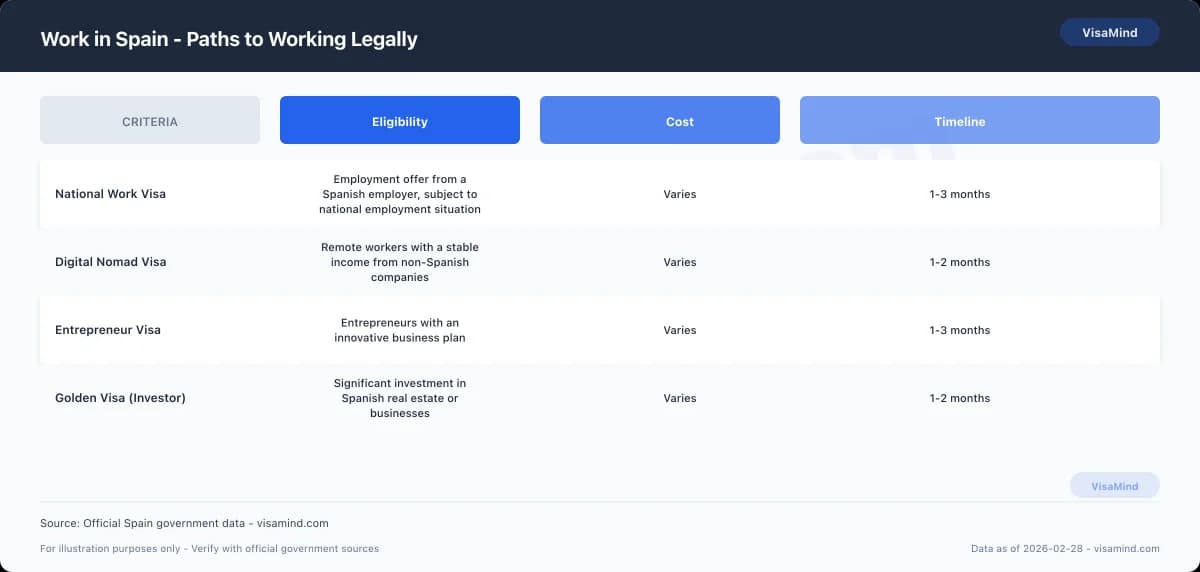
Spain offers a variety of work visa options for foreigners seeking employment opportunities within its borders. These visas are managed by the State Secretariat for Migration (SEM), under the legal framework of LO 4/2000 and RD 557/2011. Here, we'll overview the primary categories of work visas available for those aiming to work legally in Spain.
Types of Work Visas
| Visa Type | Eligibility | Cost (Euros) | Processing Time |
|---|---|---|---|
| National Work Visa | Employment contract with a Spanish company | Varies by consulate | Up to 3 months |
| Digital Nomad Visa | Remote workers for non-Spanish companies | Varies by consulate | 20-45 days |
| Entrepreneur Visa | Entrepreneurs investing in Spain | Varies by consulate | 20-45 days |
| Golden Visa (Investor) | Significant real estate or business investments | Starts at 500,000 for real estate | 20-45 days |
National Work Visa
The National Work Visa is the most common path for those with a job offer from a Spanish employer. This visa requires an employment contract and specific details from both the worker and employer, including personal and contact information. This visa allows you to work and reside in Spain for the duration of your employment contract.
Tip: Ensure your employment contract is in accordance with Spanish labor laws to avoid processing delays.
Digital Nomad Visa
Spain has introduced the Digital Nomad Visa for remote workers employed by companies outside of Spain. This visa is ideal for individuals who wish to work remotely while enjoying the Spanish lifestyle. It typically requires proof of employment and sufficient income to support yourself during your stay.
Entrepreneur Visa
For those looking to start a business in Spain, the Entrepreneur Visa offers a pathway to residency. Applicants must present a viable business plan that demonstrates potential economic interest for Spain. This visa is suitable for innovative entrepreneurs intending to launch a startup in Spain.
Golden Visa (Investor)
The Golden Visa targets investors willing to make a substantial investment in Spain, such as purchasing real estate worth at least €500,000. This visa not only allows you to work in Spain but also grants residency to family members, offering a direct route to long-term residence.
Important: The Golden Visa is particularly beneficial as it does not require actual residence in Spain, allowing for flexibility in maintaining your primary residence elsewhere.
For more detailed information on the application process and required documents for each visa, you can refer to the How To Apply and Documents Checklist guides. Each visa type has specific requirements and application processes, so reviewing the eligibility criteria and preparing the necessary documentation in advance is crucial.
Does Your Employer Need to Do Anything?
#Understanding your employer's role is crucial. Employers play a significant part in the application process for work permits, which is governed by the Spanish immigration framework, particularly LO 4/2000 and RD 557/2011.
Employer Sponsorship Requirements
Before you can start working in Spain, your employer must meet certain legal criteria to sponsor a work permit. Key responsibilities include:
-
Job Offer: The employer must provide a legitimate job offer and demonstrate that the position cannot be filled by a local worker. This requirement helps prioritize employment for residents.
-
Company Compliance: Employers must prove that their business complies with Spanish labor and tax regulations. This includes being registered with the Social Security system and having no outstanding tax or Social Security debts.
-
Financial Stability: Employers need to show they have the financial capacity to pay the employee's salary and meet other contractual obligations.
Required Documentation from Employers
Employers need to gather and submit specific documentation to support your work permit application. These documents typically include:
-
The Employment Contract: A signed contract detailing the job role, salary, and working conditions, aligned with Spanish labor laws.
-
Company Registration Documents: Proof of the company's registration and compliance with local regulations.
-
Proof of Recruitment Efforts: Documentation showing attempts to recruit locally, often necessary to justify hiring a non-EU worker.
Can Employers Influence the Application Process?
Employers have a substantial influence on the success of a work permit application. Their commitment to fulfilling the sponsorship requirements can significantly impact the processing time and approval rate. Here’s how they can affect the process:
-
Timely Submission: Promptly submitting all required documents can expedite the process. The Secretaría de Estado de Migraciones evaluates applications based on completeness and compliance.
-
Accurate Information: Providing accurate and truthful information is critical. Any discrepancies can lead to delays or rejections.
Important: Employers must ensure all documentation is accurate and up-to-date to avoid complications. Incorrect or incomplete submissions can lead to delays or even denial of the work permit.
Coordination with the Employee
While employers handle the sponsorship side, coordination with you, the prospective employee, is essential. Both parties should maintain open communication to ensure all necessary documents and information are gathered efficiently. You can guide your employer by referring them to resources like the National Work Visa section for more detailed information about the types of visas and their requirements.
For detailed steps on gathering necessary documentation, refer to the Documents Checklist to ensure nothing is overlooked. Understanding these requirements helps both you and your employer prepare adequately for the application process.
The Application Process
#Determine Your Eligibility
Before beginning the application process for temporary residence and work authorization in Spain, it's crucial to determine your eligibility based on Spanish legislation, specifically LO 4/2000 and RD 557/2011. Eligibility depends on factors such as your employment offer, qualifications, and the visa type you are applying for, such as the National Work Visa or the Digital Nomad Visa. Ensure you review the specific requirements for your category to avoid any unnecessary complications.
Gather Required Documentation
The application requires comprehensive details about the worker, employer, and any representative involved. Make sure to gather all necessary documents, which typically include:
- Valid passport and photocopies
- Employment contract or offer letter from a Spanish employer
- Proof of qualifications and experience
- Health insurance policy
- Police clearance certificate
- Any additional documents specific to your visa category
For a detailed checklist, refer to the Documents Checklist.
Submit Your Application
Once you have determined your eligibility and gathered all necessary documents, you can proceed to submit your application through the Secretaría de Estado de Migraciones. You can lodge your application either online or at a Spanish consulate if you are outside Spain. Ensure that all sections are completed accurately and that any required evidence is attached to support your application.
Tip: Applying online through the SEM portal can help you avoid mail delays and provide an immediate receipt number.
Pay the Application Fee
The application process involves a fee, which varies depending on the type of work authorization you are applying for. Payment methods and exact fees can be verified on the official SEM website. Ensure you keep the payment receipt as proof, as it will be required during the processing of your application.
Await Decision and Follow Up
After submission, the processing time can vary, but you should generally expect to wait several weeks. The SEM will notify you of their decision. It is important to track the status of your application, which you can do through the SEM portal or by contacting the relevant consulate or immigration office processing your application.
Important: If your application is approved, you will need to register with the National Police in Spain to obtain your NIE/TIE, which formalizes your residency and work authorization.
For comprehensive guidance on the application process, including potential issues that could arise, consult the How To Apply guide or explore comparisons such as Work Permit Vs Blue Card to understand different pathways and their benefits.
Your Rights as a Worker
#When working in Spain, it's important to understand your rights and the opportunities available to you beyond employment. Here's what you need to know about changing employers, bringing your family, and pursuing education.
Can You Change Employers?
If you're considering changing employers in Spain, you generally need to apply for a modification of your existing work authorization. This process involves notifying the State Secretariat for Migration (SEM) and ensuring your new employment offer meets the same conditions as your original permit. The new employer must also meet specific requirements, such as being registered with Spanish authorities and offering a contract that aligns with your current work authorization.
Tip: Ensure your new job offer is secured before changing employers to avoid potential gaps in your work authorization.
Can Your Family Join You?
Family reunification is an important aspect of working in Spain. If you hold a valid work visa, your immediate family members, such as a spouse and dependent children, may be eligible to join you. They can apply for a Family Reunification Visa at a Spanish consulate in their home country. Once in Spain, family members can apply for residency status that allows them to live with you.
- Eligible Family Members:
- Spouse or registered partner
- Dependent children under 18
- Dependent parents over a certain age
Can You Study While Working?
Yes, holding a work permit often allows you to study part-time or enroll in courses while in Spain. This flexibility enables you to enhance your skills and qualifications, which can be beneficial for career advancement. If your primary intention is to pursue full-time studies, you might consider applying for a National Student Visa instead, which may offer more suitable conditions for students.
Important: Balancing work and study commitments requires careful time management to comply with both employment and educational obligations.
Understanding these aspects of working in Spain can enhance your experience and provide opportunities for personal and professional growth. Be sure to consult official resources or seek legal advice for the most accurate and personalized guidance.
Transitioning to Permanent Residence
#Transitioning from a work visa to permanent residence in Spain involves understanding specific pathways, timelines, and requirements. For those who have initially secured a work visa, such as the National Work Visa or the Digital Nomad Visa, the State Secretariat for Migration (SEM) governs the progression towards more permanent residency options.
How Work Visas Lead to Permanent Residence
In Spain, transitioning from a temporary work visa to permanent residence is typically a multi-step process. Here's how you can move along this pathway:
- Initial Work Visa: Typically, a work visa is the first step for foreign nationals seeking employment in Spain. This visa allows you to reside and work in the country temporarily.
- Temporary Residence: After holding a work visa, you can apply for temporary residence. This is usually granted for one year and can be renewed annually.
- Long-Term Residence: After five years of continuous legal residence in Spain, you are eligible to apply for long-term residence. This status allows you to live and work in Spain indefinitely and provides similar rights to those of Spanish citizens.
Important: Maintaining continuous legal residence is crucial. Interruptions could affect your eligibility for long-term residency.
Timeline for Transitioning to Permanent Residence
The timeline from a temporary work visa to permanent residence typically spans several years. Here's a general overview:
| Step | Duration |
|---|---|
| Initial Work Visa | Valid for up to 1 year |
| Temporary Residence | Renewable annually for 5 years |
| Long-Term Residence | Eligible after 5 years |
Tip: Ensure you renew your temporary residence permit on time each year to avoid disruptions in your residency status.
Can You Change Employers While on a Work Visa?
Changing employers in Spain while on a work visa is possible but requires careful consideration and action. You must ensure that your new employment meets the conditions of your initial visa. Additionally, you may need to lodge an application with the SEM to update your visa details or possibly apply for a new one if your role changes significantly.
Additional Considerations
- Residency Requirements: To qualify for long-term residence, you must have resided continuously in Spain for five years. Short trips abroad do not usually affect this, but extended absences might.
- Integration: Demonstrating integration into Spanish society, such as language proficiency or community involvement, can be beneficial when applying for permanent residency.
For more detailed guidance, consider exploring our PR Pathway Guide, which provides comprehensive information on navigating the transition to permanent residency in Spain.
Why Work Visa Applications Fail
#Important: Thorough preparation and attention to detail can significantly increase the chances of a successful work visa application.
Common Reasons for Work Visa Rejection in Spain
Understanding why a work visa application might be rejected is key to avoiding pitfalls. Here are the most common reasons:
-
Incomplete or Incorrect Documentation: Missing or inaccurate documents can lead to immediate refusal. Ensure all required documents are included, and double-check for errors.
-
Insufficient Financial Proof: Applicants must demonstrate financial stability to support themselves in Spain. Verify the latest financial requirements on the Secretaría de Estado de Migraciones website to ensure compliance.
-
Lack of Employer Compliance: Your employer must meet specific criteria, including being registered and in good standing with Spanish authorities. Confirm that your employer's obligations are met before lodging your application.
Eligibility and Compliance
Several eligibility criteria must be met for a successful work visa application:
-
Qualifications and Experience: The position you are applying for should match your qualifications and experience. Mismatches can lead to application failure.
-
Job Offer Validity: Ensure that the job offer is genuine and adheres to the Spanish labor market regulations. The offer should specify contract details clearly and reflect compliance with local laws.
Tip: Use the Visa Refusal Reasons guide to understand specific pitfalls and learn how to navigate them effectively.
Legal and Administrative Issues
Beyond documentation and eligibility, legal and administrative factors can impact your application:
-
Previous Visa Violations: A history of overstaying or violating visa conditions in Spain or other Schengen countries can lead to rejection.
-
Incorrect Application Process: Follow the correct application process as specified by the SEM. Missteps in the process can lead to delays or refusal.
For more detailed steps on how to apply and what to include, refer to the How To Apply guide. Understanding these critical aspects can help you avoid common mistakes and increase the likelihood of your work visa being approved.
Skills and Qualifications
#When seeking work in Spain, particularly if your role falls under regulated professions, you may need a skills assessment to ensure your qualifications meet Spanish standards. Here's what you need to consider:
- Regulated Professions: Professions such as medicine, law, and engineering often require validation of your qualifications. Contact the relevant Spanish professional body for assessment procedures.
- Non-Regulated Professions: For roles not subject to specific regulations, a general recognition of your skills and experience may suffice.
Tip: Check if your profession is regulated in Spain by consulting the Documents Checklist for work visa applications.
Qualification Recognition
To ensure your qualifications are recognized in Spain, you might need to undergo a process known as homologación or equivalencia:
- Homologación: This process is necessary when your profession is regulated. It involves validating your foreign qualifications to match the Spanish educational system. The Ministry of Education, Culture, and Sport handles this procedure.
- Equivalencia: For non-regulated professions, equivalence ensures that your foreign degree corresponds to a certain level within the Spanish education system. It is typically less rigorous than homologación.
Important: For equivalence or homologation, provide certified translations of your documents into Spanish. Missing documentation may delay your application.
Degree Requirements
Certain job positions in Spain require specific academic credentials:
- Higher Education Degrees: Many professional roles, especially those in management or technical fields, require a university degree equivalent to the Spanish standard.
- Vocational Training: Some sectors, like technical trades, may require vocational qualifications. Ensure your training is recognized in Spain through the equivalency process.
Resources and Next Steps
For further guidance on your work visa options related to qualifications and skills, explore:
- Highly Qualified for roles requiring significant expertise.
- EU Blue Card for high-skill employment opportunities within the EU.
For those considering entrepreneurial ventures, the Entrepreneur Visa offers a pathway to innovation-driven business opportunities in Spain.
Salary and Cost Considerations
#Important: Ensure you meet the specific salary and income thresholds for your visa category before applying, as non-compliance could lead to application rejection.
Salary Thresholds and Minimum Income Requirements
When applying for a work visa in Spain, understanding salary thresholds and minimum income requirements is essential. The National Work Visa requires you to demonstrate an income that meets or exceeds the Spanish minimum wage, which is set at €1,080 per month in 2023. For the Digital Nomad Visa, your monthly income should be at least 200% of the Spanish minimum wage, equating to €2,160. If you're considering the Entrepreneur Visa, you must show that your business plan is financially viable and capable of generating sufficient income to support yourself and any dependents.
| Visa Type | Salary Threshold |
|---|---|
| National Work Visa | At least €1,080/month |
| Digital Nomad Visa | At least €2,160/month |
| Entrepreneur Visa | Viable income from proposed business plan |
Application Fees
The cost of applying for a work visa can vary depending on the specific visa category. Generally, application fees can range from €60 to €200. For example, the Entrepreneur Visa typically incurs a higher fee due to the complexity of the application process and the necessity of business evaluation. For precise fee details, it is recommended to consult the Financial Requirements guide.
Additional Considerations
Beyond salary and fees, consider additional financial obligations such as healthcare insurance and potential costs of living adjustments based on your intended region in Spain. For those interested in the Golden Visa, which requires a significant financial investment, reviewing the Golden Visa Vs Entrepreneur guide could provide valuable insights.
Tip: Check the most recent salary thresholds and fee updates on the State Secretariat for Migration website to ensure compliance with current standards before lodging your application.
Your Tax Situation Abroad
#When you work in Spain as a temporary or permanent resident, understanding your tax obligations is critical. Spain’s tax system requires residents to pay taxes on worldwide income, while non-residents are taxed only on income generated within Spain.
What Are Your Tax Obligations?
As a resident, you must report and pay taxes on all global income, including earnings from employment, investments, and rental properties. The Spanish tax year runs from January 1 to December 31. You must file your annual tax return by June 30 of the following year.
For non-residents, only Spanish-sourced income is taxable. The tax rate for non-residents is generally a flat rate of 24%, but it could vary.
Important: Check whether you are considered a tax resident in Spain. Typically, you are a tax resident if you spend more than 183 days in Spain during the calendar year.
Do You Need to Contribute to Social Security?
In Spain, both employees and employers contribute to the social security system. As an employee, your contributions are usually deducted from your salary. The employer handles the payment to the Spanish social security authorities.
- Employee contribution: Typically around 6.35% of your salary.
- Employer contribution: Approximately 29.9% of your salary.
How Do Double Taxation Treaties Affect You?
Spain has agreements with various countries to prevent double taxation, meaning you won't be taxed twice on the same income. These treaties can offer relief by reducing the tax rate or providing tax credits.
- Check Spain's treaties: If your home country has a treaty with Spain, you might benefit from reduced tax rates or exemptions.
- Consult a tax advisor: It's advisable to consult with a tax professional to understand how these treaties impact your specific situation.
Key Considerations
- Filing Requirements: Ensure you understand Spain's specific tax filing requirements and deadlines.
- Professional Advice: Consulting a tax advisor familiar with Spanish tax law can save you from potential pitfalls.
Tip: For detailed guidance on economic requirements, consider reviewing the Financial Requirements guide to ensure compliance.
By understanding these aspects, you can better manage your tax responsibilities while working in Spain.
Real-World Work Visa Stories
#A software engineer from India received an enticing job offer from a tech company in Barcelona. The engineer was eager to start but faced the challenge of meeting Spain's specific temporary residence and work authorization requirements as outlined by LO 4/2000 and RD 557/2011. The engineer's employer needed to provide detailed information about the job offer and justify the hiring decision, demonstrating the candidate's qualifications aligned with the job requirements. With the guidance of the employer's legal team, they submitted the work authorization application through the Secretaría de Estado de Migraciones. After a thorough review, the authorization was approved within three months, allowing the engineer to obtain a National Work Visa and relocate to Barcelona.
Scenario: Freelance Designer Navigates the Digital Nomad Visa
A freelance graphic designer based in Canada decided to explore the vibrant culture of Spain while continuing to work remotely for clients worldwide. The designer opted for the Digital Nomad Visa, which would allow them to stay in Spain while maintaining their freelance business. The process required demonstrating a stable income from outside Spain, a crucial eligibility factor. The designer gathered financial records and client contracts and applied via the Secretaría de Estado de Migraciones. After successfully showcasing their financial independence and non-Spanish client base, the visa was granted within four months, enabling the designer to enjoy the creative atmosphere of Madrid while working remotely.
Scenario: Entrepreneur Establishes a Startup in Madrid
An entrepreneur from Brazil sought to launch a tech startup in Madrid, aiming to tap into Spain's burgeoning tech scene. The entrepreneur decided to apply for the Entrepreneur Visa, requiring a comprehensive business plan and evidence of potential economic impact. Collaborating with a local business advisor, the entrepreneur crafted a detailed proposal and submitted it to the Secretaría de Estado de Migraciones. The thorough assessment process involved demonstrating the innovation and scalability of the business idea. After six months, the visa was approved, allowing the entrepreneur to establish the startup and contribute to Madrid's vibrant entrepreneurial ecosystem.
FAQs
Can I transition from a Digital Nomad Visa to a National Work Visa in Spain?
How does the application process for a Work Visa in Spain involve the Secretaría de Estado de Migraciones?
What rights do workers have when working in Spain on a National Work Visa?
Can I combine an Entrepreneur Visa with a Golden Visa to work in Spain?
What are the common reasons for Work Visa application failure in Spain?
What are the salary and cost considerations for working in Spain?
How does Spain handle taxes for foreign workers on a Work Visa?
Sources
Last reviewed: March 1, 2026
VisaMind provides informational guidance only and is not a government agency. This is not legal advice. Requirements can change and eligibility depends on your specific facts. If your case is complex or high-stakes, consult a licensed immigration attorney.
Next steps
Requirements vary by nationality, purpose, timeline, and case details. Use Find My Visa to get a personalized checklist for Spain with official sources and deadlines.
Find my visa