Official sources referenced
Is This Guide for You?
#Obtaining residence and work authorization in Spain under exceptional circumstances requires navigating the Arraigo Regularization process. This guide is specifically for those considering applying for residence due to social, labor, or family ties, a process overseen by the State Secretariat for Migration (SEM). The arraigo process is a pathway for individuals who are already in Spain and wish to regularize their status due to strong connections to the country.
Who Should Consider This Guide?
If you have been residing in Spain for an extended period without legal status and have established significant ties, this guide is relevant for you. The Arraigo Social requires demonstrating strong social connections, such as integration into Spanish society, typically through a job offer and a minimum of three years' residency. The Arraigo Laboral applies if you have worked in Spain for at least six months under an employment contract. For those with family members who are Spanish citizens or legal residents, the Arraigo Familiar may be appropriate.
When Is This Guide Useful?
The guide is particularly beneficial when you need to gather evidence of your exceptional circumstances, such as labor contracts, family ties, or proof of social integration. This evidence is crucial for successfully lodging an application with the SEM. Understanding which category of arraigo fits your situation will guide you through selecting the right application process.
Important: Incomplete applications or insufficient evidence of ties can lead to delays or rejections. Ensure you have all necessary documents before submitting your application.
For more details on the specific types of arraigo and the necessary documentation, you can refer to related visas like Arraigo Social, Arraigo Laboral, and Arraigo Familiar. Additionally, understanding the difference between these and options like the Family Reunification visa can clarify your best pathway to residency.
Overview
#The Spain Arraigo Regularization Guide provides a pathway for individuals to obtain residence and work authorization in Spain under exceptional circumstances. Managed by the State Secretariat for Migration (Secretaría de Estado de Migraciones), this process is essential for those who have established significant ties to Spain but do not qualify for standard residency options.
What is Arraigo Regularization?
Arraigo regularization allows non-EU citizens to apply for legal residency in Spain due to special circumstances. These circumstances are categorized mainly into three types:
- Social Arraigo: For individuals who have developed strong social ties within Spain, such as community involvement or personal connections.
- Labor Arraigo: For those who have worked in Spain, even if informally, and can demonstrate their employment history.
- Family Arraigo: For applicants with close family members who are Spanish citizens or legal residents.
Additionally, there are provisions for those seeking residency due to international protection or humanitarian reasons.
Key Requirements
The application process for arraigo regularization requires specific documentation to prove your eligibility. Essential requirements include:
- Evidence of exceptional circumstances, such as social, labor, or family ties.
- Completion of a specific application form tailored to the type of residency you seek. Forms like EX-01 for social arraigo or EX-02 for labor arraigo are common.
- Submission of documents to the appropriate Spanish immigration office, detailing your exceptional circumstances.
Important: Ensure that you provide comprehensive evidence of your circumstances, as failing to do so is a common pitfall.
The Application Process
The process of applying for arraigo regularization involves several steps, each requiring careful attention:
- Prepare Your Documents: Gather all necessary documents, including proof of your exceptional circumstances.
- Complete the Application: Fill in the appropriate forms with all required information.
- Submit Your Application: Lodge your application with the relevant immigration office. Make sure to review the instructions for your eligibility category on the Secretaría de Estado de Migraciones website.
Tip: Consider applying online where possible to avoid delays and receive immediate confirmation of your submission.
Related Residency Options
While the arraigo process is a valuable pathway, it is not the only option for obtaining residency in Spain. Depending on your circumstances, other visas might be more appropriate. For example, the Family Reunification visa is an alternative if your primary ties are familial, or the EU Blue Card for highly qualified workers.
Understanding the nuances and requirements of each residency option can help you determine the best path forward. For further guidance, refer to the Documents Checklist to ensure all necessary paperwork is in order before proceeding with your application.
Eligibility and Requirements
#To apply for residence and work authorization in Spain under exceptional circumstances, such as through social, labor, or family arraigo, it is crucial to meet specific eligibility criteria and requirements. Understanding these prerequisites can be the key to a successful application with the State Secretariat for Migration (SEM).
Eligibility Criteria
-
Social Arraigo: You must demonstrate strong ties to Spanish society. This includes proving continuous residence in Spain for at least three years before applying and having a job offer or sufficient economic resources.
-
Labor Arraigo: This applies if you can prove a minimum of two years of residency in Spain along with an employment relationship lasting at least six months. Supporting documents such as employment contracts and payslips are necessary.
-
Family Arraigo: This category is for those with close family members who are Spanish citizens or legal residents. You need to demonstrate the family connection and provide evidence of dependency or cohabitation.
Required Documentation
When applying for regularization under any arraigo category, ensure you gather the following documents:
-
Proof of Residence: Documentation such as a padrón certificate that verifies your continuous presence in Spain for the required period.
-
Employment Evidence: For labor arraigo, provide contracts, payslips, and possibly a report from the Tesorería General de la Seguridad Social confirming your employment history.
-
Family Ties Proof: Birth certificates, marriage certificates, or registration documents that establish your relationship to Spanish citizens or legal residents.
Important Considerations
Important: Failure to provide sufficient evidence of exceptional circumstances or incomplete documentation can significantly delay or jeopardize your application.
Additional Pathways and Resources
While arraigo regularization is aimed at individuals in specific situations, those looking for alternative pathways might consider options like the Family Reunification Visa or the EU Blue Card, which cater to different eligibility profiles.
For those interested in a more detailed process breakdown, refer to the Documents Checklist to ensure all necessary paperwork is in order before submission.
Tip: Consult with an immigration advisor familiar with Spanish residency laws to tailor your application to your specific circumstances and increase the likelihood of success.
Step-by-Step Process
#Determine Your Eligibility
Begin by evaluating your eligibility for the Spain Arraigo Regularization process. This regularization is available for those who can demonstrate exceptional circumstances, such as social, labor, or family arraigo. Understanding your category is crucial, as it determines the specific type of application you need to lodge with the State Secretariat for Migration (SEM).
Gather Required Documentation
Collect all necessary documents to support your application. This includes evidence of your exceptional circumstances, such as proof of social ties, employment records, or family connections in Spain. Additionally, ensure you have a valid passport and any relevant Spanish residency documents, if applicable. Consult the Documents Checklist for a comprehensive list.
Choose the Appropriate Application Form
Your application form will vary based on your specific circumstances. For example, if you are applying under the Arraigo Social (Social Ties Regularization) category, you will use a different form compared to the Arraigo Laboral (Employment Ties Regularization) category. Visit the SEM website or consult with an immigration advisor to confirm the correct form for your situation.
Complete and Lodge Your Application
Fill in the application form with precise details about your circumstances. Ensure all sections are complete and that you have signed where required. Once your application is ready, lodge it with the appropriate Spanish immigration office. You might need to book an appointment online or submit it through a postal service, depending on local procedures.
Important: Ensure your application is complete and all evidence is included. Incomplete applications are a common reason for delays.
Attend an Interview (if required)
In some cases, you may be required to attend an interview to further discuss your circumstances. The SEM will notify you if this step is necessary. Prepare thoroughly by reviewing your application and gathering any additional evidence that might be requested.
Await Decision
After submission, the SEM will review your application. Processing times can vary, so check the Processing Times guide for current estimates. During this period, it's advisable to stay updated with any requests for additional information from the authorities.
Tip: Regularly check your email and mail for any communication from the SEM to avoid missing important updates.
Receive Your Outcome and Next Steps
Once a decision is made, you will be notified of the outcome. If approved, you will receive instructions on how to proceed with your residency and work authorization. In case of a refusal, you may have the option to appeal the decision or reapply if circumstances change.
By following these steps, you can navigate the Spain Arraigo Regularization process with greater confidence. For more detailed advice on specific visa categories, such as the Arraigo Familiar (Family Ties Regularization), consult the relevant sections of our guide.
Fees, Timeline, and What to Expect
#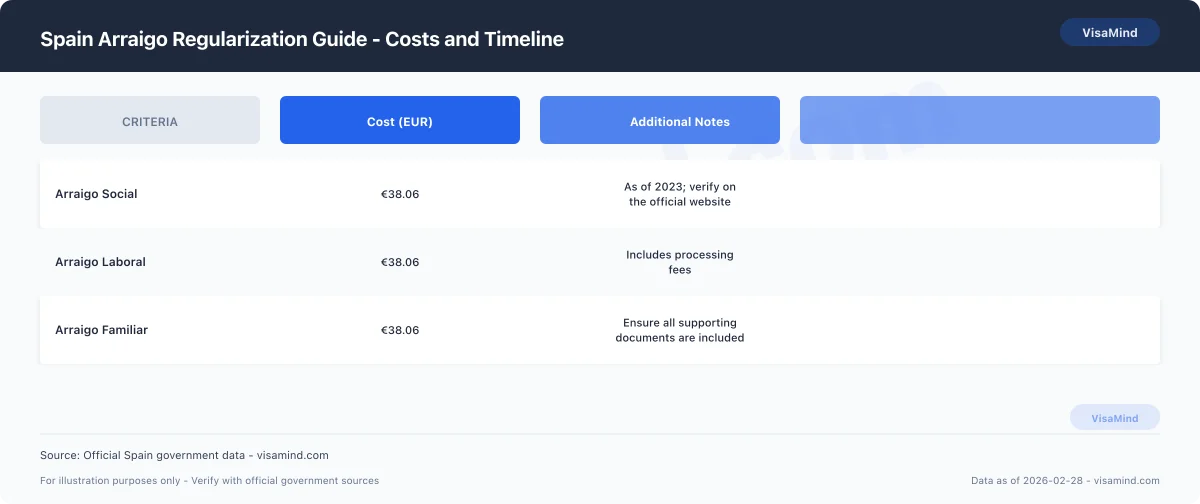
When applying for residence and work authorization under exceptional circumstances like the Arraigo Regularization, understanding the associated fees and timeline is essential. Here's what you need to know about the costs, processing times, and what to expect during this process.
Fees and Costs
The fees for applying through the Arraigo Regularization can vary depending on the specific type of application and circumstances.
| Arraigo Type | Processing Fee (EUR) |
|---|---|
| Social Ties (Arraigo Social) | €36.78 |
| Employment Ties (Arraigo Laboral) | €36.78 |
| Family Ties (Arraigo Familiar) | €36.78 |
Tip: Make sure to verify the current fees on the official State Secretariat for Migration (SEM) website as these figures can change.
Timeline
The processing time for Arraigo Regularization applications with the SEM typically varies based on the complexity and completeness of your application. Here’s a general overview:
| Arraigo Type | Estimated Processing Time |
|---|---|
| Social Ties | 3-6 months |
| Employment Ties | 3-6 months |
| Family Ties | 3-6 months |
Important: Delays can occur if documentation is incomplete or if further evidence of exceptional circumstances is required.
What to Expect
-
Initial Submission: After gathering your documents and lodging your application, you'll receive an acknowledgment from the immigration office.
-
Review Process: Your application will be reviewed by the SEM to confirm eligibility and verify all supporting documentation.
-
Decision: Once a decision is made, you will be notified. If approved, you'll be granted residence and work authorization under the specific category of Arraigo you applied for.
-
Post-Approval Steps: If approved, you might need to register with the local authorities and apply for a NIE (Número de Identificación de Extranjero) or TIE (Tarjeta de Identidad de Extranjero).
For more detailed guidance on the steps involved, you can refer to the How To Apply guide, which provides insights on preparing your application. Additionally, consider checking the Processing Times guide for the most current timeline information.
What Experienced Applicants Recommend
#You can learn a lot from the experiences of past applicants. Here are some practical tips to help you navigate the process more smoothly.
Preparing Your Application
- Gather Comprehensive Evidence: Ensure all your documents clearly demonstrate your exceptional circumstances, such as social, labor, or family ties. Insufficient evidence is a common pitfall.
- Use the Correct Application Form: Different types of arraigo require specific forms. Double-check that you're using the correct one for your situation. For example, refer to the Arraigo Social, Arraigo Laboral, or Arraigo Familiar guides for more information on specific requirements.
Navigating the Submission Process
- Review Instructions Carefully: Before lodging your application, review the instructions pertinent to your eligibility category. This can prevent submitting incomplete applications, a common error that leads to delays.
- Timing Matters: Be aware of deadlines and processing times. As of 2023, processing can take several months, so apply as early as possible. For more details on timelines, consult the Processing Times guide.
Common Pitfalls and How to Avoid Them
- Incomplete Applications: Ensure that every section of your application is complete before submission. Missing information can result in delays or rejections.
- Keep Copies of Everything: Maintain a file of all submitted documents and correspondence. This can be invaluable if you need to reference past communications or if documents are misplaced.
Tip: If possible, apply online through the SEM's platform to receive a receipt number immediately, which can help track your application's status.
Follow-Up and Communication
- Stay Informed: Keep track of your application status through the How To Apply guide and be proactive if there are delays.
- Be Prepared for Interviews: Depending on your case, you might be required to attend an interview. Prepare by reviewing the Interview Prep guide to ensure you're ready to discuss your circumstances.
By learning from others’ experiences, you can increase your chances of a successful application for arraigo regularization in Spain. Remember, thorough preparation and understanding of the process are crucial to navigating this complex procedure.
What Goes Wrong Most Often
#Tip: Ensure that all your documents are translated into Spanish by a certified translator to avoid any processing delays.
Common Mistakes in Document Submission
-
Insufficient Evidence: One of the most frequent issues is failing to provide enough evidence of exceptional circumstances. Applicants often overlook the importance of detailed documentation to support their claims, such as proof of social, labor, or family ties. It's crucial to gather comprehensive documents that clearly demonstrate your situation, which might include employment contracts, certificates of social integration, or family records.
-
Incomplete Applications: Submitting incomplete applications is another common pitfall. Make sure every required section of your application is complete, and double-check that you have included all necessary documents. Missing a single document or leaving a section blank can lead to application rejection.
Misunderstanding Eligibility Requirements
-
Choosing the Wrong Category: Applicants sometimes select the wrong arraigo category, which can result in an application being denied. For example, if you are applying under Arraigo Social, ensure that you meet the specific criteria for social ties. Familiarize yourself with each category's requirements by reviewing guides such as the How To Apply and Visa Refusal Reasons.
-
Not Meeting Residency Criteria: Many applicants fail to meet the residency duration requirement before applying. Generally, you need to have resided in Spain continuously for a certain period, often three years, to qualify for arraigo. Verify this requirement and plan your application timing accordingly.
Errors in Form Completion
-
Incorrect Form Use: Using the wrong form is a frequent error. Since the correct form depends on your specific situation, carefully select the appropriate form from options like EX-01 or EX-04. Refer to the Documents Checklist to ensure you are using the correct paperwork.
-
Language Mistakes: Forms must be completed in Spanish. Mistakes in language can cause confusion or misinterpretation of your details. If Spanish is not your first language, consider seeking assistance to fill out your application accurately.
Important: Regularly check the official SEM website for updates on application requirements and deadlines to avoid missing any critical information.
Real-World Examples
#A young chef from Argentina found herself in Spain with an expired tourist visa but had been living in Barcelona for over three years. She wanted to regularize her status through Arraigo Social due to her strong social connections and community involvement. To navigate the process, she gathered evidence of her community ties, such as letters from local organizations and a Spanish language course certificate. She approached the Secretaría de Estado de Migraciones (SEM) to lodge her application and used the specific EX-10 form for Arraigo Social. After submitting her application and supporting documents, she received a favorable resolution within six months, granting her a temporary residence permit.
Scenario: Securing Residency through Labor Arraigo
A Brazilian construction worker had been employed in Madrid for over two years without a formal contract. He learned about the Arraigo Laboral option, which could regularize his status based on his employment in Spain. He consulted with a migration advisor who helped him gather necessary documents, such as payslips and a declaration from his employer confirming his work history. By filing the MI-T form with the SEM, he demonstrated his labor ties. After several months, he received approval for a work and residence permit, providing him the legal status to continue working and living in Spain.
Scenario: Navigating Family Arraigo for Reunification
A Moroccan woman living in Valencia sought residency through Arraigo Familiar to join her Spanish citizen daughter. She prepared her application by collecting proof of her daughter's citizenship and evidence of their relationship, such as birth certificates and family photos. She submitted her application to the SEM using the appropriate form, ensuring all sections were complete and accurately reflected her circumstances. Within five months, she was granted a residence permit, allowing her to remain in Spain and strengthen her family bonds.
FAQs
Can I switch from Arraigo Social to Arraigo Laboral using the Spain Arraigo Regularization Guide?
How long does the State Secretariat for Migration take to process the Spain Arraigo Regularization?
What is the purpose of the EX-10 form in the Spain Arraigo Regularization Guide?
Can I combine an internship with the Spain Arraigo Regularization application?
What evidence is required for the Spain Arraigo Regularization Guide?
Is it possible to apply for Spain Arraigo Regularization under humanitarian reasons?
What fees are associated with the Spain Arraigo Regularization application?
VisaMind provides informational guidance only and is not a government agency. This is not legal advice. Requirements can change and eligibility depends on your specific facts. If your case is complex or high-stakes, consult a licensed immigration attorney.
Next steps
Requirements vary by nationality, purpose, timeline, and case details. Use Find My Visa to get a personalized checklist for Spain with official sources and deadlines.
Find my visa