Do You Need a Visa?
#For those planning a longer stay in Thailand, understanding the visa requirements is essential. Thailand offers a variety of visa-free entry options, but these typically cater to short visits. For extended stays, you'll likely need to explore visa options such as the Long-Term Resident (LTR) Visa, which is designed for specific categories of foreign nationals.
Visa-Free Entry
Thailand allows nationals from 64 countries to enter without a visa for stays of up to 30 days. This is part of the Visa Exemption Program, which can be extended once for an additional 30 days within Thailand. However, if your intention is to stay longer, this option will not suffice, and a visa application will be necessary.
When Is a Visa Required?
A visa is required for stays beyond the visa-free period or if you intend to engage in activities not covered by the visa exemption, such as work or study. Specific types of visas, like the Tourist Visa or Non-Immigrant Visa O, cater to different purposes and durations of stay.
Long-Term Resident (LTR) Visa
The LTR Visa is aimed at attracting wealthy or talented individuals to Thailand. It offers benefits like tax incentives and is available to four main categories:
- Wealthy Global Citizens: Must have at least USD 1 million in assets and invest a minimum of USD 500,000 in Thailand.
- Wealthy Pensioners: Must be 50 years or older with an annual unearned income of at least USD 80,000.
- Work-from-Thailand Professionals: Must have a minimum average personal income of USD 80,000/year over the past two years.
- Highly Skilled Professionals: Similar income requirements apply, and work must be in targeted industries.
Important: All conditions, such as investment and employment criteria, must be maintained throughout the visa's duration.
Application Process
To apply for the LTR Visa, you need to submit an online application for qualifications endorsement, followed by a pre-approval process. This involves submitting additional documents and can take 1-3 working days. Once pre-approved, you will need to make an appointment for visa issuance either at a Royal Thai Embassy or at the One Stop Service Center in Thailand.
For more detailed guidance on visa application procedures, visit the How To Apply and Documents Checklist guides.
Which Visitor Visa Fits Your Trip?
#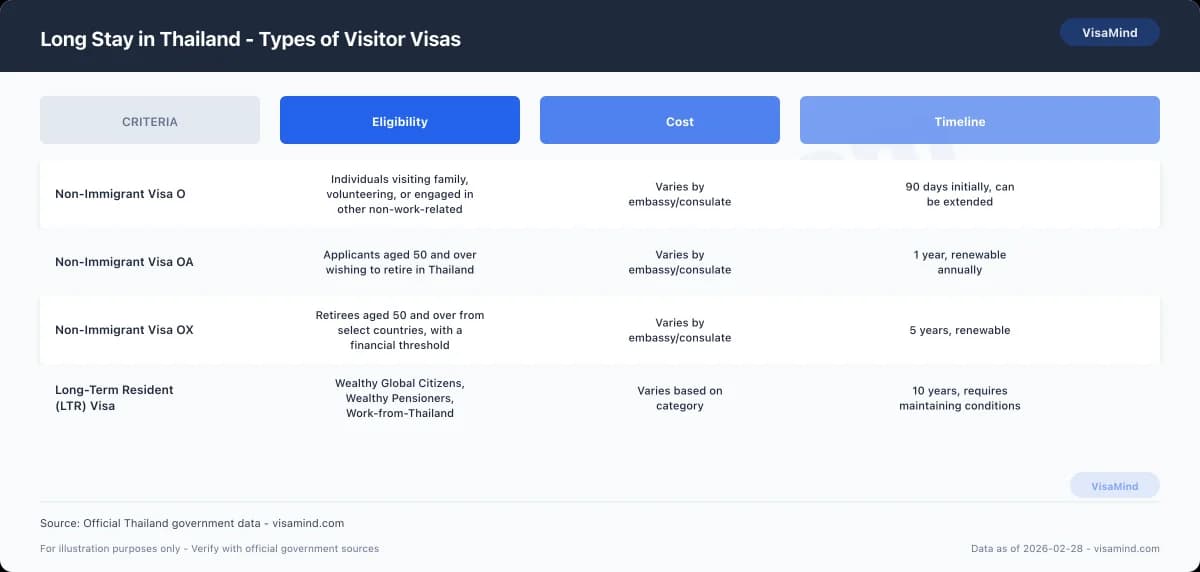
Thailand offers a variety of visitor visas to accommodate different types of long stays. Whether you're planning to retire, work, or even live with family, choosing the right visa is essential. Below is a comparison of the available visitor visa types, outlining their key differences.
| Visa Type | Eligibility | Cost | Timeline |
|---|---|---|---|
| Tourist Visa | General tourists who wish to visit Thailand for leisure | Approximately THB 2,000 | Processing times vary; check with the nearest Thai embassy |
| Non-Immigrant B Visa | Individuals working for a Thai company or conducting business in Thailand | Varies based on specific circumstances | Usually processed within 5-10 business days |
| Non-Immigrant O Visa | Spouses of Thai nationals, volunteers, retirees, and dependents | Varies depending on the category | Processing times vary; verify with the Thai embassy |
| Non-Immigrant OA Visa | Retirees aged 50 and above, meeting specific financial requirements | Costs include application fees and health insurance | Typically processed within 10-15 business days |
| Long-Term Resident (LTR) Visa | Targets wealthy individuals, retirees, skilled professionals, and digital nomads | Application fees plus potential investment requirements | Pre-approval takes 1-3 working days |
What Is the Long-Term Resident (LTR) Visa?
The Long-Term Resident (LTR) Visa is designed for affluent individuals and professionals. It offers significant benefits, including tax exemptions and the possibility of a long stay for up to 10 years. Applicants must meet specific financial and professional criteria, such as holding at least USD 1 million in assets or having a personal income of USD 80,000/year. For more details, refer to the How To Apply guide.
Are Non-Immigrant Visas Right for You?
Non-Immigrant Visas come in various categories, each serving different purposes. The Non-Immigrant O Visa suits those looking to retire or live with family, while the Non-Immigrant B Visa is geared towards business and employment. These visas typically require proof of financial stability or employment.
Tip: Ensure all documents are complete and valid when applying, as incomplete submissions can delay processing times.
Considerations for Retirees
For retirees, the Non-Immigrant OA Visa offers a straightforward path to enjoying a long stay in Thailand. Applicants must be over 50 and meet financial thresholds, including health insurance coverage. The Retirement Guide provides additional information on eligibility and document requirements.
Choosing the correct visa type depends heavily on your personal circumstances and goals for staying in Thailand. It's crucial to gather all necessary documentation and understand the requirements specific to each visa category. For a comprehensive list of documents needed, consult the Documents Checklist.
Document Requirements
#One must be prepared to meet specific document requirements for the Long-Term Resident (LTR) Visa. This visa is designed to attract individuals such as Wealthy Global Citizens, Wealthy Pensioners, Work-from-Thailand Professionals, and Highly Skilled Professionals. Each category has distinct requirements, so it is crucial to gather all necessary documentation.
Personal Identification and Photos
- Passport: A valid passport with at least six months of validity remaining.
- Photographs: Two recent passport-sized photos, typically 4x6 cm, taken against a white background.
Financial Proof
- Wealthy Global Citizens: Proof of holding at least USD 1 million in assets and investment of at least USD 500,000 in Thailand.
- Wealthy Pensioners: Evidence of a minimum unearned income of USD 80,000 per year.
- Work-from-Thailand Professionals and Highly Skilled Professionals: Proof of a minimum average personal income of USD 80,000 per year over the past two years.
Important: All financial conditions must be maintained throughout the validity of the visa to avoid complications.
Employment and Expertise
- Employment Contract: For professionals, a valid employment contract or proof of expertise in targeted industries is required.
- Qualifications Endorsement: An online application for qualifications endorsement along with supporting documents must be submitted.
Health and Insurance
- Health Insurance: Proof of valid health insurance covering the duration of your stay in Thailand.
- Social Security Benefits: Documentation of social security benefits, if applicable.
Additional Documents
- Proof of Assets or Investments: Documents verifying assets or investments in Thailand.
- Pre-Approval Documents: Additional documents might be requested during the pre-approval process, which typically takes 1-3 working days.
Tip: To streamline the process, consider scheduling your LTR Visa issuance appointment at a Royal Thai Embassy or the One Stop Service Center as early as possible.
For more detailed information on financial requirements, you can refer to the Financial Requirements guide. Additionally, the Documents Checklist provides a comprehensive overview of the necessary paperwork for various visa types, including the LTR Visa. Being well-prepared with the correct documentation will facilitate a smoother application experience.
Submitting Your Visitor Visa
#-
Determine Your Eligibility
Before beginning the application process for a long stay in Thailand, ensure you meet the eligibility criteria for the type of visa you are pursuing. For instance, the Long-Term Resident (LTR) Visa is available to wealthy global citizens, wealthy pensioners, work-from-Thailand professionals, and highly skilled professionals. Each category has specific financial and occupational requirements that must be satisfied and maintained throughout the visa duration. For more details on financial thresholds, refer to the Financial Requirements.
-
Register and Submit an Online Application
Start by registering your application through the official Immigration Bureau of Thailand's online portal. This involves submitting your qualifications for endorsement, which verifies that you meet the necessary requirements for the chosen visa category. You'll need to provide evidence such as proof of assets or employment contracts. The initial pre-approval process generally takes 1-3 working days, but this could extend if further documentation is required.
Tip: Ensure all documents are complete and valid to avoid delays or a possible rejection during the pre-approval stage.
-
Schedule an Appointment
After obtaining pre-approval, you will need to schedule an appointment for visa issuance. This can be done at the nearest Royal Thai Embassy or Consulate if you are applying from outside Thailand. If you are already in Thailand, you might visit the One Stop Service Center for visa processing. It's advisable to book your appointment in advance to secure a suitable date and time.
-
Attend Your Appointment
On the day of your appointment, bring all necessary documents, including your pre-approval confirmation and any additional documents required by your visa type. The appointment will typically involve verification processes and possibly an interview. For comprehensive preparation, consider reviewing the Interview Prep guide.
-
Receive Your Visa
Once your application is approved, your visa will be issued. Ensure you understand the visa conditions, including any financial or employment obligations, as failing to maintain these can jeopardize your stay. If your visa type requires a work permit, apply for it immediately after receiving your LTR Visa to avoid any legal issues.
-
Link Dependent Applications
If you have dependents, such as a spouse or children, who will accompany you, make sure to correctly link their applications to yours. This step is crucial to ensure that their dependent visas are processed and approved in conjunction with your own.
Important: Failing to link dependent applications correctly can result in processing delays or the need to reapply.
For further guidance, consult the How To Apply section for a detailed overview of the application process.
What to Avoid
#It's crucial to be aware of common pitfalls that can jeopardize your visa status. Here are some key areas to avoid:
Overstaying Your Visa
-
Fines and Penalties: Overstaying your visa can lead to daily fines. As of 2023, the fine is 500 THB per day. It's important to keep track of your visa's expiration date and plan renewal or departure accordingly.
-
Blacklist Risks: Extensive overstays (more than 90 days) can lead to being blacklisted from re-entering Thailand for up to 10 years. Always ensure compliance with visa conditions and deadlines.
Working on a Tourist Visa
-
Prohibited Activities: Engaging in any form of work without the appropriate Non Immigrant B or Smart Visa is illegal. This includes both paid and unpaid work and can lead to deportation.
-
Apply for the Correct Visa: If you plan to work, ensure you have the correct visa type and a work permit from the Immigration Bureau of Thailand.
Insufficient Financial Resources
-
Financial Evidence: Certain visas, like the Long-Term Resident (LTR) Visa, require proof of substantial financial resources. For example, wealthy global citizens need at least USD 1 million in assets.
-
Maintenance of Funds: Ensure that you maintain the required financial thresholds throughout your stay. Dropping below these thresholds can jeopardize your visa status.
Important: Failure to maintain the required investment amounts or employment status can lead to visa revocation. Regularly verify your compliance with all conditions on the official Immigration Bureau website.
Maintaining awareness of these common pitfalls can help prevent complications during your long stay in Thailand. Always consult the Visa Extension Guide for more detailed advice on staying compliant with Thai immigration requirements.
What Happens at Immigration
#When arriving in Thailand for a long stay, you will go through several immigration procedures designed to ensure a smooth entry. This process is managed by the Immigration Bureau of Thailand and may include fingerprinting, interviews, and the use of e-gates.
Fingerprinting and Biometric Data
Upon arrival, the collection of biometric data, including fingerprints, is standard practice. This step is crucial for verifying identity and maintaining security.
- Fingerprint Scans: Typically, all ten fingers are scanned.
- Facial Recognition: Photographs may also be taken as part of the biometric data collection.
Important: Ensure your hands are clean and free of any cuts or abrasions to avoid delays during fingerprinting.
Interviews at Immigration
Depending on your visa type, you may be subject to an interview with an immigration officer. This is particularly relevant for those on the Long-Term Resident (LTR) Visa and other long-stay visas.
- Purpose of Visit: Be prepared to discuss the reasons for your long stay in Thailand.
- Supporting Documents: Have your visa paperwork, proof of funds, and any other relevant documents ready for review.
Tip: Review the Interview Prep guide to better prepare for potential questions.
E-Gates for Faster Processing
Thailand's major airports offer e-gates for expedited processing, primarily available to citizens and residents. However, some long-term visa holders may also be eligible.
- Eligibility: Check your visa category for e-gate eligibility.
- Process: Simply scan your passport and follow the on-screen instructions.
Final Steps
Once these procedures are completed, you will receive an entry stamp indicating the duration of your stay. Ensure this aligns with your visa type and any specific conditions associated with it.
For further guidance on transitioning into life in Thailand, including how to apply for a work permit once you have your LTR Visa, refer to the Visa Extension Guide and Retirement Guide for additional insights.
Options If You Want More Time
#If you're planning an extended stay in Thailand, you have several options to extend your time in the country. Extensions are crucial for those who wish to remain longer than initially planned, and understanding how to apply for them can save you from potential complications.
How to Extend Your Stay
For individuals holding a Long-Term Resident (LTR) Visa, extensions are possible, but each visa category has its own set of requirements. Typically, extensions must be applied for through the Immigration Bureau of Thailand. It's important to ensure that all conditions stipulated by your visa type, such as maintaining certain investment levels or employment status, are consistently met.
Applying for an Extension
To apply for an extension, you must gather the necessary documents, which may include proof of investments, employment contracts, or health insurance, depending on your visa category. The application process often starts with an online application for qualifications endorsement. After submitting additional required documents, you should make an appointment for visa issuance at the Royal Thai Embassies or the One Stop Service Center.
Important: Ensure you maintain valid health insurance and social security benefits throughout your stay. Failure to do so can jeopardize your extension application.
Common Pitfalls to Avoid
Several common pitfalls can delay or complicate the extension process. These include not maintaining the required financial or employment conditions or failing to apply for a work permit promptly after receiving your LTR Visa. Additionally, submitting incomplete or incorrect documentation can result in delays or denials. For those with dependents, make sure their applications are correctly linked in the system to avoid any issues.
Tip: File your application online to avoid delays and receive a receipt number immediately, ensuring a smoother process.
For more guidance on extending your stay, consider consulting the Visa Extension Guide to better understand the steps involved and any specific requirements associated with your visa type.
What Other Visitors Experienced
#A retired entrepreneur, eager to settle in Thailand, was attracted by the Thailand Long-Term Resident (LTR) Visa for its appealing benefits. To qualify as a Wealthy Global Citizen, he needed to invest at least USD 500,000 in Thailand. He chose to invest in local real estate and government bonds. Working with a local financial advisor, he ensured all necessary investments were properly documented. He then registered on the official Immigration Bureau portal to submit his application and supporting documents for qualifications endorsement. After a week, he received pre-approval and scheduled an appointment at the One Stop Service Center in Bangkok. Within a month, he was granted his LTR Visa, allowing him to enjoy the economic opportunities and rich culture of Thailand.
Scenario: Highly Skilled Professional Securing a Work Permit
An IT specialist from Singapore wanted to capitalize on the opportunities in Thailand's burgeoning tech industry. He qualified for the LTR Visa as a Highly Skilled Professional due to his expertise and income level. After securing a job with a Thai tech firm, he submitted an online application for qualifications endorsement through Thailand's Immigration Bureau system. Despite initial hiccups with incomplete documentation, he promptly submitted missing documents upon request. Once his visa was issued, he immediately applied for a work permit, a critical step often overlooked. Thanks to timely action and adherence to guidelines, he was able to start his new role within two months.
Important: Always apply for a work permit immediately after receiving the LTR Visa to avoid legal issues with employment in Thailand.
Scenario: Wealthy Pensioner Managing Income Verification
A retired university professor from Canada, aged 65, dreamed of spending his golden years in Thailand. With an unearned income exceeding USD 80,000 per year, he was eligible for the LTR Visa as a Wealthy Pensioner. He faced challenges in proving his income due to varied income statements from multiple pension plans. By consulting a Thai immigration lawyer, he compiled all necessary financial documents, ensuring they met the Immigration Bureau's requirements. After a meticulous review process, he successfully lodged his application online. Within three weeks, he received his visa, granting him the ability to enjoy Thailand's warm climate and vibrant community fully.
Tip: Ensure all financial documents are clear and corroborate your income claims to avoid delays during the application process.
FAQs
What documents are required for a Long Stay in Thailand with a Long-Term Resident Visa?
How long does the Immigration Bureau of Thailand take to approve a Long-Term Resident Visa for a Long Stay in Thailand?
Can my spouse work in Thailand on a Long-Term Resident Visa for a Long Stay in Thailand?
What happens if I don't maintain my investment levels during my Long Stay in Thailand on a Long-Term Resident Visa?
Is it possible to apply for Permanent Residence after a Long Stay in Thailand with the LTR Visa?
What is the minimum income requirement for Work-from-Thailand Professionals seeking a Long Stay in Thailand with the LTR Visa?
How can I extend my Long Stay in Thailand if my Long-Term Resident Visa is about to expire?
Sources
Last reviewed: March 1, 2026
VisaMind provides informational guidance only and is not a government agency. This is not legal advice. Requirements can change and eligibility depends on your specific facts. If your case is complex or high-stakes, consult a licensed immigration attorney.
Next steps
Requirements vary by nationality, purpose, timeline, and case details. Use Find My Visa to get a personalized checklist for Thailand with official sources and deadlines.
Find my visa