On this page
Who Moves Here and Why
#Thailand has become a sought-after destination for a diverse range of individuals, from retirees to skilled professionals, thanks to its attractive Long-Term Resident (LTR) Visa options. Designed to appeal to high-potential foreign nationals, the LTR Visa provides significant tax and non-tax benefits, making it an ideal choice for those looking to establish a long-term presence in the country.
Why People Are Moving to Thailand
Thailand's vibrant culture, affordable living costs, and strategic location in Southeast Asia make it a compelling destination for many. The Wealthy Global Citizen category is particularly popular, attracting individuals with at least USD 1 million in assets who are willing to invest at least USD 500,000 in Thailand. This visa not only opens doors to a rich cultural experience but also offers financial incentives for investors.
Retirees are another significant group moving to Thailand. The country's appeal to Wealthy Pensioners is evident, as those aged 50 and above with an annual unearned income of USD 80,000 can enjoy a comfortable retirement in a tropical paradise. The relaxed lifestyle, coupled with quality healthcare facilities, makes Thailand a top choice for retirees.
Skilled Professionals and Remote Workers
Thailand is also a hub for Highly Skilled Professionals and Work-from-Thailand Professionals, especially those in targeted industries like technology and healthcare. With a minimum average income requirement of USD 80,000 per year, these individuals are drawn by Thailand's booming economy and the opportunity to work in a dynamic environment. Remote workers appreciate the flexibility Thailand offers, along with its excellent internet infrastructure and vibrant expatriate community.
Family Accompaniment
The LTR Visa extends benefits to family members as well, allowing the spouse and children of visa holders or applicants to apply for a dependents’ visa. This family-friendly policy ensures that the move to Thailand is seamless for all members of the household.
Tip: Ensure all required conditions, such as investment amounts and proof of income, are maintained throughout the visa period to avoid complications.
For those looking to explore other visa options, such as the Non Immigrant O-A (Retirement) or Smart Visa, Thailand offers a range of choices tailored to various needs. Whether you are interested in investment, retirement, or professional opportunities, Thailand's diverse visa options cater to an array of lifestyles and ambitions.
Joining Family Members
#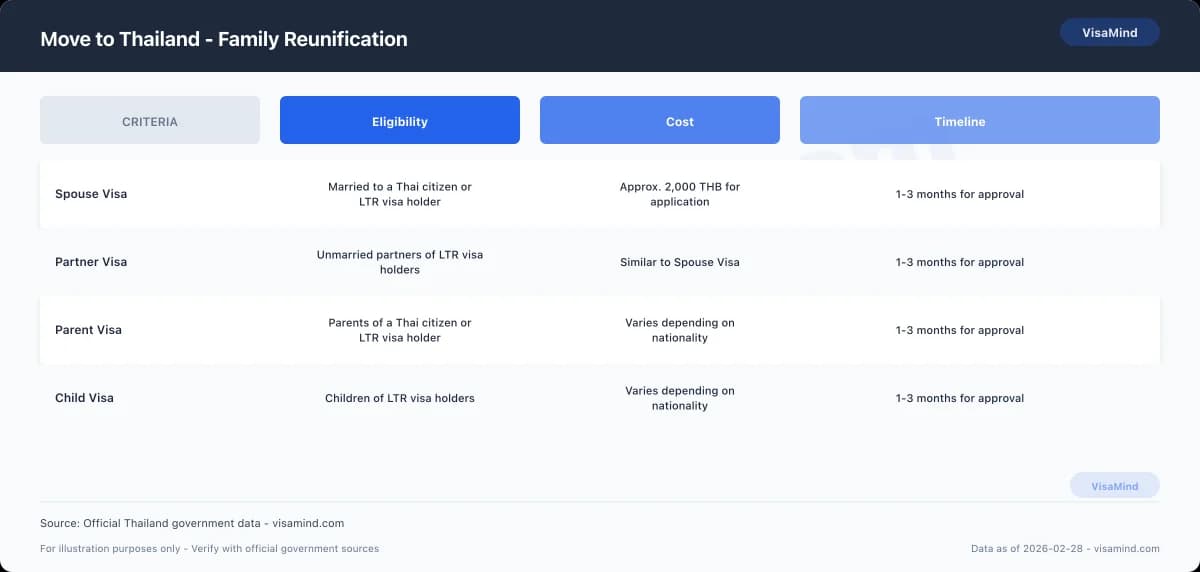
And children is essential. Thailand offers specific visas designed to facilitate family reunification, providing a pathway for dependents of Long-Term Resident (LTR) visa holders or applicants of other eligible visa categories. Below, we compare the options available for family members looking to join their loved ones in Thailand.
Visa Pathways for Joining Family Members
| Visa Type | Eligibility | Cost | Timeline |
|---|---|---|---|
| Dependent Visa for LTR Holders | Spouse and children of LTR visa holders or applicants of any eligible visa types | Varies by nationality | 1-3 working days for pre-approval |
| Non-Immigrant O | Spouse, children, or parents of Thai nationals or foreigners on a valid Thai visa | Varies by nationality | Varies; check with local embassy |
| Non-Immigrant O-A (Retirement) | Spouses of retirees holding a Non-Immigrant O-A visa | Varies by nationality | Varies; check with local embassy |
What Are the Requirements?
For family members to join you in Thailand, certain documentation and criteria must be met:
- Proof of Relationship: Marriage certificate for spouses, birth certificates for children, or other legal documents to establish familial relationships.
- Financial Proof: Depending on the visa type, you may need to demonstrate financial stability or income to support family members.
- Insurance: Health insurance covering the duration of stay may be required, particularly for long-term visas.
How to Apply?
The application process for bringing family members to Thailand involves several steps:
- Online Application: Begin by registering and submitting the required documents for qualifications endorsement through the Immigration Bureau of Thailand.
- Pre-Approval Process: Submit additional documents as requested. This step generally takes 1-3 working days but may vary if more documents are needed.
- Visa Issuance Appointment: Once pre-approved, schedule an appointment with the Royal Thai Embassy or One Stop Service Center for visa issuance.
Important: Ensure all documents are complete and valid to avoid delays. Missing key documents can lead to rejection or postponement of your family’s visa application.
Key Considerations
- Maintain Eligibility: Ensure you meet all conditions, such as financial requirements and insurance, throughout the visa duration.
- Deadlines: Be mindful of application deadlines and appointment schedules to prevent any setbacks in the visa process.
For more information on the specific visa pathways, you can explore options such as the Non-Immigrant Visa O or the Non-Immigrant Visa O-A (Retirement). Additionally, you may find the Documents Checklist useful for preparing your application.
Skilled Migration Pathways
#For those considering a move to Thailand, there are various pathways for skilled migration, each with its own set of criteria and benefits. Below is a comparison of the skilled migration pathways available, focusing on the Long-Term Resident (LTR) Visa options for potential residents.
Skilled Migration Pathways to Thailand
| Visa Type | Eligibility Criteria | Cost | Processing Timeline |
|---|---|---|---|
| Wealthy Global Citizen | Must have at least USD 1 million in assets and invest a minimum of USD 500,000 in Thailand | Varies | Processing might take longer if additional documents are requested; initial pre-approval takes 1-3 days |
| Wealthy Pensioner | Retirees aged 50+ with a minimum unearned income of USD 80,000 per year | Varies | Initial pre-approval process takes 1-3 days; longer if extra documentation is needed |
| Work-from-Thailand Professional | Remote workers with a minimum average personal income of USD 80,000 per year | Varies | Initial endorsement within 1-3 days; follow-up with additional documentation |
| Highly Skilled Professional | Professionals in targeted industries with a minimum average personal income of USD 80,000 per year | Varies | Initial pre-approval process takes 1-3 days; longer if extra documentation is needed |
Key Requirements
To proceed with your application for an LTR Visa, it's crucial to meet specific requirements:
- Wealthy Global Citizen: Provide proof of assets and investments.
- Wealthy Pensioner: Show proof of pension or passive income.
- Work-from-Thailand Professional: Present an employment contract and proof of income.
- Highly Skilled Professional: Demonstrate proof of expertise and income.
Application Process Steps
-
Register Online: Begin by registering and submitting an application for qualifications endorsement through the Immigration Bureau of Thailand.
-
Submit Additional Documents: After receiving your qualifications endorsement, submit any required additional documents for pre-approval.
-
Schedule Visa Issuance: Once pre-approved, make an appointment for LTR Visa issuance at a Royal Thai Embassy or the One Stop Service Center in Thailand.
Important: Ensure you maintain all conditions of your visa, such as investment levels and income, throughout its duration to avoid penalties or revocation.
For more detailed guidance on the application process, you can explore the Documents Checklist and How To Apply Guide.
Common Pitfalls
- Documentation Errors: Make sure your documents are complete and valid when submitting for qualifications endorsement.
- Maintaining Eligibility: Keep employment status and investment amounts consistent throughout the visa period.
- Visa Issuance Deadlines: Schedule your visa issuance appointment promptly to avoid missing deadlines.
For further information on visas, you might also consider exploring options such as the Non Immigrant B for work purposes or the Smart Visa for tech and innovation professionals.
Getting PR Step by Step
#Determine Your Eligibility for Thai Permanent Residence
To start your journey towards obtaining Permanent Residence (PR) in Thailand, it's essential to confirm your eligibility. Thailand offers PR to individuals who have held a Non-Immigrant Visa for at least three consecutive years. Categories for PR eligibility include business investments, employment, expert skills, and family relationships with a Thai national.
Tip: If you're unsure about your category, reviewing the specific requirements for each eligibility type can be helpful. Visit the Permanent Residence page for more details.
Gather Required Documents and Evidence
Once you determine your eligibility, it's time to assemble the necessary documentation. This typically includes:
- A complete application form from the Immigration Bureau of Thailand.
- A valid passport with copies of all pages.
- Evidence of your financial stability, such as bank statements or proof of income.
- Documents supporting your eligibility category (e.g., employment contracts, marriage certificates).
- A recent police clearance certificate from your home country.
Ensure that all documents are in order and translated into Thai if originally in another language.
Submit Your Application to the Immigration Bureau
With your documents prepared, you can lodge your application at the Immigration Bureau. Note that applications are generally accepted once a year, usually in December, and there is a cap on the number of PR applications approved annually.
Important: Missing the submission window could delay your application by a year. Keep an eye on the Immigration Bureau's announcements regarding application acceptance periods.
Attend the Interview and Wait for Approval
Following the submission, you will be invited for an interview with the Immigration Bureau. This interview will assess your Thai language skills and verify the information provided in your application.
After the interview, there will be a waiting period for the approval process. The processing time can vary, so it's advisable to remain patient and prepared for additional document requests.
Finalize Your Permanent Residence Status
Upon approval, you will be notified to complete the final steps, which include paying the PR fee and registering your residence in Thailand. Once these steps are completed, you will receive your residence book (Tabien Baan) and a certificate of residence.
Successfully obtaining PR in Thailand grants you several benefits, such as the ability to purchase property and apply for Thai citizenship after a few years. For more guidance, consider reviewing the Visa Extension Guide and How To Apply for additional insights.
Understanding each step in this process and preparing accordingly will help ensure a smooth transition to permanent residency in Thailand.
Becoming a Citizen
#Becoming a Thai citizen is a significant step that involves meeting specific eligibility criteria and undergoing various assessments. The process can be lengthy, usually requiring several years of residency and other commitments.
Residency Requirements
To apply for Thai citizenship, you must have lived in Thailand continuously for at least five years. This requirement is typically met by holding a Long-Term Resident (LTR) Visa or another extended visa type, such as the Non-Immigrant Visa O or Permanent Residence. You must maintain your visa conditions, including investment and income levels, throughout this period.
Citizenship Tests and Language Proficiency
Applicants for Thai citizenship must demonstrate an understanding of the Thai language. This typically involves passing a language proficiency test that assesses your ability to read, write, and speak Thai. Additionally, you will be tested on your knowledge of Thai culture and history.
Important: Failing to demonstrate sufficient language skills or cultural knowledge can delay your application process significantly.
Dual Citizenship Rules
Thailand generally does not allow dual citizenship. If you are granted Thai citizenship, you may be required to renounce your original nationality. This requirement can vary based on bilateral agreements between Thailand and other countries. It is advisable to confirm the specifics of dual citizenship policies with the Immigration Bureau of Thailand.
Summary Table: Key Steps to Thai Citizenship
| Step | Requirement |
|---|---|
| Residency | Minimum 5 years continuous residency in Thailand |
| Language Proficiency | Pass Thai language test |
| Cultural Knowledge | Pass tests on Thai culture and history |
| Dual Citizenship | Generally not allowed; check specific agreements |
For more detailed guidance on the documentation needed and steps involved, you may refer to the Documents Checklist and Visa Extension Guide.
Tip: It's advisable to begin preparing for language and cultural exams early in your residency to ensure a smooth citizenship application process.
Obstacles to Watch For
#It's essential to be aware of potential obstacles that could arise during the immigration process. Here are some key areas to focus on:
Processing Times
- Pre-Approval Duration: The pre-approval process for the Long-Term Resident (LTR) Visa typically takes 1-3 working days. However, if additional documents are required, this could extend the timeframe. Always plan ahead and monitor the status of your application.
- Visa Issuance Appointment: After receiving pre-approval, you must schedule your visa issuance appointment at a Royal Thai Embassy or the One Stop Service Center. Missing the deadline for this appointment can significantly delay your move.
Important: Always check the Processing Times for the most up-to-date information, as delays can occur due to high demand or incomplete applications.
Financial Requirements
- Wealthy Global Citizens: Ensure you have at least USD 1 million in assets and have invested a minimum of USD 500,000 in Thailand. This must be maintained throughout your stay.
- Wealthy Pensioners and Professionals: Both categories require a minimum annual income of USD 80,000. Ensure you have verifiable proof of this income, as failing to provide sufficient documentation can lead to application denial.
Tip: For detailed financial guidelines, refer to our Financial Requirements guide.
Documentation Challenges
- Qualifications Endorsement: All applicants must first apply online for a qualifications endorsement. Ensure your documents are complete and valid to avoid delays or rejection.
- Proof of Compliance: Continuously monitor and maintain the required financial and employment conditions during your visa period. Non-compliance can jeopardize your visa status.
Remember, the Immigration Bureau of Thailand requires meticulous documentation and adherence to financial criteria. For retirees, consider reviewing the Retirement Guide for more tailored advice. By understanding these potential obstacles, you can better navigate the process of moving to Thailand.
Moving Through Investment
#To move to Thailand through investment, the Long-Term Resident (LTR) Visa offers an attractive option for those willing to invest significant funds or possess high income. This visa is designed to attract affluent individuals by offering various benefits, including tax advantages.
Investor Visa Options
For those considering an investment-based move to Thailand, the LTR Visa provides several categories:
- Wealthy Global Citizen: Requires holding at least USD 1 million in assets and investing a minimum of USD 500,000 in Thailand.
- Wealthy Pensioners: Available for retirees aged 50 and over with an unearned income of at least USD 80,000 per year.
- Work-from-Thailand Professionals: Targets remote workers with a minimum average personal income of USD 80,000 annually.
- Highly Skilled Professionals: For those in targeted industries, also requiring an average personal income of USD 80,000 per year.
Important: All conditions, including investment amounts and income levels, must be maintained throughout the visa's validity.
Application Process
The application process for the LTR Visa involves several steps:
- Qualification Endorsement: Register and submit your qualifications endorsement online, including necessary documents like proof of assets or income.
- Pre-Approval: Provide additional information as requested to complete the pre-approval process, typically taking 1-3 working days.
- Visa Issuance Appointment: Once pre-approved, schedule an appointment for visa issuance at a Royal Thai Embassy or the One Stop Service Center in Thailand.
Tip: To expedite the process, ensure all documentation is complete and accurate upon submission.
Key Considerations
- Documentation: Essential documents include proof of assets, income, employment contracts, or expertise, depending on your eligibility category.
- Dependents: Spouses and children of LTR Visa holders can apply for a dependents’ visa.
- Additional Visas: If your circumstances change or additional time is required, consider other options like the Non Immigrant B or Permanent Residence visas.
By understanding the requirements and maintaining all conditions, moving to Thailand through investment can be a viable and rewarding pathway. For a detailed checklist and processing timelines, refer to the Documents Checklist and Processing Times.
Options for Retirees
#Thailand offers a variety of visa options for retirees looking to enjoy their golden years in the Land of Smiles. A popular choice is the Non-Immigrant Visa O-A (Retirement), which is specifically designed for foreign nationals aged 50 and above who wish to retire in Thailand. This visa allows for an initial stay of one year, with the possibility of extensions. To qualify, applicants need to demonstrate a monthly income of at least THB 65,000 or a bank deposit of THB 800,000 in a Thai bank account.
Long-Term Resident (LTR) Visa for Wealthy Pensioners
For retirees with a more substantial unearned income, the Long-Term Resident (LTR) Visa offers an attractive option. To qualify as a Wealthy Pensioner, you must be at least 50 years old and have a minimum unearned income of USD 80,000 per year. This visa not only provides the opportunity to reside in Thailand long-term but also comes with various tax and non-tax benefits. You will need to furnish proof of your pension or passive income when applying.
Important: Ensure you maintain the required income throughout the duration of your LTR Visa. Failing to do so can affect your visa status.
Application Process
Applying for a retirement visa involves several steps. Initially, you must gather all necessary documents, such as proof of income or financial assets, and register for an online application for qualifications endorsement. After submitting the required documents for pre-approval, an appointment must be made at the Royal Thai Embassy or the One Stop Service Center for the final issuance of the visa.
For more details on the application process, consider checking our Retirement Guide or explore the How To Apply section for a step-by-step walkthrough.
Other Considerations
While the LTR Visa and Non-Immigrant Visa O-A are popular among retirees, you might also explore other options such as the Thailand Elite program, which offers residency privileges in exchange for membership fees. This could be an ideal option for those seeking additional benefits and services during their stay in Thailand.
Tip: Apply for your visa well ahead of your planned move to Thailand to avoid any last-minute complications.
The Financial Side of Moving
#Important: When considering a move to Thailand, ensure you meet the financial requirements for the specific visa category you are interested in. This includes maintaining income thresholds and investment levels throughout your stay.
Financial Requirements for Long-Term Resident Visa
When planning your move to Thailand, it's crucial to understand the financial obligations tied to obtaining a Long-Term Resident (LTR) Visa. This visa caters to different categories of individuals, each with specific financial requirements.
| Visa Category | Eligibility Criteria | Financial Requirements |
|---|---|---|
| Wealthy Global Citizen | Own at least USD 1 million in assets | Invest at least USD 500,000 in Thailand |
| Wealthy Pensioners | Retirees aged 50 years and older | Minimum unearned income of USD 80,000 per year |
| Work-from-Thailand Professionals | Remote workers | Minimum average personal income of USD 80,000 per year |
| Highly Skilled Professionals | Professionals in targeted industries | Minimum average personal income of USD 80,000 per year |
Maintaining Financial Compliance
To secure your LTR Visa, it is essential to maintain the stipulated financial conditions throughout the visa duration. This includes:
- Investment Amounts: For Wealthy Global Citizens, ensure your investments remain active in Thailand.
- Income Proof: Wealthy Pensioners and professionals must provide regular evidence of receiving the required income.
- Documentation: Be prepared to submit proof, such as bank statements or employment contracts, whenever required.
Tip: For a smooth application process, gather all necessary financial documents in advance and consider consulting with a financial advisor familiar with Thai immigration.
Application Process and Fees
The application process involves both an online submission for qualifications endorsement and a subsequent pre-approval phase, which typically takes 1-3 working days.
- Register and submit your application online with the Immigration Bureau of Thailand.
- Provide additional documents if requested during the pre-approval process.
- Schedule an appointment at the Royal Thai Embassy or the One Stop Service Center for visa issuance.
For detailed information on financial requirements, you can explore the Financial Requirements Guide or check out the Retirement Guide for retirees considering Thailand as a long-term destination.
Real Migration Journeys
#Jessica, a software developer from the United States, decided to embrace the digital nomad lifestyle and move to Thailand to work remotely. She was particularly drawn to the vibrant tech scene in Bangkok and the cultural richness of Chiang Mai. To support her relocation, Jessica applied for the Long-Term Resident (LTR) Visa under the Work-from-Thailand Professionals category. She prepared her application by gathering proof of her remote employment contract and ensuring her average annual income met the threshold of USD 80,000. After submitting her application through the Immigration Bureau of Thailand’s online portal, she received a qualifications endorsement within a few days. With her documents in order, Jessica made an appointment at the Royal Thai Embassy in Los Angeles for her visa issuance. Within a few weeks, she was granted her visa and could start her new life in Thailand, enjoying both professional fulfillment and personal adventure.
Scenario: Retiree Seeking a Peaceful Thai Retreat
David, a retired teacher from the UK, envisioned spending his golden years in the tranquil beaches of Phuket. He opted for the Wealthy Pensioner category of the LTR Visa, which required him to demonstrate a pension income of at least USD 80,000 annually. David meticulously prepared his financial documents, including pension statements and evidence of his savings. He submitted his application to the Immigration Bureau of Thailand online and awaited the qualifications endorsement. After a smooth pre-approval process, he was able to schedule his appointment at the Royal Thai Embassy in London. David’s application was successful, and he relocated to Thailand, where he now enjoys a peaceful retirement surrounded by natural beauty and a welcoming community.
Scenario: High-Profile Investor's New Home in Thailand
Amelia, an entrepreneur from Australia, was looking to expand her business ventures in Southeast Asia and saw Thailand as the perfect base due to its strategic location and dynamic economy. She applied for the LTR Visa under the Wealthy Global Citizen category, investing over USD 500,000 into Thai real estate and bonds. Amelia submitted her application with detailed proof of her assets and investments to the Immigration Bureau of Thailand. Following a thorough review, her qualifications were endorsed. She finalized her visa issuance at a One Stop Service Center in Bangkok, allowing her to settle in Thailand and manage her investments while enjoying the numerous benefits that come with the LTR Visa.
FAQs
What is the processing time for the LTR Visa application with the Immigration Bureau of Thailand?
Is it possible to switch from a Non-Immigrant Visa O to a Permanent Residence in Thailand?
What financial proof is required for Wealthy Global Citizens to move to Thailand?
Can I combine skilled migration and investment pathways to move to Thailand?
What happens if I miss the deadline for my visa issuance appointment in Thailand?
What are the key eligibility criteria for becoming a Highly Skilled Professional in Thailand?
What documents are required for the qualifications endorsement in the LTR Visa application?
Sources
Last reviewed: March 1, 2026
VisaMind provides informational guidance only and is not a government agency. This is not legal advice. Requirements can change and eligibility depends on your specific facts. If your case is complex or high-stakes, consult a licensed immigration attorney.
Next steps
Requirements vary by nationality, purpose, timeline, and case details. Use Find My Visa to get a personalized checklist for Thailand with official sources and deadlines.
Find my visa