Visa-Free or Visa Required?
#Thailand offers a variety of entry options depending on your nationality and the purpose of your visit. As of 2023, citizens from 64 countries can enter Thailand without a visa for tourism purposes for up to 30 days, under the Visa Exemption Program. However, if you are not from a visa-exempt country or plan to stay longer, different visa options are available.
Entry Options for Visiting Thailand
| Entry Type | Eligibility | Duration | Cost |
|---|---|---|---|
| Visa Exemption | Nationals from 64 countries | 30 days | Free |
| e-Visa on Arrival | 21 eligible countries | 15 days | Approx. 2,000 THB |
| Tourist Visa (TR) | Non-exempt countries or those requiring longer stays | 60 days | Varies by country |
| Non-Immigrant Visas | For specific purposes like business, study, or retirement | Varies | Varies by type |
Who Needs a Visa?
If your nationality does not fall under the visa exemption, you may need to apply for a Tourist Visa (TR), which allows a stay of up to 60 days and can be extended once in Thailand. This visa is suitable for longer leisure visits and requires a visit to a Royal Thai Embassy or Consulate before travel. For those engaging in activities beyond tourism, such as work or study, other visa types like the Non Immigrant B or Non Immigrant Ed may be applicable.
e-Visa on Arrival
For travelers from 21 countries, an e-Visa on Arrival is an option that facilitates a quicker entry process for short stays up to 15 days. This can be applied for online before arrival, reducing the time spent at immigration checkpoints.
Tip: If you are eligible for a Visa Exemption or e-Visa on Arrival, ensure your passport is valid for at least 6 months from your date of entry into Thailand.
Visa Extensions
Visitors who enter Thailand under the Visa Exemption can extend their stay by 30 days through the Immigration Bureau of Thailand, although this may incur additional fees. For those on a Tourist Visa (TR), a 30-day extension is often possible, providing more flexibility for your travel plans.
For comprehensive preparation, consult the Documents Checklist and familiarize yourself with How To Apply for your chosen entry type. Always verify the latest requirements and fees on the official website or by contacting the nearest Thai embassy or consulate.
Your Visitor Visa Options
#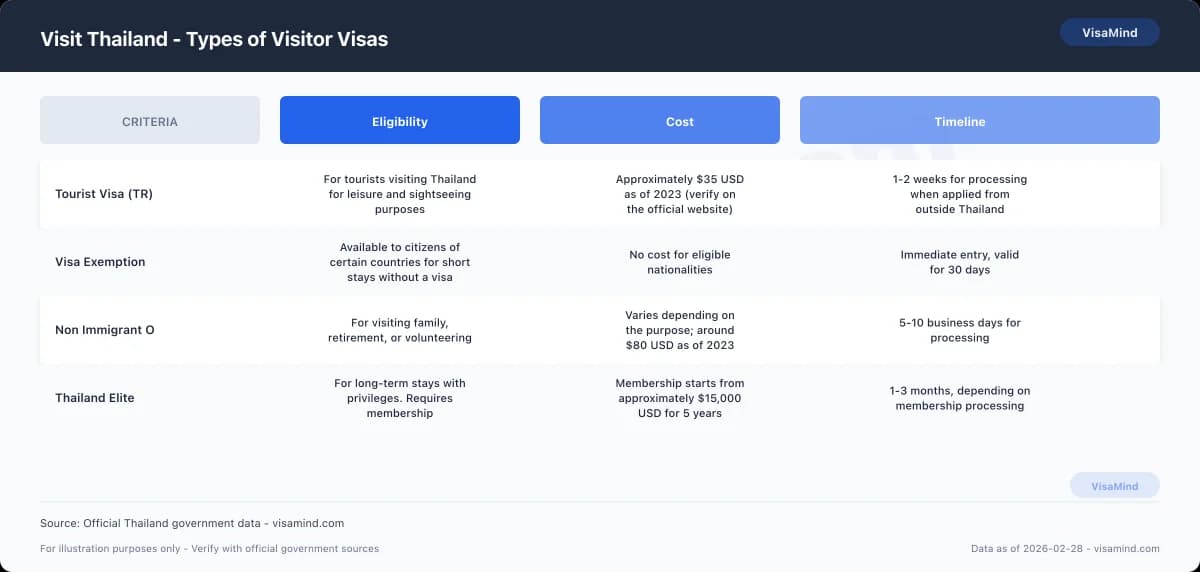
Understanding the various visitor visa options is crucial. Each visa type caters to different travel purposes and durations. Below is a comparison of the primary visitor visas available.
Visitor Visa Options
| Visa Type | Eligibility | Cost | Timeline |
|---|---|---|---|
| Tourist Visa (TR) | Individuals visiting for tourism purposes. | Varies by nationality and location of application. Verify on the official website. | Typically processed within 2-3 weeks. |
| Visa Exemption | Nationals of specified countries for short stays (usually up to 30 days). | No cost for eligible nationalities. | Immediate upon entry. |
| Special Tourist Visa (STV) | Long-stay tourists, allowing multiple entries for up to 9 months total. | Set fee as of 2023; verify on the official website. | Initial processing can take up to 4 weeks. |
Tourist Visa (TR)
The Tourist Visa (TR) is suitable if your primary purpose is leisure or visiting friends and family. This visa usually grants a stay of up to 60 days and can be extended for an additional 30 days at the Immigration Bureau in Thailand. It's perfect for extended holidays or those planning to explore Thailand's diverse regions.
Visa Exemption
Thailand offers a Visa Exemption scheme for nationals of selected countries. This allows you to enter Thailand without a visa for stays typically up to 30 days. This option is ideal for short-term visits but requires you to check if your nationality is eligible. Always verify the most current list of eligible countries and entry requirements.
Tip: If you plan to stay longer, consider applying for a Tourist Visa (TR) or extending your stay through the Visa Extension Guide.
Special Tourist Visa (STV)
For those interested in long-term stays, the Special Tourist Visa (STV) is an attractive option. It allows for an initial 90-day stay, renewable twice for a total stay of up to 270 days. This visa is geared towards long-term visitors and requires a pre-approved application before arrival. Note that this visa is subject to specific conditions, including entry requirements and health insurance.
Each visa type has distinct eligibility criteria and processes, so ensure you choose the right one for your travel needs. For detailed guidance on preparing your documentation and the application process, refer to the How To Apply guide.
What You Need to Apply
#To visit Thailand, ensuring you have the correct documentation is crucial. Below are the essential documents and requirements you'll need to apply for a visa to enter Thailand as a tourist.
Personal Documentation
- Passport: A valid passport with at least six months of validity beyond your planned stay in Thailand.
- Photographs: Two recent passport-sized photographs (4x6 cm), taken within the last six months.
- Visa Application Form: While not a "Visit Thailand" form, you must complete a visa application form at a Royal Thai Embassy or Consulate before traveling.
Financial Proof
- Proof of Funds: Demonstrate sufficient financial means to support your stay in Thailand. Generally, this means a bank statement showing at least 20,000 THB per person or 40,000 THB per family.
- Return Travel Ticket: Evidence of a return or onward travel ticket to confirm your planned exit from Thailand.
Important: Always have copies of your financial documents on hand in case they are requested by the Immigration Bureau upon arrival in Thailand.
Additional Documentation
- Accommodation Details: Proof of accommodation booking, such as a hotel reservation or a letter from a host in Thailand.
- Travel Itinerary: A detailed travel itinerary outlining your planned activities and destinations during your stay.
Specific Considerations
If you are applying for a different type of visa, such as a Non Immigrant B Visa for business or a Non Immigrant Ed Visa for education, additional documents may be required, such as a letter of invitation from a Thai company or educational institution.
Tip: Verify the latest visa requirements and processes on the official website of the Royal Thai Embassy or Consulate in your country to avoid any surprises.
Remember, maintaining up-to-date knowledge of the requirements will facilitate your entry into Thailand and help ensure a smooth journey.
How to Apply Step by Step
#Determine Your Visa Type
Before you begin the application process, identify the type of visa you need. If your visit is for tourism, you will likely need a Tourist Visa. For other purposes, consider options such as the Non Immigrant B for business or the Non Immigrant Ed for education. Each visa type has specific requirements you must meet.
Choose Your Application Method
You can apply for a visa to visit Thailand either online or through a Royal Thai Embassy or Consulate. The online application system is available for certain nationalities and visa types. This method can be convenient, as it allows you to manage documentation digitally.
-
Online Application: Check if your nationality is eligible for online applications. Gather all necessary documents before starting the process, such as your passport, photographs, and financial proof.
-
Embassy or Consulate Application: If you prefer or need to apply in person, locate the nearest Thai embassy or consulate. Schedule an appointment to submit your application and documents.
Gather Required Documents
Collect all necessary documents to support your application. Common requirements include:
- A valid passport with at least six months of validity
- Recent passport-sized photographs
- Proof of financial means, such as bank statements
- Travel itinerary or flight reservation
- Accommodation details
For a comprehensive list, refer to the Documents Checklist.
Lodge Your Application
-
Online: Submit your completed application through the online portal. Ensure all information is accurate and documents are properly uploaded.
-
At an Embassy or Consulate: Attend your scheduled appointment with all required documents. You may be asked to pay a visa fee during this visit.
Important: Ensure that all documents are complete and accurate before submission to avoid delays or rejections.
Wait for Processing
Processing times can vary based on the method of application and the specific visa type. Typically, online applications process faster. For embassy or consulate applications, inquire about the expected timeline during your appointment. For more information on timelines, visit the Processing Times guide.
Receive Your Visa
Once your application is approved, you will receive your visa. If you applied online, it might be sent electronically or you may need to visit the embassy to collect it. For in-person applications, you will usually pick up your visa from the embassy or consulate.
Tip: Consider applying well in advance of your intended travel dates to account for any potential processing delays.
By following these steps, you can efficiently navigate the process of applying for a visa to visit Thailand. Always double-check requirements and procedures with official Thai government sources to ensure compliance.
Pitfalls That Get Applications Denied
#Important: Violating visa conditions can lead to immediate deportation and potential bans on future entry to Thailand.
Overstaying Your Visa
- Consequences of Overstaying: Staying beyond your visa's expiration date can result in hefty fines and potential bans. Penalties increase the longer you overstay, and bans can range from one to ten years.
- Avoidance Tips: Track your visa expiration date and apply for an extension if needed. Extensions can often be arranged at the Immigration Bureau before your visa expires.
Engaging in Unauthorized Work
- Working on a Tourist Visa: It is illegal to work while on a tourist visa, such as the Tourist Visa (TR). Employment requires a valid work permit, typically associated with a Non Immigrant B Visa.
- Risk of Deportation: Engaging in work without appropriate authorization can lead to immediate deportation and a ban from re-entering Thailand. If you intend to work, ensure you have the correct visa and permits before starting employment.
Insufficient Financial Proof
- Financial Requirements: Demonstrating sufficient funds is crucial when applying for a visa. As of 2023, applicants typically need to show evidence of funds, such as bank statements, to support their stay. Verify on the official website for current requirements.
- Consequences of Non-Compliance: Failing to provide adequate proof of financial resources can lead to visa denial. Ensure your financial documentation is up-to-date and aligns with the Financial Requirements outlined by the Immigration Bureau.
Tip: Regularly review your financial documentation and stay informed about the latest requirements via the Visa Refusal Reasons guide to avoid common pitfalls.
At the Border
#Upon arriving in Thailand, you will go through the immigration process managed by the Immigration Bureau of Thailand. This process is crucial for ensuring the security and proper documentation of visitors entering the country.
Arrival Procedures
When you arrive at a Thai airport, you will typically pass through immigration control. Here, immigration officers will verify your documents and ensure that all entry requirements are met. Be prepared for the following steps:
- Passport Control: Present your passport, which should be valid for at least six months, and any relevant visa documents.
- Fingerprinting: As part of the security protocol, biometric data such as fingerprints may be collected. This is a standard procedure for many travelers.
- Interview: Depending on your circumstances, an immigration officer might ask a few questions about your travel plans, duration of stay, and accommodation in Thailand.
Important: Ensure that you have all necessary documents ready, including your return ticket and details of your accommodation, to facilitate a smooth entry process.
E-Gate Systems
Some airports in Thailand are equipped with e-gates to expedite the immigration process for eligible travelers. If you qualify to use the e-gate, you can expect a quicker entry experience. Here's how it works:
- Eligibility: Check if you are eligible to use the e-gates, as they are often available for Thai nationals and select foreign visitors.
- Process:
- Insert your passport into the e-gate machine for scanning.
- Look into the camera for facial recognition.
- Follow the on-screen instructions to complete the process.
Special Considerations
For travelers holding various types of visas, such as the Tourist Visa or Non Immigrant Oa, ensure you understand the specific conditions attached to your visa type.
- Visa Exemptions: If you are entering Thailand under a visa exemption, confirm the duration of stay permitted and any required registrations upon entry.
- Longer Stays: For those planning an extended visit, such as retirees or long-stay tourists, familiarize yourself with the Visa Extension Guide to understand how to legally extend your stay.
Tip: Familiarize yourself with common Visa Refusal Reasons to avoid potential issues at the border, ensuring all your documentation is complete and accurate.
Can You Stay Longer?
#If you're already in Thailand and wish to stay longer than initially planned, you might be eligible for a visa extension. The Immigration Bureau allows certain visa holders to apply for an extension to continue enjoying their time in the country.
How to Extend Your Stay
To extend your visa, you will need to visit a local Immigration Office in Thailand. The process generally involves:
- Gathering Required Documents: Typically, you'll need your passport, a recent photo, and the application form. For tourist visas, you may also need to show proof of financial means.
- Paying the Fee: As of 2023, the extension fee is 1,900 THB. Verify this on the official website for the most current information.
- Submitting Your Application: Lodge your application at the Immigration Office at least a week before your visa expires to avoid any overstay penalties.
Important: Overstaying your visa can lead to fines, detention, or even a ban from re-entering Thailand.
Eligibility for Extensions
Different visa types have varying eligibility for extensions:
- Tourist Visa (TR): Can often be extended for an additional 30 days.
- Non-Immigrant Visas: Extensions vary based on the specific visa type and purpose, such as Non Immigrant O or Non Immigrant Oa.
- Visa Exemption: Nationals from certain countries can extend their stay for 7 to 30 days.
Special Considerations
- Long-term Options: If you plan to stay in Thailand for an extended period, consider applying for a Thailand Elite membership or Permanent Residence.
- Retirement or Work: If your purpose changes to retirement or employment, you may need to switch to a relevant visa category, such as a Retirement Visa.
Tip: Always check the Visa Extension Guide for detailed steps and updates before proceeding with your application.
Real Scenarios
#An avid traveler, Maria decided to immerse herself in the cultural richness of Thailand beyond a typical tourist stay. Initially entering the country with a Tourist Visa (TR), Maria wanted to extend her visit without leaving the country. She approached the Immigration Bureau of Thailand to inquire about her options. By submitting a request for a visa extension at the local immigration office, Maria utilized the TM-7 form. After providing necessary documentation, including proof of her financial stability and accommodation details, Maria's extension was granted for an additional 30 days. This process took approximately two weeks, allowing her to explore Thailand's hidden gems longer than initially planned.
Scenario: A Digital Nomad's Journey to Thailand
Lucas, a freelance graphic designer, sought to experience the vibrant culture of Thailand while working remotely. He applied for a Visa Exemption to enter Thailand for a short stay. However, as his work picked up, Lucas wanted to extend his stay. He researched the possibility of transitioning to a Non Immigrant O visa, which would allow him a longer stay. Lucas gathered necessary documents, including financial proof and a letter explaining his remote work situation. He then visited the Immigration Bureau in Bangkok to process his application. Within a month, Lucas successfully obtained his new visa, enabling him to continue his creative projects from the picturesque landscapes of Thailand.
Scenario: A Retiree Enjoys Extended Stays in Thailand
John, a retiree with a love for Thailand's warm climate and welcoming communities, aimed to spend multiple months each year in the country. He initially traveled under the Visa Exemption program, which allowed him short stays. However, John desired longer visits without constant visa runs. Consulting the Royal Thai Embassy in his home country, he learned about the Non Immigrant Oa visa, tailored for retirees. After preparing his financial documents and health insurance as required, John applied for this visa type. The process, including an interview and background check, took about two months. Ultimately, John secured his visa, enabling him to enjoy Thailand's serene beaches and vibrant markets year-round, while managing his retirement funds efficiently.
FAQs
Can I extend my stay in Thailand if I enter via a visa exemption?
What is the fee for a Tourist Visa at the Thai Embassy?
Can I convert my Tourist Visa to a business visa while visiting Thailand?
What happens if my Tourist Visa application is denied?
What should I expect at the border when visiting Thailand with a Tourist Visa?
Can I visit Thailand on a Tourist Visa if I plan to study short-term?
How long can I stay in Thailand with a Tourist Visa?
VisaMind provides informational guidance only and is not a government agency. This is not legal advice. Requirements can change and eligibility depends on your specific facts. If your case is complex or high-stakes, consult a licensed immigration attorney.
Next steps
Requirements vary by nationality, purpose, timeline, and case details. Use Find My Visa to get a personalized checklist for Thailand with official sources and deadlines.
Find my visa