On this page
- Who Moves Here and Why
- Joining Family Members
- Skilled Migration Pathways
- Getting PR Step by Step
- Becoming a Citizen
- Obstacles to Watch For
- Moving Through Investment
- Options for Retirees
- The Financial Side of Moving
- Calculating Your Score
- Real Migration Journeys
- Visa options for this goal
- Guides for United Kingdom
- Other goals for United Kingdom
Who Moves Here and Why
#With over 200,000 people moving to the United Kingdom each year, the UK remains a top destination for a diverse range of migrants. Individuals are drawn to the UK for numerous reasons, including opportunities for skilled employment, family reunification, investment prospects, and retirement.
Skilled Migration
The UK offers a variety of pathways for skilled workers, making it an attractive option for those seeking employment in sectors such as technology, healthcare, and finance. The Skilled Worker Visa is a popular choice, enabling qualified individuals to work in the UK with a sponsoring employer. If you're a healthcare professional, you might consider the Health Care Worker Visa, which is tailored for those in the medical field. Additionally, the Global Talent Visa allows exceptionally talented individuals in fields like science, technology, and the arts to work in the UK without a job offer.
Family Reunification
Family ties are another significant reason people move to the UK. The Family Visa allows individuals to join their British or settled family members. This visa category supports spouses, partners, children, and parents in reuniting with their loved ones. To apply, you must provide evidence of your relationship, which can include joint bank statements or utility bills. For those married to a British citizen, the Spouse or Partner Visa is an essential option, provided you've lived in the UK for at least three years.
Investment and Retirement
The UK also attracts individuals looking to invest or retire. Investors can explore the Innovator Founder Visa, which is ideal for those planning to start a business in the UK. Retirees, on the other hand, might consider pathways that provide a peaceful transition to life in the UK, often leveraging existing family connections or investment options.
Tip: Before applying, ensure you meet any financial or salary requirements specific to your visa category. This will help avoid common pitfalls that could delay your application process.
Whether you're drawn by career opportunities, the desire to be close to family, or the allure of investing in a stable economy, moving to the UK offers numerous possibilities tailored to your personal and professional goals. For more detailed guidance, consult the How To Apply and Documents Checklist to ensure a successful application process.
Joining Family Members
#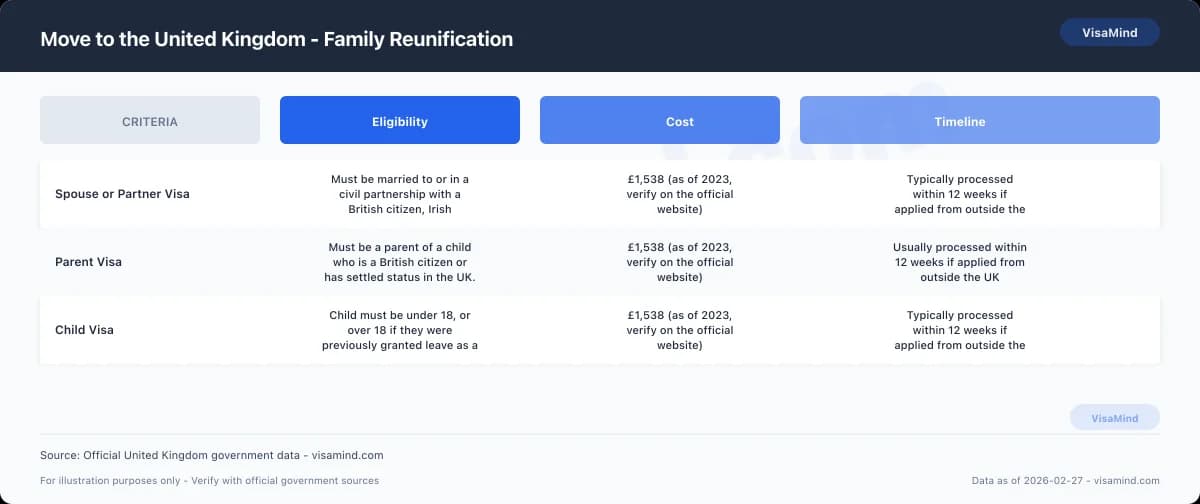
There are several visa pathways available. Each pathway has different eligibility requirements, costs, and processing times. Below is a comparison of the main family visa options in the UK.
| Visa Type | Eligibility | Cost | Timeline |
|---|---|---|---|
| Spouse or Partner Visa | Must be married to or in a civil partnership with a British or Irish citizen, or someone with settled status in the UK. Must prove relationship with documents like joint bank statements or utility bills. | Approximately £1,538 if applying from outside the UK. | 12 weeks for applications from outside the UK. |
| Family Visa | For joining a partner, parent, or child who is a British citizen or settled in the UK. Must meet financial requirements and provide evidence of relationship. | Varies depending on specific circumstances; generally starts around £1,538. | Similar to spouse visa, approximately 12 weeks if applying from outside the UK. |
| Child Visa | Child under 18 joining a parent in the UK who is a British citizen or has settled status. | Generally aligns with the family visa costs. | Processing times are similar to other family visas, around 12 weeks. |
| Parent Visa | For a parent to join a child who is a British citizen or settled in the UK. Must meet financial and relationship evidence requirements. | Costs are similar to the family visa, starting around £1,538. | 12 weeks if applying from outside the UK. |
How to Apply for a Family Visa
To apply for any of these family visas, you must gather the necessary documentation, including proof of your relationship, financial status, and English proficiency. Applications are submitted online through the UK Visas and Immigration (UKVI) portal. It's important to review the specific eligibility criteria for your situation before starting the application.
Tip: Ensure you have all the necessary documents ready before applying to avoid delays. Missing documents can lead to longer processing times or even refusals.
Key Considerations
- Financial Requirements: You may need to demonstrate a certain level of income or savings, which varies depending on your specific visa category and whether you are applying alone or with dependents.
- Relationship Evidence: Providing sufficient evidence of your relationship is crucial. This can include marriage certificates, birth certificates, and shared financial documents.
- English Language Proficiency: Most visa categories require proving your English skills through an approved test unless you are from an English-speaking country.
Common Pitfalls
- Insufficient Documentation: Failing to provide adequate evidence of your relationship or financial status can delay your application.
- Outdated Forms: Always use the most current application forms and guidelines from the UKVI website to avoid issues with your application.
For more detailed guidance on the process, you can explore guides such as the Documents Checklist and How To Apply to ensure you meet all the requirements and submit a complete application.
Skilled Migration Pathways
#The United Kingdom offers several skilled migration pathways to obtain permanent residence (PR), each with its own set of criteria and processes. This section will explore the points-based, employer-sponsored, and independent routes, comparing their key aspects in a markdown table for easy reference.
Skilled Migration Pathways: Comparison
| Visa Type | Eligibility | Cost | Timeline |
|---|---|---|---|
| Skilled Worker Visa | Must have a job offer from an approved UK employer and meet skill and salary thresholds. English proficiency required. | £610-£1,408 depending on situation | Typically 8 weeks for a decision after application |
| Global Talent Visa | For leaders or potential leaders in academia, research, arts, or digital technology. Requires endorsement. | £623 | Usually 3 weeks for endorsement, then 8 weeks for visa decision |
| Health Care Worker Visa | Must have a job offer in an eligible health or care role in the UK. | £232-£464 based on length of stay | Processed faster, typically less than 8 weeks |
| Innovator Founder Visa | Requires an innovative, viable, and scalable business idea endorsed by an approved body. | £1,036 | Decision usually within 3 weeks |
Points-Based System
The UK's points-based system is central to obtaining a Skilled Worker Visa. Points are awarded based on criteria such as having a job offer from a licensed sponsor, meeting the English language requirement, and earning above a certain salary. The total points required to qualify is typically 70.
Tip: Ensure your job offer meets the necessary salary threshold to maximize your points and secure your visa.
Employer-Sponsored Pathways
Employer sponsorship is vital for several visa types. The Health Care Worker Visa and Skilled Worker Visa both require a job offer from a UK-based organization. Employers must hold a valid sponsorship license issued by UK Visas and Immigration (UKVI).
- Requirements for Employers:
- Must hold a sponsorship license.
- Must pay the Immigration Skills Charge.
- Must ensure the job meets skill level and salary requirements.
Independent Routes
For those with exceptional talent or innovative business ideas, independent routes like the Global Talent Visa or Innovator Founder Visa provide pathways to the UK without a specific job offer. These visas emphasize personal achievements and the potential impact of your work or business in the UK.
- Considerations:
- Global Talent Visa: Requires endorsement from a relevant UK body.
- Innovator Founder Visa: Requires a business plan and endorsement.
Important: Verify eligibility criteria and application costs on the official UKVI website before applying, as these can change.
This structured approach to understanding skilled migration pathways can help you identify which route aligns best with your personal circumstances and career goals. For more tailored guidance, refer to our PR Pathway Guide or consult UKVI directly.
Getting PR Step by Step
#Determine Eligibility for Indefinite Leave to Remain (ILR)
To apply for Indefinite Leave to Remain (ILR), you generally need to have lived in the UK for at least five years under a qualifying visa, such as a Skilled Worker Visa or Spouse or Partner Visa. If you're applying through a family connection, your partner, parent, or child must be settled in the UK. Additionally, you may need to meet salary or financial requirements, which vary based on your visa type.
Gather Necessary Documentation
You must compile a comprehensive set of documents to support your ILR application. This includes:
- Proof of residency in the UK for the required period
- Documentation of your current immigration status, such as a visa or settled status
- Evidence of your financial situation, like bank statements or payslips
- Proof of English language proficiency, if applicable
Tip: Ensure all documents are up-to-date and meet UKVI guidelines to avoid delays in processing.
Submit Your Application Online
Once you have gathered all necessary documents, you need to submit your ILR application online. Be sure to review the specific instructions for your eligibility category on the UK Visas and Immigration (UKVI) website. It's important to complete all required sections of the application and submit the required evidence along with it.
Attend a Biometric Appointment
After submitting your application, you will be required to attend a biometric appointment to provide your fingerprints and photograph. This is a standard procedure for all ILR applicants and helps verify your identity.
Await Decision
The processing time for ILR applications can vary, but you can generally expect a decision within six months. During this time, UKVI may contact you for additional information or documentation.
Important: Missing required documents or failing to meet eligibility criteria can lead to application delays or refusals.
Post-ILR Steps
Once you receive your ILR, you gain the right to live, work, and study in the UK indefinitely. After holding ILR for 12 months, you may be eligible to apply for British Citizenship, provided you meet the residency and other specific requirements.
For further guidance on the permanent residency process, consult the PR Pathway Guide to ensure you understand all aspects of your application journey.
Becoming a Citizen
#The path to becoming a British citizen involves several steps and requirements. Understanding these can help you plan your journey effectively.
How Long Until You Can Apply?
To apply for British citizenship, you must first secure Indefinite Leave to Remain (ILR), which typically requires living and working in the UK for at least five years. After obtaining ILR, you need to live in the UK for an additional 12 months before applying for citizenship. If you're married to or in a civil partnership with a British citizen, you may apply after living in the UK for three years.
Citizenship Tests and Requirements
To become a British citizen, you must pass the Life in the UK Test, which assesses your knowledge of British culture, history, and values. Additionally, you need to demonstrate proficiency in English, Welsh, or Scottish Gaelic. This can be done by providing evidence of language qualifications or through an accredited English language test.
Important: Ensure you have valid proof of your language skills and pass the Life in the UK Test before applying for citizenship.
Dual Citizenship in the UK
The UK allows dual citizenship, meaning you can hold British citizenship alongside another nationality. However, it’s crucial to check with the authorities of your other nationality to ensure they permit dual citizenship, as not all countries do.
Summary Table: British Citizenship Pathway
| Requirement | Duration/Condition |
|---|---|
| Indefinite Leave to Remain (ILR) | 5 years of UK residence |
| Citizenship Eligibility after ILR | 12 months of residence post-ILR |
| Citizenship for Spouse/Civil Partner | 3 years of UK residence |
| Language Proficiency | English, Welsh, or Scottish Gaelic |
| Life in the UK Test | Must pass |
For more detailed guidance on your journey to British citizenship, explore our British Citizenship page. Additionally, our ILR Vs Citizenship guide provides a comprehensive comparison of the two statuses. Always check the UK Visas and Immigration (UKVI) website for the latest information and requirements.
Obstacles to Watch For
#It is essential to be aware of potential obstacles in the immigration process. Below are some key aspects to watch for, focusing on processing times, financial requirements, and language tests.
Processing Times
- Visa Application Delays: Processing times for UK visas can vary significantly. For instance, a Skilled Worker Visa might take several weeks, while other visas, like the Indefinite Leave to Remain (ILR), could take longer. Always check the latest Processing Times on the UKVI website.
- Seasonal Fluctuations: Application volumes can increase during peak times, such as the start of the academic year or holiday seasons, which may extend processing times.
Important: Submit your application well in advance of any planned travel to accommodate potential delays.
Financial Requirements
- Minimum Income Thresholds: Certain visas, particularly family visas, require applicants to meet specific financial requirements. For example, you may need to demonstrate a minimum annual income or savings to support yourself and any dependents.
- Proof of Funds: You must provide detailed financial documents like bank statements to verify your financial status. Insufficient financial evidence can lead to application refusals.
Tip: Consult the Financial Requirements Guide to ensure you meet all criteria before applying.
Language Tests
- English Language Proficiency: Most visa categories, including the Student Visa and Spouse or Partner Visa, require proof of English language proficiency. Accepted tests include IELTS and others approved by UKVI.
- Test Validity: Ensure your test results are valid at the time of application. Language test results typically have a validity period of two years.
By understanding these potential obstacles, you can better prepare for your move to the United Kingdom. Always verify the latest requirements and processing times on the official UKVI website to ensure a smooth application process.
Moving Through Investment
#If you're considering moving to the United Kingdom through investment, the UK Visas and Immigration (UKVI) offers options such as the Innovator Founder Visa and the Investor Visa. These pathways cater to individuals looking to establish or invest in a business within the UK.
Investor Visa Overview
The Investor Visa requires a significant financial commitment. As of 2023, you need to invest at least £2 million in UK-based businesses or government bonds. This visa allows you to live in the UK for up to 3 years and 4 months initially, with the possibility of extending your stay.
Key Requirements:
- Investment Amount: Minimum of £2 million
- Investment Type: UK government bonds, share capital, or loan capital in active and trading UK-registered companies
- Proof of Funds: You must be able to prove that the funds belong to you, your partner, or are held in a UK-regulated financial institution
Important: Ensure your investment funds have been held for at least 2 years prior to your application to meet UKVI requirements.
Innovator Founder Visa
For entrepreneurs, the Innovator Founder Visa is designed for those who have a business idea that is innovative, viable, and scalable. This visa requires endorsement by an approved body and is suitable for individuals looking to establish a new business in the UK.
Requirements:
- Endorsement: Must be endorsed by a UKVI-approved endorsing body
- Business Plan: Demonstrate an innovative, viable, and scalable business idea
- Financial Requirement: While there's no fixed amount, you must have sufficient funds to establish your business
Application Process
- Prepare Your Documents: Gather evidence of your investment funds or business plan, along with endorsements if applicable.
- Lodge Your Application: Submit your application online from outside the UK.
- Decision Timeline: Applications are typically processed within 3 weeks when applying from outside the UK.
For more details on the process and to ensure you meet all financial requirements, see the Financial Requirements Guide.
Path to Permanent Residency
Both visas can lead to permanent residency, known as Indefinite Leave to Remain (ILR), after 2 to 5 years, depending on the level of investment or business success. For more information on obtaining ILR, refer to our Indefinite Leave to Remain (ILR) page.
Tip: The PR Pathway Guide provides comprehensive steps on transitioning from a visa holder to a permanent resident.
By choosing the right investment or business route, you can successfully establish yourself in the UK and eventually attain permanent residency.
Options for Retirees
#The United Kingdom does not offer a specific retirement visa. However, retirees may explore other visa categories depending on their circumstances. One potential avenue is through the UK Ancestry Visa, which allows Commonwealth citizens with a grandparent born in the UK to live and work in the country. This visa can be an option for those who have the necessary familial connections and wish to retire in the UK.
Indefinite Leave to Remain
Another option for retirees is to apply for Indefinite Leave to Remain (ILR) if they have already been residing in the UK under a different visa category, such as a Skilled Worker Visa. To qualify for ILR, you typically need to have lived and worked in the UK for at least five years. This status grants you the right to reside permanently in the UK without any immigration time restrictions. For those who achieve ILR, the next step could be applying for British Citizenship after 12 months.
Adult Dependent Relative Visa
Retirees who have immediate family members settled in the UK might consider the Adult Dependent Relative Visa. This visa is designed for elderly parents or grandparents who need long-term care from a family member in the UK. The sponsoring family member must be a British citizen or have settled status, and the retiree must demonstrate that they require the level of care that can only be provided by their family member in the UK.
Important: The Adult Dependent Relative Visa has strict eligibility criteria and high financial requirements, making it one of the more challenging routes for retirees.
Retiring in the UK requires careful planning and thorough understanding of the immigration pathways available. Each option has specific eligibility criteria and processes, so it's crucial to consult the UK Visas and Immigration (UKVI) website for the most current information and guidance.
The Financial Side of Moving
#Understanding the financial requirements for various visa types is crucial. These requirements can include settlement funds, income thresholds, and investment amounts. Below is a comparison of some common visa types and their financial requirements.
Financial Requirements for Visa Types
| Visa Type | Financial Requirements | Notes |
|---|---|---|
| Spouse or Partner Visa | Minimum Income Threshold: £18,600 | If you have children, this threshold increases. |
| Skilled Worker Visa | Minimum Salary: £26,200 per year (as of 2023) | Specific roles may have different salary requirements. |
| Innovator Founder Visa | Investment Funds: £50,000 | Must be endorsed by an approved body. |
| Family Visa | Financial Support: Evidence of financial capability to support yourself and dependents | Financial support can be demonstrated through various documents. |
| Indefinite Leave to Remain (ILR) | Income Requirement: Generally not required for ILR, but must prove previous financial compliance relevant to your visa type | Certain categories may require financial evidence. |
Settlement Funds
For most visa applications, it's important to demonstrate that you have enough money to support yourself without relying on public funds. This often involves showing bank statements or proof of financial sponsorship.
Income Thresholds
Specific visas, such as the Spouse or Partner Visa, require applicants to meet specific income thresholds to ensure that they can financially support themselves and any dependents. This ensures that applicants are not a financial burden on the state.
Investment Amounts
For those applying through investment routes like the Innovator Founder Visa, demonstrating access to a specified level of investment funds is critical. It's necessary to have your business plan endorsed by an approved UK body.
Tip: Verify the financial requirements on the Financial Requirements Guide for your specific visa category as thresholds and amounts can change.
Understanding these financial aspects is vital to ensuring a successful immigration process to the UK. Always consult the most recent guidelines from UK Visas and Immigration (UKVI) for the latest financial requirements.
Calculating Your Score
#Understanding the points-based assessment system is essential to determine your eligibility for various immigration statuses, like Indefinite Leave to Remain (ILR) or British Citizenship. This assessment evaluates your qualifications and circumstances against specific criteria. Here's how the points system works across different categories:
Points-Based Assessment Overview
| Visa/Status Type | Eligibility Criteria | Points Required | Additional Requirements |
|---|---|---|---|
| Indefinite Leave to Remain (ILR) | Lived and worked in the UK for 5 years; or have a family member settled in the UK | N/A | Proof of employment, salary requirements, and documentation of family ties |
| British Citizenship | ILR holder for 12 months; lived in the UK for 12 months after ILR | N/A | Pass the Life in the UK Test and meet English language requirements |
| Spouse or Partner Visa | Partner is a British citizen or has settled status | N/A | Prove relationship through joint documents and meet financial requirements |
| Family Visa | Child, parent, or partner is settled in the UK | N/A | Provide evidence of relationship and financial capacity |
Key Considerations
-
Indefinite Leave to Remain (ILR): To qualify, you generally need to have lived and worked in the UK for five years. You may also be eligible if you have a partner, parent, or child who is settled in the UK. Meeting salary or financial requirements is essential for this status.
-
British Citizenship: You can apply for citizenship if you have held ILR for at least 12 months. Additional requirements include passing the Life in the UK Test and demonstrating English language proficiency.
Important: Ensure that all your documentation is up-to-date and accurately reflects your current status. Failing to provide sufficient evidence can delay or jeopardize your application.
Tips for Success
-
Prepare Thoroughly: Gather all necessary documents, such as proof of relationship for family-based applications, and evidence of financial stability for work-based applications.
-
Review Application Guidelines: Each visa type has specific requirements. It's crucial to read and understand the instructions related to your application category before proceeding.
For more details on the application processes, consider exploring our How To Apply guide and the Documents Checklist to ensure you have everything you need.
Real Migration Journeys
#After completing her master's degree in London, Priya, an international student from India, sought to remain in the UK to gain work experience. She discovered she could apply for the Graduate Visa, which would allow her to stay for two years and work in any role without requiring sponsorship. Priya lodged her application online through the UK Visas and Immigration (UKVI) portal, ensuring she provided proof of her completed degree and maintained her student visa status. Within eight weeks, her application was approved, providing her the freedom to explore various job opportunities in the UK. Priya then leveraged her time on the Graduate Visa to secure a position that met the criteria for a Skilled Worker Visa and eventually applied for Indefinite Leave to Remain after five years of residency.
Scenario: Reuniting with Family in the UK
Carlos, a software engineer from Brazil, wished to join his spouse, who had recently acquired settled status in the UK under the EU Settlement Scheme. To facilitate this move, Carlos applied for a Family Visa. He carefully gathered all necessary documents, including joint financial statements and marriage certificates, to prove their genuine relationship. Carlos applied online from Brazil, and after reviewing the specific requirements on the UKVI website, he ensured all documents were translated into English by a certified translator. Within 12 weeks, Carlos received confirmation of his visa approval, allowing him to reunite with his spouse and begin his new life in the UK, with the option to apply for Indefinite Leave to Remain after five years.
Scenario: A Path to Citizenship for Long-term Residents
Sarah, a teacher from Canada, had been living and working in the UK for over six years on a Skilled Worker Visa. After securing Indefinite Leave to Remain by meeting the residency and salary requirements, Sarah set her sights on obtaining British Citizenship. She reviewed the guidelines provided by UKVI, ensuring that she met the requirement of living in the UK for 12 months after obtaining her indefinite leave. Sarah then submitted her application for citizenship online, including her ILR documentation and proof of her English language proficiency. After a six-month review period, Sarah was invited to attend a citizenship ceremony, marking her official status as a British citizen.
FAQs
Is it possible to combine a Skilled Worker Visa and family settlement goals in the Move to the United Kingdom process?
What are the steps to achieve Indefinite Leave to Remain through skilled migration in the Move to the United Kingdom process?
Can I apply for a family visa from outside the UK in the Move to the United Kingdom process?
What is the significance of calculating your score in the Move to the United Kingdom process?
Are retirees eligible for specific visa options in the Move to the United Kingdom process?
What potential obstacles should I watch for when applying for a visa in the Move to the United Kingdom process?
How can switching visas impact my path to British citizenship in the Move to the United Kingdom process?
VisaMind provides informational guidance only and is not a government agency. This is not legal advice. Requirements can change and eligibility depends on your specific facts. If your case is complex or high-stakes, consult a licensed immigration attorney.
Next steps
Requirements vary by nationality, purpose, timeline, and case details. Use Find My Visa to get a personalized checklist for United Kingdom with official sources and deadlines.
Find my visa