On this page
- Paths to Working Legally
- Does Your Employer Need to Do Anything?
- The Application Process
- Your Rights as a Worker
- Transitioning to Permanent Residence
- Why Work Visa Applications Fail
- Skills and Qualifications
- Salary and Cost Considerations
- Your Tax Situation Abroad
- Real-World Work Visa Stories
- Visa options for this goal
- Guides for United Kingdom
- Other goals for United Kingdom
Paths to Working Legally
#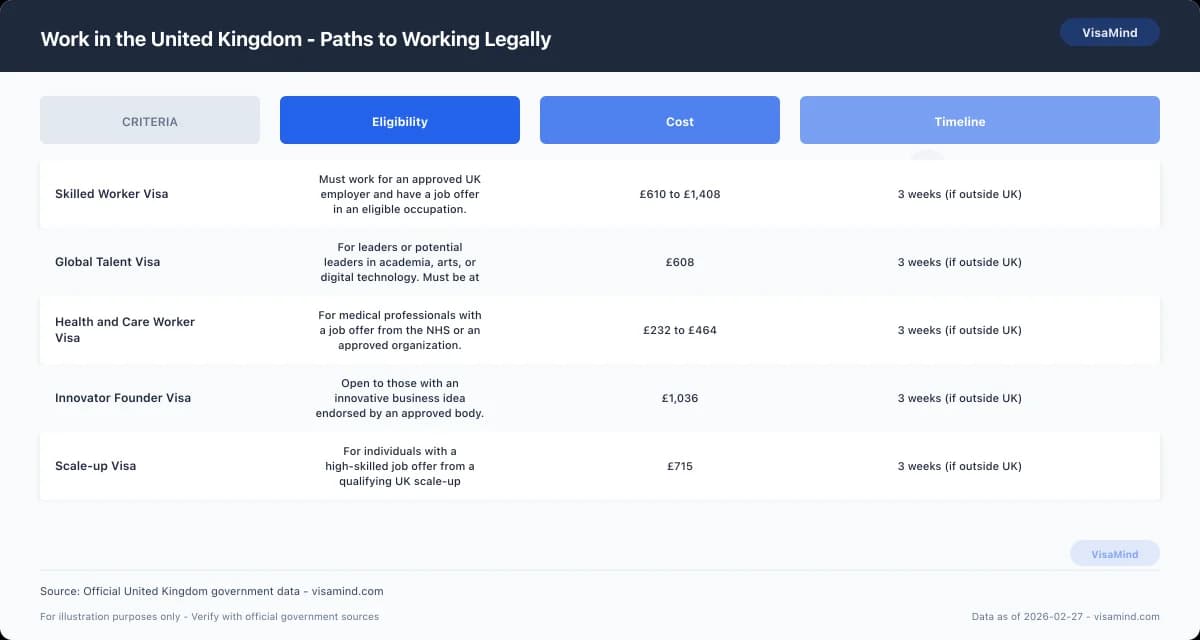
The United Kingdom offers a diverse range of work visas catering to various skills and professions. As of 2023, here are some key pathways to legally work in the UK, highlighting eligibility, costs, and timelines.
| Visa Type | Eligibility | Cost | Timeline |
|---|---|---|---|
| Skilled Worker Visa | Must work for a UK employer approved by the Home Office, have a certificate of sponsorship, do a job on the list of eligible occupations, and meet the minimum salary threshold. | £610 - £1,408 depending on your circumstances, plus a healthcare surcharge. | Typically, 8 weeks if applying from outside the UK. |
| Global Talent Visa | Must be a leader or potential leader in academia, arts, or digital technology. Requires endorsement unless you have won an eligible prize. | £608, plus a healthcare surcharge. | Usually 3 weeks if applying from outside the UK. |
| Health and Care Worker Visa | Must be a qualified doctor, nurse, or health professional in an eligible health or social care job. Requires a job offer from the NHS or an organization providing medical services to the NHS. | £247, lower than other visas, with a reduced healthcare surcharge. | Approximately 3 weeks if applying from outside the UK. |
| Innovator Founder Visa | Suitable for those with an innovative business idea endorsed by a UK endorsing body. | £1,036, plus a healthcare surcharge. | Around 8 weeks if applying from outside the UK. |
| Scale-up Visa | For those with a job offer from a recognized UK scale-up company. Must earn at least £33,000 annually. | £715, plus a healthcare surcharge. | Around 3 weeks for processing. |
| Intra-company Transfer Visa | For employees of multinational companies being transferred to a UK branch. Requires a certificate of sponsorship from the employer. | £610 - £1,408 depending on stay duration, plus a healthcare surcharge. | Typically processed within 3 weeks. |
Additional Considerations
When considering a work visa, you must ensure that you meet specific eligibility criteria, such as having a confirmed job offer for the Skilled Worker Visa or meeting the leadership potential requirements for the Global Talent Visa.
Important: Always ensure that you have a valid certificate of sponsorship where required, as missing this can lead to visa application refusals.
Additionally, certain visa types, like the Health and Care Worker Visa, offer reduced costs and expedited processing times due to high demand in the healthcare sector.
Preparing Your Application
To start your application, visit the UK Visas and Immigration (UKVI) website to apply online. Gather all necessary documentation, such as proof of identity and endorsements if needed. For more guidance, refer to resources like the Documents Checklist and How To Apply for detailed steps.
Tip: Applying online can expedite the process and provide you with immediate confirmation of your application status.
By understanding the requirements and timelines for each visa category, you can select the best path to work legally in the UK, aligning with your professional and personal goals.
Does Your Employer Need to Do Anything?
#In the UK, employers play a critical role in the work visa application process, especially for visas like the Skilled Worker Visa. Here's what you need to know about employer responsibilities and requirements.
Employer Sponsorship Requirements
To hire a non-UK worker, employers must hold a valid sponsor licence from UK Visas and Immigration (UKVI). This licence permits them to issue a Certificate of Sponsorship (CoS), a unique reference number that the worker needs to apply for a visa. The process to become a sponsor involves:
- Checking eligibility: Employers must meet specific criteria, including being a genuine business or organisation operating legally in the UK.
- Applying for a licence: This involves paying a fee, which varies depending on the size and type of organisation.
- Demonstrating a genuine need: Employers must prove a genuine need for the role and that it cannot be filled by a settled worker.
Important: A sponsor licence usually remains valid as long as the employer continues to meet all eligibility criteria and complies with UKVI regulations.
Issuing a Certificate of Sponsorship
The Certificate of Sponsorship is crucial for the Skilled Worker Visa application. Here’s how employers can effectively manage this task:
- Assign the Certificate: Once an employer has the sponsor licence, they can issue a CoS through the UKVI’s online system.
- Job Details: Ensure the job details match those on the UKVI’s list of eligible occupations and meet the minimum salary threshold.
- Timeliness: The CoS is valid for three months from the date of issue. Applicants must apply for their visa within this period.
Other Visa Categories and Employer Involvement
For visas like the Global Talent Visa, the employer's role is less direct. This visa category is designed for leaders or potential leaders in specific fields such as academia, arts, or digital technology. It requires endorsement from a recognised body rather than a UK employer.
While not all work visas require a sponsor, understanding your role as an employer is crucial for those that do. For more information on specific visa categories, visit the Skilled Worker Visa and Global Talent Visa pages.
Tip: Regularly review the UKVI's guidelines to ensure compliance with all sponsorship obligations and avoid penalties or licence suspension.
The Application Process
#Start Your Application Online
To work in the United Kingdom, you must apply for a relevant visa through the official UK Visas and Immigration (UKVI) portal. Begin by selecting the appropriate visa category, such as the Skilled Worker Visa or the Global Talent Visa. Each visa type has its own set of eligibility criteria, so ensure you meet these before proceeding.
Gather Required Documents
Once your application is initiated, gather all necessary documents. This typically includes proof of identity, such as a passport, and any specific documents related to your visa type. For instance, a certificate of sponsorship is essential for the Skilled Worker Visa, while an endorsement might be needed for the Global Talent Visa if you haven’t won a prestigious award. Consult the Documents Checklist for a detailed list tailored to your chosen visa.
Pay the Application Fee
Visa applications typically incur fees, which vary depending on the visa type and your circumstances. As of 2023, ensure you verify the exact fee on the official UKVI website, as it is subject to change. Payment is usually made online during the application process.
Submit Your Biometrics
After paying the fee, you may be required to provide biometric information, such as fingerprints and a photograph. This is usually done at a Visa Application Centre, and you will receive instructions on how to book an appointment. Failure to complete this step can delay your application.
Await a Decision
Once all steps are completed, UKVI will process your application. Processing times can vary, with some visas taking a few weeks and others potentially longer. Check the Processing Times for estimates based on your visa type. During this period, you may be contacted for additional information or documents.
Important: Ensure all information submitted is accurate and complete to avoid delays. Incomplete applications are a common reason for refusal.
By following these steps, you can effectively navigate the application process for working in the UK. For further guidance, refer to the How to Apply guide for detailed instructions.
Your Rights as a Worker
#If you're in the UK under a work visa, such as the Skilled Worker Visa, you may be able to change employers, but this often requires a new visa application. Specifically, you must:
- Obtain a new certificate of sponsorship from your prospective employer.
- Ensure the new job meets the same eligibility requirements, such as being on the list of eligible occupations and meeting the minimum salary threshold.
- Apply for a visa update through UK Visas and Immigration (UKVI) before starting the new job.
Important: Always confirm changes with UKVI to avoid any legal work status issues.
Can Family Join You?
Your family can join you in the UK while you work, depending on your visa type. Typically, this includes:
- Spouse or Partner: They can apply to join you as a dependent.
- Children: Only those under 18 years old can accompany you as dependents.
Each family member must apply individually and meet specific requirements. Refer to the Family Visa for more detailed information.
Can You Study?
Work visa holders in the UK, such as those on the Global Talent Visa, are generally allowed to pursue educational opportunities. You can:
- Enroll in short courses or part-time studies alongside your work.
- Pursue full-time education without needing to switch to a Student Visa, depending on your current visa conditions.
Tip: Verify any study plans with UKVI to ensure they align with your visa terms.
Additional Considerations
- Visa Duration: Always be aware of your visa's expiration date and apply for extensions if necessary.
- Legal Compliance: Maintain compliance with all visa conditions to avoid jeopardizing your status in the UK.
For further details on working legally in the UK, consult guides like How To Apply and Visa Extension Guide.
Transitioning to Permanent Residence
#Transitioning from a work visa to permanent residence in the United Kingdom involves a clear pathway and a defined timeline. Many work visa holders aspire to settle permanently in the UK, and understanding these steps can help you plan your journey.
How Do Work Visas Lead to Permanent Residence?
Most UK work visas can lead to permanent residence, also known as Indefinite Leave to Remain (ILR). Holding ILR allows you to live and work in the UK without any time restrictions. Common work visas that offer a path to ILR include the Skilled Worker Visa, Global Talent Visa, and Innovator Founder Visa.
To be eligible for ILR through a work visa, you typically need to meet the following conditions:
- Continuous Residence: You must have lived in the UK for at least five years on a qualifying visa.
- Employment Requirements: Continued employment with a UK-based employer, especially if you hold a visa like the Skilled Worker Visa.
- Salary Threshold: Meeting or exceeding the salary criteria set for your specific visa category.
- Knowledge of English: Proving your proficiency in English if required.
Tip: Keep track of your residency timelines carefully, as any significant break outside the UK can affect your eligibility for ILR.
Timeline for Transitioning to Permanent Residence
The timeline for obtaining ILR varies depending on your visa type. Here's a general overview:
| Visa Type | Minimum Residence Duration for ILR |
|---|---|
| Skilled Worker Visa | 5 years |
| Global Talent Visa | 3-5 years (depending on the category and achievements) |
| Innovator Founder Visa | 3 years |
Some visas, such as the Global Talent Visa, may offer accelerated paths to ILR if you can demonstrate exceptional contributions to your field.
What Steps Are Involved in Applying for ILR?
Once you meet the residency and employment conditions, you'll need to follow these steps to apply for ILR:
- Verify Eligibility: Ensure you meet all criteria for your specific visa category.
- Gather Documentation: Collect necessary documents, such as proof of residency, employment, and financial status. Refer to the Documents Checklist for detailed requirements.
- Apply Online: Applications for ILR are submitted through the UKVI online portal.
Important: Failing to provide complete documentation can delay your application. Ensure all information is accurate and up-to-date.
Can You Switch Visa Categories Before Applying for ILR?
Switching visa categories may sometimes be beneficial, especially if another visa offers a quicker path to ILR. For example, transitioning from a Skilled Worker Visa to a Global Talent Visa could reduce the required residency period. However, ensure that you meet the eligibility criteria for the new visa category before making any changes.
For more detailed guidance on navigating your pathway to permanent residence, consider reviewing the PR Pathway Guide.
Why Work Visa Applications Fail
#Even if you meet the eligibility criteria outlined by UK Visas and Immigration (UKVI), there are several reasons why your work visa application might be refused. Understanding these common pitfalls can help you avoid them.
Missing or Incorrect Documentation
- Certificate of Sponsorship: For a Skilled Worker Visa, failing to provide a valid certificate of sponsorship from an approved UK employer can lead to refusal.
- Proof of Identity: Not providing correct identification documents or failing to verify them as required can result in application denial.
- English Language Requirement: If your visa category requires proof of English proficiency, not submitting the appropriate test results or documents can cause your application to be rejected.
Important: Always verify that your documents are current and meet the specific requirements of your visa category on the UKVI website.
Employment and Salary Issues
- Job Offer: You must have a confirmed job offer before applying for most work visas. An unclear or unsubstantiated job offer can lead to refusal.
- Minimum Salary: For the Skilled Worker Visa, not meeting the minimum salary threshold specific to your role can result in rejection. Ensure your offer letter specifies a salary that meets or exceeds UKVI's requirements.
Errors in Application Process
- Incomplete Applications: Submitting an incomplete application or providing inconsistent information can lead to refusal. Ensure all sections are filled accurately.
- Application Fees: Failure to pay the correct application fee can halt the processing of your visa. Confirm the fee amount before making a payment.
Tip: Use the Visa Refusal Reasons guide for more detailed insights into avoiding application pitfalls.
How to Avoid Common Mistakes
- Document Review: Before submission, have a trusted advisor or immigration consultant review your documents and application.
- Follow Guidelines: Adhere closely to UKVI's guidelines for your specific visa type, such as the Global Talent Visa.
- Keep Updated: UKVI requirements can change, so always consult the latest information on their official website before applying.
By paying careful attention to the details of your application and ensuring all requirements are met, you can significantly reduce the risk of refusal from UKVI.
Skills and Qualifications
#Particularly through visas like the Skilled Worker Visa, certain roles might require you to undergo a skills assessment to ensure you meet the job's specific requirements. These assessments are crucial for roles that demand specialized skills, such as those in healthcare or engineering.
- Professional Registration: Some occupations, especially in healthcare, require registration with a professional body in the UK (e.g., the General Medical Council for doctors).
- Skill Verification: For jobs in engineering or other technical fields, you may need to provide evidence of your qualifications and experience to a relevant UK body.
Important: Check with your prospective UK employer or relevant professional body about specific skill assessment requirements for your role.
Qualification Recognition
Your qualifications from abroad must often be recognized in the UK to ensure they meet local standards. This process can vary depending on your field of work.
- NARIC Recognition: Use UK NARIC (now known as Ecctis) for an official statement of comparability to demonstrate how your overseas qualifications compare to UK standards.
- Academic Equivalence: For roles requiring academic qualifications, such as teaching, you may need to provide certified translations and equivalency statements.
Tip: Start the qualification recognition process early, as it can take several weeks or months to complete.
Degree Requirements
Certain visas, such as the Global Talent Visa, may not strictly require a degree but do require you to demonstrate leadership or potential leadership in your field.
- Skilled Worker Visa: Typically requires proof of a job offer in an eligible occupation, which may specify certain degree requirements.
- Global Talent Visa: Focuses on your achievements and reputation rather than formal qualifications, though a degree can strengthen your application.
- Innovator Founder Visa: Requires a viable business idea, with qualifications supporting your expertise in the relevant industry.
Proving Your Skills and Qualifications
To successfully apply for a work visa in the UK, you must provide comprehensive documentation demonstrating your skills and qualifications.
- Certificates and Transcripts: Gather original certificates or certified copies of your qualifications.
- Professional Endorsements or References: These can support your application by verifying your skills and experience.
- English Language Proficiency: Many visas require you to prove your knowledge of English, often through tests like IELTS or equivalent.
Remember to regularly check the UKVI website for any updates or changes in requirements. This ensures you stay informed about what documents and qualifications are necessary for your specific visa application.
Salary and Cost Considerations
#Different visa categories have specific salary thresholds or minimum income requirements to ensure applicants can support themselves while working in the UK. For example, the Skilled Worker Visa requires you to earn at least £26,200 per year or the "going rate" for the job, whichever is higher. Meanwhile, the Global Talent Visa does not have a minimum salary requirement, focusing instead on your achievements and potential in your field.
Important: Always check the latest salary thresholds on the UK Visas and Immigration website, as these figures may be updated.
Application Fees
Understanding the application fees for work visas is crucial for budgeting your move to the UK. Here's a comparison of some popular visa types:
| Visa Type | Application Fee (outside UK) | Additional Costs |
|---|---|---|
| Skilled Worker Visa | £625 - £1,423* | Healthcare surcharge + Proof of funds |
| Global Talent Visa | £608 | Endorsement fee (£456) may apply |
| Health and Care Worker Visa | £247 - £479* | Reduced healthcare surcharge |
| Innovator Founder Visa | £1,036 | Investment funds requirement |
*Fees vary based on your location and the length of stay. Verify on the official website for the latest figures.
Financial Considerations
Beyond the salary thresholds and application fees, you should also plan for other financial considerations. The Healthcare Surcharge is an annual fee you must pay as part of your application, allowing you access to the National Health Service (NHS). Additionally, ensure you have sufficient funds to cover your initial living expenses in the UK, as required by UKVI.
Tip: Use the Financial Requirements Guide to help you understand the financial commitments involved in your move.
Timeline for Processing
Processing times vary based on the visa type and where you apply from. Generally, processing can take about 3 weeks if you apply from outside the UK, but it might be longer for certain visas like the Innovator Founder Visa. It's advisable to apply well in advance to accommodate any potential delays, and you can check current processing times on the Processing Times Guide.
Remember to gather all necessary documents and ensure your application is complete to avoid unnecessary delays.
Your Tax Situation Abroad
#The UK has specific rules regarding income tax obligations, social security contributions, and double taxation treaties that can significantly impact your financial planning.
Income Tax Obligations
As a worker in the UK, you are required to pay income tax on your earnings. The amount of tax you pay depends on your income, and you may be subject to different tax rates depending on your residency status. The standard tax-free personal allowance is £12,570 as of 2023.
- Basic Rate: 20% on income over £12,570
- Higher Rate: 40% on income over £50,270
- Additional Rate: 45% on income over £150,000
Ensure you verify the current rates on the official UK government website as they may change annually.
National Insurance Contributions
In addition to income tax, you must also make National Insurance contributions (NICs), which help fund the UK’s social security system, including state pensions and the National Health Service (NHS). NICs are typically deducted from your salary, and the rates depend on your earnings and employment status.
- Class 1: Employees pay 12% on earnings between £242 and £967 per week, and 2% on earnings above this.
- Class 2 and 4: For self-employed individuals, rates vary depending on your profits.
Double Taxation Treaties
The UK has treaties with many countries to prevent double taxation, ensuring you do not pay tax on the same income in both your home country and the UK. These treaties dictate which country has the taxing rights over specific types of income. It is essential to understand your treaty rights to avoid paying unnecessary taxes.
Important: Consult a tax advisor or the UK Visas and Immigration (UKVI) guidelines to understand how your income will be taxed in the UK and ensure compliance with all legal obligations.
Managing Your Tax Responsibilities
To manage your tax responsibilities effectively:
- Register for Self-Assessment if you have other income not taxed at source, such as rental income or foreign income.
- Keep detailed records of your income and taxes paid, especially if you claim reliefs or exemptions under a double taxation treaty.
- Consult with a tax advisor who specializes in UK taxation for immigrants to ensure compliance and optimize your tax position.
For more information on transitioning to permanent residence and how that may affect your tax status, you can refer to the PR Pathway Guide.
Real-World Work Visa Stories
#A tech entrepreneur from India, Raj, was eager to expand his startup into the UK market. He decided to apply for the Innovator Founder Visa, which is tailored for individuals with a viable business idea. Raj first needed an endorsement from an approved UK endorsing body. He approached Tech Nation, which is known for supporting digital technology businesses. After a series of assessments and meetings, Tech Nation endorsed his business plan, recognizing its potential for innovation and growth in the UK market. With the endorsement secured, Raj submitted his application through the UKVI portal, providing detailed business plans and financial projections. Within a few months, his visa was approved, allowing him to establish his startup in London.
Scenario: Academic Excellence Leads to Global Talent Visa
Dr. Emily, a renowned researcher in environmental science from Canada, aspired to collaborate with leading academics in the UK. She chose to apply for the Global Talent Visa, as she had achieved significant recognition in her field. Emily gathered evidence of her published research, awards, and an endorsement from the Royal Society, one of the UK’s prestigious scientific bodies. The endorsement process took about eight weeks, during which her contributions to environmental science were thoroughly evaluated. Once endorsed, Emily applied for the visa online through the UKVI system, providing all necessary documents. Her application was successful, and she was able to join a top UK university's research team within three months.
Scenario: Skilled Professional Transfers to UK
Carlos, an experienced software engineer from Brazil, received a job offer from a leading UK tech company. To work in the UK, he needed a Skilled Worker Visa. The company, an approved sponsor by the Home Office, provided Carlos with a certificate of sponsorship. He then applied for the visa, ensuring his job was on the list of eligible occupations and that his salary met the minimum threshold. Carlos also needed to prove his English proficiency, which he did through a recognized language test. The entire process, from receiving the job offer to obtaining his visa, took approximately four months. Carlos successfully relocated to the UK and began his new role in the thriving tech sector of Manchester.
FAQs
Can I switch from a Skilled Worker visa to a Global Talent visa while in the United Kingdom?
What is the minimum salary requirement for a Skilled Worker visa in the United Kingdom?
How does the UKVI determine eligibility for a Global Talent visa in the United Kingdom?
What are my rights as a worker under a Skilled Worker visa in the United Kingdom?
Can I transition from a Health and Care Worker visa to permanent residence in the United Kingdom?
What are the common reasons for work visa application failures in the United Kingdom?
What is the process for obtaining an endorsement for a Global Talent visa in the United Kingdom?
VisaMind provides informational guidance only and is not a government agency. This is not legal advice. Requirements can change and eligibility depends on your specific facts. If your case is complex or high-stakes, consult a licensed immigration attorney.
Next steps
Requirements vary by nationality, purpose, timeline, and case details. Use Find My Visa to get a personalized checklist for United Kingdom with official sources and deadlines.
Find my visa