On this page
- Quick summary
- Overview (What is Form I-130A?)
- Context and workflow
- Failure prevention (What causes Form I-130A rejections?)
- What it asks for (What does Form I-130A ask for?)
- What you need (What do you need for Form I-130A?)
- Checklist (What is the Form I-130A checklist?)
- Where to file
- Fees
- Form sections (What sections does Form I-130A have?)
- Strategy tips
- Mistake severity
- Examples (What are examples for Form I-130A?)
- Common misconceptions (What misconceptions surround Form I-130A?)
- Edge cases and variations
- Scenarios
- Key differentiators
- Why it matters
- Next steps
- Verification
- Related guides
- Resources
Quick summary
#The petitioner (sponsor) files this form on behalf of the beneficiary (the relative), as described in the Form I-129 guide, as described in the Form I-129F guide.
When the official instructions indicate this form is required
Include it with your application package and follow official instructions for submission.
Names, dates of birth, and passport details on other forms Program checklist requirements Supporting documents and translations
Overview (What is Form I-130A?)
#While Form I-130A itself does not require a separate filing fee, it must be submitted alongside Form I-130, which has its own fee as specified in the USCIS fee schedule.
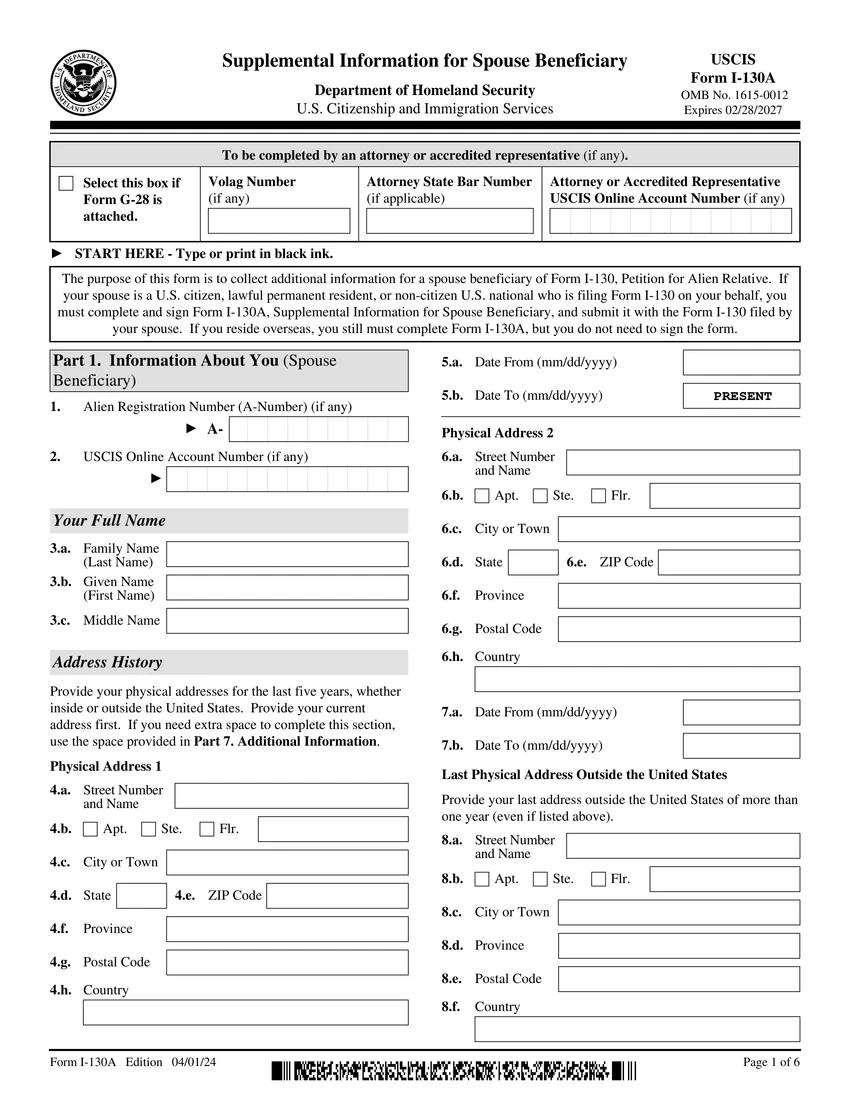
First page of I-130A form
Source: I-130A PDF
Context and workflow
#Receipt Notice (a related form) is issued by USCIS.
Why this matters
- This form acts as a cross-check point: details here must match other forms and supporting documents.
- Inconsistencies often trigger returns or follow-up requests because they create uncertainty in the case record.
Where it fits in the workflow
- Processing time for I-130A varies by category — always check the official USCIS processing time tool.
- Supporting documentation for family-based petitions.
- Part of the evidence package submitted with a spousal petition.
- Helps USCIS assess eligibility for the spouse's immigration benefits.
Who uses it
The petitioner (sponsor) files this form on behalf of the beneficiary (the relative).
When it is used
- When the official instructions indicate this form is required
- As part of a complete application package with supporting documents
- [object Object]
- [object Object]
- [object Object]
Failure prevention (What causes Form I-130A rejections?)
#Technical rejections
- Submitting the form without a valid signature.
- Failing to provide a complete English translation for documents in a foreign language.
Substantive weaknesses
- Omitting important biographic details.
- Inconsistencies between this form and the primary petition.
- To avoid missing proof of relationship or required documents: Include all required evidence per instructions; match information to civil documents.
- To avoid inconsistent information between i-130a and i-130: Match names, dates, and addresses exactly between both forms.
- To avoid missing signatures from petitioner or beneficiary: Both must sign I-130A; ensure all required sections are completed and signed.
What it asks for (What does Form I-130A ask for?)
#- Biographic information of the spouse beneficiary.
- Provide information about the spouse beneficiary, including biographical details and relationship evidence.
- Declaration and signature of the preparer.
- Applicant identification information
- Supporting documentation inventory
- Eligibility or purpose details
- Declarations and signatures
- You must select only 1 option for Part 4 (Question 61 or 62) to indicate whether the beneficiary will seek adjustment of status inside the United States or consular processing abroad
- However, you may be eligible for the bona fide marriage exemption under INA section 245(e)(3) if: A
- The photocopy, fax, or scan must be of the original document containing the handwritten ink signature
- Preparer's signature and date of signature if the form is prepared by someone other than the spouse beneficiary.
- Adjudication and determines that it has a deficient signature, USCIS may deny the request.
What you need (What do you need for Form I-130A?)
#- The current edition of I-130A
- Proof of your own immigration status (citizenship certificate, passport, or green card (Permanent Resident Card))
- Evidence of the qualifying relationship
- Beneficiary identification documents and photographs
- When you file your petition, you may need to submit all evidence and supporting documents listed in the General Requirements section of these Instructions
- Form I-130 Instructions 04/01/24 Page 7 of 11 The two identical color passport-style photos must be 2 by 2 inches
- Adoptive parent or adopted child: If you and the person you are filing for are related by adoption, you may need to submit a copy of the adoption decree showing that the adoption took place before the child turned 16 years of age
- Adjudicate any Form I-485 included as supporting evidence for a Form I-130 that was filed online.
- [object Object]
- [object Object]
Checklist (What is the Form I-130A checklist?)
#- Download the current I-130A and instructions from the official USCIS website
- Review the official I-130A instructions before filing
- Assemble all necessary supporting documents as outlined in the instructions.
- Complete all required sections of I-130A
- Confirm the form is signed and dated in all required fields
- Confirm all pages are from the same current I-130A edition
- Sign, date, and submit I-130A with all required supporting evidence
Where to file
#Online filing is available for some categories — verify on the official form page. Otherwise, file by mail to the address in the instructions.
File online
File Online Processing Information Submitting Form I-130, Petition for Alien Relative, is the first step to help an eligible relative apply to immigrate to the United States and apply for a Green Card
Filing locations and procedures may change. Always verify on the official USCIS website before submitting.
Fees
#| Component | Amount |
|---|---|
| Filing FeeTo be considered properly filed, a petition must be fully completed and signed, and the filing fee must be paid | See official schedule |
| Biometrics Services FeeNot attending the biometric services appointment. | See official schedule |
Can the Form I-130A fee be waived?
Fee waivers may be available for qualifying applicants. See official instructions for eligibility.
What happens if I submit the wrong fee?
USCIS will reject your application if the incorrect fee is submitted. Verify the current fee on the official schedule before filing.
Fee waiver: Fee waivers may be available for qualifying applicants. See official instructions for eligibility.
Fees change; always verify on USCIS.
Form sections (What sections does Form I-130A have?)
#Petitioner Information
US citizen or LPR filing the petition.
- Full name and immigration status
- Address and contact information
- Evidence of citizenship or lawful permanent residence
Beneficiary Information
Person being petitioned for.
- Full name and date of birth
- Current immigration status
- Relationship to petitioner
- A-Number or passport if applicable
Supporting Evidence
Required documentation for the petition type.
- Relationship evidence
- Civil documents
- Category-specific documentation
Strategy tips
#Mistake severity
#| Mistake type | Severity | How to avoid |
|---|---|---|
| Missing proof of relationship or required documents | Rejection | Include all required evidence per instructions; match information to civil documents. |
| Inconsistent information between I-130A and I-130 | RFE | Match names, dates, and addresses exactly between both forms. |
| Missing signatures from petitioner or beneficiary | Rejection | Both must sign I-130A; ensure all required sections are completed and signed. |
| Omitting prior marriage or divorce documentation | RFE | List all prior marriages; include certified divorce decrees or death certificates. |
Examples (What are examples for Form I-130A?)
#- Strong application: An applicant submits the form with all required documents and receives a timely decision.
- Weak application: An applicant submits Form I-130A without including the required photographs and receives a request for evidence, delaying the process.
- [object Object]
- [object Object]
- [object Object]
Common misconceptions (What misconceptions surround Form I-130A?)
#- Filing this form does not guarantee approval of the underlying case
- Requirements may differ based on your specific situation
- Some applicants assume that submitting original documents is necessary, but only photocopies of unaltered, original documents should be submitted unless specifically requested.
- [object Object]
- [object Object]
Edge cases and variations
#- If you are asked to submit or update I-130A, treat it as a package update: check every place the same details appear and keep them consistent.
Scenarios
#A petitioner files the petition with complete evidence and the correct fee. USCIS accepts the application.
Receipt notice issued. Case proceeds to adjudication. Processing time varies by form type.
Use the current form edition and correct fee. Outdated forms or wrong fees cause rejection.
An applicant receives an RFE for additional evidence and responds fully within the 30-day window.
Response accepted. Adjudication continues. Late responses may result in denial.
Respond to RFEs completely and by the deadline. Extensions are rarely granted.
A petitioner has a typo in the beneficiary's birth date that does not match the birth certificate.
Case delayed for correction. May require amended petition or signed affidavit explaining the error.
Review all dates and names against civil documents. Consistency prevents delays and requests for evidence.
Key differentiators
#- Unlike Form I-130: Petition for Alien Relative: Filed together: Required when petitioning for a spouse (Family-based immigration pathway)
- Unlike Form G-28: Notice of Entry of Appearance as Attorney or Accredited Representative: Supporting form: Attorney or accredited representative (optional) (Family-based immigration pathway)
Why it matters
#Form I-130A must be completed even if the spouse is overseas.
Why it matters: Ensures that all necessary information is collected regardless of the spouse's location.
Derivative beneficiaries do not require separate petitions.
Why it matters: Simplifies the process by allowing certain family members to be included without additional forms.
Photocopies of signatures are acceptable.
Why it matters: Facilitates the submission process by allowing copies instead of original signatures.
If married less than two years, the spouse receives conditional permanent resident status.
Why it matters: This affects the type of residency status granted and subsequent filing requirements.
Next steps
#- Receipt Notice (a related form) is issued by USCIS.
- Attend biometrics appointment (fingerprints, photo, and signature) if required.
- USCIS reviews the form and supporting documents.
- Receive notice of action regarding approval or denial.
- If approved, proceed to next stage forms for further processing.
Verification
#This guide is derived from official USCIS instructions for I-130A and is updated when form editions or filing rules change. Always verify current requirements at the official USCIS website.
FAQs
What happens if I make an error on Form I-130A or need to correct something after filing?
If your filing is accepted but later found deficient, you may receive a request for evidence (RFE). The specific timing depends on your case type and circumstances. Generally, forms should be filed according to the sequence outlined in the official instructions for your immigration category.
What should I do if I need more space for additional information on Form I-130A?
You can include additional sheets of paper to provide more information, ensuring each sheet is clearly labeled with your name and the relevant question number.
Is it necessary for the preparer to sign Form I-130A if someone other than the spouse beneficiary completes it?
If the form is completed by someone other than the spouse beneficiary, the preparer is required to sign and date it. For comprehensive guidance tailored to your specific immigration case and circumstances, please consult the official I-130A instructions.
Can I submit Form I-130A without a marriage certificate?
To establish the qualifying relationship, a marriage certificate is generally required. However, if the certificate is unavailable, you may provide a statement from the relevant civil authority along with secondary evidence.
Do I need to provide a mailing address for I-130A?
You need a reliable mailing address for notices and card delivery. If you do not have a stable address, USCIS allows alternatives (e.g., a representative's address or safe mailing options) per official rules — review the instructions for your situation.
Who is eligible to file I-130A?
Please consult the official instructions for comprehensive details.
What are common reasons I-130A gets rejected?
Common reasons I-130A is rejected include missing or incorrect signatures, using an outdated form edition, incomplete required fields, incorrect fee payment, missing required supporting documents, and photographs that do not meet official specifications. Carefully review the instructions and checklist before submitting.
When will I-130A be processed and what is the workflow?
Processing timing for I-130A varies depending on the filing category, processing location, and current application volume. Standard processing can range from a few weeks to several months. Before submitting, check the official USCIS processing times tool for the most current estimates. After filing, monitor your case status and consider whether expedited options are available.
VisaMind provides informational guidance only and is not a government agency. This is not legal advice. Requirements can change and eligibility depends on your specific facts. If your case is complex or high-stakes, consult a licensed immigration attorney.
Next steps
Requirements vary by nationality, purpose, timeline, and case details. Use Find My Visa to get a personalized checklist with official sources and deadlines.
Find my visa