On this page
- Quick summary
- Overview (What is Form I-192?)
- Context and workflow
- Failure prevention (What causes Form I-192 rejections?)
- What it asks for (What does Form I-192 ask for?)
- What you need (What do you need for Form I-192?)
- Checklist (What is the Form I-192 checklist?)
- Where to file
- Fees
- Form sections (What sections does Form I-192 have?)
- Strategy tips
- Common mistakes (What mistakes are common with Form I-192?)
- Examples (What are examples for Form I-192?)
- Common misconceptions (What misconceptions surround Form I-192?)
- Edge cases and variations
- Scenarios
- Key differentiators
- Why it matters
- Next steps
- Verification
- Related guides
- Resources
Quick summary
#Instead, you must apply for a nonimmigrant visa at a U In all other cases, you must file this application with CBP, as described in the Online Nonimmigrant Visa Application guide, as described in the B-1/B-2 Visitor Visa guide.
When the official instructions indicate this form is required
Include it with your application package and follow official instructions for submission.
Names, dates of birth, and passport details on other forms Program checklist requirements Supporting documents and translations
Overview (What is Form I-192?)
#It ensures that those who have compelling reasons for entry, such as victims of trafficking or crime, are not unduly barred from accessing the protection and opportunities available in the United States. For related guidance, see the U Nonimmigrant Status (Crime Victims) page. For related guidance, see the T Nonimmigrant Status (Trafficking Victims) page.
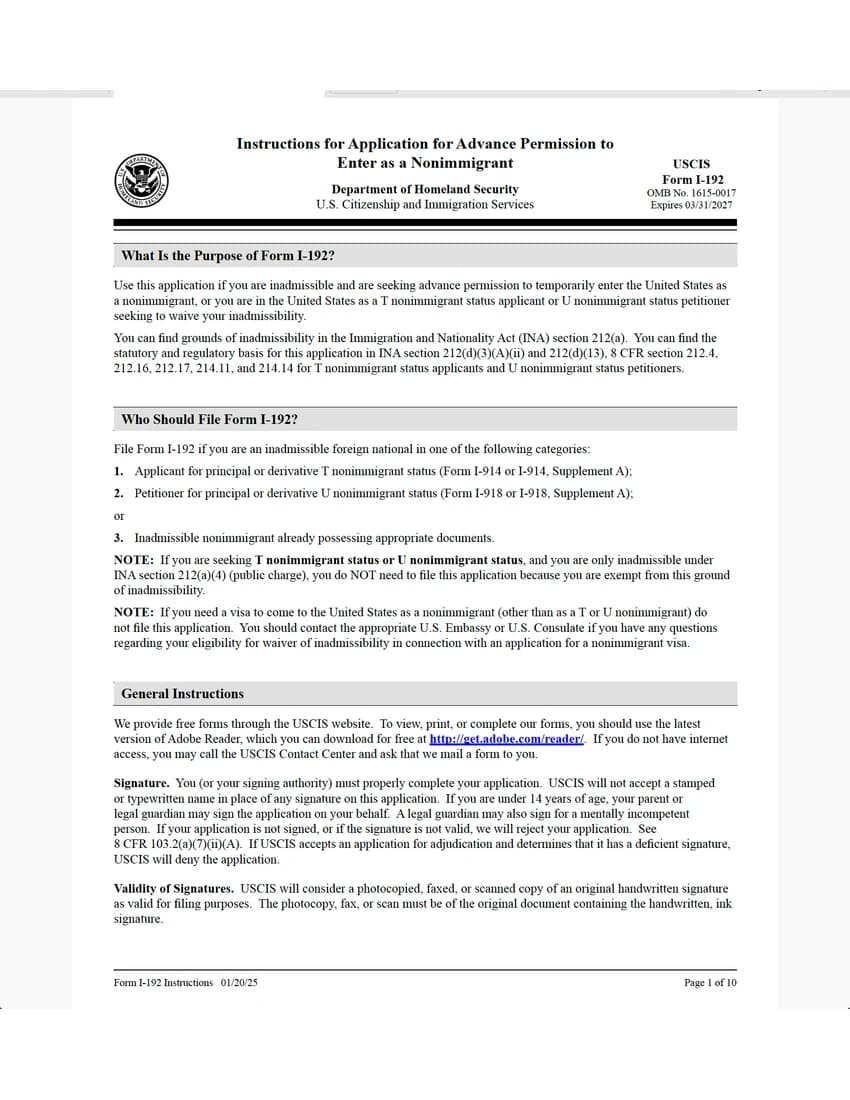
First page of I-192 form
Source: I-192 PDF
Context and workflow
#Processing time for I-192 varies by case type and current workload — always check the official USCIS processing time tool.
Why this matters
- This form acts as a cross-check point: details here must match other forms and supporting documents.
- Small mismatches inside I-192 (or between I-192 and supporting evidence) can force rework later in processing.
Where it fits in the workflow
- Initiating the process for temporary entry despite inadmissibility.
- Receipt Notice (a related form) is typically issued after submission.
- May require biometrics appointment depending on individual circumstances.
- I-192 is commonly filed alongside Form DS-160, Form I-914, Form I-918.
Who uses it
In some situations, you may need to apply for a nonimmigrant visa at a U.S. consulate. In other cases, filing this application with CBP might be necessary, as detailed in the Online Nonimmigrant Visa Application and B-1/B-2 Visitor Visa guides.
When it is used
- When the official instructions indicate this form is required
- As part of a complete application package with supporting documents
Failure prevention (What causes Form I-192 rejections?)
#Technical rejections
- Submitting the form without a valid signature.
- Failing to include all necessary supporting documents.
Substantive weaknesses
- Not fully disclosing all grounds of inadmissibility.
- Insufficient explanation or evidence for overcoming inadmissibility.
What it asks for (What does Form I-192 ask for?)
#- Full legal name and any other names used.
- USCIS Online Account Number if applicable.
- Date and place of birth.
- Applicant identification information
- Supporting documentation inventory
- Eligibility or purpose details
- Declarations and signatures
- The photocopy, fax, or scan must be of the original document containing the handwritten, ink signature
- You must provide a valid mailing address in the United States in Part 2
- Section 1367) apply to applicants for T nonimmigrant status and petitioners for U nonimmigrant status, including any qualifying family members
- Interpreter's signature and certification if an interpreter is used
- Preparer's signature and certification if someone other than the applicant prepares the form
What you need (What do you need for Form I-192?)
#- The current edition of I-192
- Proof of current immigration status
- Government-issued photo identification
- Passport-style photographs meeting specifications
- A written statement explaining the grounds of inadmissibility and reasons for seeking admission
- All evidence and supporting documentation listed in the instructions.
- Failing to provide all required evidence and supporting documentation.
- [object Object]
Checklist (What is the Form I-192 checklist?)
#- Download the current I-192 and instructions from the official USCIS website
- Review the official I-192 instructions before filing
- Gather required supporting documents per the instructions
- Complete all required sections of I-192
- Ensure that the form is signed and dated in all necessary sections.
- Ensure that all pages of your Form I-192 are from the same current edition.
- Sign, date, and submit I-192 with all required supporting evidence
Where to file
#Online filing is available for some categories — verify on the official form page. Otherwise, file by mail to the address in the instructions.
File online
USCIS Online Account Number if applicable.
Filing locations and procedures may change. Always verify on the official USCIS website before submitting.
Fees
#| Component | Amount |
|---|---|
| Filing FeeThe standard filing fee for form i-192. Check the current fee on the official USCIS fee schedule. | See official schedule |
| Biometrics Services FeeAttend a biometric services appointment if required. | See official schedule |
Can the Form I-192 fee be waived?
Fee waivers may be available for qualifying applicants. See official instructions for eligibility.
What happens if I submit the wrong fee?
USCIS will reject your application if the incorrect fee is submitted. Verify the current fee on the official schedule before filing.
Fee waiver: Fee waivers may be available for qualifying applicants. See official instructions for eligibility.
Fees change; always verify on USCIS.
Form sections (What sections does Form I-192 have?)
#Part 1. Application Type Item Number
Complete this section as described in the official instructions.
- Explanation of inadmissibility and reasons for admission
- Reasons for inadmissibility and justification for entry
- Evidence supporting your eligibility category
- Submitting an application without a valid signature.
- Failing to provide all required evidence and supporting documentation.
- Not providing a full English translation for documents in a foreign language.
- USCIS verifies eligibility category.
Part 6. Additional Information
Complete this section as described in the official instructions.
- Government-issued photo identification
- Passport-style photographs meeting specifications
- Submitting an application without a valid signature.
- Failing to provide all required evidence and supporting documentation.
- Not providing a full English translation for documents in a foreign language.
- USCIS verifies signature and photo specs.
Strategy tips
#Common mistakes (What mistakes are common with Form I-192?)
#- Submitting an application without a valid signature.
- Neglecting to submit all necessary evidence and supporting documents.
- Failing to include a complete English translation for documents originally in a foreign language.
- Submitting original documents when not required can lead to their destruction.
- Not disclosing all grounds of inadmissibility.
- Using an incorrect form edition.
- Missing pages from the form.
Examples (What are examples for Form I-192?)
#- Strong application: An applicant submits the form with all required documents and receives a timely decision.
- Strong application: A petitioner includes detailed explanations and evidence for each inadmissibility ground, resulting in approval.
- Weak application: An applicant fails to include a written statement explaining their inadmissibility, resulting in a request for additional evidence and delayed processing.
- [object Object]
- [object Object]
Common misconceptions (What misconceptions surround Form I-192?)
#- Filing this form does not guarantee approval of the underlying case
- Requirements may differ based on your specific situation
- [object Object]
Edge cases and variations
#- If you are asked to submit or update I-192, treat it as a package update: check every place the same details appear and keep them consistent.
Scenarios
#A software engineer submitted their petition with all supporting documents
The case was approved within the standard timeline
Prepare all evidence before filing to avoid delays
Key differentiators
#- Unlike Form DS-160: Online Nonimmigrant Visa Application: Filed together: Nonimmigrant visa application if waiver approved
- Unlike Form I-914: Application for T Nonimmigrant Status: Filed together: Waiver for T visa applicants who are inadmissible
- Unlike Form I-918: Petition for U Nonimmigrant Status: Filed together: Waiver for U visa applicants who are inadmissible
Why it matters
#Applicants inadmissible under INA section 212[category code — see official instructions] do not need to file this form.
Why it matters: This exemption can save time and resources for those only inadmissible under public charge grounds.
Photocopied, faxed, or scanned signatures are accepted if they are of the original document.
Why it matters: Allows flexibility in submission methods, especially for those unable to submit original documents.
Special protections apply to T and U nonimmigrant status applicants under 8 U.S.C. section 1367.
Why it matters: Ensures confidentiality and protection from adverse determinations based on information from traffickers or perpetrators.
A prior approval of Form I-192 cannot be revalidated.
Why it matters: Applicants must file a new application for any future entries if the approval is no longer valid.
Next steps
#- Receive a Receipt Notice (a related form) confirming the application has been received.
- Attend a biometrics appointment if required for fingerprints, photo, and signature.
- Await a decision from USCIS, which could include requests for additional information.
- Receive a notice of action indicating approval or denial.
- If approved, proceed with entry plans as per the terms of the permission granted.
Verification
#This guide is derived from official USCIS instructions for I-192 and is updated when form editions or filing rules change. Always verify current requirements at the official USCIS website.
FAQs
What other forms are typically filed together with Form I-192?
Review the official I-192 instructions for guidance specific to your immigration category and circumstances. The specific forms required vary by case type. Review the instructions for your particular immigration category to determine which forms must be submitted together.
Which visa categories commonly require Form I-192?
Review the official instructions for eligibility details. Review the official I-192 instructions for complete guidance specific to your immigration case and circumstances.
What happens after you file Form I-192?
The specific timing depends on your case type and circumstances. Generally, forms should be filed according to the sequence outlined in the official instructions for your immigration category.
Do I need to file Form I-192 if I'm only updating my address or contact information?
Check the official instructions to see which form or process applies to your type of update. Review the official I-192 instructions for complete guidance specific to your immigration case and circumstances.
Do I need to provide translations for documents not in English?
If you submit a document that is not in English, it must be accompanied by a complete English translation. Additionally, a certification from the translator affirming the accuracy of the translation is required.
How do I choose the correct eligibility category code on I-192?
Your eligibility category code determines your basis for filing I-192. Applying for admission as a nonimmigrant other than as a T or U nonimmigrant under INA 212(d)(3)(A). Seeking status as a victim of trafficking (T nonimmigrant status) under INA 212(d)(13). Seeking status as a victim of qualifying criminal activity (U nonimmigrant status) under INA 212(d)(14).
What supporting documents do I need for I-192?
Ensure you submit all evidence and supporting documentation as outlined in the instructions. This includes materials specified in the "What Evidence Must You Submit" and "Specific Instructions" sections. Omitting any required evidence or documentation may impact your application.
Who is eligible to file I-192?
Form I-192 is used to apply for advance permission to temporarily enter the United States as a nonimmigrant. It is intended for inadmissible nonimmigrants who already have the appropriate documents or applicants for T or U nonimmigrant status.
What happens after I submit I-192?
After submitting I-192, USCIS will issue a Confirmation of receipt confirming acceptance. You may then be scheduled for biometrics, an interview, or additional evidence requests depending on your case. You can monitor your case status online using the receipt number from your notice.
What are common reasons I-192 gets rejected?
Common reasons I-192 is rejected include missing or incorrect signatures, using an outdated form edition, incomplete required fields, incorrect fee payment, missing required supporting documents, and photographs that do not meet official specifications. Carefully review the instructions and checklist before submitting.
VisaMind provides informational guidance only and is not a government agency. This is not legal advice. Requirements can change and eligibility depends on your specific facts. If your case is complex or high-stakes, consult a licensed immigration attorney.
Next steps
Requirements vary by nationality, purpose, timeline, and case details. Use Find My Visa to get a personalized checklist with official sources and deadlines.
Find my visa