On this page
- Quick summary
- Overview (What is Form I-918?)
- Context and workflow
- Requirements snapshot
- Failure prevention (What causes Form I-918 rejections?)
- What it asks for (What does Form I-918 ask for?)
- What you need (What do you need for Form I-918?)
- Checklist (What is the Form I-918 checklist?)
- Processing times
- Where to file
- Fees
- Form sections (What sections does Form I-918 have?)
- Choose your path
- Category comparison
- Strategy tips
- Mistake severity
- Examples (What are examples for Form I-918?)
- Common misconceptions (What misconceptions surround Form I-918?)
- Edge cases and variations
- Scenarios
- Key differentiators
- Why it matters
- Next steps
- Verification
- Related guides
- Resources
Quick summary
#This form is not intended for general public self-filing, as described in the Form DS-260 guide, as described in the Form DS-2019 guide.
U-VISA: U Nonimmigrant Status (Crime Victims)
Include it with your application package and follow official instructions for submission.
Names, dates of birth, and passport details on other forms Program checklist requirements Supporting documents and translations
Overview (What is Form I-918?)
#USCIS is prioritizing the oldest petitions, and from 2025, they will begin approving eligible principal petitions for U-1 nonimmigrant status, starting with those filed on or before April 30, 2017. For further guidance, refer to the T Nonimmigrant Status (Trafficking Victims) page and the U Nonimmigrant Status (Crime Victims) page.
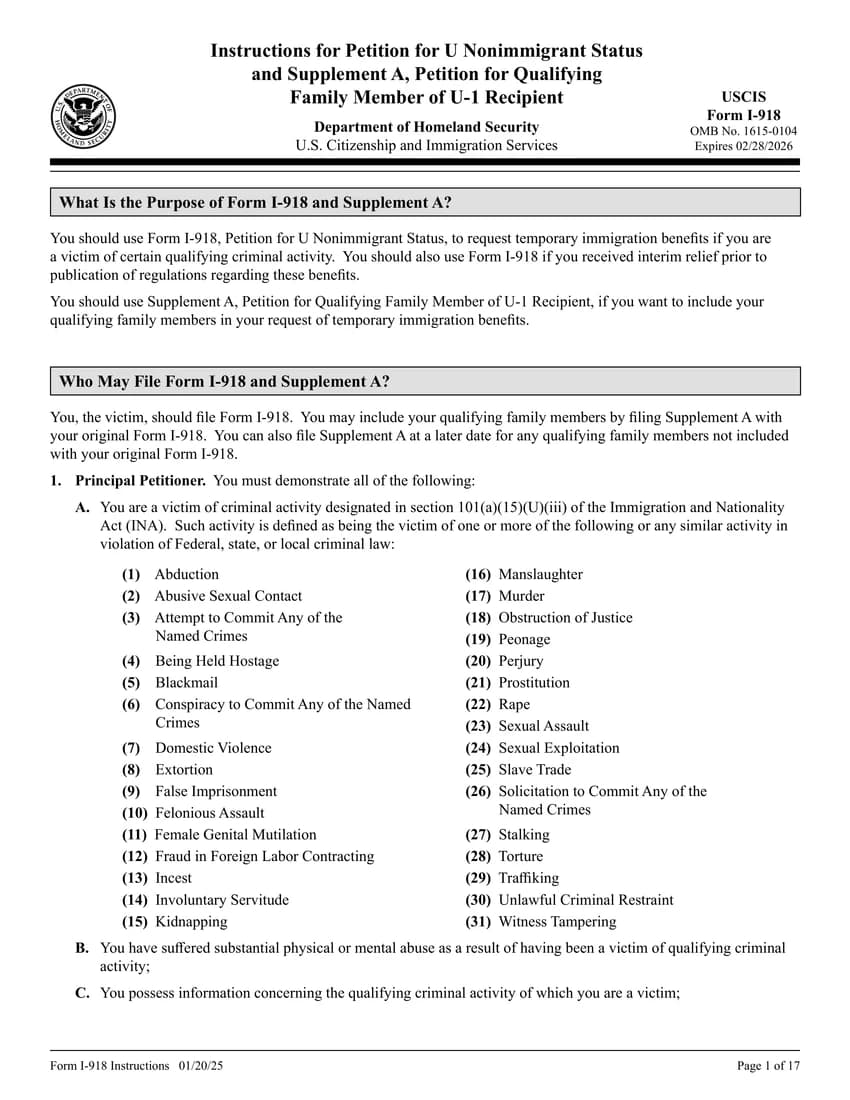
First page of I-918 form
Source: I-918 PDF
Context and workflow
#Processing time for I-918 varies by case type and current workload — always check the official USCIS processing time tool, as described in the Form I-918 SUPPLEMENT B guide.
Why this matters
- Inconsistencies often trigger returns or follow-up requests because they create uncertainty in the case record.
- This form acts as a cross-check point: details here must match other forms and supporting documents.
Where it fits in the workflow
- Initiating the process for U nonimmigrant status.
- Receipt Notice (a related form) issued upon submission.
- Attend biometrics appointment (fingerprints, photo, and signature).
- Potentially leads to further immigration benefits or status adjustments.
- I-918 is commonly filed alongside Form I-192.
Who uses it
This form is not intended for general public self-filing. Common filers: U-1 Principal Victim, U-2 Spouse of Victim, U-3 Child of Victim.
When it is used
- U-VISA: U Nonimmigrant Status (Crime Victims)
- [object Object]
- [object Object]
- [object Object]
- [object Object]
- [object Object]
Requirements snapshot
#- U-1: Direct victim of qualifying criminal activity
- U-2: Spouse of U-1 victim
- U-3: Child of U-1 victim (under 21)
Failure prevention (What causes Form I-918 rejections?)
#Technical rejections
- Submitting the form without a signature.
- Omitting the Supplement B certification.
- Failing to provide English translations for non-English documents.
Substantive weaknesses
- Insufficient evidence of substantial harm suffered.
- Inadequate documentation of cooperation with law enforcement.
- To avoid incomplete application or insufficient evidence: Follow instructions carefully; include all required supporting documents.
- To avoid filing without supplement b law enforcement certification: Obtain I-918 Supplement B from certifying agency; application cannot be approved without it.
- To avoid insufficient evidence of victimization or cooperation: Document qualifying crime, harm, and cooperation with law enforcement per instructions.
What it asks for (What does Form I-918 ask for?)
#- Full legal name and other names used.
- Home address and safe mailing address.
- Indicate whether your family member was or is in immigration proceedings.
- Applicant identification information
- Supporting documentation inventory
- Eligibility or purpose details
- Declarations and signatures
- Your full legal name as it appears on official documents
- Your date and place of birth
- You must be a victim of criminal activity designated in section 101(a)(15)(U)(iii) of the INA.
- Adjudication and determines that it has a deficient signature, USCIS may deny the request.
- Documentation related to: You must submit evidence demonstrating that you were, are, or are likely to be helpful to a certifying official in the i
What you need (What do you need for Form I-918?)
#- The current edition of I-918
- Valid government-issued identification
- Supporting documentation for your case
- Filing fee or fee waiver documentation
- A personal narrative statement describing the qualifying criminal activity and the impact on you.
- Evidence demonstrating that you were, are, or are likely to be helpful to a certifying official in the investigation or prosecution of the qualifying criminal activity.
- Evidence that the criminal activity of which you are a victim is included in the list of criminal activities contained in section 101(a)(15)(U)(iii) of the INA.
- Evidence of substantial physical or mental abuse.
- All evidence and supporting documents listed in the Specific Instructions and General Requirements sections.
- Evidence of helpfulness to law enforcement.
- [object Object]
Checklist (What is the Form I-918 checklist?)
#- Download the current I-918 and instructions from the official USCIS website
- Review the official I-918 instructions before filing
- Collect the necessary supporting documents as outlined in the instructions.
- Complete all required sections of I-918
- Confirm the form is signed and dated in all required fields
- Sign, date, and submit I-918 with all required supporting evidence
Processing times
#| Category | Processing time |
|---|---|
| Petition for a noncitizen who is a victim of qualifying criminal activity, and their qualifying family members (Time from Initial Filing to Bona Fide Determination (BFD) Review) | 19.5 to 48 monthsas of January 2026 |
- processing time information at the Check Case Processing Times webpage.
- processing times from initial receipt to the final issuance of U nonimmigrant status.
- Processing times for I-918 vary by eligibility category and service center. Data sourced from the official USCIS processing times tool.
- Processing times differ significantly by eligibility category. Initial applications, renewals, and replacements each go through different adjudication queues, and some categories consistently take longer than others.
- Renewal filings are often processed differently than initial applications. If you are renewing, file well before your current authorization expires — some categories allow you to continue working while the renewal is pending if filed on time.
- The service center assigned to your case affects how long it takes. USCIS distributes filings across multiple centers, and each has different workloads. You cannot choose which center processes your case.
Where to file
#Online filing is available for some categories — verify on the official form page. Otherwise, file by mail to the address in the instructions.
Submit application
Mail the form to the appropriate filing location based on your residence.
Filing locations and procedures may change. Always verify on the official USCIS website before submitting.
Fees
#| Component | Amount |
|---|---|
| Filing FeeThe standard filing fee for form i-918. Check the current fee on the official USCIS fee schedule. | See official schedule |
| Biometrics Services FeeNot attending the biometric services appointment. | See official schedule |
Can the Form I-918 fee be waived?
Fee waivers may be available for qualifying applicants. See official instructions for eligibility.
What happens if I submit the wrong fee?
USCIS will reject your application if the incorrect fee is submitted. Verify the current fee on the official schedule before filing.
Fee waiver: Fee waivers may be available for qualifying applicants. See official instructions for eligibility.
Fees change; always verify on USCIS.
Form sections (What sections does Form I-918 have?)
#Personal Information
Applicant identification.
- Full name and A-Number if applicable
- Date of birth and nationality
- Current address and contact
Eligibility
Basis for the application.
- Category or classification claimed
- Supporting evidence type
- Dates establishing eligibility
Supporting Documents
Required attachments.
- Identity and status documents
- Category-specific evidence
- Fee payment or waiver request
Choose your path
#Choose your path based on your eligibility category. Each block summarizes who qualifies, what to file, common mistakes, and typical processing time.
U-1 Principal Victim
Direct victims of qualifying criminal activity who suffered substantial abuse and cooperated with law enforcement.
File with:
- I-918 Supplement B (law enforcement certification)
- Personal statement
- Evidence of qualifying crime
- Evidence of substantial harm
Common mistakes:
- Law enforcement certification incomplete or from wrong agency
- Not demonstrating substantial physical or mental abuse
- Crime not on the qualifying list
Typical processing: 4-6+ years (visa cap backlog)
U-2 Spouse of Victim
Spouse of U-1 principal victim.
File with:
- I-918 Supplement A
- Marriage certificate
- Principal's U visa documentation
Common mistakes:
- Marriage certificate not properly certified or translated
- Not filing concurrently with principal's petition
Typical processing: Filed with principal
U-3 Child of Victim
Unmarried children under 21 of U-1 principal victim.
File with:
- I-918 Supplement A
- Birth certificate
- Principal's U visa documentation
Common mistakes:
- Child aging out (turning 21) during processing
- Birth certificate not certified
Typical processing: Filed with principal
Category comparison
#| Category code | Eligibility | Typical filing companion | Auto-extension? | Premium processing? |
|---|---|---|---|---|
| U-1 | Direct victim of qualifying criminal activity | I-918 Supplement B (law enforcement certification) | N/A | No |
| U-2 | Spouse of U-1 victim | Marriage certificate and I-918 Supplement A | N/A | No |
| U-3 | Child of U-1 victim (under 21) | Birth certificate and I-918 Supplement A | N/A | No |
| U-4 | Parent of U-1 victim (if victim is under 21) | Birth certificate and I-918 Supplement A | N/A | No |
Strategy tips
#Mistake severity
#| Mistake type | Severity | How to avoid |
|---|---|---|
| Incomplete application or insufficient evidence | Rejection | Follow instructions carefully; include all required supporting documents. |
| Filing without Supplement B law enforcement certification | Rejection | Obtain I-918 Supplement B from certifying agency; application cannot be approved without it. |
| Insufficient evidence of victimization or cooperation | RFE | Document qualifying crime, harm, and cooperation with law enforcement per instructions. |
| Applying when annual U visa cap is reached | Delay | U visa has annual cap; apply early; deferred action may be granted if cap is reached. |
Examples (What are examples for Form I-918?)
#- Complete all certifications: Ensure all required official certifications are properly signed and dated.
- Verify documentation: All supporting documents must be current and properly formatted.
- Cross-reference information: Information must be consistent across all sections and supporting documents.
- [object Object]
- [object Object]
- [object Object]
Common misconceptions (What misconceptions surround Form I-918?)
#- Filing this form does not guarantee approval of the underlying case
- Requirements may differ based on your specific situation
- Some applicants assume that submitting Form I-918 alone is sufficient for approval; however, a properly completed Supplement B certification is also required.
- [object Object]
- [object Object]
Edge cases and variations
#- If you are asked to submit or update I-918, treat it as a package update: check every place the same details appear and keep them consistent.
Scenarios
#An applicant files the application with all required supporting documents and the correct fee.
Application accepted. Biometrics may be scheduled. Case proceeds to adjudication.
Follow the evidence checklist for your category. Missing documents trigger RFEs or denial.
An applicant files before the eligibility window (e.g., I-751 outside the 90 days before conditional residence expires).
Application rejected. Fee returned. Must refile when eligible.
Verify eligibility dates carefully. Filing too early is as problematic as filing late.
An applicant forgets to sign the form.
Application rejected. Must resubmit with signature. Unsigned forms are not accepted.
Sign and date the form. Review the signature block before mailing.
Key differentiators
#- Unlike Form I-765: Application for Employment Authorization: Next step after approval: Work authorization after U visa approval (included with status) (U Nonimmigrant Status pathway)
- Unlike Form I-485: Application to Register Permanent Residence or Adjust Status: Next step after approval: Adjustment of status after 3 years in U status (U Nonimmigrant Status pathway)
- Unlike Form I-929: Petition for Qualifying Family Member of a U-1 Nonimmigrant: Next step after approval: Petition for qualifying family members (U Nonimmigrant Status pathway)
Why it matters
#Supplement B must be submitted with the original Form I-918 petition package.
Why it matters: Failure to include Supplement B will result in the denial of Form I-918.
If under 21, you can include parents and unmarried siblings under 18 as qualifying family members.
Why it matters: Including eligible family members can provide them with immigration benefits.
A photocopied, faxed, or scanned copy of an original handwritten signature is valid for filing.
Why it matters: Ensures that the petition is accepted even if the original signature is not submitted.
Supplement B certification is not required for petitioners who requested and received U interim relief.
Why it matters: This can simplify the filing process for those who have already received interim relief.
Next steps
#- Receive a Receipt Notice (a related form) confirming submission.
- Attend a biometrics appointment for fingerprints, photo, and signature.
- Await a decision from USCIS, which may include requests for additional evidence.
- Receive approval or denial notice.
- If approved, potentially pursue further immigration benefits or status adjustments.
Verification
#This guide is derived from official USCIS instructions for I-918 and is updated when form editions or filing rules change. Always verify current requirements at the official USCIS website.
FAQs
What is the purpose of Form I-918 Supplement B?
Form I-918 Supplement B serves as a certification from law enforcement, verifying your assistance in the investigation or prosecution of the criminal activity.
What is I-918?
Form I-918, known as the Petition for U Nonimmigrant Status, is an official document issued by USCIS. To ascertain if this form is relevant to your circumstances, it is essential to carefully review the official instructions provided.
Where can I get I-918 and its instructions?
Download the current edition of I-918 and its instructions from the official USCIS website. Always verify you are using the most recent form version before filing.
How do I choose the correct eligibility category code on I-918?
Your eligibility category code specifies the grounds for filing Form I-918. To qualify, you must be a victim of criminal activity as outlined in section 101(a)(15)(U)(iii) of the INA. It is essential to provide evidence that the criminal activity you experienced is listed among the qualifying criminal activities in this section.
What supporting documents do I need for I-918?
You must provide evidence showing your assistance to a certifying official in the investigation or prosecution of the qualifying criminal activity. Additionally, you need to demonstrate that the criminal activity you were victimized by is listed under section 101(a)(15)(U)(iii) of the INA. This includes proof of being a victim of such qualifying criminal activity.
Do I need to provide a mailing address for I-918?
A dependable mailing address is essential for receiving notices and card deliveries. If you lack a permanent address, USCIS provides alternatives, such as using a representative's address or opting for safe mailing options. Be sure to consult the official instructions to determine the best approach for your circumstances.
Who is eligible to file I-918?
It may be necessary to provide evidence demonstrating that the criminal activity you experienced is listed among those specified in section 101(a)(15)(U)(iii) of the INA.
What happens after I submit I-918?
processing times from initial receipt to the final issuance of U nonimmigrant status. USCIS will send a Confirmation of receipt confirming acceptance. You can track your case status online using the receipt number. Processing times vary by category and filing location.
What are common reasons I-918 gets rejected?
Common reasons I-918 is rejected include missing or incorrect signatures, using an outdated form edition, incomplete required fields, incorrect fee payment, missing required supporting documents, and photographs that do not meet official specifications. Carefully review the instructions and checklist before submitting.
VisaMind provides informational guidance only and is not a government agency. This is not legal advice. Requirements can change and eligibility depends on your specific facts. If your case is complex or high-stakes, consult a licensed immigration attorney.
Next steps
Requirements vary by nationality, purpose, timeline, and case details. Use Find My Visa to get a personalized checklist with official sources and deadlines.
Find my visa