On this page
- What the CR-1 Conditional Resident Visa (Spouse) Covers
- Eligibility Requirements
- Required Documents
- Prepare Your Financial Evidence
- How to Apply
- Fees and Processing Times
- Conditions and Rights
- Path to Permanent Residence
- Removing Conditions
- When to Get Help
- Relationship Scrutiny Red Flags
- Fees
- Required forms
- Related visa types
- Related guides
- Related goals
- Next steps
What the CR-1 Conditional Resident Visa (Spouse) Covers
#The CR-1 conditional resident visa allows you to sponsor your foreign national spouse for lawful permanent residence in the United States. It operates within the family-based immigration system and requires formal filings with U.S. Citizenship and Immigration Services (USCIS) and, if applicable, the U.S. Department of State.
Purpose of the petition
You use the CR-1 process to establish a valid marital relationship with your spouse and request recognition of that relationship under U.S. immigration law. The process begins with Form I-130, Petition for Alien Relative, filed with USCIS.
Form I-130 confirms that you are a U.S. citizen or lawful permanent resident and that a legally valid marriage exists between you and your spouse. You seek to classify your spouse for permanent residence.
Approval of Form I-130 does not grant a visa or a Green Card. It only recognizes the qualifying relationship.
If your spouse is applying from outside the United States, the case proceeds through consular processing with the U.S. Department of State. Your spouse files Form DS-260, Immigrant Visa Application, and you submit Form I-864, Affidavit of Support, to show financial sponsorship.
Who can be sponsored
You may sponsor your lawfully married spouse under the CR-1 category if you are a U.S. citizen or a lawful permanent resident. You must prove the marriage is legally valid.
Your spouse must seek to live permanently in the United States. The beneficiary must qualify as your spouse under immigration law.
The petition focuses strictly on the marital relationship.
| Petitioner Status | Eligible to File Form I-130 for Spouse |
|---|---|
| U.S. Citizen | Yes |
| Lawful Permanent Resident | Yes |
| Nonimmigrant Visa Holder | No |
Filing under the family-based immigration category does not guarantee approval. USCIS reviews the petition and supporting documents before making a decision.
If USCIS approves the petition and the visa is issued by the U.S. Department of State, your spouse may seek admission to the United States. U.S. Customs and Border Protection (CBP) determines admission at the port of entry.
Limitations of filing
Filing a CR-1 petition does not give your spouse immediate immigration status. It starts a multi-step legal process.
You must file Form I-130 with USCIS. If applicable, complete immigrant visa processing through the U.S. Department of State.
Submit Form I-864 to demonstrate financial sponsorship. Wait for formal approval and visa issuance before travel.
USCIS can deny the petition if you fail to prove a qualifying relationship. The U.S. Department of State can refuse visa issuance if required documentation is missing or eligibility is not established.
No benefit becomes final until approval occurs and, if applicable, your spouse is admitted to the United States.
Eligibility Requirements
#
To qualify for a CR-1 conditional spouse visa, both you and your spouse must meet specific legal standards under U.S. family-based immigration law. USCIS reviews the petition, and the U.S. Department of State handles immigrant visa processing through Form DS-260 and a consular interview.
Sponsor eligibility
You must be a U.S. citizen, lawful permanent resident, or U.S. national to file Form I-130, Petition for Alien Relative, with U.S. Citizenship and Immigration Services (USCIS). Your status determines the immigrant visa category, so you must submit correct proof of citizenship or permanent residence.
To sponsor a spouse for a CR-1 visa, you must be at least 21 years old and be legally married to the beneficiary. File Form I-130 with USCIS and be willing to submit Form I-864, Affidavit of Support.
Form I-864 is a binding financial sponsorship document. By signing it, you agree to financially support your spouse after they become a permanent resident.
If your spouse will apply through consular processing, the U.S. Department of State will require Form DS-260, Immigrant Visa Application, after USCIS approves the I-130 petition.
Beneficiary eligibility
Your spouse must be legally married to you and qualify as your immediate relative under family-based immigration rules. A CR-1 visa applies when the marriage meets the requirements for a conditional resident classification.
The beneficiary must be married to a qualifying U.S. citizen or lawful permanent resident. Eligibility for consular processing or adjustment of status depends on their location.
Complete Form DS-260 if applying abroad. The U.S. Department of State reviews the DS-260 and conducts the immigrant visa interview at a U.S. consulate or embassy.
If USCIS approves the I-130, that approval does not automatically grant a visa. The beneficiary must complete all Department of State processing steps before visa issuance.
Age and domicile rules
Age and domicile requirements apply primarily to the sponsor. You must be at least 21 years old to sponsor a spouse for an immigrant visa.
Maintain a domicile in the United States, or in a U.S. territory or possession. “Domicile” means you maintain your principal residence in the United States and intend to continue living there.
You must show this when submitting Form I-864.
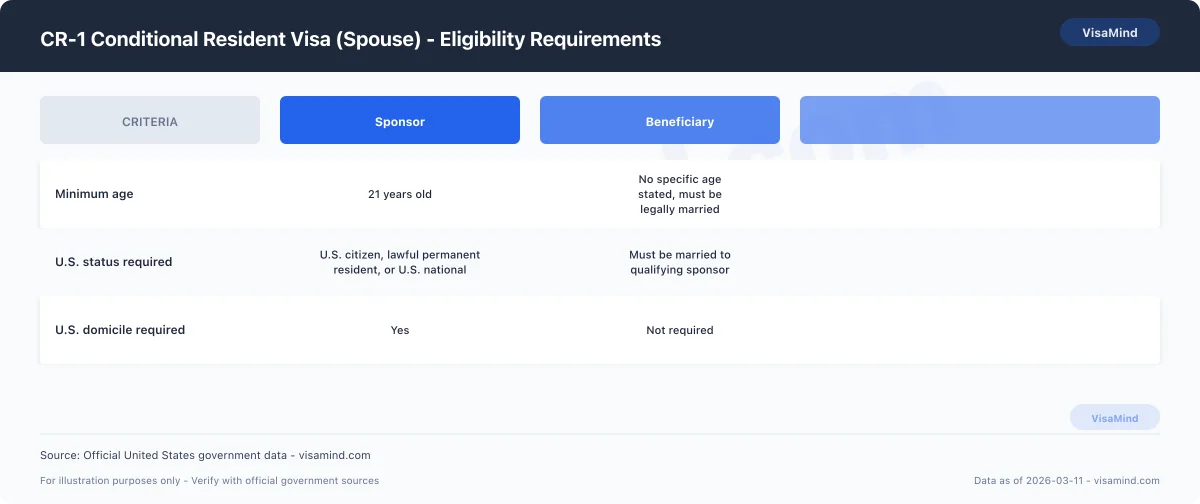
| Requirement | Sponsor | Beneficiary |
|---|---|---|
| Minimum age | 21 years old | No specific age stated, must be legally married |
| U.S. status required | U.S. citizen, lawful permanent resident, or U.S. national | Must be married to qualifying sponsor |
| U.S. domicile required | Yes | Not required |
If you do not meet the age or domicile requirement, USCIS will not approve the petition, and the immigrant visa cannot move forward.
Required Documents
#You must submit clear evidence of your identity, your sponsor’s status, and your legal marriage. U.S. Citizenship and Immigration Services (USCIS) reviews these documents with Form I-130, and the U.S. Department of State reviews related records during consular processing, including Form DS-260.
Identity and immigration status evidence
You must prove both your identity and your sponsor’s U.S. status. USCIS will not approve a family-based immigration petition without this documentation.
Provide evidence of the petitioner’s status as a U.S. citizen or lawful permanent resident, such as a U.S. birth certificate, naturalization certificate, U.S. passport, or proof of lawful permanent resident status.
You must also include personal identity information for yourself as the immigrating spouse. The forms request details about your biographical background and your relationship to the petitioner.
| Person | Required Evidence | Purpose |
|---|---|---|
| U.S. citizen or LPR petitioner | Birth certificate, naturalization certificate, U.S. passport, or proof of permanent residence | Confirms eligibility to file Form I-130 |
| Immigrating spouse | Personal identity information and relationship details | Confirms identity and qualifying relationship |
If any document does not clearly establish status, USCIS may request additional evidence.
Proof of relationship and marriage
You must prove that you are legally married to the U.S. citizen or lawful permanent resident sponsor. A valid marriage certificate is required.
Submit a copy of your marriage certificate. Provide evidence that the marriage is legally recognized.
Include documentation showing a genuine spousal relationship. USCIS evaluates whether the marriage establishes a qualifying family relationship under family-based immigration rules.
The petition must clearly show your affiliation to the sponsoring spouse. The agency looks for documentation that supports the existence of a legitimate marital relationship.
If the marriage record does not clearly identify both spouses or appears incomplete, USCIS may issue a request for evidence. Your Form I-130 must match the details shown on your marriage certificate and other civil records.
Form attachments and supporting evidence
Your CR-1 case involves several forms at different stages. Each form requires specific supporting documentation.
Key forms include Form I-130 (filed with USCIS by the petitioner), Form DS-260 (immigrant visa application processed by the U.S. Department of State), and Form I-864, Affidavit of Support (financial sponsorship form).
Attach all required civil and relationship documents to Form I-130 when filing with USCIS. During consular processing, you will submit Form DS-260 and related documentation as directed by the U.S. Department of State.
Form I-864 requires evidence supporting the sponsor’s obligation to support you. Review the official form instructions and the USCIS website for current filing requirements and document checklists, as requirements may change.
Prepare Your Financial Evidence
#You must prove you can financially support your spouse before the government will approve permanent residence. This requires a properly completed affidavit of support and clear proof of income, assets, and household size.
Affidavit of Support forms
Most CR-1 cases require Form I-864, Affidavit of Support, filed as part of the family-based immigration process. USCIS and the National Visa Center will not approve the case without it, whether your spouse files Form I-485 or completes Form DS-260 for consular processing through the U.S. Department of State.
You may qualify to use Form I-864EZ if you are sponsoring only your spouse or an unmarried child and meet the form’s eligibility rules. This shorter version simplifies the process but still requires full financial documentation.
Use Form I-864A if you need a household member’s income to meet the requirement. That household member must sign Form I-864A, provide proof of income, and show the qualifying household relationship.
File the correct form with the immigrant visa or adjustment packet. Missing or incorrect affidavits often delay approval.
| Form | Who Uses It | When Required |
|---|---|---|
| I-864 | Most sponsors | Standard requirement in CR-1 cases |
| I-864EZ | Eligible U.S. citizen sponsors | Simpler cases with qualifying criteria |
| I-864A | Household member | When combining income |
Income, assets and tax evidence
You must show income at 125% of the federal poverty guidelines, based on your total household size. Use the current Form I-864P poverty guidelines to confirm the required amount.
Household size includes you, your spouse (the immigrant), any dependent children, anyone else claimed as a dependent, and any immigrants you previously sponsored, if required by the form instructions.
Submit clear financial evidence, including your most recent U.S. federal income tax return or tax transcript. Include W-2s or equivalent wage statements.
Provide proof of current employment, such as an employer letter. If you are self-employed, include business records that show current income.
Missing tax returns or employment proof often lead to a Request for Evidence (RFE). If your income alone does not meet the requirement, you may use qualifying assets or add a household member or joint sponsor.
Verify your calculations carefully. Errors in household size or income figures commonly delay cases.
Household members and alternate sponsors
If your income does not reach the required threshold, you can combine income with a household member who lives with you. That person must complete and sign Form I-864A and provide supporting financial documents.
You may also use a joint sponsor. A joint sponsor must independently meet the income requirement and submit a separate Form I-864, their most recent federal tax return or transcript, and proof of current income.
Each sponsor must meet the 125% guideline based on their own household size. You cannot split income between two joint sponsors to meet the minimum.
Review all financial documents before submission to USCIS or the National Visa Center. Incomplete affidavits, unsigned forms, or insufficient income evidence can delay your CR-1 conditional spouse visa approval.
How to Apply
#You start the CR-1 process by filing a petition with U.S. Citizenship and Immigration Services (USCIS) and clearly stating whether your spouse will apply inside or outside the United States. Accuracy, complete documentation, and correct form selection determine whether USCIS accepts and processes your case.
Filing Form I-130
Form Form I-130, Petition for Alien Relative starts the family-based immigration process for your spouse. If you live in the United States and you’re a U.S. citizen or lawful permanent resident, you file the petition with USCIS using the current instructions.
When petitioning for a spouse, you need to submit:
- Form I-130
- Form I-130A, Supplemental Information for Spouse Beneficiary
- Evidence of your legal marriage
- Evidence of your qualifying relationship to the U.S. citizen or lawful permanent resident sponsor
Fill in all required fields, including full legal names, birth dates, and address history. USCIS rejects forms missing information.
File a separate Form I-130 for each eligible relative unless a relative qualifies as a derivative beneficiary. After you submit the petition online, USCIS sends a receipt notice confirming it received your case.
Choosing adjustment of status vs consular processing
On Form I-130, Part 4, you pick one option to show where your spouse will apply for permanent residence. You choose between adjustment of status inside the United States or consular processing abroad.
| Option | Where Your Spouse Applies | Who Handles the Process |
|---|---|---|
| Adjustment of Status | Inside the United States | USCIS |
| Consular Processing | Outside the United States | U.S. Department of State |
If your spouse is in the United States and eligible to apply here, you can indicate adjustment of status. If your spouse will apply through a U.S. embassy or consulate abroad, select consular processing.
For consular processing, your spouse later completes Form DS-260 with the U.S. Department of State. You must also submit Form I-864, Affidavit of Support to show financial sponsorship, as required in family-based immigration.
Your selection should match your spouse’s actual plan. Picking the wrong option can cause delays.
Completing, signing and submitting the form
You must complete all sections of Form I-130 before submitting. USCIS requires full and accurate details about:
- Your marital relationship
- Both spouses’ full legal names
- Dates and places of birth
- Current and prior addresses
Don’t leave required fields blank. Incomplete forms may be rejected or trigger requests for more evidence.
Sign before submission. USCIS will not accept an unsigned petition.
If filing online, follow the prompts and upload clear copies of all supporting documents, including Form I-130A. After submission, check your USCIS account for receipt notices and further instructions.
Fees and Processing Times
#Separate fees apply to U.S. Citizenship and Immigration Services (USCIS) and the U.S. Department of State in the CR-1 spouse visa process. processing times depend on the petition category and the service center.
USCIS and biometrics fees
You start with Form I-130 (Petition for Alien Relative) under family-based immigration.
As of February 2026, the filing fee for Form I-130 is $675.
USCIS may require a biometrics services fee of $85, depending on your case. Biometrics usually include fingerprinting and photos for background checks.
| Fee Type | Form | Amount (USD) | Paid To |
|---|---|---|---|
| Petition filing fee | I-130 | $675 | USCIS |
| Biometrics services fee | Biometrics appointment | $85 | USCIS |
Pay the correct fee when you submit your petition. If you pay the wrong amount, USCIS may return your package.
Check the USCIS fee schedule or fee calculator before you file, especially if you wait to submit.
Immigrant visa (consular) fees
After USCIS approves your I-130, your case goes to the National Visa Center (NVC) under the U.S. Department of State. You then complete Form DS-260 (Immigrant Visa Application) online.
As of February 2026, the immigrant visa processing fee for the DS-260 is $325.
| Fee Type | Form | Amount (USD) | Paid To |
|---|---|---|---|
| Immigrant visa application | DS-260 | $325 | U.S. Department of State (via NVC) |
You must also submit Form I-864 (Affidavit of Support) as part of consular processing. The background information doesn’t list a fee for Form I-864; confirm any required payments with the U.S. Department of State or through NVC instructions.
You can’t schedule a visa interview until you pay the immigrant visa fee and submit all required documents.
Typical processing time ranges
Processing times for Form I-130 vary by petition category and USCIS service center. USCIS publishes time ranges through its processing times tool.
As of January 2026:
| Petition Category | Reported Time Range (Months) |
|---|---|
| U.S. citizen filing for a spouse, parent, or child under 21 | 17 to 87 |
| Permanent resident filing for a spouse or child under 21 | 49.5 to 213.5 |
| U.S. citizen filing for unmarried son/daughter 21 or older | 50 to 198 |
| Permanent resident filing for unmarried son/daughter 21 or older | 48 to 240 |
| U.S. citizen filing for married son or daughter | 47.5 to 178.5 |
| U.S. citizen filing for a brother or sister | 95 to 240 |
CR-1 cases are in the spouse category. If you’re a U.S. citizen petitioning for your spouse, your case falls within the 17 to 87 month range above.
Total processing for many CR-1 cases often lands around 12 to 18 months, but timelines depend on USCIS workload, document completeness, and U.S. Department of State scheduling. Use the USCIS processing times tool for the most current estimates for your form and service center.
Conditions and Rights
#A CR-1 visa grants permanent resident status based on marriage, but it also creates binding legal duties for the sponsor. You must comply with ongoing reporting and eligibility requirements during the immigration process.
Sponsor obligations and legal duties
When you file Form I-130 for your spouse and sign Form I-864, Affidavit of Support, you accept a legal financial obligation. This is not just paperwork—it’s an enforceable duty to support your spouse.
Before signing Form I-864, know that:
- You agree to financially support your spouse.
- The obligation becomes binding once your spouse gets permanent resident status.
- Government agencies can rely on this form to determine eligibility for certain benefits.
If you become a U.S. citizen while the petition is pending, notify either USCIS or the U.S. Department of State, depending on where the case is processing. Visa issuance and consular processing fall under the Department of State, including the Form DS-260 immigrant visa application.
Here’s a breakdown of key forms and responsibilities:
| Form | Filed With | Purpose | Legal Impact |
|---|---|---|---|
| I-130 | USCIS | Establish qualifying marriage | Starts family-based immigration process |
| I-864 | USCIS or Department of State (consular stage) | Financial sponsorship | Creates binding support obligation |
| DS-260 | U.S. Department of State | Immigrant visa application | Required for visa issuance abroad |
Notification and residency requirements
After you become a sponsor, keep your address current. If you move, file Form I-865, Sponsor’s Notice of Change of Address.
This requirement continues even after the immigrant visa interview or approval. Failing to update your address can affect official communication about your affidavit of support.
You must also notify the agency if your immigration status changes while the case is pending. For example:
-
If you naturalize while your spouse is waiting for a visa, inform USCIS or the Department of State.
-
Follow the instructions from the agency handling your case.
USCIS handles petitions and immigration benefits. The Department of State manages visa interviews and issuance abroad. Updates go to the agency holding your case.
Age requirements for different steps
Family-based immigration through a CR-1 visa involves age-based eligibility at certain stages.
For sponsorship through Form I-130, you must:
- Be legally eligible to file the petition.
- Meet the age requirement to sign Form I-864 as a sponsor.
Because the affidavit of support is a binding financial contract, you must be legally able to enter into that obligation. Review the current age rules on the USCIS website before filing.
For the immigrant spouse:
- You must meet the legal requirements to qualify as a spouse under U.S. immigration law.
- You must complete Form DS-260 and follow Department of State instructions for visa processing abroad.
If you have questions about age eligibility at any stage, confirm the standards directly with USCIS or the U.S. Department of State before applying.
Path to Permanent Residence
#After USCIS approves your Form I-130, you move into the immigrant visa or adjustment stage. Your next steps depend on where you live and whether you qualify to file Form I-485 in the United States.
Adjustment of status vs consular steps
Your location determines the process.
| If you are… | You generally pursue… | Agency handling the case |
|---|---|---|
| In the United States and eligible | adjustment of status (Form I-485) | USCIS |
| Outside the United States | Consular processing (Form DS-260) | U.S. Department of State |
If you qualify for adjustment of status, USCIS will adjudicate your Form I-485 along with or after approval of your Form I-130A. You may file Form I-130 online and include Form I-485 as supporting evidence if eligible.
If you live abroad, your approved I-130 goes to the National Visa Center (NVC). You then complete the online Form DS-260, Immigrant Visa Application through the U.S. Department of State before a visa interview at a U.S. embassy or consulate.
Concurrent filing and I-485 considerations
If you’re physically present in the United States and meet eligibility, you may file Form I-130 and Form I-485 together. This is called concurrent filing and may reduce overall processing time.
You need to confirm that:
- You’re eligible to adjust status in the United States.
- A visa is available in your category under family-based immigration rules.
- You properly complete and sign both forms.
USCIS will review both filings and decide whether to approve the I-130 and the I-130A. If you file Form I-130 online, USCIS can still adjudicate a properly filed Form I-485 submitted as supporting evidence.
Check the USCIS website for current filing fees and required initial evidence. Incomplete filings delay your case and may result in rejection.
NVC processing and interview preparation
If you process through a U.S. embassy or consulate, the NVC manages your case before the interview.
You must complete several steps:
-
Submit Form DS-261 (Choice of Address and Agent) so the NVC knows where to send notices.
-
Pay required visa fees as instructed by the NVC.
-
Complete and submit Form DS-260 online.
-
Upload civil documents and Form I-864, Affidavit of Support.
Prepare all civil documents and the signed I-864 before starting the DS-260. The NVC usually requests them together.
Schedule your medical exam and gather police certificates early. You’ll need these at the visa interview. The U.S. Department of State schedules the interview after you complete required fees and document submissions.
Removing Conditions
#You must address financial sponsorship requirements when moving forward with permanent residence processing tied to your CR-1 visa. The Affidavit of Support remains central, and timing and household participation directly affect how you prepare your forms.
Affidavit and support at interview
You complete Form I-864, Affidavit of Support Under Section 213A of the Act, when your immigrant visa interview is scheduled or when you file for adjustment to permanent resident status with USCIS.
For consular processing, the U.S. Department of State handles the visa interview after approval of the Form I-130 petition and submission of the Form DS-260 immigrant visa application. At that point, the Affidavit of Support must be completed and ready for review.
Key points:
- The sponsor must complete and sign Form I-864.
- The form supports a family-based immigration case.
- You prepare it in connection with either:
-
A scheduled immigrant visa interview, or
-
An adjustment of status filing with USCIS.
If you need filing instructions or fee details, refer to the USCIS or U.S. Department of State instructions, depending on your processing location.
When additional household contracts apply
If a household member’s income is needed to support the sponsorship, that person must complete Form I-864A, Contract Between Sponsor and Household Member.
Form I-864A creates a formal agreement between the sponsor and the household member. This allows the household member’s income to be counted in support of the intending immigrant.
Use this table for clarification:
| Form | Who Completes It | Purpose | When Used |
|---|---|---|---|
| I-864 | Petitioning sponsor | Affidavit of Support | At visa interview scheduling or adjustment filing |
| I-864A | Household member | Contract with sponsor | When household income is needed |
Only use Form I-864A if you’re including a household member’s income. If the sponsor meets the income requirements alone, you do not submit this contract.
Always check the official form instructions from USCIS to confirm who qualifies as a household member and how to complete the agreement.
Timing for support-related forms
Timing is important. You do not file Form I-864 at the same time as the initial Form I-130 petition.
Instead, prepare and complete Form I-864:
- When the immigrant visa interview is scheduled through the U.S. Department of State, or
- When you submit an application for adjustment of status with USCIS.
This applies whether you’re using consular processing after DS-260 submission or seeking adjustment inside the United States.
If you need Form I-864A, complete it at the same stage as the sponsor’s Form I-864.
When to Get Help
#Certain filing errors lead to rejections or Requests for Evidence from USCIS. Mistakes at the National Visa Center (NVC) stage can stall your case.
You should seek help when facts are complicated, deadlines are tight, or prior filings contain gaps or inconsistencies.
Complex or time-sensitive cases
Guidance is especially helpful if your case includes missing civil documents, prior filings with errors, or tight travel or relocation timelines.
Even small inconsistencies across Form I-130, Petition for Alien Relative, Form I-130A, Form DS-260, and Form I-864, Affidavit of Support can cause delays.
Common problem areas:
- Incomplete address or travel history since age 16
- Different spellings of names across forms and passports
- Omitting family members on immigration forms
- Filing the DS-260 before paying required NVC fees
These issues often lead to rejections or Requests for Evidence from USCIS, or processing holds at the Department of State stage.
If you face urgent family circumstances, expiring documents, or prior filing mistakes, act early.
Key expert tips to avoid delays
You can prevent many delays by submitting a complete and consistent package the first time. Focus on accuracy, documentation, and order of filing.
For the I-130 stage with USCIS:
- File Form I-130A together with Form I-130 for a spouse
- Include primary civil documents (such as marriage certificates)
- Add supporting evidence like photos or affidavits when relevant
- Use identical name spellings across every form and document
For the NVC and Department of State stage:
-
Pay required fees first.
-
Submit Form DS-260.
-
Upload civil and financial documents as instructed.
Frequent filing problems:
| Issue | Likely Result |
|---|---|
| Missing I-130A | Rejection of petition |
| Gaps in address or travel history | Request for Evidence |
| Name inconsistencies | Processing delay |
| DS-260 filed out of order | Case hold at NVC |
When to consult an immigration professional
Consult an immigration professional if USCIS has already issued a Request for Evidence, rejected your filing, or identified missing information. Fixing an error after submission often takes precise documentation and clear explanations.
You also benefit from legal review if:
- You previously submitted incomplete travel or address history
- You are unsure how to document your marriage with primary and secondary evidence
- You have concerns about completing Form I-864 accurately
- You discovered inconsistencies in earlier filings
An immigration professional can check your forms for consistency across I-130, DS-260, and I-864 before submission. They can also ensure you follow current USCIS and Department of State instructions.
If you feel uncertain about any required document or sequence, verify requirements directly from USCIS and, when appropriate, seek individualized legal advice before filing.
Relationship Scrutiny Red Flags
#USCIS and the U.S. Department of State review your forms and supporting documents for accuracy and consistency. Filing errors and weak relationship proof often lead to rejections, Requests for Evidence (RFEs), or delays in family-based immigration cases.
Missing signatures, wrong editions, translations
USCIS rejects unsigned forms. Failing to sign and date the Form I-130, Form I-130A, or any required section will stop your petition.
You must use the current edition of each form. Submitting an outdated version or missing pages leads to rejection. Always confirm the edition date on the form before filing.
For a spouse, include Form I-130A. For biological or adopted children, file a separate Form I-130 for each child.
Foreign-language documents require a full English translation and a signed translator certification. USCIS rejects documents without proper certification.
Common filing errors:
- Leaving Part 4 incomplete or selecting both options
- Failing to provide proof of U.S. citizenship or lawful permanent resident status
- Omitting required signatures in Part 8 or sponsor sections
- Submitting civil documents without certified translations
| Error Type | Likely Outcome |
|---|---|
| Missing signature | Automatic rejection |
| Wrong form edition | Rejection |
| Missing I-130A for spouse | Rejection |
| No translator certification | Rejection |
Insufficient or inconsistent relationship evidence
CR-1 cases face close review because you must prove a bona fide marriage. Weak documentation often results in an RFE.
Submit evidence showing you share a real marital life. Strong examples:
- Joint financial records
- Photos from different periods of your relationship
- Sworn affidavits from people with personal knowledge of your marriage
- Certified marriage certificate
Information must match across Form I-130, Form DS-260, and all civil documents. Differences in dates, prior marriages, names, or addresses raise credibility concerns.
If your DS-260 lists details that conflict with your petition or divorce records, the U.S. Department of State may delay visa processing or question you at the interview. Inconsistent answers create avoidable risk.
| Issue | Consequence |
|---|---|
| Minimal joint documentation | RFE |
| Conflicting marital history | Delay or denial |
| Missing civil documents | RFE or processing delay |
Incorrect fees, categories, and incomplete histories
Pay the correct filing fees and use the proper category. Submitting the wrong fee or choosing the wrong relationship category can mean rejection.
Always verify current fees through the USCIS fee calculator.
Select the correct relationship classification when filing your Form I-130. An incorrect category can delay or derail your case. If you fail to indicate how the beneficiary will proceed in Part 4, USCIS may choose an option that doesn’t match your intent.
Your history must be complete and consistent. Disclose prior marriages, divorces, and any other required background information exactly as shown on your civil records.
For the financial stage, ensure the Form I-864, Affidavit of Support, is properly completed and signed by all required parties. Missing signatures from joint sponsors or household members delay processing.
| Problem | Result |
|---|---|
| Wrong fee | Rejection |
| Incorrect category | Delay or denial |
| Incomplete marital history | Credibility concerns |
| Unsigned I-864 | Processing delay |
Fees
#| Component | Amount |
|---|---|
| Filing fee (I-130)Filing fee (I-130): $675 (as of 2026-02). Verify the current fee on the official schedule before filing. | $675 |
| BiometricsBiometrics: $85 (as of 2026-02). Verify the current fee on the official schedule before filing. | $85 |
| Immigrant visa processing (DS-260)Paid to NVC/consulate | $325 |
Fees change; always verify on USCIS.
Next steps
#Use Find My Visa to build a sequenced plan with official sources and deadlines.
FAQs
How do you qualify for a CR-1 visa?
You’ll need a legally valid marriage to start.
A properly filed Form I-130 is required.
You also have to complete Form DS-260.
A qualifying financial sponsor must submit Form I-864.
USCIS sets specific eligibility standards for this process. Double-check those before filing.
Who can file Form I-130 to sponsor a spouse?
U.S. citizens, lawful permanent residents, or U.S. nationals may petition for an eligible relative; you must be a U.S. citizen, lawful permanent resident, or U.S. national to file.
Who is eligible to be sponsored for a CR-1 spouse visa?
A foreign citizen spouse can be sponsored if married to a U.S. citizen or lawful permanent resident; for an immigrant visa the sponsor must generally be at least 21 years old (for some steps) and either a U.S. citizen or lawful permanent resident.
What core documents should I submit to prove identity and relationship?
Typical required documents include evidence of U.S. citizenship or lawful permanent residence (birth certificate, naturalization certificate, or passport) and proof of the family relationship such as a marriage certificate and evidence of the bona fides of the marriage.
Do I need to file Form I-130A when petitioning for a spouse?
Yes — when petitioning for a spouse you must submit Form I-130 and Form I-130A along with supporting documents; omitting I-130A can cause rejection.
What fees should I expect for filing and processing?
As of the cited dates, the Form I-130 filing fee is $675, the biometrics service fee is $85, and immigrant visa processing (Form DS-260) is $325 (paid to the NVC/consulate).
How long does I-130 processing typically take?
processing times vary by eligibility category and service center; published ranges include multiple-category windows (for example, some spouse categories show ranges from months to years) and USCIS processing times should be consulted for current data.
What happens if the form is unsigned or the wrong edition is used?
Unsigned forms will be rejected; submitting the wrong edition of the form or missing pages will lead to rejection, and forgetting to sign the petition causes delays or rejection.
What is the affidavit of support and when is it required?
Sponsors must complete Form I-864 (Affidavit of Support) — and I-864A if applicable — and gather affidavit of support documentation; I-864 is completed when the immigrant visa interview is scheduled or when submitting an application for adjustment to permanent resident status.
Does filing the CR-1 petition guarantee a visa or approval?
No — filing the CR-1 (Form I-130) does not guarantee approval; USCIS will adjudicate properly filed forms, and outcomes depend on evidence and eligibility.
Official sources referenced
Last reviewed: 2026-03-11
VisaMind provides informational guidance only and is not a government agency. This is not legal advice. Requirements can change and eligibility depends on your specific facts. If your case is complex or high-stakes, consult a licensed immigration attorney.
Next steps
Every United States visa case depends on your nationality, purpose, and timeline. Get a personalized plan with official sources and deadlines.
Get my CR-1 Conditional Resident Visa (Spouse) plan