What the Diversity Visa (DV Lottery) Covers
#The diversity visa Lottery offers an opportunity to seek permanent residence in the United States if you’re from a country with historically low immigration rates. It’s an opportunity, not a guarantee, and requires further government processing if you’re selected.
Program purpose
The Diversity Visa Lottery exists to diversify the immigrant population in the United States. It targets individuals from countries that have sent relatively few immigrants to the U.S. in recent years.
You participate by submitting an entry during the official registration period. Selection is random, but eligibility depends on your country of origin as defined by the program rules.
Key elements of the program’s purpose include:
- Expanding immigration opportunities for underrepresented countries
- Promoting diversity within the lawful permanent resident population
- Providing a structured, government‑run selection process
The program doesn’t prioritize family sponsorship, employment sponsorship, or investment. It operates separately from petitions filed with USCIS.
| Feature | What It Means for You |
|---|---|
| Country-based eligibility | Your country of origin affects whether you can enter |
| Random selection | Submission does not ensure selection |
| Immigration pathway | Selection allows you to pursue an immigrant visa |
What the entry provides
Submitting a Diversity Visa Lottery entry gives you a chance to apply for an immigrant visa if selected. It doesn’t grant lawful status, work authorization, or travel permission.
If you’re selected, you must complete additional steps. This may include submitting Form DS-260 to the U.S. Department of State and providing required documentation during visa processing.
You may also need to submit supporting forms if required by your case. For example:
- Form DS-260 (Immigrant Visa Application)
- Form I-864, Affidavit of Support, if applicable
- Supporting civil documents and identification records
USCIS does not approve the lottery entry itself. The U.S. Department of State manages visa processing and issuance.
Key limits
The Diversity Visa Lottery has strict limits. Filing an entry doesn’t guarantee approval or issuance of a green card.
You must meet eligibility rules tied to your country of origin. If your country does not qualify for a given program year, you cannot participate unless another qualifying rule applies.
Other important limits include:
- Selection does not guarantee a visa
- You must complete all required forms accurately
- You must follow government deadlines exactly
Government agencies apply these requirements strictly.
When to Consult a Professional
#
You can complete many diversity visa Lottery steps on your own. Certain situations increase the risk of denial or delay.
Errors in petition filings, false information, or unusual case factors often require experienced legal review before you submit anything to USCIS or the U.S. Department of State.
Complex petition filings
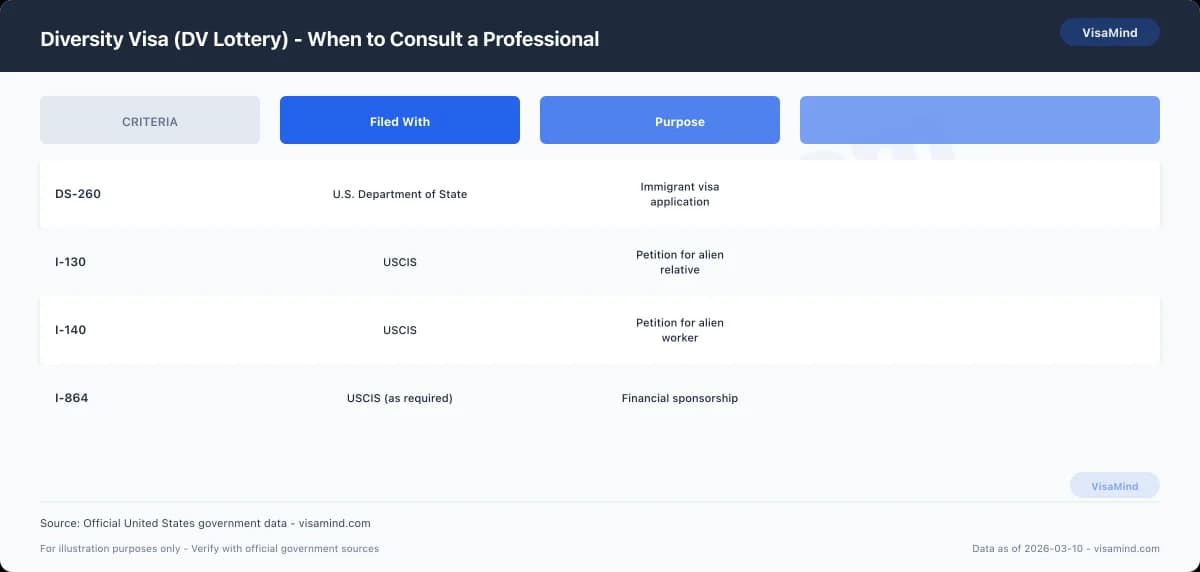
Most Diversity Visa Lottery winners file Form DS-260 with the U.S. Department of State for consular processing. Your case might involve additional petitions or affidavits that require precision.
If a qualifying relative files Form I-130, Petition for Alien Relative, or an employer files Form I-140, Petition for Alien Worker, those petitions must follow USCIS instructions exactly. Missing signatures, incomplete evidence, or filing at the wrong location can result in rejection.
If a sponsor submits Form I-864, Affidavit of Support, accuracy is critical. Submitting false documents or incorrect financial information can lead to denial of the affidavit and other immigration benefits.
Consider legal help if your case involves:
- Multiple petition types (I-130, I-140, I-864)
- Questions about who qualifies as a sponsor
- Prior petition denials
- Uncertainty about where or how to file with USCIS
| Form | Filed With | Purpose |
|---|---|---|
| DS-260 | U.S. Department of State | Immigrant visa application |
| I-130 | USCIS | Petition for alien relative |
| I-140 | USCIS | Petition for alien worker |
| I-864 | USCIS (as required) | Financial sponsorship |
Fraud and legal risks
You must provide truthful and complete information at every stage of the Diversity Visa Lottery process. False statements or fabricated documents can trigger serious consequences.
If you submit false information with Form I-864, USCIS may deny the affidavit and may deny related immigration benefits. Knowingly providing false information can also expose you to criminal prosecution under U.S. law.
Consult a professional immediately if:
- You previously submitted incorrect information
- A sponsor’s financial documents contain inconsistencies
- You are unsure whether a document meets USCIS standards
- You suspect a third party prepared inaccurate paperwork
Do not attempt to correct serious errors without guidance.
Unusual case types
Some Diversity Visa Lottery cases fall outside standard processing. These situations often require careful legal analysis before you file Form DS-260 or respond to agency requests.
Seek advice if your case involves:
- Prior immigration filings with USCIS
- Multiple pending petitions
- Conflicting information across forms
- Requests for additional documentation from the U.S. Department of State
Unusual procedural history can affect how agencies review your case. A professional can evaluate your filings, confirm consistency across forms, and help you follow official instructions published by USCIS and the U.S. Department of State.
Conditions of Stay
#Your ability to receive and keep lawful permanent residence through the diversity visa Lottery depends on proper financial sponsorship and complete documentation. USCIS and the U.S. Department of State review specific forms and supporting records before approving your immigrant visa or adjustment of status.
Affidavit of Support rules
Most family-based immigrants must submit Form I-864, Affidavit of Support, from the petitioner. This form confirms that the sponsor accepts legal responsibility for financially supporting you.
You must include the Affidavit of Support when applying for an immigrant visa or when filing for adjustment of status with USCIS, if required for your category. Failure to submit it can delay processing.
Key points:
- The petitioner completes and signs Form I-864
- The form is required at the immigrant visa or adjustment stage
- Incomplete financial evidence delays your case
If you apply through consular processing after submitting Form DS-260, the U.S. Department of State reviews the Affidavit of Support at the visa stage. If you adjust status inside the United States, USCIS reviews it.
| Form | Who Completes It | When It Is Reviewed | Agency |
|---|---|---|---|
| I-864 | Petitioner/Sponsor | Immigrant visa or adjustment stage | USCIS or U.S. Department of State |
| DS-260 | Immigrant applicant | Consular processing | U.S. Department of State |
Sponsor obligations
When someone signs Form I-864, that person enters a legally binding agreement. The sponsor agrees to financially support you if necessary.
This obligation is not symbolic. It creates enforceable responsibilities.
Before signing, your sponsor should understand:
- The commitment is legal, not optional
- The obligation supports your permanent residence process
- Signing without understanding the duty can create serious consequences
You do not complete Form I-864A unless you have accompanying family members who require additional income support documentation.
Sponsors must carefully review their financial evidence before submission. Missing or incorrect information can delay approval of your green card.
Documents that affect processing
USCIS or the U.S. Department of State will not move forward without complete financial documentation. Missing tax returns or proof explaining why a return was not required can delay action on your application.
You must ensure your sponsor includes:
- A completed and signed Form I-864
- The sponsor’s federal tax return, if required
- Evidence showing why no tax return was required, if applicable
If required documents are missing, the agency may issue a request for evidence or delay visa issuance.
In Diversity Visa Lottery cases, document completeness is critical because visa numbers are limited. Delays can affect whether you receive a visa before the program year ends.
Fees and Processing Times
#You will not pay a fee to enter the diversity visa Lottery, but you will pay required government fees if you are selected and move forward. processing times depend on your case type and where you complete your application, and they can shift during the fiscal year.
Typical processing windows
Under standard processing, many Diversity Visa Lottery cases move within 2 to 6 months. This timeframe reflects current estimates as of March 2026 and can change based on case volume and staffing.
Your timeline depends on whether you apply for adjustment of status with U.S. Citizenship and Immigration Services (USCIS) or complete consular processing through the U.S. Department of State. Each path follows a different workflow.
A typical sequence looks like this:
-
Submit the Form DS-260 immigrant visa application.
-
Provide civil documents as instructed.
-
Pay required visa fees.
-
Attend your immigrant visa interview (consular processing) or complete USCIS processing if adjusting status.
Delays often occur when applicants submit incomplete forms or wait to pay fees. Follow all instructions from the National Visa Center before your interview is scheduled.
| Stage | Who Handles It | Key Action |
|---|---|---|
| DS-260 submission | U.S. Department of State | Complete and submit online form |
| Civil documents | U.S. Department of State | Upload or submit as instructed |
| Adjustment filing (if eligible) | USCIS | File required forms with supporting evidence |
Fee payment notes
You do not pay a fee to enter the Diversity Visa Lottery. Fees apply only if you are selected and continue with immigrant visa processing or adjustment of status.
The exact amounts change. You must confirm current fees on the official USCIS website or the U.S. Department of State website before you pay.
If you adjust status in the United States, you may file forms that require payment to USCIS. If you process through a U.S. embassy or consulate, you will pay immigrant visa fees to the U.S. Department of State.
In some family-based immigration cases, Form Form I-864, Affidavit of Support, requires a separate fee and sponsor documentation. Diversity Visa applicants generally do not use Form I-864 unless specifically instructed.
- Fees vary — check the official website.
- Pay only through approved government payment systems.
- Follow the payment timing instructions in your case notices.
Do not send payment before you receive official instructions tied to your case number.
Where processing times vary
Processing times vary based on several case-specific factors. The most important are your eligibility category and where your case is handled.
USCIS processing times differ by service center. One center may move cases faster than another, even for similar filings.
Consular processing timelines vary by:
- Embassy or consulate workload
- Local staffing levels
- Volume of Diversity Visa cases in your region
The Diversity Visa program also operates within a fiscal year limit. If your case number becomes current later in the year, you may have less time to complete processing.
| Factor | Why It Matters |
|---|---|
| Eligibility category | Determines processing track |
| Service center | Affects USCIS case speed |
| Embassy workload | Affects interview scheduling |
| Case number timing | Influences when you can proceed |
You must monitor official case updates and respond quickly to requests to avoid preventable delays.
Eligibility Requirements
#You must register during the official entry period and follow strict submission rules. After selection, you need specific information and online access to continue your case with the appropriate government agencies.
When you can apply
The diversity visa Lottery opens for a limited registration period each fiscal year. You may submit your entry only during that window.
If you miss the registration period, you must wait until the next fiscal year to apply. The government does not accept late entries.
Key timing rules:
- You can submit your entry only during the official registration period.
- The registration period occurs once per fiscal year.
- Entries submitted outside that period are not considered.
The U.S. Department of State manages the Diversity Immigrant Visa (DV) Program.
| Requirement | What You Must Know |
|---|---|
| Registration window | Limited period each fiscal year |
| Late submissions | Not accepted |
| Managing agency | U.S. Department of State |
Do not wait until the last day. Technical issues do not excuse a missed deadline.
Entry rules
You may submit only one entry per person during the registration period.
Submitting more than one entry leads to disqualification, even if the duplicate was accidental.
Follow these core rules:
- Submit one entry only.
- Do not create multiple registrations.
- Complete the entry during the official period.
The system tracks entries by individual applicant. Duplicate submissions result in automatic disqualification, and you can't fix this after the deadline.
After selection, you'll receive notification and instructions that reference your case. Keep all confirmation details secure, since you'll need them for your immigrant visa process.
What applicants must have
To participate and continue your case, you need certain tools and information.
At minimum, you must have:
- Internet access
- Your Diversity Visa case number
- Your selection notification details
You'll use your case number to complete Form DS-260, the Immigrant Visa Application, through the Department of State’s online system.
Your case number appears in your selection notification. Enter it exactly as issued—mistakes can delay processing.
During later stages, other forms may apply depending on your situation, such as Form I-864, Affidavit of Support, which U.S. Citizenship and Immigration Services (USCIS) oversees in related processes.
| Item | Why It Matters |
|---|---|
| Internet access | Required to submit forms and check status |
| DV case number | Identifies your specific case |
| Selection notice | Confirms eligibility to proceed |
Keep digital and printed copies of all confirmation messages and case information. You'll need them throughout the process.
Required Documents
#You must gather specific identification numbers, complete online forms, and submit financial and civil evidence before the government will approve your diversity visa Lottery case.
Missing documents delay processing with the National Visa Center (NVC), U.S. Citizenship and Immigration Services (USCIS), or the U.S. Department of State.
Case numbers and online access
You can't move forward without reliable internet access and your official case information. The NVC assigns a case number and provides an Invoice ID number in its notice to you.
You need these details to:
- Log into the Consular Electronic Application Center
- Complete and submit Form DS-260 (Immigrant Visa Application)
- Upload required civil documents
- Track your case status
Keep your case number exactly as issued. Enter it consistently on all forms and correspondence.
If you adjust status in the United States through USCIS instead of consular processing, you must follow USCIS filing instructions for your application package.
| Item | Where You Receive It | Why It Matters |
|---|---|---|
| NVC Case Number | NVC notice | Identifies your Diversity Visa case |
| Invoice ID Number | NVC notice | Allows online access to your case |
| DS-260 Confirmation | After online submission | Required for visa interview processing |
Affidavit of Support options
Most Diversity Visa Lottery applicants must submit Form I-864, Affidavit of Support, before approval.
USCIS and the NVC will not approve your case without a properly completed financial sponsorship form when required.
You should file Form I-864 together with your adjustment or immigrant visa package as instructed.
You may use alternative versions in limited situations:
- Form I-864A if a household member’s income helps meet the requirement
The household member must sign the form
-
You must include proof of that income
-
Form I-864EZ if you qualify under its simplified criteria
Your sponsor must include current tax returns and W-2 forms. Household size directly affects the income threshold, so count all dependents when calculating eligibility.
Civil and financial evidence
You must submit civil documents and financial proof through the online system or as instructed for your case type.
The NVC and the U.S. Department of State review these documents before scheduling or completing visa processing.
Common required evidence includes:
- Civil status documents listed in the immigrant visa instructions
- Financial evidence supporting Form I-864
- Current tax returns
- W-2 forms
- Proof of household member income (if using Form I-864A)
Upload clear, complete copies in the correct format. Incomplete submissions delay review.
If you apply for adjustment of status with USCIS instead of consular processing, follow the document checklist in the relevant USCIS form instructions.
How to Apply Step by Step
#You must submit your entry online during the official registration period and keep your confirmation number.
If selected, you complete additional government forms and follow detailed instructions from the appropriate agency.
Registering online
You enter the diversity visa Lottery only through the official Electronic Diversity Visa (E‑DV) website during the designated registration window.
Follow these steps:
-
Access the E‑DV entry form during the official registration period.
-
Complete the electronic entry form in full.
-
Submit the form electronically.
-
Save and securely store your unique confirmation number.
After you submit a complete entry, the system generates a confirmation screen with your confirmation number. Keep this number—it's the only way to check your selection status and continue if you're chosen.
Do not mail paper forms to USCIS for the initial lottery entry. The first step is strictly electronic submission through the E‑DV system.
| Stage | What You Do | Why It Matters |
|---|---|---|
| Entry period | Submit online form | Required to participate |
| Confirmation | Save confirmation number | Needed to check status and proceed |
After submission — next forms
If the program selects you, you must complete additional immigration forms before you can receive permanent resident status.
A key form in this stage is Form DS‑
- Complete and submit it as instructed. Provide accurate personal information throughout.
In some cases, a financial sponsor may need to complete Form I‑864, Affidavit of Support, which USCIS uses to evaluate financial responsibility.
For current filing requirements, processing steps, and fees, refer to the instructions from the U.S. Department of State and USCIS.
Following instructions and packets
After selection, you will receive detailed instructions about the next steps in your case.
You may need to prepare and submit a packet of documents as directed. If a relative is applying for permanent resident status based on your case, provide the required information for them as well.
Keep copies of your confirmation number, submitted forms such as DS‑260, and any supporting documentation you provide.
Respond promptly to any official notice. Delays or incomplete submissions can prevent your case from moving forward.
Tips and Common Mistakes
#Accuracy and timing control most diversity visa Lottery delays. Keep your records consistent, submit complete civil documents, and follow the National Visa Center (NVC) sequence exactly.
Expert tips to streamline your case
Act early once you are selected in the Diversity Visa Lottery. Complete Form DS-261 (Choice of Address and Agent) promptly so the National Visa Center sends notices to the correct contact.
Prepare key documents before you start Form DS-
- NVC typically requests the Form DS-260 and civil documents together.
Use this checklist:
- Certified copies of birth, marriage, and divorce certificates
- Police certificates
- Medical exam scheduling confirmation
- Most recent tax transcript and employer letter (for Form I-864)
- Business records if self-employed
Keep name spellings identical across your passport, civil documents, and DS-
- Even small variations trigger verification requests.
If a sponsor files Form I-864, Affidavit of Support, confirm the income meets 125% of the poverty guidelines listed in Form I-864P. Add a household member (Form I-864A) or a joint sponsor if needed.
Retain your Diversity Visa entry confirmation number. You can't check status without it.
Frequent documentation errors
Most refusals and Requests for Evidence stem from inconsistent or missing documents. Your DS-260 must match your civil records exactly.
Common problems include:
| Error | How to Avoid It |
|---|---|
| Information does not match birth or marriage certificates | Copy names, dates, and places exactly as shown |
| Missing certified civil documents | Obtain certified copies before NVC review |
| Incomplete address or travel history since age 16 | List every address and trip; do not leave gaps |
| Missing tax or employment proof for I-864 | Include most recent tax transcript and employer letter |
Unsigned or undated forms also cause delays. The sponsor must sign and date the correct section of Form I-864, and any joint sponsor or household member must sign their required sections.
If income calculations are incorrect, NVC will question the affidavit. Count every required household member and verify the income threshold carefully.
Submission and sequencing mistakes
Follow the NVC order precisely. Paying required fees, submitting Form DS-260, and uploading civil documents must occur in the instructed sequence.
Submitting DS-260 before completing required fee steps or document uploads can delay scheduling. Review the instructions from the U.S. Department of State carefully.
Do not leave mandatory fields blank on any form. A single empty required field can result in rejection.
Track your process in order:
-
Pay required fees (fees vary — check the official instructions).
-
Submit Form DS-260 accurately.
-
Upload all required civil documents.
-
Ensure Form I-864 and financial evidence are complete.
-
Schedule and complete the medical exam before the visa interview.
Bring complete originals to your interview. The U.S. Department of State conducts visa interviews, and incomplete files can prevent issuance even if you were selected in the Diversity Visa Lottery.
What Consular Officers Evaluate
#Consular officers focus on whether your case is accurate, complete, and internally consistent.
They compare your forms and supporting records line by line and assess whether your financial evidence supports the information you provided.
Consistency across forms
Every answer must be consistent across your diversity visa Lottery entry, your Form DS-260 Immigrant Visa Application, and any documents submitted to U.S. Citizenship and Immigration Services (USCIS) or the U.S. Department of State.
Officers compare names, dates, marital history, children, education, employment history, and addresses.
Even small differences can delay your case or lead to refusal.
Use this checklist before your interview:
- Spelling of your full legal name matches your passport and civil documents
- Dates of birth match across all forms
- Marital status is the same on every filing
- All children appear consistently on each form
- Employment and address histories follow the same timeline
| Item Reviewed | Must Match Across | Common Risk Area |
|---|---|---|
| Full legal name | Passport, DS-260, civil records | Spelling variations |
| Marital status | DS-260, prior filings | Recent changes not updated |
| Children listed | Lottery entry, DS-260 | Omitted child |
| Employment history | DS-260, supporting records | Gaps or overlapping dates |
If you update information, make sure every related document reflects the same change.
Truthfulness of documents
You must present genuine and accurate documents. Officers examine whether your records support the answers you gave on the DS-260.
They look for contradictions between your statements and your paperwork. If a document conflicts with your form responses, the officer may question your credibility.
Review civil documents for correct names and dates. Check education or work records for consistency with your DS-260.
Any prior submissions to USCIS should match the information you provide now.
Accuracy matters more than volume. Submitting extra documents doesn't fix incorrect answers.
If you discover an error before your interview, correct it through the proper channel listed by the U.S. Department of State and be ready to explain the change clearly and directly.
Income and household evidence
If your case requires financial sponsorship, the officer reviews the Form I-864, Affidavit of Support, and supporting evidence to confirm the sponsor’s claimed income and household size.
Your financial documents must align with the information listed on the I-864 and the DS-
- Household size, dependents, and claimed income must not conflict with other filings.
Check for consistency in:
- Number of dependents
- Marital status of the sponsor
- Reported income figures
- Relationship between you and the sponsor
| Financial Element | What Officers Compare |
|---|---|
| Household size | I-864 vs. sponsor’s supporting records |
| Sponsor’s income | I-864 vs. submitted evidence |
| Relationship | DS-260 vs. I-864 |
If the numbers or household details do not match, the officer may delay the case until the discrepancy is resolved.
Next steps
#Use Find My Visa to build a sequenced plan with official sources and deadlines.
FAQs
Which agency handles each step?
Different agencies are responsible for separate parts of the process.
- Stage: Entry into diversity visa Lottery. Government Authority: U.S. Department of State
- Stage: Form DS-260 processing and interview. Government Authority: U.S. Department of State
- Stage: adjustment of status (if eligible in the U.S.). Government Authority: USCIS
- Stage: Admission at port of entry. Government Authority: U.S. Customs and Border Protection (CBP)
How much are the fees?
Fees change from time to time. The U.S. Department of State and USCIS set the official amounts.
Unofficial sources often get fee details wrong. Always confirm with the agency directly.
What is the Diversity Visa (DV) Lottery?
The DV Lottery is the entry used to apply for a chance to immigrate to the United States under a program designed to diversify the U.S. immigrant population by selecting applicants from countries with historically low rates of immigration. Filing an entry does not guarantee approval.
When can I register for the DV Program?
There is a limited registration period each fiscal year during which you must submit your entry electronically on the E-DV website; access to the entry form is available only during the official registration period.
How must I submit my entry?
All entries must be submitted electronically on the Electronic diversity visa (E-DV) website during the specified registration period and you must complete the online entry form during that period.
What happens after I submit an entry?
After submitting a complete entry you will receive a confirmation screen with a unique confirmation number; retaining that confirmation number is essential for checking your status and for next steps if selected.
Can I submit more than one entry?
No. Ensure only one entry is submitted per person; submitting more than one entry during the registration period results in disqualification.
What documents should sponsors expect to provide?
Sponsors may need to complete Form I-864 (affidavit of support); household members may need to use I-864A if their income is counted, or I-864EZ if they qualify. Include current tax returns and W-2s as part of the financial evidence.
How long does processing typically take?
Processing time under a standard track can be about 2 to 6 months (as of the cited data); processing times vary by eligibility category and service center.
What are common mistakes that cause delays or denials?
Common mistakes include leaving mandatory fields blank, inconsistent information across petitions and civil documents, missing or incomplete civil documents, incomplete travel or address history, submitting forms unsigned or undated, and insufficient income or assets to meet 125% of the poverty guidelines.
What should I do to avoid RFEs or delays at the NVC stage?
Prepare certified civil documents ahead of time, list full travel and address history since age 16, include tax returns and employer evidence, and follow the NVC sequence of paying fees first, then submitting Form DS-260 and documents as instructed.
When should I consult an immigration professional?
You should consult a qualified immigration professional for complex petition filings such as I-130 or I-140 instructions, unusual petitions (e.g., Petition U), and if there are risks like false documents or information that could lead to denial or criminal prosecution.
Official sources referenced
Last reviewed: 2026-03-10
VisaMind provides informational guidance only and is not a government agency. This is not legal advice. Requirements can change and eligibility depends on your specific facts. If your case is complex or high-stakes, consult a licensed immigration attorney.
Next steps
Every United States visa case depends on your nationality, purpose, and timeline. Get a personalized plan with official sources and deadlines.
Find my visa