On this page
- What the IR-2 Immigrant Visa (Child of US Citizen) Covers
- Conditions and Rights
- Fees and Processing Times
- Path to Permanent Residence
- Renewal and Extension
- When to Consult a Professional
- Application Process
- Required Documents
- Eligibility Requirements
- Relationship Scrutiny Red Flags
- Common Filing Mistakes and How to Avoid Them
- How USCIS Adjudicates These Cases
- Fees
- Required forms
- Related visa types
- Related guides
- Related goals
- Next steps
What the IR-2 Immigrant Visa (Child of US Citizen) Covers
#The IR-2 immigrant visa allows certain children of U.S. citizens to immigrate permanently through family-based immigration. It confirms the parent-child relationship and leads to lawful permanent residence.
Who this visa is for
The IR-2 visa applies to the unmarried child under 21 years old of a U.S. citizen. The U.S. citizen parent must file the petition on the child’s behalf.
To qualify, you must:
- Be a U.S. citizen
- File Form I-130, Petition for Alien Relative, with USCIS
- Prove a qualifying parent-child relationship
- Petition for a child who is unmarried and under 21
This category is considered an immediate relative in family-based immigration. Immediate relatives include spouses, parents, and unmarried children under 21 of U.S. citizens.
Your child can apply from inside the United States or through consular processing abroad. USCIS reviews the I-130 petition.
If your child applies abroad, the U.S. Department of State manages the visa application and interview process.
| Requirement | IR-2 Standard |
|---|---|
| Petitioner status | U.S. citizen only |
| Child’s age | Under 21 |
| Marital status | Unmarried |
| Petition form | Form I-130 (USCIS) |
What the process leads to
Approval of the IR-2 petition lets your child pursue lawful permanent residence, also known as a Green Card. The next step depends on your child’s location.
If your child is outside the United States, the process usually includes:
-
Completing Form DS-260, Immigrant Visa Application
-
Submitting required civil documents
-
Attending an immigrant visa interview with the U.S. Department of State
-
Filing Form I-864, Affidavit of Support, to show you can financially support your child
If your child is in the United States and eligible, they may apply to adjust status with USCIS.
Once approved and admitted to the United States as an immigrant, your child becomes a lawful permanent resident and may receive a Permanent Resident Card. Admission at the port of entry is determined by U.S. Customs and Border Protection (CBP).
Conditions and Rights
#An IR-2 child visa requires a binding financial commitment from the U.S. citizen sponsor. The child beneficiary gains specific rights tied to lawful permanent residence.
Sponsor financial obligations
When you file Form I-130 with USCIS under family-based immigration, you start the sponsorship process. Before USCIS or the U.S. Department of State can approve the case, you must also submit Form I-864, Affidavit of Support.
You file Form I-864:
-
With the Form I-485 adjustment of status packet, or
-
As part of the consular process after submitting Form DS-260.
You must show that your income meets at least 125% of the Federal Poverty Guidelines based on household size.
Required financial evidence includes:
- Your most recent U.S. federal income tax return
- W-2s or equivalent income statements
- Proof of current employment
- Form I-864A, if using a household member’s income
| Issue | What You Must Do |
|---|---|
| Income below 125% guideline | Add a household member (Form I-864A) or obtain a joint sponsor |
| Incorrect household size | Count all dependents and sponsored immigrants |
| Missing tax documents | Provide the most recent federal return and supporting forms |
By signing Form I-864, you agree to a legally enforceable obligation to financially support the child. USCIS and the National Visa Center will not approve the case without a properly completed affidavit.
What beneficiaries can do
After approval of Form I-130 and completion of either Form I-485 or consular processing through Form DS-260, the child becomes a lawful permanent resident upon admission or approval.
As a permanent resident, you can:
- Live permanently in the United States
- Attend school without needing a separate student visa
- Work in the United States without applying for separate employment authorization
If you complete consular processing, the U.S. Department of State issues the immigrant visa. U.S. Customs and Border Protection (CBP) makes the final decision on admission at the port of entry.
You must maintain permanent resident status by complying with U.S. immigration laws. For current policy details, review guidance from USCIS and the U.S. Department of State.
Fees and Processing Times
#You must pay separate government fees at different stages of the IR-2 child visa process. Costs apply to the immigrant petition filed with USCIS and to the immigrant visa application handled by the U.S. Department of State.
USCIS & biometrics fees
You begin the family-based immigration process by filing Form I-130, Petition for Alien Relative, with USCIS. As of February 2026, the filing fee for Form I-130 is $675.
If USCIS requires biometrics, you’ll also pay an $85 biometrics services fee. USCIS collects biometrics to verify identity and conduct background checks.
USCIS Fees (as of February 2026)
| Fee Type | Form | Amount (USD) | Paid To |
|---|---|---|---|
| Petition filing fee | I-130 | $675 | USCIS |
| Biometrics services fee | Biometrics appointment | $85 | USCIS |
You pay these fees directly to USCIS when you submit your petition.
Immigrant visa and processing times
After USCIS approves Form I-130, your case moves to the National Visa Center and then to a U.S. embassy or consulate for immigrant visa processing. You must submit Form DS-260, Immigrant Visa Application, and pay a $325 immigrant visa processing fee to the Department of State.
If required, the petitioner must also submit Form I-864, Affidavit of Support, to show financial ability to sponsor the child.
Department of State Fee (as of February 2026)
| Fee Type | Form | Amount (USD) | Paid To |
|---|---|---|---|
| Immigrant visa application | DS-260 | $325 | U.S. Department of State |
processing times vary significantly depending on the petitioner’s status and USCIS service center.
| I-130 Category | Approximate Processing Range (Months) |
|---|---|
| U.S. citizen filing for child under 21 | 17 to 87 |
| Permanent resident filing for child under 21 | 49.5 to 213.5 |
USCIS publishes current processing estimates through its online tool. Check the latest timelines before filing to plan for possible delays.
Path to Permanent Residence
#An IR-2 child visa grants lawful permanent resident (LPR) status upon admission to the United States. From there, you may automatically acquire U.S. citizenship if you meet specific statutory requirements under the Immigration and Nationality Act.
Acquisition of citizenship (INA 320/322)
Under INA 320, your child automatically becomes a U.S. citizen when all of the following are true:
- The child is under 18 years old
- The child is a lawful permanent resident (LPR)
- The child resides in the United States
- The child is in the legal and physical custody of the U.S. citizen parent
An IR-2 visa issued through family-based immigration, after approval of Form I-130 by USCIS and immigrant visa processing through the U.S. Department of State (including Form DS-260 and Form I-864), results in LPR status at admission. If the child meets the custody and age requirements at that time, citizenship occurs automatically by operation of law.
Special rules exist for children of U.S. armed forces members or U.S. government employees stationed abroad. In certain cases, children residing outside the United States may still qualify under INA 320 if statutory conditions are met.
Under INA 322, a child who resides outside the United States may acquire citizenship if specific eligibility requirements apply, including a qualifying U.S. citizen parent and required physical presence in the United States.
Conditions for automatic citizenship
Automatic citizenship under INA 320 depends on meeting every required element at the same time. If one element is missing, citizenship does not occur.
| Requirement | What You Must Show |
|---|---|
| Age | Child is under 18 |
| Status | Child is a lawful permanent resident |
| Residence | Child resides in the United States |
| Custody | Child is in legal and physical custody of U.S. citizen parent |
For children living abroad with a U.S. citizen parent, eligibility may depend on:
- The parent’s qualifying U.S. citizenship
- The parent’s physical presence in the United States for at least 5 years, including 2 years after age 14
- The child being under 18
- Legal and physical custody
Adopted children may qualify under INA 320 if they meet the same age, custody, and residence requirements.
If you’re serving in the U.S. armed forces or employed by the U.S. government abroad, special statutory provisions may apply. Confirm current procedural requirements directly with USCIS before filing.
Renewal and Extension
#
The IR-2 child visa doesn’t require periodic renewal once lawful permanent residence is granted, but you must maintain status and address any conditional issues tied to citizenship or documentation. You also need to resolve any problems involving improperly issued certificates or pending citizenship applications.
Maintaining status
An approved Form I-130 establishes the qualifying parent-child relationship for family-based immigration, but approval alone doesn’t guarantee continued immigration benefits. You must complete all required steps with USCIS and, if processing abroad, the U.S. Department of State.
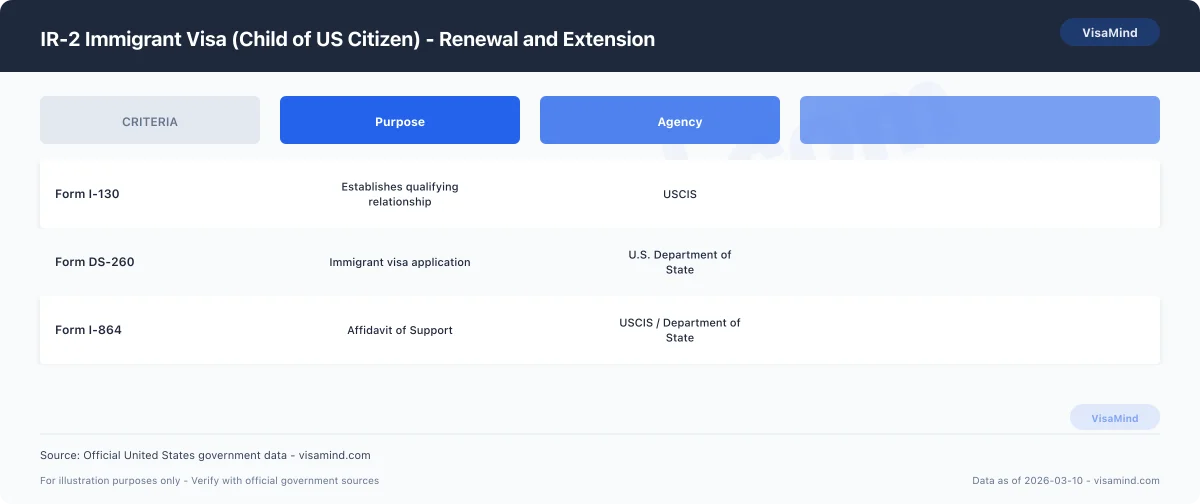
Key documents in the IR-2 process include:
| Form | Purpose | Agency |
|---|---|---|
| Form I-130 | Establishes qualifying relationship | USCIS |
| Form DS-260 | Immigrant visa application | U.S. Department of State |
| Form I-864 | Affidavit of Support | USCIS / Department of State |
You must:
- Ensure each eligible child has a separately filed Form I-130, unless eligible as a derivative beneficiary.
- Provide complete and accurate information on Form DS-260 during consular processing.
- Submit a properly completed Form I-864 from the sponsoring parent.
If you apply for a Certificate of Citizenship or for citizenship under Section 322, USCIS may delay adjudication until the Department of State provides necessary information. Monitor your case status directly through the USCIS website.
Removing conditions
IR-2 classification doesn’t involve routine extensions, but you must correct or address any status issues that affect your permanent residence or citizenship documentation.
USCIS may review and reassess:
- An Application for Certificate of Citizenship.
- An Application for Citizenship and Issuance of Certificate under Section 322.
If USCIS finds that a certificate was issued illegally, fraudulently, or in error, it can revoke or correct that document. This review can happen during adjudication or after issuance.
You must ensure:
-
All filings are accurate and supported by evidence.
-
The parent-child relationship remains properly documented.
-
Any prior approvals were lawfully obtained.
Check the USCIS website for current filing procedures and documentary requirements before submitting any follow-up application.
When to Consult a Professional
#You can prepare many IR-2 child visa cases on your own, but certain errors lead to rejection, delays, or visa refusal. Legal guidance becomes important when forms, eligibility, or supporting documents raise specific risks.
When to get legal help
Get legal help if you're unsure how to complete or file Form I-130, Petition for Alien Relative, or if USCIS has sent a rejection or a request for more evidence.
Incorrect filings, missing pages, or inconsistent answers can cause delays.
You should also consult a professional if:
- Your child is in the United States and you're thinking about filing Form I-130 and Form I-485 at the same time
- You're not sure whether you qualify to sponsor under Family-based immigration rules
- Your answers on Form DS-260 don't clearly match your I-130 petition
- You're preparing Form I-864, Affidavit of Support, and have questions about the documentation
Accuracy across forms matters. Even minor differences in name spelling, dates, or family information can slow down National Visa Center processing or impact the visa interview with the U.S. Department of State.
| Stage | Agency | Common Risk |
|---|---|---|
| I-130 Petition | USCIS | Missing evidence or incorrect sponsor status |
| DS-260 & civil docs | U.S. Department of State | Inconsistent answers or incomplete submissions |
| I-864 Review | USCIS / NVC | Insufficient or unclear financial documentation |
If you've received a notice from USCIS, act quickly and review the instructions provided before responding.
Complex sponsor or relationship situations
Talk to a professional if your relationship documentation is complicated. While IR-2 cases focus on parent‑child relationships, you still need to provide clear primary civil documents and, when necessary, secondary evidence.
You should get guidance if:
- Official birth records are missing or inconsistent
- Names are different across passports, certificates, and forms
- You previously left out a family member on an immigration filing
- Your immigration status as petitioner is tough to document
Your immigration category depends on whether you are a U.S. citizen or lawful permanent resident. You must prove your status correctly when filing Form I-130.
Get help if you're preparing consular processing and need to coordinate:
-
Form DS-260
-
Civil documents requested by the National Visa Center
-
Form I-864
-
Medical exam and police certificates before the interview
Mistakes at this stage can delay interview scheduling by the U.S. Department of State or result in refusal until documents are fixed.
Application Process
#Start the IR-2 child visa process by filing a petition with U.S. Citizenship and Immigration Services (USCIS). Decide whether your child will finish the process inside the United States or through a U.S. consulate abroad.
Filing I-130
File Form I-130, Petition for Alien Relative, with USCIS for each child you want to sponsor under family-based immigration.
Steps:
-
Create or log in to your USCIS online account, or prepare a paper filing.
-
Complete every required field on Form I-130.
-
Select only one option in Part 4 to indicate:
adjustment of status in the United States, or
-
Consular processing abroad.
-
Sign the form. USCIS will reject unsigned forms.
-
Submit supporting documents.
Include:
- Proof of your U.S. citizenship or lawful permanent resident status
- Evidence of the parent-child relationship
- Any other supporting documentation listed in the form instructions
If you're filing for more than one child, submit a separate Form I-130 for each.
USCIS may skip an interview if the record already has enough documentation to establish eligibility.
Choosing adjustment or consular processing
You must pick how your child will apply for permanent residence. Not selecting one option causes delays.
| Option | Where Child Is Located | Agency Involved | Key Forms |
|---|---|---|---|
| Adjustment of Status | Inside the U.S. | USCIS | Form I-130 and related adjustment forms |
| Consular Processing | Outside the U.S. | U.S. Department of State | Form I-130, Form DS-260, Form I-864 |
If your child is in the United States and eligible, you may pursue adjustment of status with USCIS.
If your child is abroad, the case moves to the U.S. Department of State after I-130 approval. Your child must complete Form DS-260 (Immigrant Visa Application) and attend a visa interview. You must also submit Form I-864, Affidavit of Support, to show financial sponsorship.
After visa issuance, U.S. Customs and Border Protection (CBP) makes the final admission decision at the port of entry.
Required Documents
#Submit clear evidence of the parent‑child relationship and the U.S. citizen parent’s status. USCIS reviews these documents with Form I-130, and the U.S. Department of State checks civil documents again during consular processing with Form DS-260.
Identity & family documents
Provide documents that prove who you are and how you are related to the U.S. citizen parent.
Core civil documents include:
- Child’s birth certificate showing the parent’s name
- U.S. citizen parent’s U.S. birth certificate, naturalization certificate, or U.S. passport
- Copies of any marriage certificates relevant to the child’s parents
- Proof of termination of any prior marriages for each parent, if applicable
- Two passport-style photographs of the child
If you file Form I-130, include copies of these documents with the petition. Bring original civil documents or certified copies to the immigrant visa interview scheduled by the U.S. Department of State after submitting Form DS-260.
Names, dates of birth, and places of birth need to match across all records.
| Document | Purpose | Submitted With |
|---|---|---|
| Child’s birth certificate | Proves parent-child relationship | I-130, DS-260 interview |
| Parent’s proof of U.S. citizenship | Confirms petitioner’s status | I-130 |
| Marriage/divorce records | Confirms legal family relationship | I-130, interview |
| Passport-style photos | Identity verification | As instructed by USCIS or consular post |
Proofs of custody and status
Show that the U.S. citizen parent has legal and physical custody of the child when required.
Submit evidence such as:
- Court custody orders, if parents are separated or divorced
- Documentation showing the child resided in the physical custody of the U.S. citizen parent
- Evidence the child lived in the United States in the parent’s physical custody while under age 18, if applicable
- Proof of the parent’s physical presence in the United States
- Documentation of the child’s lawful permanent resident status, if relevant
USCIS may ask for more evidence if custody or residence is unclear. Provide records that clearly show dates and addresses.
If required, include Form I-864, Affidavit of Support, to demonstrate the U.S. citizen parent’s financial sponsorship in this family-based immigration process.
Eligibility Requirements
#You must meet strict relationship and status requirements before U.S. Citizenship and Immigration Services (USCIS) will approve an IR-2 petition. Both you and your child must qualify under family-based immigration rules, and you must document every requirement with the correct forms and evidence.
Sponsor requirements
You must be one of the following:
- A U.S. citizen
- A lawful permanent resident
- A U.S. national (not a U.S. citizen)
For an IR-2 visa, file Form I-130, Petition for Alien Relative, with USCIS.
The petition must include:
- Proof of your U.S. citizenship or lawful permanent resident status
- Biographical information for you and your child
- Evidence of the parent-child relationship
- Information about whether your child will apply through adjustment of status or consular processing
If your child will process abroad, they will later submit Form DS-260 to the U.S. Department of State. You must also submit Form I-864, Affidavit of Support, agreeing to financially support your child.
| Requirement | What You Must Provide |
|---|---|
| Immigration status | Proof of U.S. citizenship or lawful permanent residence |
| Relationship | Documents showing legal parent-child relationship |
| Petition | Form I-130 filed with USCIS |
| Financial support | Form I-864 |
USCIS checks that names, dates, and identity details match across all filings.
Child eligibility rules
Your child must qualify as a “child” under U.S. immigration law. This classification depends on age and the legal parent-child relationship.
Key requirements include:
- The child must be under 18 years old in certain citizenship-related situations
- The child must have a qualifying legal relationship with you
- The child’s biographical and identity information must be fully documented
- The child’s residence and custody arrangements must be clear
If your child lives outside the United States, extra rules apply in citizenship-related cases. The child may qualify if:
- The child is under 18
- The child is in the legal and physical custody of a U.S. citizen parent
- The U.S. citizen parent or qualifying grandparent meets physical presence requirements
You must provide detailed information about:
- Your child’s identity
- The child’s parents
- How and when you obtained U.S. citizenship, if applicable
- The child’s lawful permanent resident status, if relevant
USCIS and the U.S. Department of State review these facts before approving the immigrant visa.
Relationship Scrutiny Red Flags
#USCIS reviews the parent‑child relationship in every IR‑2 child visa case. Missing records, inconsistent information, or weak custody evidence can delay or derail your Family-based immigration process.
Common evidence gaps
USCIS often issues requests for evidence when key civil documents are missing or incomplete. The most common problem is failure to prove the biological or legal relationship between you and the U.S. citizen parent.
You must provide clear documentation, not assumptions.
Frequent gaps include:
- Missing or incomplete child’s birth certificate
- No proof of the U.S. citizen parent’s citizenship
- Lack of evidence showing termination of any prior marriages of either parent
- Missing legal custody documentation where custody is required
- No proof of the child’s residence in the physical custody of the U.S. citizen parent
- Inconsistent information between Form I-130 and Form DS-260
If lawful permanent resident status or physical presence of a U.S. citizen grandparent is relevant to your case, document it with official records.
| Document Type | Why USCIS Scrutinizes It |
|---|---|
| Birth certificate | Confirms biological parent-child link |
| Marriage termination records | Confirms legal validity of parental relationship |
| Custody orders | Verifies legal and physical custody |
| Proof of citizenship | Establishes qualifying U.S. citizen parent |
How to strengthen your case
Strengthen your case by submitting complete, consistent, and organized documentation with your Form I-130. Don't wait for USCIS to request missing evidence.
Provide certified copies of all civil documents and make sure names, dates, and places match across the I-130, Form DS-260, and supporting records.
Focus on documenting:
- Biological connection through official birth records
- Legal custody through court orders or formal agreements
- Physical custody through residence documentation
- Proof that any previous marriages legally ended
- U.S. citizen parent’s citizenship evidence
If a financial sponsor submits Form I-864, make sure the parental relationship documentation matches the petitioning parent’s identity.
A clean submission packet with labeled sections helps. Clear documentation lowers the chance of a Request for Evidence and keeps your IR‑2 case moving.
Common Filing Mistakes and How to Avoid Them
#Small errors on Form I-130, Form DS-260, or Form I-864 can lead to rejection, requests for evidence (RFEs), or long delays. You avoid most problems by using the correct form editions, paying the proper fees, and submitting complete civil and financial documents.
Frequent form & fee errors
USCIS rejects many IR-2 petitions because of basic filing mistakes on Form I-130.
Common problems include:
- Submitting an unsigned or undated petition
- Using an outdated edition or mixing pages from different editions
- Paying the wrong fee amount or using an incorrect payment method
- Leaving Part 4 incomplete or selecting more than one option
- Choosing the wrong relationship category
Always use the current edition and confirm the filing fee before you submit. Use only one edition date for all pages and sign every required section.
You must also include clear proof of your U.S. citizenship or lawful permanent resident status. Acceptable evidence includes:
- U.S. birth certificate
- Naturalization certificate
- Certificate of citizenship
- Copy of your green card (front and back)
If you move to consular processing, complete the DS-260 exactly as your I-130 and civil documents list names, dates, and places. Inconsistent information triggers delays at the National Visa Center or the U.S. Department of State.
For Form I-864, calculate household size correctly and confirm your income meets 125% of the federal poverty guidelines. Sign and date every required section, including any joint sponsor pages.
| Error Type | What Happens | How You Prevent It |
|---|---|---|
| Wrong fee or outdated form | Rejection | Verify current fee and edition on USCIS website |
| Missing signature | Rejection or delay | Sign and date all required sections |
| Incorrect category | Delay or denial | Select the correct child classification |
| Income miscalculation (I-864) | RFE | Recalculate household size and income carefully |
Missing evidence & translation problems
Incomplete supporting documents cause many RFEs in family-based immigration cases.
Before the National Visa Center stage, gather certified copies of required civil documents, such as:
- Birth certificates
- Marriage certificates (if applicable)
- Divorce decrees (if applicable)
Do not send original documents to USCIS unless specifically requested.
Submit copies unless instructions require otherwise.
If any document is in a foreign language, include a full English translation with a certification from the translator stating it is complete and accurate.
Partial translations or summaries are not acceptable.
On the DS-260, list every address and all travel history since age 16 without gaps.
Missing months or unexplained breaks often lead to follow-up review.
For the Form I-864, include your most recent tax transcript and proof of current employment.
If you are self-employed, provide business records that support your reported income.
Missing tax documents or weak income evidence almost always results in an RFE.
| Missing Item | Likely Result | Prevention Step |
|---|---|---|
| Civil document | RFE | Obtain certified copies before submission |
| English translation | RFE | Include full certified translation |
| Tax transcript | RFE | Attach most recent IRS transcript |
| Employment proof | RFE | Add employer letter or business records |
Match every form entry to your civil documents.
Submit complete, organized evidence the first time to reduce delays.
How USCIS Adjudicates These Cases
#USCIS reviews an IR-2 case on its merits and does not approve a petition simply because you filed it.
Officers follow a structured review process and coordinate with the U.S. Department of State when a visa or citizenship issue involves consular action.
Adjudication steps
USCIS begins by confirming that you properly filed Form I-130, Petition for Alien Relative under the family-based immigration category.
Filing alone does not guarantee approval.
An officer reviews the petition and all supporting evidence to decide whether it meets the legal requirements.
If you filed Form I-485, Application to Register Permanent Residence or Adjust Status, with or after the I-130, USCIS adjudicates that application as well.
USCIS only completes adjudication of an adjustment application once you are physically present in the United States and USCIS has jurisdiction.
The officer evaluates the case on its merits before making a decision.
If a revocation or cancellation issue arises, the officer reviews the case record and may seek internal legal guidance before proceeding.
USCIS follows its Policy Manual when resolving complex or potentially erroneous approvals.
| Step | What USCIS Reviews | Why It Matters |
|---|---|---|
| 1 | Proper filing of Form I-130 | Establishes a valid petition |
| 2 | Supporting evidence | Determines eligibility under the law |
| 3 | Form I-485 (if filed) | Decides adjustment eligibility |
| 4 | Jurisdiction and presence in U.S. | Confirms USCIS authority to decide |
Coordination with the Department of State
If your child will process the immigrant visa abroad, USCIS approves or denies the Form I-130, and the U.S. Department of State handles visa processing.
This includes the Form DS-260, Immigrant Visa Application, and the immigrant visa interview.
When a case involves a potential revocation or a citizenship issue tied to consular action, USCIS may pause adjudication until the Department of State responds.
Officers may also consult USCIS counsel before issuing a final decision.
The agencies coordinate when a certificate or immigration benefit may have been issued in error, through fraud, or unlawfully.
USCIS does not finalize certain decisions until it receives confirmation from the Department of State.
| Agency | Role in IR-2 Case |
|---|---|
| USCIS | Adjudicates Form I-130 and any Form I-485 |
| U.S. Department of State | Processes DS-260 and issues immigrant visa |
| USCIS (with counsel) | Reviews revocation, cancellation, or error issues |
Fees
#| Component | Amount |
|---|---|
| Filing fee (I-130)Filing fee (I-130): $675 (as of 2026-02). Verify the current fee on the official schedule before filing. | $675 |
| BiometricsBiometrics: $85 (as of 2026-02). Verify the current fee on the official schedule before filing. | $85 |
| Immigrant visa processing (DS-260)Paid to NVC/consulate | $325 |
Fees change; always verify on USCIS.
Next steps
#Use Find My Visa to build a sequenced plan with official sources and deadlines.
FAQs
Who decides if I receive the IR-2 visa?
Different agencies handle different stages:
-
USCIS approves or denies the Form I-130 petition.
-
The U.S. Department of State conducts the visa interview and issues the immigrant visa.
-
U.S. Customs and Border Protection (CBP) determines admission at the port of entry.
Each agency reviews eligibility at its own stage.
What is the IR-2 visa and who is it for?
The IR-2 is an immigrant visa for eligible children of U.S. citizens who seek to immigrate to the United States and apply for a Permanent Resident Card; U.S. citizens can petition for their unmarried children under 21 to immigrate on this visa.
Who can file the petition for an IR-2 visa?
A U.S. citizen must file for an unmarried child under age 21; petitioners for eligible relatives more broadly must be a U.S. citizen, lawful permanent resident, or a U.S. national (non-citizen).
Which form starts the family immigration process for an IR-2 beneficiary?
The first step is submitting Form I-130, Petition for Alien Relative, with USCIS to establish the qualifying relationship so the relative can apply to immigrate and seek a Green Card.
Do children on IR-2 visas automatically become U.S. citizens?
A child can automatically acquire U.S. citizenship under specific provisions (for example, INA 320) when certain conditions are met—such as being under 18, being a lawful permanent resident, and residing in the U.S. in the legal and physical custody of the U.S. citizen parent.
What documents usually prove the parent-child relationship?
Common evidence includes a birth certificate or other official record proving the biological relationship and documentation that shows the parent's U.S. citizenship (for example, a U.S. birth certificate, naturalization certificate, or passport).
Can USCIS waive the interview for this petition?
USCIS may waive the interview requirement if all required documentation necessary to establish eligibility is already included in USCIS administrative records.
What fees should petitioners and applicants expect to pay?
As of February 2026, the Form I-130 filing fee is $675; the biometrics services fee is $85; and immigrant visa processing (Form DS-260) is $325 (paid to the NVC/consulate).
How long does I-130 processing typically take?
processing times vary by eligibility category and service center; examples from January 2026 show ranges such as 17–87 months for a U.S. citizen filing for a spouse, parent, or child under 21, and other categories have different ranges.
What are common filing mistakes to avoid?
Common errors include submitting unsigned forms, using wrong fees or outdated form editions, missing proof of petitioner citizenship or required civil documents, incomplete Part 4 choices about adjustment vs consular processing, and insufficient translations for foreign-language documents.
Does filing Form I-130 guarantee approval of the visa?
No — filing the petition does not guarantee approval; USCIS will adjudicate the petition on the merits.
Official sources referenced
Last reviewed: 2026-03-10
- Form I-130, Petition for Alien Relative (USCIS)
- DS-260, Immigrant Visa Application (Department of State)
- Affidavit of Support overview (USCIS)
- I am the Child of a U.S. Citizen (USCIS)
- USCIS Policy Manual Vol 12 Part H Ch 4 - Automatic Acquisition (INA 320)
- USCIS Policy Manual Vol 12 Part H Ch 5 - Child Residing Abroad (INA 322)
- Obtaining U.S. Citizenship for a Child Born Abroad (Department of State)
VisaMind provides informational guidance only and is not a government agency. This is not legal advice. Requirements can change and eligibility depends on your specific facts. If your case is complex or high-stakes, consult a licensed immigration attorney.
Next steps
Every United States visa case depends on your nationality, purpose, and timeline. Get a personalized plan with official sources and deadlines.
Get my IR-2 Immigrant Visa (Child of US Citizen) plan