Official sources referenced
Is This Guide for You?
#If you are the spouse of a Canadian citizen or permanent resident, applying for a Spousal Open Work Permit allows you to work in Canada while your permanent residence application is processed. This permit is an excellent option for maintaining financial stability and integrating into Canadian society during the waiting period.
When to Consider This Guide
You should consider using this guide if you are already in Canada on a temporary resident visa or if you plan to join your spouse in Canada soon. This guide will be most beneficial if you are currently applying for permanent residency through the Spousal Sponsorship program, as it enables you to engage in employment without needing a job offer tied to a specific employer.
Tip: The Spousal Open Work Permit is not location-restricted, giving you the freedom to work anywhere across Canada.
Eligibility Highlights
To determine if this guide is applicable for you, ensure you meet the basic criteria: being legally married or in a common-law partnership with a Canadian citizen or permanent resident. Additionally, you must have submitted a complete application for permanent residence through the Spousal Sponsorship program.
If you're curious about other work permits, you might want to explore the Open Work Permit or Bridging Open Work Permit options. These alternatives cater to different situations and might better suit your circumstances if the Spousal Open Work Permit does not align with your needs.
What This Guide Covers
This guide is a comprehensive resource aimed at helping you understand the application process, document requirements, and timelines involved with the Spousal Open Work Permit. By following the guidance provided, you can navigate the application process with confidence.
Important: Carefully review the guidelines to ensure you provide all necessary documentation, as incomplete applications can lead to delays.
Overview
#The Spousal Open Work Permit (SOWP) in Canada provides an opportunity for eligible spouses or common-law partners of Canadian citizens or permanent residents to work in Canada while their permanent residence application is under review. This permit is a type of open work permit, meaning it is not job-specific, allowing holders to work for almost any Canadian employer without needing a Labour Market Impact Assessment (LMIA).
How Does the Spousal Open Work Permit Work?
The SOWP is mainly designed to facilitate the integration of the spouse or common-law partner into Canadian society and the labor market while they await a decision on their permanent residence application. Here's a breakdown of how it functions:
- Eligibility: To qualify, your spouse or partner must be a Canadian citizen or permanent resident who has applied for your permanent residency through the Spousal Sponsorship program.
- Application Process: You can apply for the SOWP either from within Canada or from abroad. However, applying from within Canada often allows for quicker processing.
- Validity: The permit is usually valid for the same duration as your spouse or partner's temporary resident status in Canada.
- Flexibility: As an open work permit, it offers the flexibility to work for any employer and in any occupation across Canada, without the need for a job offer at the time of application.
Benefits of the Spousal Open Work Permit
The SOWP offers several advantages for applicants and their families:
- Economic Stability: By allowing you to work, it provides financial support and stability while waiting for your permanent residence application to be processed.
- Integration: Working in Canada can help you integrate into the community and gain Canadian work experience, which can be beneficial if you plan to settle permanently.
- No LMIA Required: Unlike other work permits, there is no need for your employer to obtain an LMIA, making the process smoother and faster.
Tip: Consider applying online to expedite the process and receive updates directly from the IRCC.
Comparison with Other Open Work Permits
While the Spousal Open Work Permit is one option for those seeking to work in Canada, it's important to consider how it compares to other open work permits:
| Permit Type | Eligibility Criteria | LMIA Required? | Work Flexibility |
|---|---|---|---|
| Spousal Open Work Permit | Spouses of Canadian citizens/permanent residents | No | Work for any employer |
| Bridging Open Work Permit | For those with expiring status and PR in progress | No | Work for any employer |
| IEC (International Experience Canada) | Young adults from partner countries | No | Work for any employer, limited by age and nationality |
Important Considerations
- Processing Time: The time it takes to process a SOWP application can vary. Ensure you check the IRCC website for the most current timelines.
- Simultaneous Applications: You can apply for the SOWP at the same time as your permanent residence application. This can be beneficial in reducing overall waiting time.
The Spousal Open Work Permit is a significant opportunity for spouses and partners of Canadian citizens or permanent residents to engage with the Canadian workforce and society. By providing the flexibility to work in various roles across the country, it supports economic and social integration, making the waiting period for permanent residency both productive and enriching.
Eligibility and Requirements
#To qualify for a Spousal Open Work Permit in Canada, you must meet certain criteria and provide required documents. This section outlines the eligibility requirements and prerequisites for spouses of Canadian citizens or permanent residents seeking this permit.
Who Qualifies?
- Spousal Relationship: You must be the spouse or common-law partner of a Canadian citizen or permanent resident. Legal documentation proving the relationship is required.
- Permanent Residence Application: You should already have a permanent residence application in progress under the Spousal Sponsorship category. This is essential to demonstrate your intent to settle in Canada with your partner.
Key Requirements
- Residence in Canada: You must be residing in Canada at the time of application. The Spousal Open Work Permit is specifically for those who are already within Canada.
- Valid Status: Ensure that you maintain valid temporary resident status as a visitor, student, or worker in Canada. If your status is about to expire, you may need to apply for an extension to remain eligible.
Prerequisites
- Application Under Spousal Sponsorship: Your permanent residence application should be submitted under the Spousal Sponsorship category. This category allows spouses to live together in Canada while awaiting a decision on their permanent residence application.
- Medical and Police Certificates: Depending on your country of origin or recent travel history, you might need to provide medical exams or police certificates. Refer to the Medicals And Police Certificates guide for more details.
- Proof of Relationship: Gather evidence such as marriage certificates or affidavits that substantiate your relationship with your Canadian spouse or partner.
Tip: Ensure you have a copy of the receipt for your permanent residence application, as it may be required to verify your eligibility for the Spousal Open Work Permit.
Documentation
- Proof of Relationship:
- Marriage certificate or common-law declaration
- Joint financial documents or shared lease agreements
- Proof of Status in Canada:
- Copy of temporary resident visa or permit
- Evidence of maintained status (e.g., Temporary Resident Permit)
- Supporting Documents:
- Any correspondence from IRCC regarding your permanent residence application
- Additional documents as specified by IRCC guidelines
Familiarize yourself with the full application process by reviewing the Work Permits Overview and ensure all required documents are prepared in advance to avoid delays.
Step-by-Step Process
#Determine Your Eligibility
Before starting the process, verify your eligibility for the Spousal Open Work Permit. This permit is designed for spouses or common-law partners of Canadian citizens or permanent residents who have applied for permanent residency themselves. Ensure you meet the specific criteria set by Immigration, Refugees and Citizenship Canada (IRCC) for this type of permit. If you are uncertain about your eligibility, you might want to consult related resources, such as the Spousal Sponsorship guidelines.
Gather Necessary Documents
Compiling the required documents is a crucial step in the application process. You will need to provide proof of your relationship to the Canadian citizen or permanent resident, such as a marriage certificate or proof of common-law status. Additionally, gather any needed identification documents, proof of your spouse's status in Canada, and evidence of your own application for permanent residence. For a comprehensive list, consult the Work Permit Checklist.
Tip: Ensure all documents are current and complete to avoid processing delays.
Complete the Application
The application for a Spousal Open Work Permit must be completed accurately. Access the necessary forms and instructions through the IRCC's online portal. It is crucial to fill in all required fields correctly, as incomplete applications may result in delays or rejections. If you need assistance, the Visa Application Steps guide can provide additional support.
Submit Your Application
Once your application is complete, submit it along with the required documents and any applicable fees. You can apply online to expedite the process and receive immediate confirmation of receipt. Using the online system also allows you to track the status of your application. Remember that processing times can vary, so it's important to apply well in advance of any planned travel or work start date.
Await Decision
After submitting your application, IRCC will review it and make a decision. The processing time can fluctuate, so it's advisable to check the Processing Times Explained resource for the most current estimates. During this period, you may be asked to provide additional information or attend a biometrics appointment.
Important: Keep an eye on your email and online account for any communication from IRCC. Respond promptly to avoid delays.
Receive Your Work Permit
If your application is approved, you will receive your Spousal Open Work Permit, which allows you to work for any employer in Canada. This permit is typically valid for the duration of your spouse's temporary resident status or until your permanent residence application is processed. For more information on working in Canada, explore the Work In Canada section.
Fees, Timeline, and What to Expect
#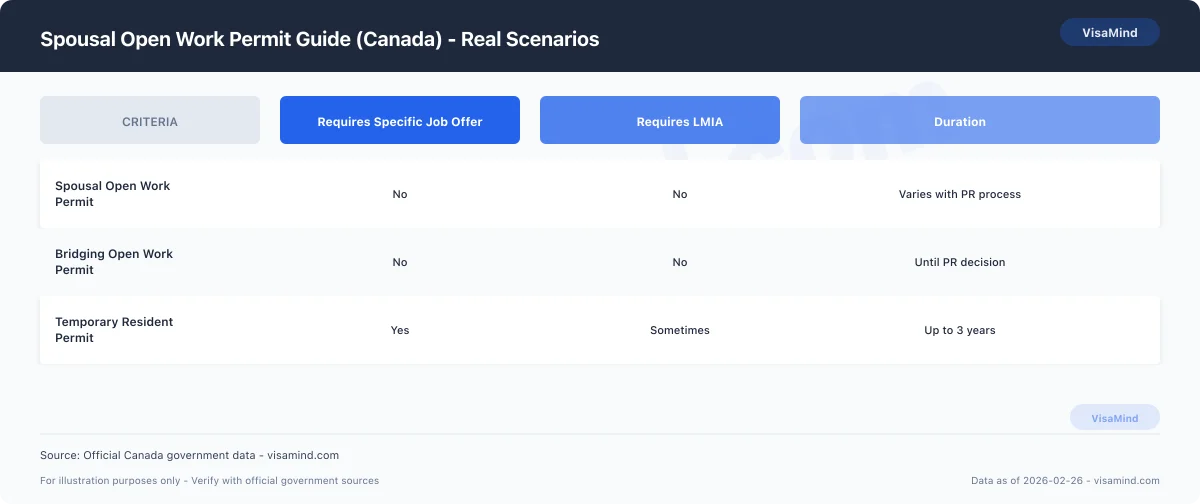
Applying for a Spousal Open Work Permit in Canada involves understanding the associated fees, timelines, and what you can expect during the process. Here's a detailed breakdown to help you plan accordingly.
Fees and Costs
The cost of applying for a Spousal Open Work Permit can vary. As of 2023, the application fee is CAD $155. Applicants should verify the latest fees on the official IRCC website to ensure accuracy, as these are subject to change.
Processing Times
Processing times for the Spousal Open Work Permit can fluctuate based on several factors, including the country of residence and application volume. As of 2023, it typically takes between 3 to 4 months. For the most up-to-date processing times, consult the Processing Times Explained guide.
What to Expect Next
Once your application is submitted, you will receive an acknowledgment from IRCC. This will be your first indication that your application is being processed. Be prepared to provide additional documents if requested, such as medical or police certificates. For more details on these requirements, refer to the Medicals And Police Certificates guide.
Tip: Applying online can expedite the process, allowing you to receive updates and upload additional documents quickly.
Comparison Table
Here's a quick comparison to summarize the key aspects:
| Item | Cost (CAD) | Estimated Timeline (Months) | What to Expect |
|---|---|---|---|
| Spousal Open Work Permit | $155 | 3 to 4 | Acknowledgment of receipt, possible requests for additional documents, and eventual decision on application. |
For those interested in other immigration pathways, the Work Permits Overview and Spousal Sponsorship sections provide further insights into related processes.
Important: Keep your contact information updated with IRCC to receive timely notifications and requests regarding your application.
What Experienced Applicants Recommend
#Tip: Applying online is often faster and allows you to track your application status through your IRCC account.
Thorough Document Preparation
- Gather All Required Documents: Ensure you have all necessary documents before starting your application. This includes your marriage certificate, proof of your spouse's status in Canada (citizen or permanent resident), and any additional documents specific to your situation.
- Double-Check Translations: If any of your documents are not in English or French, make sure they are translated by a certified translator. Include both the original documents and the translations in your application.
- Keep Copies: Retain copies of all documents submitted in case you need to provide additional information or if documents get misplaced.
Timing Your Application
- Align with PR Application: If you're applying for permanent residence concurrently, submit your Spousal Open Work Permit application together with your PR application package. This can streamline processing and prevent unnecessary delays.
- Check Processing Times: Be aware of the current processing times for Spousal Open Work Permits to better plan your application timeline. You can find up-to-date processing times on the IRCC website.
Avoiding Common Mistakes
- Accurate Information: Double-check that all personal information in your application is accurate. Errors in names, dates, or other key details can lead to delays or refusals.
- Consistent Information: Ensure that information on all submitted documents is consistent. Discrepancies can lead to requests for additional information or even application refusal.
Preparing for Life in Canada
- Understand Work Rights: Once your Spousal Open Work Permit is approved, you can work for any employer in Canada. Familiarize yourself with the Canadian job market and potential employment opportunities.
- Learn About Other Permits: If you plan to transition to permanent residence through programs like Express Entry or want to explore other work opportunities, familiarize yourself with Work Permits Overview and related pathways.
- Explore Family Sponsorship: If you're considering bringing other family members to Canada, explore options like Parent Grandparent Sponsorship for additional family reunification possibilities.
Important: Incomplete applications can lead to processing delays. Make sure every section of your application is filled out correctly and all required documents are included before submission.
What Goes Wrong Most Often
#When applying for a Spousal Open Work Permit in Canada, several common mistakes can delay or jeopardize the approval of your application. Awareness of these pitfalls can help you avoid unnecessary complications.
Incorrect or Incomplete Documentation
-
Missing Documents: Not providing all required documents is a frequent issue. Ensure that you gather all necessary documents, including proof of relationship and any additional evidence requested by the IRCC. Refer to the Work Permit Checklist to ensure completeness.
-
Incorrect Information: Double-check all details for accuracy. Errors in your personal information, such as name, date of birth, or passport number, can lead to delays.
Eligibility Misunderstandings
- Eligibility Criteria Misinterpretation: Some applicants misunderstand the eligibility requirements. Ensure you meet all criteria, such as being a spouse of a Canadian citizen or permanent resident, before applying. Reviewing the detailed eligibility requirements on the Spousal Open Work Permit page can be helpful.
Application Submission Errors
- Wrong Application Category: Choose the correct application category. Applying under the wrong category can lead to rejection. Ensure you are applying specifically for the Spousal Open Work Permit, not a general work permit.
Important: Carefully review the application category to avoid processing delays.
Financial and Timing Missteps
-
Failure to Provide Financial Proof: Demonstrating adequate financial resources is critical. Ensure you have the necessary financial proof to support your stay in Canada.
-
Ignoring Processing Times: Underestimating processing times can cause issues, especially if you have employment opportunities waiting. Check the Processing Times Explained for current timelines and plan accordingly.
By addressing these common mistakes, you can enhance your application’s chances of success and reduce the likelihood of delays. Always verify details on the official IRCC website to ensure up-to-date compliance.
Real-World Examples
#A young couple, Sara, a Canadian citizen, and her husband, Anil, who is from India, recently tied the knot and decided to settle in Canada. Anil wished to work while awaiting his permanent residence approval. To facilitate this, they explored the Spousal Open Work Permit pathway. Sara sponsored Anil's permanent residence application through IRCC's Spousal Sponsorship program, and Anil concurrently applied for a Spousal Open Work Permit. They submitted the applications online, ensuring all necessary documents were provided. Within roughly four months, Anil received his work permit, allowing him to start working in Canada while his residency application proceeded.
Scenario: Professional Couple Manages Work and Study Transitions
Mark, a software engineer from Brazil, and his spouse, Ana, a graduate student in Canada, faced a dilemma when Ana's study permit was about to expire. Ana was in the final stages of her degree at a Canadian university and had applied for a Post-Graduation Work Permit (PGWP) to continue working in Canada. Meanwhile, Mark applied for a Spousal Open Work Permit to maintain his ability to work while Ana transitioned from a student to a professional status. They ensured all applications were lodged through the IRCC portal, keeping track of processing times and requirements. Ana received her PGWP within three months, and Mark's open work permit followed shortly after, allowing them both to work and settle in Canada seamlessly.
Scenario: Managing Work Permit Renewal Amidst Permanent Residence Application
Emily, an Australian nurse, had been living in Canada with her Canadian partner, John, on a Spousal Open Work Permit. As her permit was nearing expiration, Emily and John decided to apply for permanent residence under the Express Entry system. To bridge the gap between her current permit's expiration and the approval of her residency, Emily applied for a Bridging Open Work Permit through IRCC. This move ensured she could continue working without interruption. The bridging permit was approved in about three months, providing Emily with the security to maintain her employment status while her permanent residence application was processed.
FAQs
What are the eligibility requirements for the Spousal Open Work Permit Guide (Canada)?
Can I switch from a visitor visa to a Spousal Open Work Permit in Canada?
What fees should I expect when applying for a Spousal Open Work Permit in Canada through IRCC?
How do I download the Spousal Open Work Permit Guide (Canada) instructions from the IRCC website?
What is the first step in the Spousal Open Work Permit Guide (Canada) process?
Can I combine a Spousal Open Work Permit with a study permit in Canada?
What happens if something goes wrong during the Spousal Open Work Permit application process in Canada?
Sources
Last reviewed: March 1, 2026
VisaMind provides informational guidance only and is not a government agency. This is not legal advice. Requirements can change and eligibility depends on your specific facts. If your case is complex or high-stakes, consult a licensed immigration attorney.
Next steps
Requirements vary by nationality, purpose, timeline, and case details. Use Find My Visa to get a personalized checklist for Canada with official sources and deadlines.
Find my visa