Is This Program for You?
#To qualify for the Rural and Northern Immigration Pilot (RNIP), you must intend to settle in one of the participating rural or northern communities in Canada. This program is designed to support the economic development of smaller communities by facilitating permanent residency for newcomers who can fill labor shortages.
Who Should Consider the RNIP?
The RNIP is ideal for individuals who:
- Have a genuine job offer from an employer in a participating rural or northern community.
- Possess the necessary skills and qualifications to contribute to the local economy.
- Meet the minimum language proficiency requirements in either English or French.
- Have relevant work experience or have completed a post-secondary program of study within the last 18 months.
- Demonstrate an intention to reside in the community.
Participating Communities
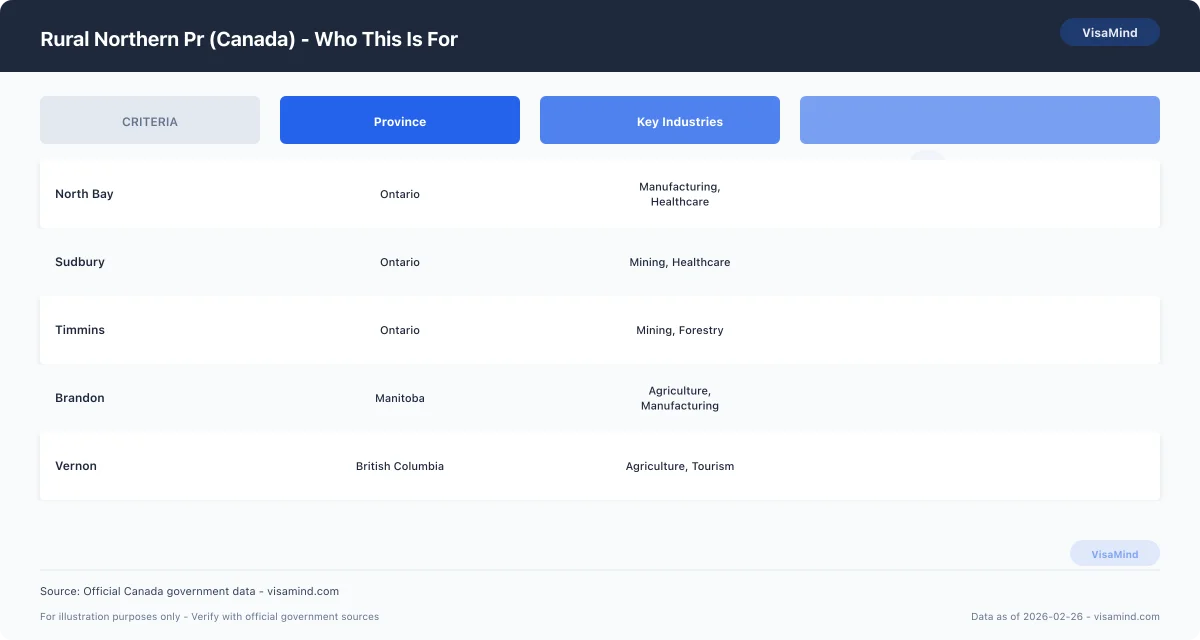
The program is currently available in various communities across provinces such as Ontario, Manitoba, Saskatchewan, Alberta, and British Columbia. Each community may have additional specific requirements or priorities based on its local economic needs.
Language and Work Experience Requirements
You need to demonstrate language proficiency at a Canadian Language Benchmark (CLB) level of 4 or higher, depending on your National Occupational Classification (NOC) level. Additionally, you should have at least one year of continuous work experience in the past three years in a relevant field. This ensures that you are adequately prepared to integrate into the community and contribute effectively.
Important Considerations
Important: Ensure you meet all community-specific criteria and maintain ongoing communication with your potential employer in the community. Each community may have unique requirements in addition to the general program criteria.
If you're exploring other paths to Canadian permanent residency, you might also consider options like the Express Entry or Provincial Nominee Program. These pathways may better align with your qualifications and long-term goals, depending on your circumstances.
For a deeper understanding of permanent residency options, visit the Permanent Residence page.
Eligibility Criteria
#To apply for permanent residency under Canada's Rural and Northern Immigration Pilot (RNIP), you must meet several specific eligibility criteria. These requirements are categorized into qualifications, experience, income, age, language proficiency, and community-specific criteria.
Qualifications and Experience
- Educational Requirements: You need to have a Canadian high school diploma or an equivalent foreign credential. If your education was completed outside of Canada, an Educational Credential Assessment (ECA) is required to prove its equivalency to a Canadian standard.
- Work Experience: You must have at least one year (1,560 hours) of continuous work experience in the past three years in a job that aligns with the National Occupational Classification (NOC) of the position you are offered in the rural or northern community.
Language Proficiency
- Language Tests: Depending on the NOC category of your job offer, you must meet the minimum Canadian Language Benchmark (CLB) level:
- CLB 4 for NOC C and D jobs
- CLB 5 for NOC B jobs
- CLB 6 for NOC A jobs
- Approved Tests: The language tests must be from approved providers like IELTS or CELPIP for English or TEF for French.
Age and Income
- Age Limit: While there is no specific age limit for the RNIP, being of working age with relevant work experience and qualifications can enhance your application.
- Income Requirements: You must demonstrate that you have sufficient funds to support yourself and any accompanying family members upon arrival in Canada. The exact amount varies based on family size, and you can find detailed information in the Proof Of Funds guide.
Community-Specific Criteria
Each participating community in the RNIP has its unique criteria and processes, which may include:
- Job Offer: You must have a genuine job offer from an employer located in a participating community. The job must be full-time, non-seasonal, and meet the community's specific employment needs.
- Community Recommendation: A recommendation from the community is essential. This involves engaging with the community, such as visiting or living there, to demonstrate your intent to reside and integrate into the community.
- Additional Requirements: Some communities may have additional requirements, such as specific work experience or a connection to the community, like family ties or previous residence.
Important: Ensure you review the specific requirements of the community you wish to apply to, as they can vary significantly. Missing community-specific criteria can result in application delays or rejections.
For more information on related pathways and options, you may consider exploring the Provincial Nominee Program or Express Entry as alternative routes to permanent residency. Each program has its unique set of criteria and benefits, which you can compare in our Express Entry Vs PNP guide.
When preparing your application, make sure to gather all necessary documentation to substantiate your eligibility, including proof of work experience, education credentials, language test results, and financial capacity. This will facilitate a smoother application process and help you avoid common pitfalls.
Step-by-Step Application
#-
Prepare Your Documents and Information
Before beginning your application for permanent residency under the Rural and Northern Immigration Pilot (RNIP), gather all necessary personal and professional information. This includes your telephone number, email address, Social Insurance Number (SIN), financial records, medical history, and employment details. You will need Adobe Acrobat Reader version 10 or higher to access and fill out the application form. Ensure you have this software ready on your computer.
-
Access the Application Form
To start your application, visit the official IRCC website to download the Rural Northern PR form and accompanying instructions. It's crucial to use a computer for this step, as mobile devices and tablets may not support the form properly. Save the form to your computer to prevent any loss of data during the process.
-
Review Eligibility Requirements
Carefully read through the instructions provided with the application form. Each eligibility category under the RNIP has specific requirements, and understanding these is critical to ensure you qualify for the program. If you are unsure about your eligibility, consult the PR Pathways Overview for additional guidance.
-
Complete the Application Form
Open the saved form using Adobe Acrobat Reader. Fill in all required sections, ensuring that your information is accurate and complete. Pay special attention to any fields requiring signatures or additional documentation. For a detailed understanding of common requirements, you might find the Proof Of Funds guide helpful.
-
Submit Your Application
Once your form is completed, gather all supporting documents as specified in the instructions. Submit your application through the designated portal or by mail, as instructed by IRCC. Be mindful of any submission deadlines, as missing these could affect your application status.
Tip: Submitting your application online is recommended to avoid potential delays and to receive a confirmation receipt instantly.
-
Pay the Required Fees
After submitting your application, you will need to pay the application fees as outlined by IRCC. The fees vary depending on your specific circumstances, so verify the current rates on the official website. Payment can often be made online for convenience.
-
Await Confirmation and Further Instructions
After submission, IRCC will review your application. Be prepared to receive further instructions or requests for additional information. While waiting, keep track of your application's status through the IRCC online portal. If needed, explore related visa options like the Rural Community Immigration program for more opportunities.
By following these steps, you can navigate the application process for the Rural and Northern Immigration Pilot effectively. Ensure all information is accurate to avoid delays or complications in achieving your goal of permanent residency in Canada.
Supporting Documents Checklist
#It is important to gather and prepare the necessary supporting documents meticulously. This section outlines the essential documents, certifications, and translations required for your application to be processed smoothly by Immigration, Refugees and Citizenship Canada (IRCC).
Personal Identification and Civil Documents
- Passport: A valid passport for each family member included in the application.
- Birth Certificates: Provide birth certificates for all applicants and dependents.
- Marriage Certificate: If applicable, include a marriage certificate or proof of common-law partnership.
- Divorce or Separation Certificates: Include these if applicable, to clarify your marital status.
Employment and Financial Documents
- Job Offer: A valid job offer from an employer within one of the designated rural or northern communities.
- Proof of Work Experience: Evidence such as contracts, letters of recommendation, and pay stubs to verify your employment history.
- Financial Support: Documents demonstrating sufficient funds to support yourself and your family upon arrival in Canada. Refer to the Proof Of Funds guide for more details.
Medical and Security Checks
- Medical Examination: You must undergo a medical examination by an IRCC-approved panel physician. Ensure your medical check is up-to-date before submission.
- Police Certificates: Obtain police clearance certificates from every country you have lived in for six months or more since the age of 18. The Medicals and Police Certificates guide offers further guidance.
Language Proficiency
- Language Test Results: Provide results from a recognized language test like IELTS or CELPIP. Your scores should meet the minimum requirement for your specific eligibility category under the Rural and Northern Immigration Pilot.
Important: Ensure all documents not in English or French are accompanied by certified translations. This step is crucial for IRCC to accurately assess your application.
Community Recommendation
- Community Recommendation Letter: Secure a recommendation from one of the participating communities. This document is a vital part of your application, as it demonstrates community support for your settlement.
Tip: Regularly check the official IRCC website for any updates or changes to document requirements to ensure you have the most current information.
By organizing these documents effectively, you can enhance your application for the Rural and Northern Immigration Pilot. For a comprehensive overview of permanent residency options, you can explore our Permanent Residence section. Remember, attention to detail in preparing your application can significantly impact the processing time and outcome.
Timeline and Processing
#The Rural and Northern Immigration Pilot (RNIP) program, managed by Immigration, Refugees and Citizenship Canada (IRCC), offers a pathway to permanent residency for applicants aiming to settle in rural and northern communities across Canada. Understanding the timeline and processing stages is critical for applicants.
Expected Processing Times
Processing times for the RNIP can vary based on several factors, such as the volume of applications and the specific community involved. As of 2023, the average processing time for a complete application is approximately 12 to 18 months. It's essential to check the Processing Times Explained guide for the most up-to-date information.
Factors Affecting Processing Speed
Several elements can influence the speed of your application processing:
- Completeness of Application: Ensure all required documents are included and forms are fully completed.
- Volume of Applications: High volume periods may lead to longer processing times.
- Community-Specific Processes: Some communities may have additional steps or requirements.
- Background Checks: Delays can occur due to thorough security and background verifications.
Tip: Submit a complete application with all necessary supporting documents to avoid delays.
Expedited Options
While there are no formal expedited options for the RNIP, ensuring your application is complete and accurate can help prevent unnecessary delays. Unlike other programs, the RNIP does not offer priority processing options. However, if you're also considering other immigration pathways, such as Express Entry or Provincial Nominee Program, these might offer quicker processing under certain conditions.
Community Involvement
Each participating community in the RNIP can have its own specific requirements and timelines, which may affect the overall processing time. Engaging directly with the community's designated contact can provide insights into their specific processes and any additional steps they may require.
For a comprehensive understanding of how timelines might vary and what you can do to prepare, consider exploring the Permanent Residence situation for more insights. Always verify current processing times and requirements directly on official channels to ensure you're working with the most accurate and up-to-date information.
Where Applicants Go Wrong
#-
Device Compatibility: Many applicants mistakenly try to open the Rural Northern PR application form on tablets or mobile phones, which leads to issues with form functionality. Always use a computer with Adobe Acrobat Reader version 10 or higher for this task.
-
Incomplete Information: Failing to provide complete personal information, such as your telephone number, email address, Social Insurance Number (SIN), financial, medical, or work details, can lead to delays or refusals. Carefully check each section of your application for required details.
Tip: Double-check that all sections are completed and saved before submitting your application to avoid unnecessary processing delays.
Misunderstanding Eligibility Requirements
-
Eligibility Criteria: Not reviewing the specific eligibility criteria for the Rural and Northern Immigration Pilot program often results in ineligible applications. Ensure you thoroughly review the instructions related to your specific eligibility category on the IRCC website before proceeding.
-
Community Endorsement: Some applicants overlook the requirement to secure a community endorsement, which is essential for this program. Without this endorsement, your application will not be considered.
Documentation Errors
-
Missing Documents: Omitting required evidence can lead to refusal. It's crucial to gather all necessary documents beforehand. Use resources like the Medicals and Police Certificates guide to understand what's needed.
-
Incorrect Document Format: Submitting documents in the wrong format or with poor image quality can cause significant issues. Ensure all documents are clear and legible.
Avoiding Refusal
-
Failure to Follow Instructions: Not following the specific instructions provided by IRCC can be a major pitfall. Carefully read through all guidelines, and if necessary, seek additional guidance from the Visa Refusal Reasons guide to understand common refusal reasons and how to avoid them.
-
Ignoring Deadlines: Missing deadlines for submitting your application or additional documents can lead to automatic denial. Be mindful of all timelines and set reminders to ensure timely submission.
By addressing these common pitfalls, you can improve your chances of a successful application for the Rural and Northern Immigration Pilot program. For further assistance, consider exploring resources like the PR Pathways Overview for additional guidance on navigating Canada's immigration processes.
How It Compares to Alternatives
#
The Rural and Northern Immigration Pilot (RNIP) presents unique opportunities and challenges compared to other immigration programs. Below is a comparative analysis of the RNIP and similar pathways available in Canada.
How It Compares to Other Programs
| Program | Eligibility | Target Areas | Processing Time | Community Involvement |
|---|---|---|---|---|
| Rural and Northern Immigration Pilot (RNIP) | Skilled workers with a job offer in participating rural/northern communities | Rural and Northern communities | Varies by community, typically 6-12 months | Required; community recommendation needed |
| Express Entry | Skilled workers based on points system (age, education, experience) | Nationwide | Approximately 6 months | Not required |
| Provincial Nominee Program (PNP) | Varies by province; often requires a job offer | Specific provinces or territories | Varies by province, typically 6-19 months | May be required depending on the province |
| Atlantic Immigration Program (AIP) | Skilled workers and international graduates | Atlantic provinces | Around 12 months | Not required |
Key Differences
Eligibility and Community Focus:
The RNIP is specifically designed for skilled workers who are willing to settle in rural and northern communities. Unlike the Express Entry system, which uses a points-based approach and is open nationwide, the RNIP requires a job offer from a participating community and a community recommendation. This makes it an ideal choice for individuals who are committed to living in less urbanized areas.
Processing Time:
The timeline for RNIP can vary significantly depending on the community and the completeness of your application. Generally, processing can take anywhere from 6 to 12 months. This is comparable to the Atlantic Immigration Program (AIP) but potentially longer than Express Entry, which often processes within six months.
Tip: To improve your chances of approval, ensure all required documents are submitted accurately and promptly. Delays often occur due to incomplete applications.
Community Involvement:
A unique aspect of the RNIP is its emphasis on community involvement. Applicants must receive a recommendation from the community they wish to settle in, which adds an additional layer of engagement and integration. This contrasts with the Provincial Nominee Program (PNP) where community involvement may not always be necessary.
Considerations
The RNIP is particularly beneficial for those who are open to living in smaller communities and who have a specific job offer in a participating area. It provides a pathway to permanent residency while promoting the economic development of rural areas. For those who prefer a broader range of location options or wish to reside in urban centers, programs like the Express Entry or PNP might be more suitable.
When deciding on the best immigration pathway, consider your lifestyle preferences, the job market in potential communities, and the specific criteria of each program. Always verify the latest details on the Rural Community Immigration program and other pathways to ensure you're making an informed decision.
Fees and Financial Requirements
#Tip: When applying for permanent residency through the Rural and Northern Immigration Pilot (RNIP), ensure you are aware of all financial obligations, as these can significantly impact your eligibility.
Application Fees
When applying for permanent residency through the Rural and Northern Immigration Pilot (RNIP), you will encounter various fees that must be addressed. These include processing fees for both the principal applicant and any accompanying family members.
| Fee Type | Amount (CAD) |
|---|---|
| Principal applicant fee | $1,325 |
| Spouse or partner fee | $825 |
| Dependent child fee (per child) | $225 |
These fees cover the cost of processing your application and must be paid to the Immigration, Refugees and Citizenship Canada (IRCC). Always verify the most current fees on the official IRCC website to ensure there have been no recent changes.
Financial Requirements
To qualify for the RNIP, applicants must demonstrate their ability to financially support themselves and any family members who are accompanying them. This is often referred to as "proof of funds." The amount required can vary based on the size of your family.
| Family Size | Required Funds (CAD) |
|---|---|
| 1 | $8,922 |
| 2 | $11,107 |
| 3 | $13,654 |
| 4 | $16,579 |
These figures are indicative and subject to change, so it's important to verify the latest requirements on the official IRCC website. These funds must be readily available to you and cannot be borrowed.
Investment Minimums
While the RNIP does not specifically require an investment minimum, applicants may need to meet community-specific requirements which could include job offers or commitments to reside in the community. Each participating community may have its own criteria and considerations.
Important: Ensure all financial documentation is up-to-date and clearly demonstrates your ability to meet these financial requirements. Incomplete or outdated financial proof can delay your application processing.
Related Topics
For further guidance on immigration processes, consider exploring related resources such as the Visa Application Steps and understanding Proof Of Funds. Additionally, if you're weighing other immigration options, you might find the Express Entry Guide helpful for comparison.
What You Can and Cannot Do
#Once you gain permanent residency through the Rural and Northern Immigration Pilot (RNIP), you have the right to work in Canada without needing a separate work permit. This allows you to seek employment in your designated community and contribute to its economy. However, certain restrictions may apply depending on the terms of your permanent residency. For example, you may be required to live and work in the community that endorsed your application for a specific period.
Important: Ensure that your employment aligns with the conditions outlined by your community endorsement to maintain your status.
Travel Abilities
As a permanent resident under the RNIP, you can freely travel within Canada. You also have the ability to travel outside the country, but it's crucial to maintain your residency obligations by living in Canada for at least 730 days during the last five years. Ensure your Permanent Resident (PR) card is valid when you travel internationally, as it is required for re-entry into Canada.
Family Members
Your immediate family members can be included in your application for permanent residency. This means your spouse or common-law partner, and dependent children can also gain PR status and join you in Canada. Once they are permanent residents, they too have the right to work and study in Canada without needing additional permits.
Restrictions to Consider
While the RNIP provides various benefits, there are certain limitations:
-
Community-Specific Requirements: You must adhere to any specific conditions set by the community that endorsed your application, such as living and working in that region for a predetermined time.
-
Prohibition on Certain Activities: Engaging in activities that violate Canadian laws or the conditions of your residency can jeopardize your status. This includes illegal work or residing outside of Canada for extended periods without meeting residency obligations.
Tip: Keep a valid PR card and maintain a connection with your endorsing community to ensure compliance with your residency requirements.
For further guidance on work permits in Canada, you can explore the Work Permits Overview, or if you're transitioning from a Post-Graduation Work Permit, the PGWP To PR Roadmap may be useful.
Real-World Examples
#Ahmed, a skilled mechanical engineer from Egypt, was eager to transition to permanent residency in Canada through the Rural and Northern Immigration Pilot. He targeted a community in northern Ontario for its demand for engineers in the local manufacturing industry. Ahmed first reached out to the community's economic development office to understand the specific local needs and endorsement process. After receiving the community's support, he prepared his application, ensuring all personal information, including his Social Insurance Number (SIN) and employment details, were accurately documented. Ahmed lodged his application with Immigration, Refugees and Citizenship Canada (IRCC) using the required forms downloaded from the IRCC website. Within eight months, Ahmed received his permanent residency approval, allowing him to contribute to the community's growth.
Scenario: A Healthcare Professional Navigating the Application Process
Maria, a nurse from the Philippines, aimed to settle in a rural community in Alberta through the Rural and Northern Immigration Pilot. She knew that her profession was in high demand, which increased her chances of receiving a community recommendation. Maria contacted the local community coordinator to verify the specific requirements and gather necessary documents, such as her medical credentials and proof of work experience. She used Adobe Acrobat Reader to open and complete the required forms, ensuring all sections were filled correctly. After submitting her application, Maria monitored her progress using the IRCC's online portal. Approximately ten months later, she was granted permanent residency, allowing her to start her career in Canada and address the community's healthcare needs.
FAQs
What supporting documents are required for the Rural Northern Pr (Canada) application?
How long does IRCC take to process a Rural Northern Pr (Canada) application?
What are common pitfalls when applying for the Rural Northern Pr (Canada)?
Can I apply for the Rural Northern Pr (Canada) and another Canadian visa simultaneously?
What is the cost of applying for the Rural Northern Pr (Canada) program?
What activities are restricted under the Rural Northern Pr (Canada) program?
How does the Rural Northern Pr (Canada) compare to other Canadian immigration programs?
Sources
Last reviewed: March 1, 2026
VisaMind provides informational guidance only and is not a government agency. This is not legal advice. Requirements can change and eligibility depends on your specific facts. If your case is complex or high-stakes, consult a licensed immigration attorney.
Next steps
Requirements vary by nationality, purpose, timeline, and case details. Use Find My Visa to get a personalized checklist for Canada with official sources and deadlines.
Find my visa