On this page
- Paths to Working Legally
- Does Your Employer Need to Do Anything?
- The Application Process
- Your Rights as a Worker
- Transitioning to Permanent Residence
- Why Work Visa Applications Fail
- Skills and Qualifications
- Salary and Cost Considerations
- Your Tax Situation Abroad
- Real-World Work Visa Stories
- Visa options for this goal
- Guides for Japan
- Other goals for Japan
Paths to Working Legally
#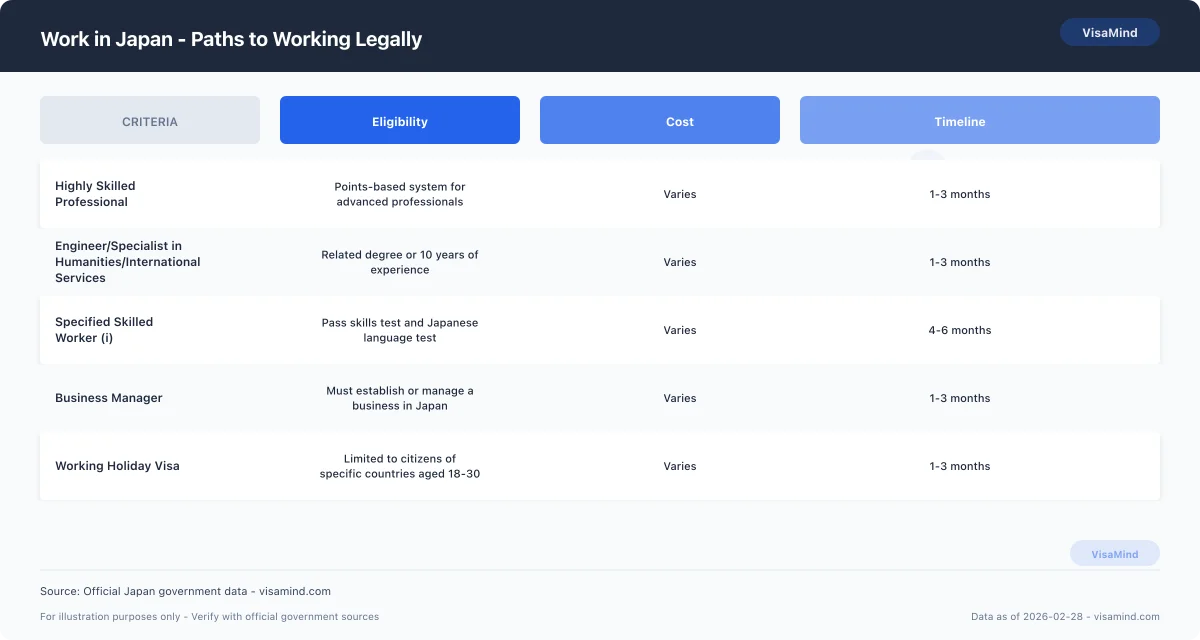
Japan offers a variety of work visa categories to accommodate different professional backgrounds and skills, managed by the Immigration Services Agency of Japan (ISA). The primary work visa types help facilitate employment for foreign nationals across diverse fields. Below is an overview of the most common work visa categories:
| Visa Type | Eligibility | Cost | Timeline |
|---|---|---|---|
| Professor | University professors and researchers | ¥4,000 to ¥10,000 (as of 2023) | 1-3 months |
| Artist | Individuals engaged in artistic activities | ¥4,000 to ¥10,000 (as of 2023) | 1-3 months |
| Business Manager | Entrepreneurs and business managers | ¥4,000 to ¥10,000 (as of 2023) | 1-3 months |
| Engineer/Specialist in Humanities/International Services | Engineers, specialists in humanities, and international service professionals | ¥4,000 to ¥10,000 (as of 2023) | 1-3 months |
| Specified Skilled Worker (i) | Individuals in designated industries facing labor shortages | ¥4,000 to ¥10,000 (as of 2023) | 1-3 months |
| Highly Skilled Professional | Individuals with advanced and specialized skills | ¥4,000 to ¥10,000 (as of 2023) | 1-3 months |
Key Requirements
When applying for a work visa, you will need to gather several documents:
- A valid passport
- One visa application form
- One photograph
- Certificate of Eligibility
For Chinese nationals, additional documents such as a copy of the Chinese Family Register and a Temporary Residence Permit or Residence Certificate are required. For applicants from Russia, CIS countries, or Georgia, two visa application forms and two photographs are necessary.
Important: Ensure you submit the original or a copy of the Certificate of Eligibility, as failing to do so can delay processing.
Application Process
The work visa application involves several steps:
- Certificate of Eligibility: Obtain this from the ISA or through your employer in Japan.
- Document Preparation: Gather all necessary documents as outlined above.
- Submission: Lodge your application at the Japanese embassy or consulate-general in your home country.
Popular Visa Options
Among the various options, the Engineer/Specialist in Humanities/International Services and Highly Skilled Professional visas are popular due to their broad applicability across industries. These visas facilitate roles in technology, academia, and international business.
Moreover, the Specified Skilled Worker (i) visa addresses labor shortages in specific industries, providing opportunities for skilled workers from abroad.
Tip: Consider the Highly Skilled Vs Engineer Specialist guide to determine which visa best suits your qualifications and career goals.
As you explore your options for working in Japan, ensure you review the eligibility criteria and prepare your application carefully to increase the success of your visa application.
Does Your Employer Need to Do Anything?
#When you plan to work in Japan, your employer plays a significant role in facilitating the process. Understanding what your employer needs to do can streamline your journey towards obtaining a work visa.
Employer Sponsorship Requirements
In many cases, your prospective Japanese employer will need to act as your sponsor. This involves several responsibilities and obligations to ensure your application for a work visa is successful. Here are some key points your employer should consider:
-
Certificate of Eligibility (COE): One of the primary responsibilities is obtaining a Certificate of Eligibility (COE) on your behalf. The COE is issued by the Immigration Services Agency of Japan and is a prerequisite for most work visa applications. Your employer must apply for this document, which serves as proof of your eligibility for the specific visa category.
-
Verification Documents: Employers might need to provide various documents to verify the nature of the job and your suitability for the position. These documents often include:
- A detailed job description outlining the role and responsibilities.
- Evidence of the company's registration and financial health.
- Proof that the position requires specific skills that you possess.
-
Communication with Japanese Authorities: Employers are expected to liaise with the Immigration Services Agency and ensure that all necessary requirements are met.
Important: Failing to secure a Certificate of Eligibility can significantly delay your visa application process. Ensure your employer starts this process well in advance.
Does Your Employer Need to Nominate You?
While the concept of nomination is more common in other countries, in Japan, the focus remains on the Certificate of Eligibility. However, certain highly specialized roles or industries might require additional steps similar to a nomination process.
-
Highly Skilled Professionals: If applying under the Highly Skilled Professional category, your employer might assist in showcasing your qualifications and the benefits you bring to Japan.
-
Specified Skilled Workers: For roles under the Specified Skilled Worker (i) visa, employers may need to demonstrate that they cannot fill these positions with local workers, although this requirement is not as stringent as in some other countries.
Employer Responsibilities Post-Visa Issuance
Once you have been granted a work visa, your employer still bears certain responsibilities:
-
Employee Support: Employers are encouraged to offer support in settling into Japan, which might include helping with accommodation and understanding local customs.
-
Compliance with Labor Laws: Ensuring that your work conditions comply with Japanese labor laws is crucial. This includes providing appropriate working hours, salary, and benefits.
Tip: Staying in close contact with your employer throughout the process can prevent misunderstandings and ensure all obligations are met efficiently.
By understanding and fulfilling these responsibilities, your employer can significantly contribute to a smooth and successful transition to working in Japan. For more detailed guidance, consider reviewing our How To Apply and Documents Checklist guides.
The Application Process
#To work in Japan, you need to navigate the application process for a work visa, which is managed by the Immigration Services Agency of Japan (ISA). The process involves several crucial steps and requires specific documentation based on your nationality and the category of work visa you are applying for. Below is a structured guide to help you understand and complete the application process effectively.
Step-by-Step Application Process
-
Determine Your Visa Category
Identify the appropriate work visa category based on your job and qualifications. Categories include Professor, Artist, Engineer/Specialist in Humanities/International Services, and others. Each category has specific requirements and eligibility criteria.
-
Obtain a Certificate of Eligibility (COE)
Before applying for a work visa, you must secure a Certificate of Eligibility (COE) from the ISA. This document confirms that you meet the criteria for the visa. It is typically obtained by your employer in Japan and is a prerequisite for the visa application. More information about the COE process can be found on the COE-APPLICATION page.
-
Gather Required Documents
Prepare the necessary documents, which generally include:
- A valid passport
- One visa application form
- One recent photograph
- The original or a copy of the COE
Important: If you are a Chinese national, additional documents such as a copy of the Chinese Family Register and a Temporary Residence Permit or Residence Certificate are required. Ensure all documents are complete and accurate to avoid delays.
-
Submit Your Application
Lodge your application at the Japanese embassy or consulate-general in your country. This step involves submitting your visa application form along with all required documents. For some applicants, especially from Russia, CIS countries, or Georgia, two visa application forms and two photographs are necessary.
-
Pay the Visa Fee
Be prepared to pay the non-refundable visa fee. Fees vary depending on your nationality and the visa category. Verify the exact amount and payment methods on the official ISA website or through your local Japanese consulate.
-
Wait for Processing
The processing time can vary significantly, often taking several months, so apply well in advance of your intended departure date. You can check estimated processing times on the Processing Times page.
Tip: Consider using the online application portal if available, as it can expedite the process and provide immediate confirmation of your submission.
Common Pitfalls and Tips
- Certificate of Eligibility: Ensure you submit the original or a certified copy of the COE with your application.
- Incomplete Documents: Double-check that all documents are complete and tailored to your specific nationality requirements.
- Multiple Forms and Photos: Applicants from certain countries must submit additional forms and photographs. Check the specific requirements for your nationality.
By following these steps carefully and ensuring all documentation is correct and complete, you can improve your chances of a successful application. For more details on related visas, explore options like the Highly Skilled Professional and Business Manager visas.
Your Rights as a Worker
#Tip: Before making any significant decisions, consult the Immigration Services Agency of Japan (ISA) for guidance on your specific visa category and legal rights.
Can You Change Employers?
- Changing Employers: If you wish to change employers while holding a work visa in Japan, you must notify the Immigration Services Agency of Japan. Depending on your visa type, you may need to apply for a change in the status of residence if your new job falls under a different category.
- Consistency with Visa Requirements: Ensure that your new employment aligns with the activities permitted under your current visa. For example, if you are on an Engineer/Specialist in Humanities/International Services visa, your new job should fit within the same category.
- Documentation: You might need to provide additional documents proving your new employment and its compliance with visa terms. It is advisable to review the necessary documents and consult with ISA.
Can Family Join You in Japan?
- Dependent Visa: Family members such as spouses and children can join you in Japan under a Dependent Visa. This requires you to demonstrate sufficient financial means to support them during their stay.
- Application Process: You will need to apply for a Certificate of Eligibility for each family member through the Immigration Services Agency of Japan as part of the visa application process.
- Spouse and Child Rights: Once in Japan, your spouse may be able to work part-time after obtaining permission from the ISA. Children may attend school under the Dependent Visa, contributing to their educational development.
Can You Study While Working?
- Permission for Activities Outside Visa Status: If you hold a work visa and wish to study, you may apply for permission to engage in activities outside your visa status. This allows you to pursue educational opportunities without changing your visa.
- Types of Study: You may engage in part-time studies or specific courses that do not interfere with your primary work duties. For full-time studies, consider applying for a Student Visa instead.
- Application Procedure: To apply for permission, submit the appropriate form to the Immigration Services Agency. This ensures that you remain compliant with Japanese immigration laws while expanding your skills and knowledge.
Important: Always keep your visa status updated and comply with all immigration regulations to avoid legal issues during your stay in Japan.
Transitioning to Permanent Residence
#Transitioning from a work visa to permanent residence in Japan involves a structured pathway, managed by the Immigration Services Agency of Japan (ISA). This process allows individuals who have established themselves professionally in Japan to secure a more stable and long-term residency status.
How Work Visas Lead to Permanent Residence
A work visa in Japan can be a stepping stone towards permanent residence. To qualify, you need to have held a valid work visa and have resided in Japan for a certain period. Typically, the minimum duration is 10 years, but this timeline can be reduced for certain visa categories, such as the Highly Skilled Professional visa, which may allow you to apply after just 1-3 years based on your points score. Key Requirements:
- Continuous residence in Japan for a minimum of 10 years (or shorter for certain visas)
- Holding a valid work visa throughout this period
- Demonstrating good conduct and sufficient financial resources
- Having a stable and sufficient income
Steps to Transitioning to Permanent Residence
- Assess Eligibility: Ensure you meet the residency duration and other requirements, such as income and conduct. 2. Gather Required Documents: You will need:
- Passport and residence card
- Proof of employment and income
- Tax records and proof of residence
- Other supporting documents as specified by the ISA
- Apply for Permanent Residence: Submit your application to the ISA. You may need to provide additional documentation if requested. 4. Await Processing: Processing times can vary, so check the Processing Times guide for current estimates. > Important: Processing times for permanent residence applications can be lengthy, often taking several months.
Timeline and Considerations
The timeline for transitioning to permanent residence varies based on visa type and individual circumstances. Here's a general overview:
| Visa Type | Typical Residency Requirement | Processing Time |
|---|---|---|
| General Work Visa | 10 years | 6-12 months |
| Highly Skilled Professional | 1-3 years | 4-6 months |
Considerations:
- Maintain a Clean Record: Any legal issues or unpaid taxes can hinder your application. - Stable Income: Consistent employment and financial stability are crucial. - Language Skills: While not officially required, Japanese proficiency can be advantageous. For those interested in a permanent stay in Japan, understanding the Pr Pathway Guide is beneficial. It provides detailed insights into navigating this transition effectively. By meeting the requirements and following the necessary steps, individuals on work visas can successfully transition to permanent residence in Japan, ensuring long-term stability and opportunities within the country.
Why Work Visa Applications Fail
#There are several potential pitfalls that can lead to application refusal. Understanding these can help you prepare effectively.
Missing or Incorrect Documentation
- Certificate of Eligibility (CoE): Failing to include the original or a certified copy of the CoE is a common reason for refusal. Ensure that you have obtained this document before applying.
- Nationality-Specific Requirements: Certain nationalities require additional documentation. For instance, Chinese nationals must provide a copy of the Chinese Family Register and a Temporary Residence Permit or Residence Certificate. Check the Documents Checklist to ensure you have all necessary documents.
- Dual Application Forms and Photos: If you are from Russia, CIS countries, or Georgia, you must submit two visa application forms and two photographs. Missing these can result in denial.
Incomplete or Inaccurate Information
- Consistency Across Forms: Ensure all details are consistent across your application and supporting documents. Discrepancies can lead to delays or rejection.
- Detailed Job Description: Provide a clear and detailed job description that aligns with the visa category you are applying for, such as Engineer/Specialist in Humanities/International Services.
Employer and Job-Related Issues
- Employer Accreditation: The Japanese employer must be properly registered and accredited to sponsor foreign workers. Any issues with employer documentation can affect your application.
- Job Offer Validity: Ensure that your job offer is valid and falls under one of the recognized categories, such as a Business Manager or a Specified Skilled Worker (i).
Important: Always review the specific requirements for your visa category and nationality before lodging your application to avoid unnecessary delays or refusals.
Application Timing and Processing
- Processing Times: Applications can take several months to process. To avoid time constraints, plan your application submission well in advance. Refer to the Processing Times guide for more information.
- Submission Deadlines: Be aware of any deadlines related to your visa application process, especially if transitioning from another visa type such as a Student Visa.
By being thorough and attentive to these details, you can improve your chances of a successful application for working in Japan.
Skills and Qualifications
#To work in Japan, it is crucial to understand the skills and qualifications necessary for obtaining a work visa. The Immigration Services Agency of Japan (ISA) has specific requirements to ensure that applicants meet the necessary standards for employment in the country.
Skills Assessments
- Highly Skilled Professional Visa: This visa requires a points-based assessment covering academic qualifications, professional experience, and salary level. Points are awarded for higher degrees, specialized skills, and work experience in particular fields.
- Specified Skilled Worker Visa (i): Applicants must demonstrate proficiency through skills tests and Japanese language evaluations relevant to their industry.
- Engineer/Specialist in Humanities/International Services Visa: Requires either a university degree relevant to the field of employment or ten years of professional experience in a related role.
Qualification Recognition
- Degree Verification: Applicants must provide proof of their academic qualifications. This includes certified copies of diplomas and transcripts. If your documents are not in Japanese, translation may be required.
- Professional Licenses: Some visa categories, like Medical Services, necessitate recognition of professional licenses from your home country. Verification through Japanese professional bodies may be required.
Important: Ensure all foreign qualifications are officially recognized by relevant Japanese authorities to avoid processing delays.
Degree Requirements
- Minimum Educational Standards: For most professional categories, a bachelor's degree or higher is typically required. Fields such as teaching or research may have more specific requirements tied to the subject of study.
- Vocational Training: Certain visas, like the Skilled Labor Visa, may accept vocational qualifications if they are directly relevant to the job role.
Common Pitfalls
- Incomplete Documentation: Failing to provide all necessary documents, such as the Certificate of Eligibility, can lead to application rejection.
- Incorrect Information: Ensure that all information provided matches your official documents to avoid complications.
For further details on the types of work visas available and their specific requirements, you can explore the Highly Skilled Professional and Specified Skilled Worker (i) visa pages. Additionally, the How To Apply guide offers insights into application procedures and essential documentation.
Salary and Cost Considerations
#Important: Ensure you meet the minimum salary thresholds for your visa category, as failure to do so can result in visa denial.
Salary Thresholds for Different Visa Categories
Japan has specific salary requirements for various working visa categories. Meeting these thresholds is crucial to maintaining your visa status.
| Visa Category | Minimum Salary Requirement (per month) |
|---|---|
| Business Manager | ¥250,000 |
| Engineer/Specialist in Humanities/International Services | ¥200,000 |
| Highly Skilled Professional | ¥300,000 |
| Specified Skilled Worker (i) | ¥180,000 |
These figures represent the baseline salaries as of 2023 and are subject to change. Always verify the latest thresholds on the Immigration Services Agency of Japan website.
Cost Considerations for Visa Applications
Applying for a work visa involves certain costs, which vary based on the type of visa and your nationality.
| Visa Category | Application Fee (JPY) |
|---|---|
| Business Manager | ¥4,000 |
| Engineer/Specialist in Humanities/International Services | ¥4,000 |
| Specified Skilled Worker (i) | ¥4,000 |
These fees are standard for many work visas, but it’s advisable to confirm the exact amount when you begin your application. The Visa Refusal Reasons guide can help you prepare a comprehensive application to avoid additional costs.
Additional Financial Requirements
In addition to salary and application fees, you may need to demonstrate sufficient financial resources or sponsorship to support yourself in Japan. This is especially relevant for categories like the Specified Skilled Worker (i) and Business Manager visas.
Tip: Consider consulting the Financial Requirements guide to ensure you meet all necessary financial criteria.
By understanding and meeting these financial requirements, you can improve your chances of securing a work visa in Japan.
Your Tax Situation Abroad
#When working in Japan, understanding your tax obligations and social security contributions is crucial. Different rules apply depending on your residence status and the existence of international agreements between Japan and your home country.
Income Tax Obligations
As a foreign worker in Japan, you may be required to pay Japanese income tax. Tax residency status determines your tax obligations:
- Non-residents: Those who have lived in Japan for less than one year and do not intend to stay longer. You are taxed only on income earned in Japan.
- Residents: Those who have lived in Japan for more than one year or intend to stay longer. You are taxed on both Japanese and worldwide income.
Income tax rates can vary, so it’s important to consult the most recent tax tables or seek advice from a tax professional.
Social Security Contributions
Japan has a mandatory social security system that covers health insurance, pension, and unemployment. Foreign workers are generally required to contribute to this system. The contributions are typically shared between you and your employer:
- Health Insurance: Provides coverage for medical expenses.
- Pension: Contributes to the national pension scheme.
- Unemployment Insurance: Provides benefits if you lose your job.
Important: If you are a Highly Skilled Professional, you may have specific benefits or exemptions regarding pension contributions.
Double Taxation Treaties
Japan has agreements with several countries to prevent double taxation. These treaties can reduce or eliminate your tax burden in Japan or your home country. Key elements typically covered include:
- Exemption or Reduction: Certain types of income, such as dividends or interest, may be taxed at a reduced rate or exempted in one of the countries.
- Tax Credits: A credit for taxes paid in Japan may be available against your home country's tax obligations.
Refer to the specific treaty between Japan and your home country for detailed guidance. You can find more information on the How To Apply page for additional resources.
Understanding these facets of your tax situation can help you manage your finances efficiently while working in Japan. Always verify the latest information on the official website or through a qualified tax advisor.
Real-World Work Visa Stories
#"I was worried about the Certificate of Eligibility because I heard it's crucial for a work visa application in Japan. My employer had assured me they would handle it, but I was still anxious because delays in obtaining this certificate could affect my start date. To address this, I maintained regular communication with both my employer and the Immigration Services Agency of Japan. I also made sure to gather all necessary personal documents, such as my passport and photographs, well ahead of time. In the end, my diligence paid off. The certificate was issued without a hitch, allowing me to submit my application smoothly. Checking the Visa Refusal Reasons guide also helped me avoid common pitfalls."
"I was concerned about the extensive documentation needed for my Engineer/Specialist in Humanities/International Services visa application. As a Chinese national, I knew I needed additional documents like the Family Register and Temporary Residence Permit. To prepare, I created a detailed checklist and consulted the Documents Checklist to ensure I wouldn't miss anything. I also reached out to other expats in Japan who had gone through similar processes for advice. Despite the initial anxiety, the thorough preparation meant that when I submitted my application, it was complete, and I avoided the stress of having to resubmit due to missing documents."
"Working in a small startup, I was anxious about how the size of my company might be perceived by the immigration authorities. The company had only five employees, and I feared this might raise questions about the job's legitimacy. To mitigate this, I gathered detailed evidence of the company's operations, including business plans, financial statements, and my specific role within the team. I also familiarized myself with the Highly Skilled Vs Engineer Specialist guide to better understand where my application fit within Japan's visa frameworks. This proactive approach helped build a strong case, and my work visa was approved without issue, confirming the importance of presenting a comprehensive and transparent application."
FAQs
What happens if I don't provide the Certificate of Eligibility when applying to work in Japan?
How can I transition from a Working Holiday Visa to a Specified Skilled Worker (i) visa in Japan?
Do employers in Japan need to provide documents for my Highly Skilled Professional visa application?
How long does the Immigration Services Agency of Japan take to process a work visa application?
What are the salary requirements for an Engineer/Specialist in Humanities/International Services visa in Japan?
Can my spouse work on a dependent visa in Japan if I have a Business Manager visa?
What is the role of the Immigration Services Agency of Japan in the work visa process?
VisaMind provides informational guidance only and is not a government agency. This is not legal advice. Requirements can change and eligibility depends on your specific facts. If your case is complex or high-stakes, consult a licensed immigration attorney.
Next steps
Requirements vary by nationality, purpose, timeline, and case details. Use Find My Visa to get a personalized checklist for Japan with official sources and deadlines.
Find my visa