Official sources referenced
Overview of Financial Requirements
#When applying for a visa to Japan, demonstrating sufficient financial capacity is crucial. The Immigration Services Agency of Japan (ISA) requires applicants to provide proof of financial means to ensure that they can support themselves during their stay. This is particularly important for those seeking a Short-Term Stay visa, which allows for visits of up to 90 days for purposes like tourism or business, without engaging in remunerative activities. The primary aim is to ensure applicants can cover expenses such as accommodation, food, and transportation without working illegally.
What Financial Proof Do You Need?
For most visa types, including the Short Stay and Student Visa, the proof of financial capacity might include bank statements, salary slips, or proof of sponsorship. The specific requirements will vary depending on the visa category and the applicant’s nationality. Generally, the financial proof should cover expenses for the duration of the stay and demonstrate a stable financial background.
Financial Requirements for Long-Term Stay
If you are applying for a Long-Term Stay visa, such as the Highly Skilled Professional or Engineer Specialist, a Certificate of Eligibility from ISA is mandatory. This certificate serves as preliminary approval and indicates that the applicant meets the financial and other requirements. The Certificate of Eligibility must be obtained before lodging a visa application, and it is the inviting organization or guarantor's responsibility to send the necessary documents to the applicant, not directly to Japanese authorities.
Important: Failing to provide comprehensive financial evidence can result in application delays or rejection. Ensure all documents are complete and accurate before submission.
Collaborative Financial Support
In cases where an applicant cannot demonstrate sufficient personal finances, a guarantor or sponsor may be required. This is often applicable for Student or Dependent visas. The guarantor, typically a resident of Japan or a relative, must provide a Letter of Guarantee along with their financial documents to assure the applicant's ability to meet the financial needs during their stay.
Tip: If possible, apply through the Japan eVISA website to streamline the process. This option is available for ordinary passport holders from certain countries.
By understanding these financial requirements and preparing the necessary documentation, you can strengthen your application and increase the likelihood of a successful outcome. Always refer to the ISA's official guidelines for the most current requirements and ensure your financial documentation is thorough and well-organized.
Proof of Funds by Visa Type
#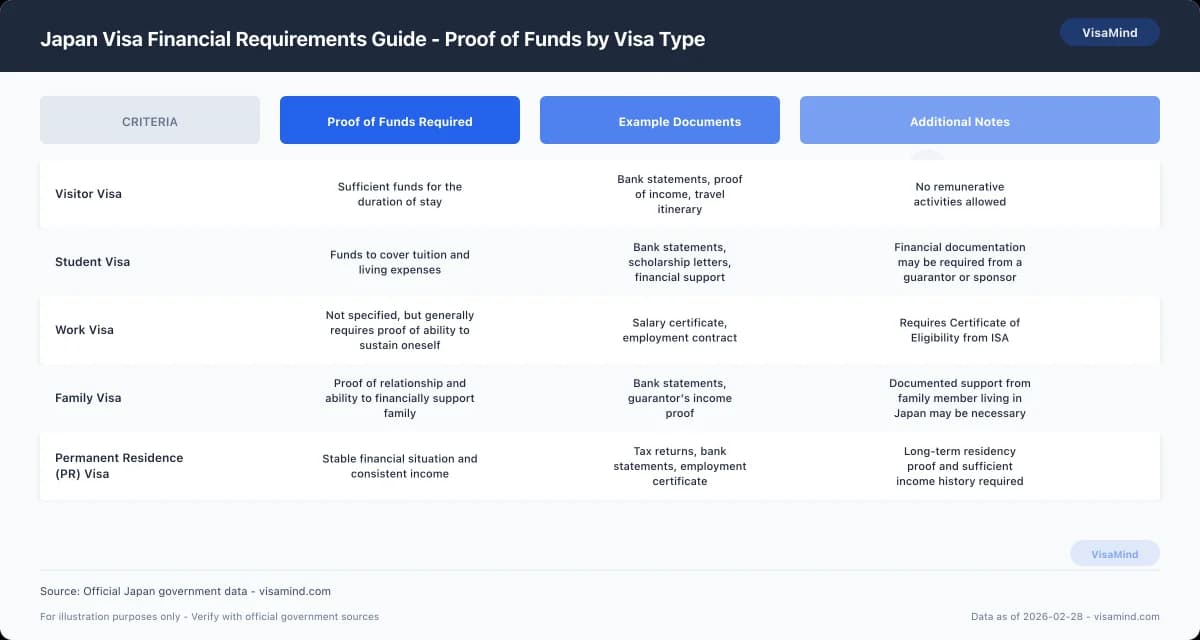
Understanding the financial requirements for different types of visas is crucial for applicants planning their visit, study, or work in Japan. Here's a breakdown of the specific amounts and types of evidence required for various visa categories.
| Visa Type | Financial Requirement | Evidence Required |
|---|---|---|
| Short Stay | Sufficient funds for duration of stay | Bank statements, travel itineraries, proof of accommodation |
| Student Visa | Approximately ¥1,000,000 per year | Bank statements, scholarship certificates, sponsor’s financial guarantee |
| Work Visa | Sufficient income to support living in Japan | Employment contract, bank statements, tax return documents |
| Family Visa | Sponsor’s income of at least ¥3,000,000 per year | Sponsor’s employment certificate, bank statements, tax documents |
| Permanent Residence | Stable and sufficient income | Tax certificates, employment proof, bank statements |
What Constitutes Sufficient Funds?
For the Short Stay visa, the Immigration Services Agency of Japan emphasizes the importance of having enough financial resources to cover your entire stay. This generally includes accommodation, travel, and daily expenses, which should be demonstrable through bank statements and proof of pre-booked accommodations.
For Student Visas, the required amount, approximately ¥1,000,000 per year, should cover tuition and living expenses. You may be asked to provide proof of a scholarship or a financial guarantee from a sponsor.
Proving Financial Capability for Long-Term Stays
Work visas, such as the Engineer/Specialist in Humanities/International Services, require evidence of a legitimate job offer in Japan, with an income that can sustain your lifestyle. This typically includes an employment contract and recent tax returns.
For family-dependent visas, like the Dependent Visa, the sponsor in Japan must demonstrate an annual income of at least ¥3,000,000 to support the family member. This is evidenced through employment certificates and bank statements.
Financial Stability for Permanent Residence
Achieving Permanent Residence status requires proof of a stable and sufficient income over several years. Applicants must submit tax certificates and employment proof to showcase their financial stability.
Important: Ensure all financial documents are current and accurately reflect your financial status. Incomplete or outdated documents can delay processing.
For further details on required documentation, consult the Documents Checklist to ensure you have everything needed for your specific visa application.
Bank Statement Rules
#- You typically need to provide bank statements covering the last three months to demonstrate financial stability when applying for a visa to Japan.
- Ensure that the statements are recent and reflect consistent activity over the specified period.
Minimum vs. Average Balance
- While there is no universally fixed minimum balance requirement, your bank statements should demonstrate consistent funds that cover your planned stay in Japan.
- The average balance is often considered more indicative of financial stability than occasional high balances. Aim for a steady average balance that comfortably supports your intended activities during your visit, such as tourism or studying.
Important: Consistently low balances or sudden large deposits just before applying may raise concerns about financial reliability. Ensure your financial history reflects genuine, stable capability.
Eligible Accounts
- Savings and Checking Accounts are the most commonly accepted types of accounts for proving financial stability. They should be in your name and show regular activity.
- Fixed Deposits or other long-term deposit accounts may also be considered, but it is crucial to demonstrate that these funds are accessible for use during your stay in Japan.
Joint Accounts
- Joint accounts can be used as proof of funds, but you must clearly demonstrate your access to these funds. This typically involves providing documentation that shows your co-ownership and the terms of access to the account.
- If you are applying with a spouse or family member, ensure that the joint account reflects both parties' names and provides sufficient funds to support all applicants.
For further guidance on other aspects of your Japan visa application, consider reviewing our Documents Checklist and Visa Application Process.
What Qualifies as Proof
#Demonstrating financial capability is crucial. The Immigration Services Agency of Japan (ISA) requires applicants to provide evidence of their financial status to ensure they can support themselves during their stay. Here's what qualifies as proof and what does not.
Cash and Bank Savings
- Bank Statements: Recent bank statements showing sufficient balance to cover your expenses while in Japan. This is one of the most straightforward proofs of financial capability.
- Fixed Deposits: Certificates of fixed deposits can be presented, provided they are easily accessible funds.
Important: Ensure bank statements are up-to-date and reflect consistent account activity to avoid suspicion of sudden large deposits.
Investments and Assets
- Stocks and Bonds: Documentation showing ownership of stocks or bonds can be used as proof of investment assets.
- Property Ownership: Title deeds or property valuation reports indicating ownership of real estate can support your financial stability claim.
Scholarships and Educational Funding
- Scholarship Awards: For students, proof of scholarship awards from recognized institutions can be submitted. This should clearly state the amount and duration of the scholarship.
- Sponsorship Letters: If you are sponsored by an organization or individual, a formal sponsorship letter detailing the financial support provided must be included.
What Does Not Count
- Unsecured Loans: Loans or credit lines that are not backed by collateral are generally not accepted as proof.
- Cryptocurrency: As of now, cryptocurrency holdings are not considered valid proof due to their volatile nature.
- Undocumented Income: Any income that cannot be substantiated with official documentation, like cash earnings without receipts, will not be accepted.
Tip: Always verify the latest financial requirements and acceptable forms of proof on the Immigration Services Agency of Japan's official website before lodging your application. Requirements may vary based on the visa type you are applying for, such as a Highly Skilled Professional Visa or Specified Skilled Worker (i) Visa.
Ensuring you gather the appropriate financial documents can significantly improve your chances of a successful application. For a detailed checklist of required documents, refer to the Documents Checklist.
Money Mistakes That Sink Applications
#Ensuring your financial documentation is in order is crucial when applying for a visa to Japan. Common errors in financial documents can lead to delays or even the denial of your application. Below are some of the most critical financial mistakes to avoid as you prepare your Japan visa application.
Last-Minute Deposits
- Large, Sudden Deposits: Avoid making large deposits into your bank account shortly before applying. Immigration Services Agency of Japan (ISA) scrutinizes sudden increases in funds as they might not reflect your actual financial status.
- Unexplained Transactions: Be prepared to provide explanations for any significant, unexplained transactions. Lack of transparency can raise red flags and complicate the application process.
Tip: Maintain a steady account balance for at least six months before applying for your visa to demonstrate financial stability.
Insufficient Financial History
- Short Account History: A bank account history that is too short can be problematic. Aim to provide at least six months of financial statements, as this demonstrates a consistent financial capability.
- Limited Financial Activity: Showing minimal activity in your bank account may suggest that you lack the necessary financial means to support your stay.
Wrong Currency
- Currency Mismatches: Ensure that your financial documents are in the correct currency. For example, if you are showing funds in your local currency, provide a conversion to Japanese yen (JPY) to facilitate the review process.
- Exchange Rate Fluctuations: Be mindful of exchange rate fluctuations, as these can affect the perceived value of your available funds.
Missing Explanations
- Lack of Supporting Documents: Always provide supporting documentation to explain the source of your funds, especially if they are from sources like scholarships or family support.
- Unclear Financial Support: If someone is sponsoring your trip, make sure to include a detailed Letter of Guarantee with comprehensive details about your sponsor's ability to support you financially.
Important: Missing documentation or vague explanations can result in delays or rejection. Ensure all financial transactions and sources of income are clearly documented and explained.
For more detailed guidance on preparing your financial documents, consult the Visa Refusal Reasons or the How To Apply guide. By avoiding these common financial pitfalls, you can enhance your chances of a successful visa application.
Sponsor Financial Evidence
#Financial evidence from a sponsor or guarantor can play a crucial role in demonstrating the applicant's ability to support themselves during their stay. This section will guide you through the types of financial documents that sponsors need to provide.
What Financial Evidence is Required from Sponsors?
Sponsors or guarantors need to present clear evidence of their financial capability. This typically includes documents that verify their income and financial standing. Here are some key documents sponsors should prepare:
-
Proof of Income: This can be recent pay slips, employment contracts, or a detailed letter from the employer. The documents should clearly state the sponsor's position, length of employment, and annual salary.
-
Affidavit of Support: A formal declaration where the sponsor confirms their commitment to financially support the visa applicant during their stay in Japan.
-
Tax Returns: Providing recent tax return documents helps demonstrate the sponsor’s consistent income over time. Typically, the most recent tax return is sufficient, but having a few years' worth of returns can strengthen the application.
How to Submit Sponsor Documents?
Sponsors need to ensure that all financial documentation is well-organized and legible. These documents should be sent directly to the visa applicant, who will then include them in their visa application package. It’s important to remember that these documents should not be sent directly to the Ministry of Foreign Affairs or any Japanese diplomatic mission.
Important: Submitting incomplete or incorrect sponsor documents can delay or even result in the denial of the visa application. Always double-check that all required financial documents are included and up-to-date.
Tips for Gathering Sponsor Financial Evidence
When gathering these documents, sponsors should focus on clarity and completeness:
- Ensure All Information is Current: Financial documents should reflect the most current information available, usually no older than three months.
- Translate Non-Japanese Documents: If the documents are in a language other than Japanese, they should be translated into Japanese or English by a certified translator.
- Verify Requirements Based on Visa Type: Different visa categories, such as the Highly Skilled Professional or Working Holiday Visa, may have specific requirements. Refer to the Documents Checklist to ensure all necessary documents are prepared.
By meticulously organizing and submitting the correct financial evidence, sponsors can significantly enhance the visa applicant's chances of a successful application. Always refer to the latest guidance on the official website of the Immigration Services Agency of Japan to verify any updates or changes to these requirements.
Getting Your Finances Application-Ready
#-
Start Early and Stay Organized
Begin organizing your financial documents well in advance of your visa application to Japan. The Immigration Services Agency of Japan (ISA) requires a detailed financial history, which often includes bank statements, pay slips, and tax documents. Keeping consistent records is crucial; it helps demonstrate your financial stability and supports your application. Make sure to maintain a clear and consistent trail of your financial activities, as discrepancies can lead to delays or additional inquiries.
-
Gather Consistent Financial Records
Collect all required financial documents, such as recent bank statements and proof of income, ensuring they cover the necessary period specified for your visa type. Consistency is key. For example, if applying for a Student Visa or Working Holiday Visa, ensure your documents clearly show you meet the financial requirements for the duration of your stay. This can include showing that you have enough funds to cover living expenses and any tuition fees if applicable.
-
Explain Unusual Financial Patterns
If there are any unusual patterns in your financial records, such as large deposits or withdrawals, it’s essential to provide a cover letter explaining these anomalies. This proactive step can help clarify your financial situation, preventing misunderstandings. For example, if you received a significant one-time payment, explain its source and relevance to your application.
Tip: Include a clear explanation for any sudden changes in your financial situation to help the ISA understand your financial history better.
By following these steps, you ensure that your financial documentation is comprehensive and clear, thereby supporting a smoother visa application process through the Immigration Services Agency of Japan. Always verify the latest requirements and guidelines on the official ISA website before submitting your application.
FAQs
Can funds from a sponsor be used as proof according to the Japan Visa Financial Requirements Guide?
What mistakes should be avoided when providing financial evidence for a Japan visa application?
What qualifies as proof under the Japan Visa Financial Requirements Guide?
How does the Japan Visa Financial Requirements Guide address combining goals for Work and Student visas?
How can one switch from a Working Holiday Visa to a Specified Skilled Worker (i) Visa according to the Japan Visa Financial Requirements Guide?
What is the timeline for submitting financial proof when applying through the JAPAN eVISA website?
Does the Japan Visa Financial Requirements Guide allow for application submission within Japan?
VisaMind provides informational guidance only and is not a government agency. This is not legal advice. Requirements can change and eligibility depends on your specific facts. If your case is complex or high-stakes, consult a licensed immigration attorney.
Next steps
Requirements vary by nationality, purpose, timeline, and case details. Use Find My Visa to get a personalized checklist for Japan with official sources and deadlines.
Find my visa