The Admission Step
#-
Receive a Letter of Acceptance from a Japanese University
The first step towards studying in Japan is securing admission to a recognized Japanese educational institution. This involves applying to universities and receiving a Letter of Acceptance. Without this letter, you cannot proceed with the visa application process. It's important to research universities and their programs thoroughly to ensure they meet your academic and personal preferences. Admission requirements and deadlines vary by institution, so check each university's specific criteria and timelines.
-
Obtain a Certificate of Eligibility (COE)
Once you've been accepted by a university, the next crucial step is to obtain a Certificate of Eligibility (COE). This document is essential for applying for a student visa. The university usually assists in applying for the COE on your behalf, submitting it to the regional immigration authority, which operates under the jurisdiction of the Immigration Services Agency of Japan (ISA). The COE serves as preliminary approval from the Japanese government, confirming that you meet the necessary requirements to study in Japan. Note that processing can take several months, so initiate this step as soon as possible after receiving your acceptance letter.
-
Prepare Required Documents for the COE and Visa Applications
To secure your COE and subsequently your student visa, you must prepare several important documents:
- Passport: Ensure your passport is valid for the duration of your intended stay in Japan.
- Photograph: A recent passport-sized photo that meets the specifications outlined by the ISA.
- Visa Application Form: This form must be completed accurately, with attention to detail.
- Proof of Financial Stability: Evidence that you can support yourself financially during your studies. This may include bank statements or a scholarship award letter.
- Additional Documents for Chinese Nationals: These include a copy of the Chinese Family Register and a Temporary Residence Permit or Residence Certificate.
Important: If you are a national of Russia, CIS countries, or Georgia, ensure you submit the correct number of visa application forms to avoid processing delays.
-
Submit the COE and Visa Application
When you have gathered all necessary documents, submit your COE and visa application to the nearest Japanese embassy or consulate. The visa application process cannot commence without a valid COE, and any discrepancies or missing documents can significantly delay your application.
Tip: Consult the Student Visa page for more detailed information on the visa application process and Documents Checklist to ensure you have all the required documentation.
By following these steps, you can navigate the admission process effectively and move closer to your goal of studying in Japan. Remember that each stage is interconnected, and careful preparation at each step will help facilitate a smooth transition into your academic life in Japan.
Student Visa Requirements
#Understanding the specific requirements for a student visa is essential. This includes meeting financial, health insurance, and language criteria, all of which are regulated by the Immigration Services Agency of Japan (ISA).
Financial Requirements
To apply for a student visa, you need to demonstrate that you have sufficient funds to cover your tuition and living expenses in Japan. This often involves showing proof of financial support, such as bank statements or scholarship certificates. While there is no fixed amount set by the ISA, it is generally recommended to have at least ¥2,000,000 to ¥3,000,000 available per year. For the most up-to-date financial requirements, please refer to the Financial Requirements guide.
Health Insurance
While health insurance is not a direct requirement for obtaining a student visa, it is mandatory for all international students residing in Japan to enroll in the National Health Insurance (NHI) program upon arrival. This ensures you have access to healthcare services at a reduced cost. The NHI premiums typically range from ¥20,000 to ¥30,000 per year, depending on your location and income. More details can be found in the Documents Checklist guide.
Language Requirements
Although not a strict visa requirement, Japanese language proficiency is often necessary for admission into Japanese educational institutions. Many universities and language schools require proof of Japanese language skills, such as passing the Japanese-Language Proficiency Test (JLPT) at a certain level. For programs taught in English, proof of English proficiency may be required instead, typically through tests like TOEFL or IELTS.
| Requirement | Description |
|---|---|
| Financial Proof | Show at least ¥2,000,000 to ¥3,000,000 for tuition and living expenses |
| Health Insurance | Enroll in National Health Insurance after arrival, costing ¥20,000 to ¥30,000 per year |
| Language Proficiency | Japanese or English proficiency may be required by your educational institution |
Tip: To avoid delays, start gathering your financial documents and language proficiency certificates early in the application process.
For further details on student visa types, visit the Student Visa page to understand the specific requirements suited to your educational goals.
The Application Process
#Obtain a Certificate of Eligibility
Before you can apply for a student visa to study in Japan, you must first secure a Certificate of Eligibility. This document is issued by a regional immigration authority under the jurisdiction of the Immigration Services Agency of Japan (ISA). It verifies your intended activities in Japan and your eligibility to engage in them. To obtain this certificate, your educational institution in Japan will typically handle the application on your behalf. Once issued, the Certificate of Eligibility will be sent to you, and you must include it in your visa application.
Prepare the Required Documents
As part of your student visa application, you need to gather the following documents:
- Passport: Ensure that your passport is valid for the duration of your stay in Japan.
- Visa Application Form: This must be completed with accurate details. The form is available on the official website of the ISA.
- Photograph: Provide a recent passport-sized photograph.
- Certificate of Eligibility: Include the original certificate along with a copy.
- Additional Documents for Chinese Nationals: If you are a Chinese national, you must also submit a copy of your Chinese Family Register and a Temporary Residence Permit or Residence Certificate.
Important: Incomplete or incorrect submissions can lead to delays or rejection of your application. Be meticulous in ensuring all documents are accurate and complete.
Submit Your Application
With all documents prepared, you can proceed to submit your application. This is typically done at the Japanese embassy or consulate in your home country. During submission, you will need to present your passport and the completed visa application form along with the required documents.
Tip: Consider visiting the Documents Checklist to ensure you have everything in order before submission.
Await Your Visa Approval
After submitting your application, the processing time can take several months, so it is advisable to apply well in advance of your intended start date. The Japanese consulate will contact you once your visa is approved. You will then need to visit the consulate to have the visa stamped in your passport.
For more detailed guidance, refer to the How To Apply guide. If your visa is approved, you can look forward to joining the vibrant student community in Japan under the Student Visa category.
Working While Studying
#International students in Japan holding a student visa have the opportunity to work part-time to supplement their income and gain practical experience. However, certain restrictions are in place to ensure that work does not interfere with their studies.
How Many Hours Can You Work?
Student visa holders in Japan are typically allowed to work up to 28 hours per week during academic terms. During long school holidays, such as summer or winter breaks, this limit increases to 40 hours per week. It's crucial to adhere to these limits as exceeding them can lead to violations of visa conditions, which may impact your ability to remain in Japan.
What Are the Restrictions?
While working as a student in Japan, you must adhere to specific conditions:
- Type of Work: You cannot engage in activities considered harmful to public morals, such as working in bars, nightclubs, or adult entertainment venues.
- Work Permit: Before starting any employment, you must obtain a "Permission to Engage in Activity Other than that Permitted under the Status of Residence Previously Granted" from the Immigration Services Agency of Japan. This is an essential step to ensure your employment is legal.
Important: Ensure that your part-time work does not interfere with your academic commitments, as maintaining your student status is paramount for your continued stay in Japan.
How to Apply for Work Permission?
To apply for permission to work part-time:
- Gather necessary documents, including your Residence Card, passport, and a completed application form.
- Submit these documents to the Immigration Services Agency of Japan. You may need to visit a regional immigration office in person.
- After approval, you will receive a stamp in your passport or a sticker on your Residence Card indicating your work permission status.
For more detailed guidance, you can refer to resources like the Documents Checklist and Visa Extension Guide.
By understanding these restrictions and following the correct procedures, you can enjoy a balanced student life in Japan while gaining valuable work experience.
After Graduation
#Upon completing your studies in Japan, you might be considering your next steps and exploring options to stay and work in the country. Japan offers several visa options to facilitate this transition from student to professional.
Post-Study Work Visa Options
After graduation, you can apply for a visa that aligns with your career aspirations. The most common options include:
- Designated Activities Visa: This visa allows graduates to stay in Japan for up to one year to search for employment. It is an excellent choice if you need additional time to secure a job.
- Engineer/Specialist in Humanities/International Services Visa: Suitable for those who have secured a job offer in fields such as engineering, humanities, or international services. This visa is based on employment with a specific employer.
- Highly Skilled Professional Visa: If you meet certain criteria, such as higher education and specialized skills, this visa provides benefits like a longer period of stay and the possibility to bring family members to Japan.
For those interested in entrepreneurship, the Startup Visa could be an attractive option. It supports new business ventures with a temporary status while you set up your enterprise.
Required Documents for Post-Study Visas
To apply for a post-study work visa, you will generally need to submit the following documents:
- Your degree certificate proving graduation
- A valid passport
- An updated resume or CV
- Offer letter or contract from a Japanese company (if applicable)
- Certificate of Eligibility, where applicable
Tip: Begin gathering these documents well in advance to ensure a smooth application process.
Transitioning to Permanent Residence
If you plan to stay in Japan long-term, you might consider applying for Permanent Residence. This status provides significant benefits, such as no restrictions on employment activities and easier re-entry into Japan. To qualify, you typically need to have lived in Japan for at least 10 years, although this period can be shorter if you hold a Highly Skilled Professional Visa.
Important Considerations
- Timelines: Processing times for work visas can vary, so plan accordingly. Refer to the Processing Times Guide for detailed information.
- Employment Search: If you're still searching for a job, the Designated Activities Visa can give you the necessary time to find suitable employment.
Important: Always verify the most current visa requirements and policies on the official website of the Immigration Services Agency of Japan, as regulations may change.
Pathway to Permanent Residence
#For international students in Japan, the journey from academics to securing permanent residence can be a strategic pathway. This process involves several steps and requirements that students must carefully navigate to achieve their goal of becoming a permanent resident in Japan.
Transitioning from a Student Visa to a Work Visa
Upon graduation, many students seek employment in Japan, which typically requires a change in visa status. Graduates often transition to work visas such as the Engineer Specialist or Highly Skilled Professional visas, depending on their qualifications and job offers.
- Application for Certificate of Eligibility: This is a critical document that must be obtained before applying for a work visa. It verifies that the candidate meets the conditions for the new visa status.
- Employment Contract: A valid job offer is essential. The employment should align with the new visa's requirements.
- Submit Visa Application: After securing the Certificate of Eligibility, submit your application to the Immigration Services Agency.
Tip: Starting the job search early during your final year can help ensure a smooth transition from student to professional life.
Meeting the Requirements for Permanent Residence
The path to permanent residence in Japan often requires applicants to live and work in the country for a certain period. Typically, this involves:
- Continuous Stay: As of 2023, you generally need to have lived in Japan for at least 10 years, with at least 5 years on a work visa. Verify this timeline on the official website as policies may change.
- Stable Income: Demonstrating a stable, sufficient income is crucial. The Financial Requirements guide provides details on income thresholds.
- Contribution to Japan: Demonstrating contributions to Japanese society and compliance with laws strengthens your application.
Understanding the Permanent Residence Application
When eligible, you can apply for permanent residence through the Permanent Residence process. Key documents include:
- Application Form: Complete and submit to the Immigration Services Agency.
- Proof of Residency and Income: Documentation that supports your continuous stay and financial stability.
- Certificate of Good Conduct: This may be required to demonstrate adherence to local laws.
Important: Ensure all documents are complete and accurate to avoid processing delays. Missing documents or information can lead to applications being returned or denied.
Navigating the study-to-PR pipeline in Japan requires careful planning and understanding of the visa transitions and requirements. Utilize resources like the Pr Pathway Guide for detailed insights into each step of the process.
Common Mistakes
#It's important to be aware of common pitfalls that can lead to delays or denials. Here are some of the most frequent mistakes applicants make:
Financial Requirements
-
Insufficient Funds: The Immigration Services Agency of Japan requires proof of adequate financial resources to support your stay. Failing to demonstrate this could result in a visa denial. It's vital to provide clear evidence of your ability to cover tuition and living expenses. For more details, refer to the Financial Requirements.
-
Lack of Documentation: Ensure all required financial documents, such as bank statements or sponsorship letters, are translated into Japanese or English and meet the guidelines set by the ISA.
Tip: Double-check the currency conversion rates and ensure your funds meet the required thresholds as of the latest guidelines. Verify on the official website for updates.
Certificate of Eligibility and Documentation
-
Incomplete Certificate of Eligibility: This document is crucial for your student visa application. An incomplete or improperly filled Certificate of Eligibility can lead to significant processing delays. Make sure all sections are completed and that it is issued by a recognized institution.
-
Missing Additional Documents for Chinese Nationals: Chinese nationals must submit extra documents like the Chinese Family Register and Residence Certificate. Omitting these can result in immediate rejection of the application.
Intent to Study
-
No Genuine Student Intent: Demonstrating a genuine intent to study is crucial. Applications lacking convincing evidence of this intent are likely to be denied. This includes having a clear plan for your studies and future career in Japan.
-
Not Consulting with the Embassy or Consulate: For activities without a Certificate of Eligibility, it's essential to consult with the Japanese embassy or consulate in your country. This step ensures you understand the specific requirements for your situation.
For further guidance on the application process and timelines, you can explore the How To Apply and Processing Times sections. By avoiding these common mistakes, you can enhance your chances of securing a student visa to Japan.
What It Actually Costs
#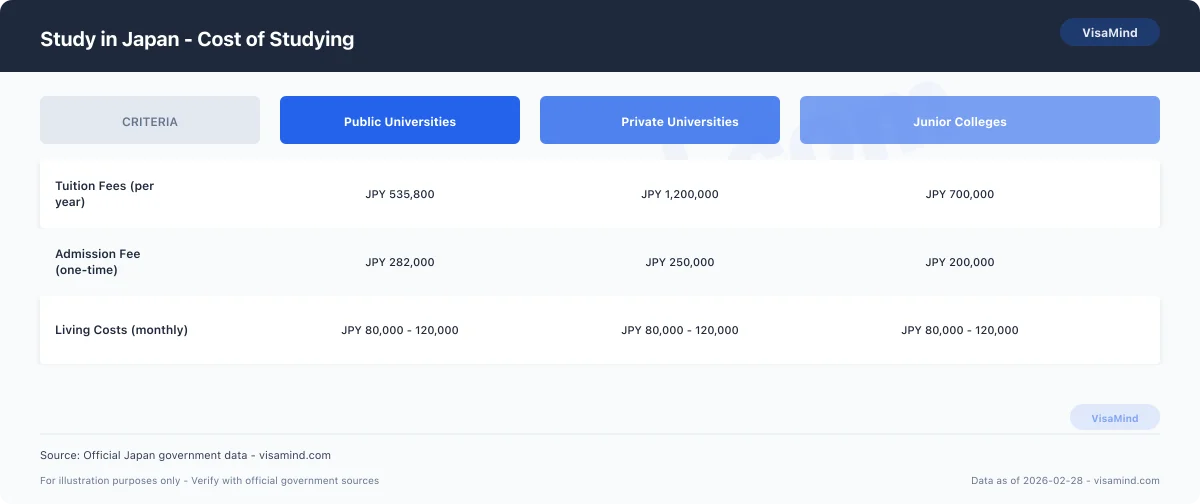
Important: Ensure you have a clear understanding of the financial requirements for studying in Japan. This includes tuition fees, living costs, and any additional expenses you may encounter. Verify current figures on the official Immigration Services Agency of Japan website.
Tuition Costs
Tuition fees in Japan can vary significantly depending on the type of institution and the program of study. Here's a general overview:
| Institution Type | Average Annual Tuition (JPY) |
|---|---|
| National Universities | 535,800 JPY |
| Public Universities | 535,800 JPY + additional fees |
| Private Universities | 875,000 JPY - 3,700,000 JPY |
| Japanese Language Schools | 600,000 JPY - 1,200,000 JPY |
These figures are subject to change, and it's crucial to check the specific costs associated with your chosen institution.
Living Expenses
Living expenses in Japan can also vary depending on the city you choose to reside in. Major cities like Tokyo and Osaka are more expensive compared to rural areas. Here's a breakdown:
| Expense Type | Monthly Cost (JPY) |
|---|---|
| Accommodation | 40,000 - 80,000 |
| Food | 30,000 - 60,000 |
| Transportation | 10,000 - 20,000 |
| Other Expenses | 20,000 - 40,000 |
As of 2023, the average monthly living cost for a student is approximately 100,000 to 150,000 JPY. Always verify these figures on official platforms.
Financial Requirements for Visa
To apply for a Student Visa, you must demonstrate financial capability to support your stay in Japan. This includes:
- Proof of funds or a financial guarantor
- Bank statements showing sufficient balance to cover tuition and living expenses
- Documentation of any scholarships or financial aid
Tip: If you plan to work part-time, consider checking the Visa Extension Guide for details on work permissions.
Ensuring you have a comprehensive understanding of these costs and requirements will help you budget effectively for your study in Japan. Always consult the How To Apply guide for the most accurate and updated information.
Day-to-Day Student Life
#- National Health Insurance (NHI): As a student residing in Japan for more than three months, you are required to enroll in the National Health Insurance (NHI) program. This provides you with access to medical services at a reduced cost—typically 70% of your medical expenses are covered by the insurance.
- Enrollment Process: You can enroll in NHI at your local city or ward office. You will need your residence card and proof of address. The insurance premiums vary depending on income, but as a student, you may qualify for reduced rates.
- Private Insurance: While NHI covers most medical needs, you may want to consider additional private insurance for comprehensive coverage, such as overseas travel or dental care.
Housing
- University Accommodation: Many universities offer dormitory facilities for international students. These are often more affordable and provide a convenient way to integrate into student life. However, availability can be limited, so early application is advisable.
- Private Housing: Renting an apartment is another option. You may need to provide a guarantor, often required in Japan, to back your lease agreement. Monthly rents can vary significantly based on location and size.
- Share Houses: An increasingly popular choice for students is share houses, which offer a more social living environment. These can be cost-effective and do not usually require a guarantor.
Banking
- Opening a Bank Account: It is advisable to open a Japanese bank account to manage your finances while studying. You will need your residence card, student ID, and personal seal (inkan) in some cases.
- Banking Options: Major banks like Mitsubishi UFJ, SMBC, and Japan Post Bank offer services tailored for students. Some banks provide online banking in English, which can simplify managing your finances.
- Currency Exchange: Consider using international money transfer services for remittances, as they often offer better exchange rates and lower fees than traditional banks.
Important: Always carry your residence card, as it is essential for accessing many services, including health insurance enrollment and banking.
Real Student Visa Stories
#I remember feeling incredibly anxious before applying for my student visa to study in Japan. My main concern was that my parents' financial situation might not seem sufficient on paper, even though they assured me they could support my studies abroad. To address this, I focused on gathering comprehensive documentation that not only included their bank statements but also letters of financial support from extended family members who were willing to contribute. I also prepared a detailed personal statement explaining my commitment to my studies and future career plans, which I believed would demonstrate my seriousness and dedication. When I finally submitted everything to the Immigration Services Agency of Japan, my thorough preparation seemed to pay off as my visa was approved without any additional questions.
Another worry I had was about switching fields entirely. I had previously studied engineering in my home country, but I wanted to pursue a degree in Japanese language and culture. My biggest fear was that the visa officer might question the relevance of this shift. To mitigate this concern, I included a letter of intent with my visa application, explaining my passion for Japanese culture and my career ambitions as a cultural liaison. I also highlighted any relevant experiences, such as language courses and cultural immersion programs I had previously attended. This proactive approach seemed to resonate well with the authorities, as my visa was granted, allowing me to embark on a new academic journey in Japan.
Tip: If switching fields, clearly articulate your motivations and future plans to reassure visa officers of your genuine interest.
FAQs
How can I switch from a student visa to a work visa in Japan?
What is the role of the Immigration Services Agency of Japan in studying in Japan?
Is it possible to stay in Japan after graduation on a student visa?
Do Chinese nationals face additional requirements when applying to study in Japan?
Can I apply for permanent residence in Japan after studying?
What are common mistakes when applying for a student visa to study in Japan?
What costs should I expect when applying for a student visa to study in Japan?
Sources
Last reviewed: March 1, 2026
VisaMind provides informational guidance only and is not a government agency. This is not legal advice. Requirements can change and eligibility depends on your specific facts. If your case is complex or high-stakes, consult a licensed immigration attorney.
Next steps
Requirements vary by nationality, purpose, timeline, and case details. Use Find My Visa to get a personalized checklist for Japan with official sources and deadlines.
Find my visa