Official sources referenced
Is Extension Possible?
#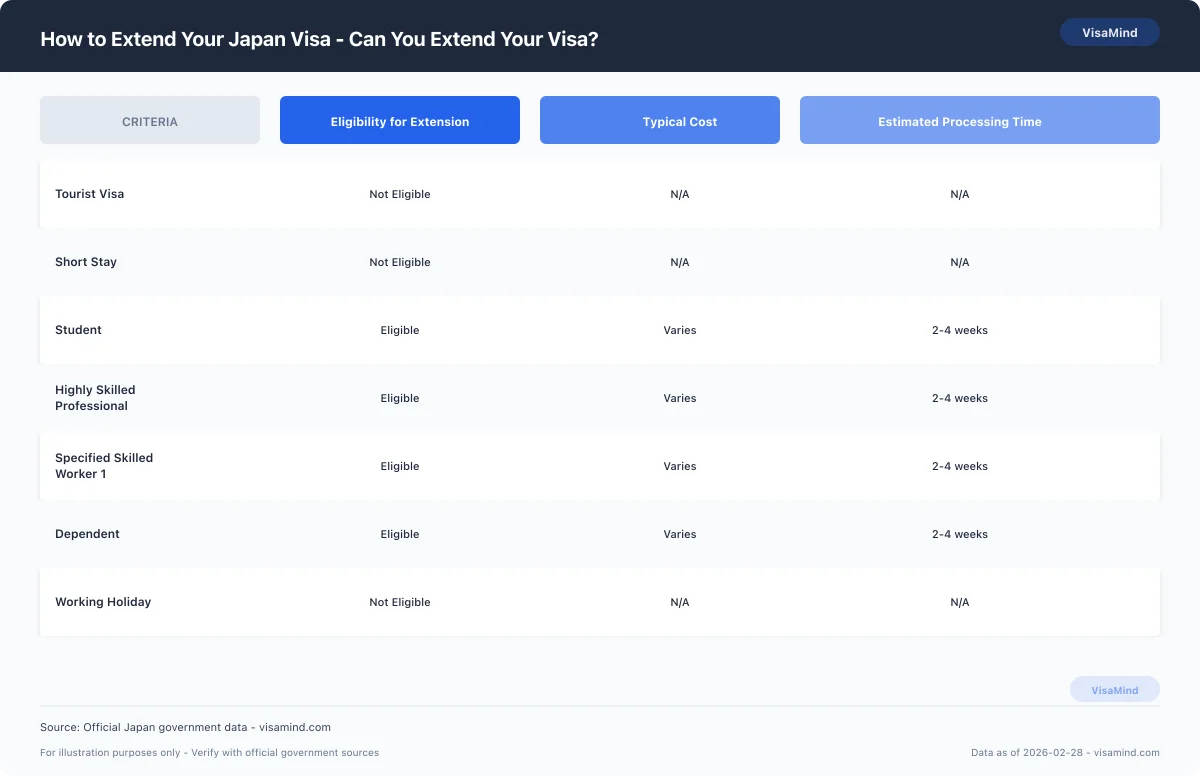
For many foreign nationals residing in Japan, the ability to extend their visa is a crucial part of continuing their stay. As of 2023, not all visa types in Japan are eligible for extension, so understanding which ones can be extended is a key first step.
Which Visas Can Be Extended?
The Immigration Services Agency of Japan (ISA) allows extensions for several visa types, primarily those intended for long-term residents and those engaged in specific skilled work. Here’s a quick comparison of common visa types and their extension eligibility:
| Visa Type | Eligibility for Extension |
|---|---|
| Long-term Resident | Yes |
| Student | Yes |
| Specified Skilled Worker (i) | Yes |
| Specified Skilled Worker (ii) | Yes |
| Highly Skilled Professional | Yes |
| Spouse or Child of Japanese National | Yes |
| Dependent | Yes |
| Permanent Residence | No (Permanent status does not expire) |
| Short Stay | No |
Understanding Eligibility
Certain visas, such as the Short Stay Visa, are not eligible for extension. These are typically intended for tourists, business visitors, or other temporary stays, usually limited to 90 days. Conversely, visas like the Student Visa and Long-term Resident Visa are designed to support longer stays and can be extended as necessary, provided you meet the conditions set by the ISA.
Special Considerations
Important: If you are on a visa type that cannot be extended, such as a Short Stay Visa, you must leave Japan upon its expiration or apply for a different visa type before your current visa expires.
For those on extendable visas, be mindful of the timeline for applying for an extension. It is recommended to start the process at least three months before your current visa expires to avoid any lapse in your legal status.
Conclusion
Understanding which visas can be extended is a fundamental step in planning your continued stay in Japan. Always verify the latest requirements and deadlines on the official Immigration Services Agency of Japan website to ensure compliance and avoid complications in your extension process. For more detailed guidance on application procedures, visit our How To Apply and Documents Checklist pages.
How to Apply for an Extension
#Determine Your Eligibility
Before you begin the process of extending your Japan visa, it's crucial to confirm that you're eligible to apply for an extension. The Immigration Services Agency of Japan (ISA) is responsible for managing applications for visa extensions. Foreign nationals residing in Japan on long-term visas, such as the Long-term Resident, Student Visa, or Specified Skilled Worker (i), may be eligible to apply. Be sure to check the specific requirements related to your visa category.
Gather Required Documents
The next step involves gathering all necessary documents to ensure your application is complete. Common documents required for most visa extension applications include:
- Your Residence Card
- Passport
- A completed application form for extension of period of stay (available from the Immigration Services Agency of Japan website)
- Proof of financial stability (such as bank statements or a letter from your employer)
- Certificate of Eligibility for long-term stays, if applicable
Important: Submitting incomplete or incorrect documents can lead to delays or rejection of your application. Refer to the Documents Checklist to ensure nothing is missed.
Choose Between Online or In-Person Application
You have the option to submit your application either online or in-person. Applying online can be more convenient and allows you to receive a receipt number immediately, which helps in tracking your application. However, some applicants might prefer to apply in person at the Immigration Services Agency of Japan local office for direct assistance.
Tip: Opting for online submission can help you avoid mail delays and expedite the process.
Submit Your Application
Once you have gathered all the required documents, proceed to lodge your application. If you are applying in person, visit the nearest Immigration Services Agency of Japan office. For online submissions, follow the instructions provided on the official ISA website.
Await the Decision
After submission, the ISA will review your application. Processing times can vary, so it's advisable to apply well in advance of your visa's expiration date. Keep track of your application status online, if applicable. If additional documentation is needed, you will be contacted by the ISA.
By following these steps, you can effectively apply for a visa extension in Japan. Remember to review the specific guidelines related to your visa type and ensure that all information is up-to-date by checking the Immigration Services Agency of Japan website regularly.
Documents Needed
#To extend your Japan visa, you must gather a comprehensive set of documents required by the Immigration Services Agency of Japan (ISA). Ensuring you have all the necessary paperwork will help streamline your application process and minimize delays.
Personal Identification
- Passport: Your original, valid passport with at least one blank page.
- Residence Card: A current, valid residence card that proves your residency status in Japan.
Application Documentation
- Visa Extension Application Form: Ensure this is fully completed with accurate details. This form is essential for communicating your request to extend your stay.
- Recent Photograph: A passport-sized photo taken within the last three months, adhering to ISA specifications.
Supporting Evidence
- Certificate of Eligibility: Required for long-term stays, this document confirms your eligibility for your specific visa category.
- Proof of Financial Stability: Bank statements or financial documents demonstrating your ability to support yourself during your extended stay.
- Employment Verification: If applicable, a letter from your employer confirming your position, duration of employment, and salary. This is particularly relevant for those on a Skilled Worker Visa.
Study and Research
- Enrollment Confirmation: For those on a Student Visa, a document from your educational institution confirming your continued enrollment and course details.
Family and Dependent Information
- Proof of Relationship: Birth or marriage certificates if you are applying to extend your stay based on family ties in Japan.
- Dependent Documents: Necessary for those on a Dependent Visa, including proof of the principal visa holder’s status.
Important: Incomplete or incorrect documentation is a common pitfall that can delay or jeopardize your visa extension application. Double-check all documents for accuracy.
Additional Documents
- Tax Payment Certificate: Proof of annual tax payments, which may be required to demonstrate compliance with Japanese tax obligations.
- Letter of Explanation: If applicable, a letter detailing the reasons for your visa extension, especially if your situation has changed since your original visa application.
Completing this checklist will prepare you to effectively lodge your visa extension application with the ISA. For more detailed guidance, see our Documents Checklist and consult the official website for the most current requirements.
Extension Costs and Timeline
#Understanding the costs and timelines involved is vital. Below, we outline the key elements you need to consider for extending your visa, including fees, processing times, and expedited options available through the Immigration Services Agency of Japan.
Extension Fees and Processing Times
The costs and timelines for extending a Japan visa can vary depending on the type of visa you hold. Here's a quick comparison:
| Visa Type | Cost (JPY) | Timeline |
|---|---|---|
| Long-term Resident | 4,000 | 2 weeks to 1 month |
| Student Visa | 4,000 | 2 weeks to 1 month |
| Spouse Japanese | 4,000 | 2 weeks to 1 month |
| Specified Skilled Worker 1 | 4,000 | 2 weeks to 1 month |
Tip: It's advisable to apply for an extension at least one month before your current visa expires to accommodate any potential delays.
Expedited Processing Options
Currently, there are no formal expedited processing options for visa extensions through the Immigration Services Agency of Japan. However, applying well in advance and ensuring all your documentation is complete can help prevent delays.
Important: Submitting incomplete or incorrect documents can lead to processing delays. Ensure all required documents are gathered and in order.
For more detailed information on how to extend your specific visa type, refer to the Visa Refusal Reasons and Documents Checklist guides. Additionally, you can learn about other visa types like the Highly Skilled Professional and Business Manager on our site.
Consequences of Overstaying
#Overstaying your visa in Japan, whether intentionally or not, can lead to serious consequences that can affect your ability to enter or stay in Japan in the future. The Immigration Services Agency of Japan (ISA) enforces strict measures to ensure compliance with visa regulations.
What Happens if You Overstay?
If you overstay your visa, you may face several penalties:
- Fines and Detention: You could be subject to fines or even detention. The exact amount or duration depends on the circumstances of your overstay.
- Deportation: In many cases, overstaying can result in deportation from Japan, which is a serious matter that affects your future travel plans.
- Entry Bans: After deportation, you may be banned from re-entering Japan for a period, typically ranging from one to ten years, depending on the severity of your overstay and any previous violations.
Impact on Future Visa Applications
Overstaying your visa can severely impact your ability to obtain any type of visa to Japan in the future. This applies to all visa categories, including Short Stay and Highly Skilled Professional visas. When applying for a new visa, you may be required to provide additional documentation to explain the overstay, which might complicate or prolong the application process.
Important: A history of overstaying can lead to visa refusals, as it raises concerns about compliance with immigration laws.
How to Avoid Overstaying
- Keep Track of Your Visa Expiry Date: Always be aware of your visa expiration date and plan your stay accordingly.
- Apply for Extensions Early: If you need to extend your stay, make sure to lodge an application for an extension well before your current visa expires. Refer to the Processing Times guide for expected timelines.
- Seek Legal Advice: If you're uncertain about your status or facing issues with your visa, consult with a legal expert or contact the ISA for guidance.
By understanding the repercussions of overstaying and taking proactive steps, you can ensure compliance with Japanese immigration laws and maintain a positive entry record for future visits.
Extension Eligibility by Visa Type
#Understanding the eligibility criteria for each visa type is crucial. The application for an extension must be lodged with the Immigration Services Agency of Japan (ISA). Here's a detailed breakdown of extension eligibility by visa category.
Visa Extension Eligibility Comparison
| Visa Type | Eligibility | Cost (as of 2023) | Timeline |
|---|---|---|---|
| Tourist | Typically not eligible for extension unless extenuating circumstances are proven (e.g., illness) | ¥4,000 | Generally 2 weeks |
| Student | Eligible if you are continuing studies and remain enrolled at an accredited institution | ¥4,000 | 2-3 weeks |
| Work | Eligible if employment contract is extended or renewed; must be in good standing with your employer | ¥4,000 | 2-3 weeks |
| Family | Eligible if family ties remain valid and financially supported by a resident spouse or parent | ¥4,000 | 2-3 weeks |
Tourist Visa Extensions
Tourist visas are generally issued for short stays and are not typically eligible for extensions. However, in special cases such as medical emergencies, you may apply for an extension. Documentation proving the necessity of your extended stay will be required.
Important: Tourist visa extensions are rare and must be substantiated with compelling reasons and documentation.
Student Visa Extensions
To extend a Student Visa in Japan, you must continue to remain enrolled and in good academic standing at your educational institution. Ensure that your Certificate of Eligibility and enrollment documents are up-to-date. For more details on extending your stay for study, visit Study.
Work Visa Extensions
Holders of a work visa, such as the Engineer Specialist or Skilled Labor visa, can apply for an extension if their employment contract is renewed or extended. You must provide evidence of continued employment and meet the requirements of your specific work visa category.
Family Visa Extensions
Family visa holders, such as those on a Spouse Japanese visa, can apply for an extension if family relationships remain intact and financially supported. Documentation proving the ongoing relationship and financial support, such as a letter from a guarantor, will be necessary.
Tip: Begin gathering your documents well in advance of your visa's expiration to ensure a smooth extension process.
Ensure you verify the latest requirements on the Immigration Services Agency of Japan website, as rules and costs can change.
Other Options If You Can't Extend
#If extending your Japan visa is not an option, there are several alternatives to consider. Each option has its own requirements and processes, so it's important to evaluate which best fits your situation.
Change of Status of Residence
If you're looking to stay in Japan but cannot extend your current visa, you might consider applying for a Change of Status of Residence. This process involves switching from your current visa type to another that better suits your circumstances, such as transitioning from a Student Visa to a Skilled Worker Visa.
- Process:
- Gather necessary documents, including a Certificate of Eligibility if required.
- Submit your application to the Immigration Services Agency of Japan.
- Await a decision, typically within a few weeks.
Important: Ensure your current visa is valid while your application is under review. Overstaying can result in penalties.
Re-entering Japan
Leaving and re-entering Japan is another option if you cannot extend your current visa. This involves exiting the country and applying for a new visa from abroad, potentially under different conditions or visa types.
- Steps:
- Exit Japan before your current visa expires.
- Apply for the desired visa, such as a Short Stay Visa or a Working Holiday Visa, through the appropriate Diplomatic Mission of Japan.
- Re-enter Japan once your new visa is issued.
Switching to a Different Visa Type
If an extension of your current visa isn't possible, switching to a different visa might be a viable option. For instance, those on a Dependent Visa might transition to a Business Manager Visa if they plan to start a business.
- Considerations:
- Evaluate the eligibility requirements for the new visa type.
- Prepare necessary documents as listed in the Documents Checklist.
- Submit your application to ISA.
Voluntary Departure
In some cases, voluntarily leaving Japan might be the best option if extending your stay isn't feasible. This allows you to maintain a positive immigration record, which can be beneficial for future visa applications.
- Actions:
- Ensure all outstanding obligations in Japan are settled.
- Plan your departure in accordance with your visa’s expiration date.
Tip: Keep records of your departure and any communications with ISA as they may assist in future applications or re-entry.
Each alternative has unique considerations, and it's important to thoroughly research and prepare for the option you choose. Always verify the latest requirements and processes with the Immigration Services Agency of Japan.
FAQs
Can I switch from a student visa to a specified skilled worker visa while in Japan?
How long does the Immigration Services Agency of Japan take to process a permanent residence visa extension?
What happens if I overstay my visa in Japan?
Is it possible to extend a specified skilled worker (ii) visa in Japan?
Can I combine a work visa and a permanent residence application in Japan?
What should I do if my Japan visa extension application is rejected?
Can I extend my Japan visa while outside the country?
VisaMind provides informational guidance only and is not a government agency. This is not legal advice. Requirements can change and eligibility depends on your specific facts. If your case is complex or high-stakes, consult a licensed immigration attorney.
Next steps
Requirements vary by nationality, purpose, timeline, and case details. Use Find My Visa to get a personalized checklist for Japan with official sources and deadlines.
Find my visa