On this page
- About This Employer-Sponsored Visa
- Eligibility Requirements
- What Your Employer Must Do
- How to Apply
- Fees and Processing Times
- Changing Employers
- Family Members
- When Self-Preparation Isn't Enough
- From Work Visa to PR
- Renewal and Extension
- RFE Patterns
- Required forms
- Related visa types
- Related guides
- Related goals
- Next steps
Official sources referenced
About This Employer-Sponsored Visa
#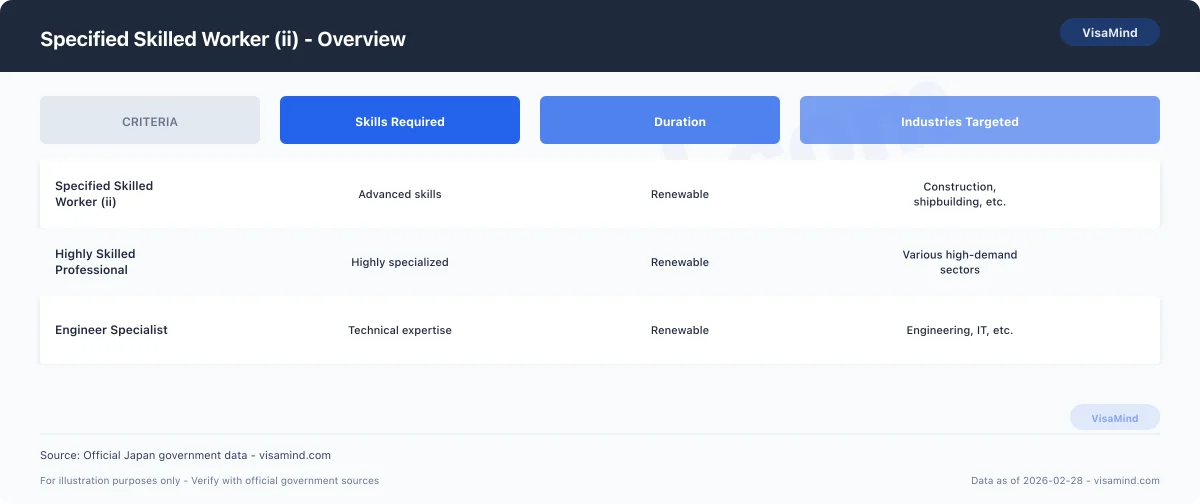
The Specified Skilled Worker (ii) visa is a work visa category in Japan designed for individuals with advanced skills in specific industries. As of February 2026, applicants aiming to secure this visa must first obtain a Certificate of Eligibility (CoE), which serves as a prerequisite for lodging their application with the Immigration Services Agency of Japan (ISA). This visa is primarily targeted at those who have already demonstrated considerable expertise in their field and are seeking to engage in work that requires higher-level specialized skills.
Who Uses This Visa?
The Specified Skilled Worker (ii) visa is intended for individuals who possess advanced technical skills and experience in certain sectors that are crucial to Japan’s economic growth. This category is distinct from the Specified Skilled Worker (i) visa, which caters to workers with intermediate skills. Industries such as construction, shipbuilding, and manufacturing often employ workers under this visa category to fill roles that require both expertise and professional experience.
Key Features of the Visa
This visa not only allows holders to work in Japan but also provides the opportunity for long-term residence, which can potentially lead to permanent residency status. Unlike other visas where employment must be renewed periodically, the Specified Skilled Worker (ii) visa offers a more stable and enduring pathway for skilled professionals. While the processing time for this visa can range from 1 to 3 months, depending on the category and location, it is crucial for applicants to verify the latest timelines and requirements with the ISA.
Tip: To expedite your application process, ensure all necessary documents, such as your passport, visa application form, and photograph, are complete and ready for submission.
Related Visa Options
For those exploring different pathways to work in Japan, the Highly Skilled Professional and Engineer/Specialist in Humanities/International Services visas are also available. Each of these visas caters to different expertise levels and industry needs, providing a range of opportunities for skilled workers looking to build a career in Japan.
The Specified Skilled Worker (ii) visa is an excellent option for those who meet the advanced skill and experience requirements and are seeking a long-term professional engagement in Japan. To ensure a smooth application process, staying informed about the latest guidelines from the Immigration Services Agency of Japan is essential.
Eligibility Requirements
#To qualify for a Specified Skilled Worker (ii) visa in Japan, you must secure a job offer that meets specific criteria:
- Industry-Specific Roles: The position must align with designated industry sectors in Japan that require advanced skills.
- Full-Time Employment: The job offer must be for full-time work, as part-time roles are not eligible.
- Contractual Agreement: A formal employment contract must be in place, detailing the terms and conditions of the job.
Qualifications and Experience
Candidates for the Specified Skilled Worker (ii) visa are expected to demonstrate:
- Advanced Skills: Possession of specialized skills or expertise that are recognized at a national level or by relevant industry bodies.
- Experience: A proven track record in the related field, often requiring several years of professional experience.
- Certification: Where applicable, certification or recognition of skills from a credible authority may be required.
Important: Ensure that your qualifications and experience align with the requirements specified by the Immigration Services Agency of Japan.
Salary Thresholds
The salary offered for your role must meet certain thresholds to ensure fair compensation:
- Competitive Salary: The compensation should be comparable to Japanese nationals in similar roles and industries.
- Minimum Earnings: As of 2026, the minimum salary must meet or exceed a threshold (verify exact figures on the official website).
Labor Market Tests
Employers in Japan must conduct labor market tests to ensure that hiring foreign workers does not negatively impact the local job market:
- Job Posting Requirements: Employers may need to advertise the position domestically before offering it to a foreign national.
- Proof of Need: Documentation demonstrating the inability to fill the role with a local candidate may be required.
If you are considering applying for the Specified Skilled Worker (ii) visa, it is essential to understand these eligibility requirements thoroughly. For further guidance, review the Documents Checklist and consult the How To Apply guide for a comprehensive overview of the application process.
What Your Employer Must Do
#When sponsoring a candidate for the Specified Skilled Worker (ii) visa, employers in Japan must fulfill several critical responsibilities. These obligations ensure that both the employer and employee comply with the requirements set by the Immigration Services Agency of Japan.
Sponsorship Duties
Employers must first verify that their potential employee meets the eligibility criteria for the Specified Skilled Worker (ii) visa. This includes ensuring the applicant has the necessary skills and qualifications for the position. The employer must also obtain a Certificate of Eligibility (CoE) for the applicant, which is a pivotal document required before the visa application can proceed.
Compliance Requirements
To maintain compliance, employers must adhere to the following:
- Work Conditions: Ensure that the working conditions and wages meet the standards outlined in the employment contract and comply with Japanese labor laws.
- Monitoring: Keep track of the employee’s work activities and report any significant changes in employment status or contract terms to the Immigration Services Agency of Japan.
- Renewals and Extensions: Assist the employee with any visa renewals or extensions by providing necessary documentation and support. For detailed guidance on extensions, refer to our Visa Extension Guide.
Important: Failure to comply with these requirements can result in penalties or affect future sponsorship eligibility.
Financial Responsibilities
Employers are typically responsible for covering various costs associated with the visa process. These may include:
- Application Fees: Any fees related to obtaining the Certificate of Eligibility or other necessary documentation.
- Travel Costs: Expenses for the employee’s travel to Japan, if specified in the employment agreement.
- Support Services: Costs associated with any relocation or settlement support services provided to the employee.
Can Employers Change Workers' Visa Status?
If an employee’s role changes significantly, employers may need to assist in changing the worker’s visa status. This could involve shifting to a different visa category, such as the Highly Skilled Professional or Engineer Specialist, depending on the new job requirements and the employee's qualifications.
Employers should regularly consult with the Immigration Services Agency of Japan to stay informed about any changes in procedures or requirements. For a detailed overview of required documents, visit our Documents Checklist.
Tip: Regularly review the Processing Times to ensure timely submission of applications and compliance with deadlines.
How to Apply
#Employer Petition
The application process for a Specified Skilled Worker (ii) visa begins with your employer in Japan. They must first file a petition with the Immigration Services Agency of Japan (ISA) to sponsor your visa application. This petition serves as an initial step to verify the employer's eligibility and the necessity of hiring a foreign worker under this category. Employers must provide details about the role, the skills required, and evidence of attempts to hire locally. Once the petition is approved, the employer will receive a notification that allows them to proceed with the next steps.
Obtain a Certificate of Eligibility
Before you can apply for your visa, you must secure a Certificate of Eligibility (CoE). This is an essential document issued by the ISA that confirms you meet the requirements for the Specified Skilled Worker (ii) category. Your employer will assist in applying for the CoE on your behalf. This document is crucial, as it simplifies the visa application process and significantly impacts the processing time.
Worker Application Process
With the CoE in hand, you can now proceed with your visa application. Gather all necessary documents, including a valid passport, one visa application form, and a recent photograph. Ensure that all forms are accurately completed and signed where required. Submit these documents to the Japanese embassy or consulate in your home country.
Important: Processing times can vary, so it's advisable to check the Processing Times guide for the most current information.
Await Visa Processing
Once your application is lodged, the processing time for the Specified Skilled Worker (ii) visa typically ranges from 1 to 3 months for work categories without a CoE, as of February 2026. During this period, the ISA will review your application to ensure all criteria are met. Remember, filing the application does not guarantee approval, so ensure all details are accurate and complete.
Finalizing Your Arrival
After receiving your visa, you are ready to make travel arrangements to Japan. Upon arrival, ensure you have your CoE and other important documents readily accessible for inspection. You will be issued a residence card at the port of entry, which you should carry at all times during your stay in Japan. If you're considering a long-term stay or eventual transition to a different visa type, such as the Permanent Residence, it's wise to familiarize yourself with those processes early on.
Tip: Consider consulting the Documents Checklist to ensure you have all necessary paperwork ready for both your application and entry into Japan.
Fees and Processing Times
#Important: Ensure you have a valid Certificate of Eligibility before lodging your Specified Skilled Worker (ii) visa application with the Immigration Services Agency of Japan.
Fees for the Specified Skilled Worker (ii) Visa
When applying for the Specified Skilled Worker (ii) visa through the Immigration Services Agency of Japan, be prepared for certain fees which are standard across most visa types. As of 2026, the typical application fee is 4,000 JPY. Payment methods may vary, so check the latest guidance on the official ISA website.
Processing Times
Processing times for your visa can vary based on your specific circumstances and the processing location. Here's a comparison of typical timelines for the Specified Skilled Worker (ii) visa:
| Visa Category | Processing Time |
|---|---|
| Short-term Stay (Standard) | Approximately 5 days |
| Work / Long-term without CoE | 1 to 3 months |
| With Certificate of Eligibility (CoE) | Generally shorter, check with ISA |
Expedited Processing Options
While the Immigration Services Agency of Japan does not offer specific premium processing for the Specified Skilled Worker (ii) visa, having all required documentation, including the Certificate of Eligibility, may expedite your processing time. It is crucial to verify current timelines by consulting the Processing Times Guide.
Tip: Consider lodging your application well in advance of your planned move to Japan, especially if applying under the "Work / Long-term without CoE" category.
For more details, you might also be interested in exploring the Highly Skilled Professional visa or understanding the Engineer Specialist visa requirements.
Changing Employers
#Before considering a change of employers under the Specified Skilled Worker (ii) visa in Japan, it's important to understand the specific rules and requirements associated with this process. This visa category allows skilled workers to continue contributing to Japan's workforce while offering some flexibility in employment.
Can You Change Employers?
Yes, you can change employers if you hold a Specified Skilled Worker (ii) visa, but there are important conditions and steps to follow. Unlike the Specified Skilled Worker (i) visa, which is more restrictive, the (ii) category provides greater freedom in changing jobs within the same industry.
- Industry Consistency: You must remain within the same industry that your visa was granted for. For example, if you are in the construction sector, you need to find a new employer within the same field.
- Notification Requirement: Inform the Immigration Services Agency of Japan of your intention to change employers. This notification ensures that your employment status remains compliant with your visa terms.
Important: Failing to notify the ISA of a job change can result in complications with your visa status and future applications.
Required Steps for Changing Employers
Changing employers involves several key steps to ensure compliance with Japanese immigration regulations:
- Find a New Employer: Secure a job offer within the same industry as your current employment.
- Gather Necessary Documents: Prepare the necessary documents, including a new employment contract and any updated information that might be required by the ISA.
- Submit Notification to ISA: Provide formal notice to the Immigration Services Agency of Japan about your job change. This can often be done by submitting a Notification of Activity form.
- Await Confirmation: Ensure that you receive confirmation from the ISA that your change of employment has been processed correctly.
Document Checklist
When changing employers, make sure you have the following documents ready:
- A copy of your current Specified Skilled Worker (ii) visa
- New employment contract
- Notification of Activity form
- Proof of continued eligibility in your industry
You can also refer to the Documents Checklist for more comprehensive guidance.
Processing Times and Considerations
The processing time for changes related to the Specified Skilled Worker (ii) visa can vary. As of February 2026, timelines range from 1 to 3 months. Ensure that you verify the most current processing times with the ISA, as they can fluctuate depending on the volume of applications and specific circumstances.
Tip: Consider lodging your application online to receive a receipt number immediately and potentially expedite the process.
By understanding these requirements and following the correct procedures, you can navigate the process of changing employers while maintaining your legal status in Japan.
Family Members
#If you are granted a Specified Skilled Worker (ii) visa in Japan, your family members may be eligible to join you. The Dependent Visa is available for spouses and children of visa holders, allowing them to reside in Japan.
- Spouse: Eligible for a Dependent Visa if legally married to the visa holder.
- Children: Eligible if under the age of 18 and dependent on the visa holder for financial support.
Important: Ensure all necessary documentation, such as marriage and birth certificates, are translated into Japanese by a certified translator for the application process.
Work Rights for Dependents
Dependents holding a Dependent Visa may be eligible to work in Japan under certain conditions. They must apply for and receive permission to engage in activities outside their visa status.
- Application: Submit a Permission for Activities Outside the Visa Status application to the Immigration Services Agency of Japan.
- Working Hours: Once approved, dependents can work up to 28 hours per week.
Tip: Be sure to apply for work permission as soon as your dependent receives their residence card to maximize their ability to work legally.
Key Considerations
- Certificate of Eligibility: Dependents generally require a Certificate of Eligibility to apply for their visas. Ensure this process is coordinated alongside your own application.
- Processing Time: Visa processing times can vary, so it's advisable to consult the Processing Times Guide and plan accordingly.
The Specified Skilled Worker (ii) visa provides a pathway for your family to join you in Japan, with opportunities for dependents to work part-time. Always verify the latest information with the Immigration Services Agency of Japan to ensure compliance with current regulations.
When Self-Preparation Isn't Enough
#Work visa petitions involve both you and your employer for Japan immigration. If the case is straightforward, this guide covers what you need. But professional help is worth considering if:
- Your employer has a complex corporate structure (staffing agency, multinational, franchise)
- You are changing employers mid-petition or mid-status
- You have a prior visa denial or refusal
- You have a prior overstay, unlawful presence, or removal order
- You have a criminal record, arrest history, or pending charges
- You have a prior misrepresentation or fraud finding
- You are in removal or deportation proceedings
From Work Visa to PR
#The Specified Skilled Worker (ii) visa is an opportunity for skilled laborers to work in Japan across specific sectors. While this visa allows for an extended stay and employment, it is also a significant stepping stone towards achieving Permanent Residence (PR) status in Japan.
Pathway to Permanent Residence
Holding a Specified Skilled Worker (ii) visa can indeed lead to Permanent Residence. This visa is designed for individuals with advanced skills and experience in their respective fields, making it a favorable category for those aiming to settle in Japan permanently. To transition from a work visa to PR, you need to demonstrate a stable income, a clean legal record, and a commitment to integrating into Japanese society. The Permanent Residence application process requires you to have lived in Japan for a certain period, typically around ten years, although exceptions exist for those with higher qualifications or contributions to the Japanese economy.
Requirements for Applying for PR
To apply for Permanent Residence, you must satisfy several requirements. These include:
- Holding a valid Specified Skilled Worker (ii) visa.
- A minimum stay in Japan, generally around ten years, though highly skilled professionals might qualify sooner.
- Evidence of financial stability and ability to support oneself.
- A proven record of paying taxes and social contributions.
- No criminal record in Japan or abroad.
For a thorough understanding of the steps and documentation required, review the PR Pathway Guide.
Comparison with Other Visa Types
To understand how the Specified Skilled Worker (ii) visa compares to other visas in terms of pathways to PR, consider the following table:
| Visa Type | Time to PR Eligibility | Key Considerations |
|---|---|---|
| Specified Skilled Worker (ii) | Typically 10 years | Must demonstrate advanced skills and stability |
| Highly Skilled Professional | As little as 1-3 years | Points-based system with faster PR eligibility |
| Long-term Resident | Varies, usually 5-10 years | Must meet criteria for special circumstances |
Tip: Maintaining a consistent employment record and demonstrating integration into the local community can strengthen your PR application.
Steps to Transition to PR
- Evaluate Eligibility: Ensure you meet the residency, employment, and financial criteria.
- Gather Documents: Collect all necessary documentation, including proof of employment, tax records, and a clean criminal record.
- Submit Application: Lodge your application with the Immigration Services Agency of Japan, ensuring all paperwork is complete and accurate.
- Await Decision: The processing time can vary, so remain patient and stay informed via the Permanent Residence Application.
Pursuing Permanent Residence as a Specified Skilled Worker (ii) not only broadens your career prospects but also enriches your personal experience in Japan. For further guidance, consider consulting the Permanent Residence resources available.
Renewal and Extension
#Renewing or extending your Specified Skilled Worker (ii) visa in Japan involves several key steps and considerations. Here's what you need to know to ensure your application process goes smoothly.
Renewal Process
To renew your Specified Skilled Worker (ii) visa, you must apply with the Immigration Services Agency of Japan before your current visa expires. The renewal process includes:
-
Gather Required Documents:
- Your current passport
- A recent photograph
- Your residence card
- Proof of employment continuity, such as a letter from your employer
-
Submit Your Application:
- Lodge your application at the local immigration office or online, where available.
-
Await Processing:
- Processing times generally range from 1 to 3 months, depending on your specific category and location. Always verify current times with the Immigration Services Agency.
Tip: Consider starting the renewal process at least three months before your visa expires to accommodate any unexpected delays.
Extension Eligibility
To be eligible for an extension, you must continue to meet the original conditions of your visa, including employment in an appropriate sector and maintaining a valid Certificate of Eligibility. If your employment situation changes, such as a job transfer to another eligible employer, ensure your new position aligns with visa requirements.
Timeline for Re-filing
If your application is incomplete or additional documents are required, you may be asked to re-file. It’s essential to respond promptly to any requests from the Immigration Services Agency to avoid delays.
- Initial Filing: Begin the renewal process approximately three months before expiration.
- Re-filing Requests: Typically, you will have a specified period to submit additional information if requested.
For more details on how to handle your visa extension, refer to our Visa Extension Guide and Documents Checklist.
Important: Filing your renewal or extension late can lead to gaps in your legal status, affecting your ability to work and stay in Japan legally. Always keep track of deadlines and renew promptly.
RFE Patterns
#When applying for the Specified Skilled Worker (ii) visa in Japan, you might encounter a Request for Evidence (RFE) from the Immigration Services Agency of Japan. Understanding common RFE patterns can help you prepare your application thoroughly and increase your chances of success.
Occupation-Qualification Alignment
One primary reason for RFEs is the alignment between your occupational role and your qualifications. The agency scrutinizes whether your educational background and work experience align with the skilled work you intend to perform in Japan.
- Ensure your certifications and work history match the specific skills required for the role.
- Provide detailed descriptions of past job roles and responsibilities.
- Submit any relevant licenses or certificates that demonstrate your competency.
Wage Compliance
Compliance with wage standards is another area closely examined. The Immigration Services Agency requires that your salary aligns with the prevailing wage for your specified industry and role in Japan.
- Verify that the offered salary meets or exceeds the industry standard.
- Include official documentation or contracts that specify your wage.
- Consider consulting with a local industry expert to ensure compliance.
Important: Wage discrepancies can lead to application delays or denials. Double-check all figures to avoid issues.
Credential Mismatch
Credential mismatches can trigger RFEs when there's a discrepancy between the documents submitted and the requirements for the visa type. It is crucial to ensure that all credentials are valid and translated if necessary.
- Cross-check your qualifications against the visa requirements.
- Use professional translation services for documents not in Japanese.
- Provide notarized copies where required.
For more detailed guidelines on applying for the Specified Skilled Worker (ii) visa, refer to the How To Apply guide. You can also explore other visa options, such as the Long Term Resident and Technical Intern, to understand different pathways available.
By addressing these common RFE patterns proactively, you can bolster your application and streamline the visa process.
Next steps
#Use Find My Visa to build a sequenced plan with official sources and deadlines.
Sources
Last reviewed: 2026-03-02
VisaMind provides informational guidance only and is not a government agency. This is not legal advice. Requirements can change and eligibility depends on your specific facts. If your case is complex or high-stakes, consult a licensed immigration attorney.
Next steps
Requirements vary by nationality, purpose, timeline, and case details. Use Find My Visa to get a personalized checklist for Japan with official sources and deadlines.
Find my visa