On this page
- Is This Program for You?
- Eligibility Criteria
- Step-by-Step Application
- Supporting Documents Checklist
- Timeline and Processing
- Where Applicants Go Wrong
- How It Compares to Alternatives
- Fees and Financial Requirements
- What You Can and Cannot Do
- Real-World Examples
- Visa options for this goal
- Guides for Japan
- Other goals for Japan
Is This Program for You?
#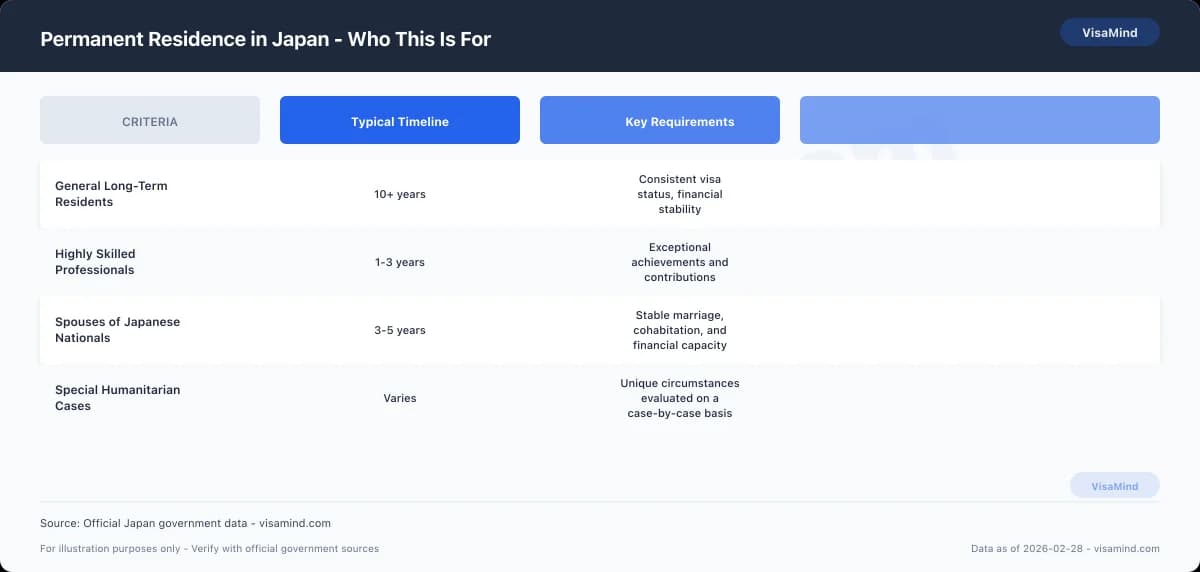
When considering Permanent Residence in Japan, one important criterion is the length of stay. Applicants typically need to have resided in Japan for at least ten consecutive years. Within this period, they must have held a work or residence status for at least five years. Exceptions exist for certain categories, such as spouses of Japanese nationals or those with a Highly Skilled Professional Visa, which may allow for a shorter residency period.
Who Should Consider Permanent Residence?
Permanent residence is ideal for individuals who wish to stay in Japan long-term without the need to renew their visa. This status provides stability and greater freedom in terms of employment and activities within the country. Those who have established a stable life in Japan, including a consistent income and contributions to social security, should contemplate this pathway.
Key Eligibility Factors
- Residency Duration: At least ten years of continuous residence in Japan, with five years under a work or residence status.
- Legal Compliance: A history free from legal issues, including no violations of immigration laws.
- Financial Stability: Demonstrable ability to sustain oneself and dependents financially.
Important: Some applicants, such as those under the Highly Skilled Professional Visa, may qualify for a reduction in the residency requirement to as little as one year.
Alternative Pathways
While permanent residence offers many benefits, it is not the only option for long-term residency in Japan. Some individuals might also consider the Japanese Citizenship (Naturalization) route, which involves relinquishing other citizenships but provides the full rights of a Japanese national.
Is Permanent Residence the Right Path for You?
Consider your future plans and current status in Japan. If your goal is to maintain ties with Japan without the need to navigate frequent visa renewals, permanent residence could be an excellent fit. However, for those still exploring their long-term commitment to Japan, visas like the Specified Skilled Worker 1 or Engineer Specialist may provide a more flexible option.
For more detailed guidance and to assess your specific situation, visit our PR Pathway Guide to explore all potential routes and requirements.
Eligibility Criteria
#To apply for Permanent Residence in Japan, you must meet certain eligibility criteria set by the Immigration Services Agency of Japan (ISA). These requirements ensure that applicants are well-integrated into Japanese society and can contribute positively to the community. Here are the key eligibility criteria you need to consider:
Residency Requirements
- Minimum Duration of Stay: You generally need to have lived in Japan for at least 10 consecutive years. However, exceptions exist for those on the Highly Skilled Professional Visa or Spouse Visa.
- Visa Status: You should currently hold a visa status such as Long Term Resident, Spouse or Child of Japanese National, or Highly Skilled Professional.
Financial Stability
- Stable Income: Demonstrating a consistent and stable income is crucial. This often involves showing tax returns or income statements over several years.
- Tax Compliance: You must provide proof of having paid all necessary taxes during your stay in Japan. This includes national and local taxes.
Conduct and Behavior
- Criminal Record: A clean criminal record is essential. Both domestic and international criminal checks may be required.
- Public Conduct: Good moral character and adherence to Japanese laws and societal norms are expected.
Special Considerations
- For Highly Skilled Professionals: If you are on a Highly Skilled Professional Visa, you may qualify for permanent residence after just 1 to 3 years, depending on your points under the Highly Skilled Foreign Professionals Points System.
- Family Connections: If you are a spouse of a Japanese national or permanent resident, you might be eligible for a quicker pathway to permanent residence.
Language and Integration
- Language Proficiency: While not strictly required, a good command of the Japanese language can strengthen your application, as it demonstrates integration into Japanese society.
- Cultural Understanding: Participation in community or cultural activities is encouraged and may be beneficial in demonstrating your commitment to Japan.
Tip: If you are unsure about your eligibility or need guidance on improving your chances, consider consulting the PR Pathway Guide for detailed strategies and tips.
Age and Health
- Age Considerations: There is no specific age requirement; however, applicants should be of working age and demonstrate the ability to support themselves financially.
- Health Requirements: While there are no specific health requirements, being in good health is generally expected as part of your overall capability to live independently in Japan.
These criteria are designed to ensure that applicants are well-prepared to live permanently in Japan, contributing to its society and economy. For detailed guidance on each aspect, you may want to explore the Documents Checklist to ensure you meet all necessary qualifications and requirements.
Step-by-Step Application
#-
Determine Your Eligibility and Gather Necessary Documents
Before you can apply for permanent residence in Japan, you need to ascertain your eligibility. Review the specific requirements for your eligibility category on the Immigration Services Agency of Japan (ISA) website. Common categories include those holding a Long Term Resident Visa or Spouse Visa. It is crucial to gather all required documents, such as your residence card, passport, and proof of stable income. Refer to the Documents Checklist for a comprehensive list.
-
Complete the Application Form
Access the official application form, titled "Permanent Residence in Japan," available from the ISA website. Ensure you complete all relevant sections that correspond to your eligibility category. Pay close attention to the guidance notes, as requirements may vary depending on your current visa status. If you are employed under a Highly Skilled Professional visa, different criteria might apply compared to a Student Visa.
-
Prepare for Submission
Once you have completed the application form, organize your documents into a single submission package. This should include any additional evidence of your eligibility, such as tax certificates and employment contracts. Make sure all documents are current and correctly translated into Japanese if they are not already.
Tip: Filing your application online via the ISA portal can expedite the process and provide you with a receipt number for tracking.
-
Submit Your Application and Pay the Fee
Your application can be lodged at the regional immigration office in Japan. There is a fee associated with the permanent residence application, typically around 8,000 yen as of 2023, but confirm the exact amount on the ISA website before applying. After submission, you will receive a receipt, which you should keep safe until your application process is complete.
-
Attend Any Required Interviews or Follow-Up Appointments
If the ISA requires further information or an interview, you will be notified through the contact information you provided. Prepare for any interviews by reviewing your application details and understanding the specifics of your visa status. Resources like the Interview Prep Guide can be useful for anticipating potential questions.
-
Await Decision and Collect Residence Card
The processing time for permanent residence applications can vary, so check the Processing Times for the most current estimates. Once approved, you will be issued a new residence card reflecting your permanent resident status. Ensure to update your personal records with this new status.
Important: Any error or omission in your application can delay the process or result in a denial. Double-check your application and documents before submission.
These steps outline the journey towards obtaining permanent residence in Japan. For those considering this pathway, understanding the nuances of the application process and preparing accordingly can significantly enhance your odds of success.
Supporting Documents Checklist
#To apply for Permanent Residence in Japan through the Immigration Services Agency of Japan (ISA), you'll need to gather a range of supporting documents. These documents will help demonstrate your eligibility and compliance with the requirements set by the ISA. Below is a checklist of the essential documents and related items you should prepare.
Personal Identification and Legal Documents
- Passport: A valid passport with clear copies of all relevant pages.
- Residence Card: Your current residence card issued by the Japanese government.
- Certificate of Eligibility: If applicable, a certificate of eligibility for your current visa status.
Financial and Employment Records
- Proof of Income: Recent tax returns or income certificates (such as a 源泉徴収票, gensenchoshuhyo) to verify stable income.
- Employment Certificate: A certificate from your employer detailing your position, salary, and employment period.
- Bank Statements: Recent bank statements that demonstrate financial stability.
Tip: Ensure all financial documents are up-to-date and accurately reflect your earnings and savings. This evidence is crucial for showcasing your ability to support yourself financially in Japan.
Family and Relationship Documents
- Marriage Certificate: If applicable, a certified translation of your marriage certificate.
- Birth Certificates: For any dependents, provide birth certificates with certified translations where necessary.
- Family Registry (戸籍謄本, koseki tohon): Required if you are married to a Japanese national.
Documentation of Residency and Duration of Stay
- Proof of Residence: Recent utility bills or rental agreements showing your current address in Japan.
- History of Residence: A complete history of your residence in Japan, detailing addresses and dates.
Language and Cultural Adaptation
- Japanese Language Proficiency: Documentation such as a JLPT certificate, if applicable, that demonstrates your proficiency in Japanese.
- Cultural Adaptation Evidence: Participation in community activities or cultural programs can be beneficial.
Important: All documents in languages other than Japanese must be accompanied by a certified translation. Ensure translations are accurate and complete to avoid processing delays.
For more detailed guidance on the application process, including timelines and additional documentation, refer to the Pr Pathway Guide and the Documents Checklist. Additionally, consider exploring other visa options like the Long Term Resident or Spouse Pr if they apply to your situation.
Preparing a comprehensive set of supporting documents is a critical step in applying for Permanent Residence in Japan. Carefully review each requirement and ensure that all your paperwork is complete and accurate before submission to the ISA. This will help streamline your application process and increase the likelihood of a successful outcome.
Timeline and Processing
#The processing time for obtaining permanent residence in Japan typically ranges from six months to one year. This timeline can vary significantly based on several factors, including the completeness of your application and the specific immigration office handling your case. The Immigration Services Agency of Japan (ISA) strives to manage applications efficiently, but it's essential to be prepared for possible delays.
Factors Affecting Processing Speed
Several factors can influence the speed of your application:
- Completeness and Accuracy: Ensure all documents are complete and accurate. Missing or incorrect information can lead to delays.
- Your Current Visa Status: Applications from those on certain visas, such as the Highly Skilled Professional, may be processed faster due to preferential treatment.
- Volume of Applications: The overall number of applications submitted at a given time can affect processing times, especially during peak periods.
Expedited Processing Options
Currently, there are no formal expedited processing options for permanent residence applications through the ISA. However, you can take steps to ensure your application is processed as quickly as possible:
- Prepare Thoroughly: Review the How To Apply guide to ensure you understand the requirements.
- Submit Early: Lodge your application well in advance of any critical personal deadlines.
Tip: Submitting your application at a less busy immigration office may lead to quicker processing times.
Application Status Updates
While waiting, you can inquire about your application status. Contacting the office where you submitted your application can provide updates, but note that they may not be able to give detailed information over the phone.
For more detailed information on processing times, consider consulting the Processing Times guide, which provides insights into average timelines for various visa categories.
Where Applicants Go Wrong
#-
Incomplete Documentation: One of the most frequent reasons for application refusal is the submission of incomplete documentation. Ensure that all necessary documents, such as proof of residence, tax payments, and employment history, are included. Refer to the Documents Checklist to verify completeness.
-
Incorrect Eligibility Category: Some applicants mistakenly apply under the wrong eligibility category, leading to delays or refusals. Before applying, review which category you fit into, such as Highly Skilled Professional or Long Term Resident.
Misunderstanding Financial Requirements
-
Insufficient Financial Evidence: Demonstrating financial stability is crucial. Inadequate proof of financial resources, like bank statements or income tax returns, can lead to rejection. Consult the Financial Requirements for detailed information on the necessary financial documentation.
-
Misrepresentation of Income: Providing inconsistent or misleading information about your income is a serious error. Ensure that all financial data submitted is accurate and supported by verifiable documents.
Timing and Deadlines
- Missed Deadlines: Timing is critical in the application process. Failing to apply within the specified timeframe or not meeting renewal deadlines can result in having to restart the process. Keep track of all deadlines and allow ample time for gathering necessary documents.
Important: Missing the deadline for submitting your application may result in losing your current visa status. Always plan to submit well before the deadline.
Poorly Prepared Interviews
- Lack of Interview Preparation: If an interview is part of your application process, being unprepared can negatively impact your application. Thoroughly prepare by reviewing potential questions and practicing your responses. Use the Interview Prep guide to enhance your readiness.
By avoiding these common mistakes and thoroughly preparing your application, you can improve your chances of obtaining Permanent Residence in Japan. Always cross-check requirements and guidelines directly from the official Immigration Services Agency of Japan to ensure compliance.
How It Compares to Alternatives
#Permanent residence in Japan offers a path to long-term stability and many benefits, but it's important to understand how it compares to other options like Japanese citizenship or other long-term visas.
How It Compares to Alternatives
To better understand the distinctions between permanent residence, Japanese citizenship, and other long-term visa options, here's a detailed comparison:
| Option | Eligibility | Benefits | Cost | Timeline |
|---|---|---|---|---|
| Permanent Residence | 10 years of continuous residence (exceptions apply) | No restrictions on employment or length of stay | Application fee varies | 6-12 months (estimated) |
| Japanese Citizenship | 5 years of residence, renounce previous nationality | Full rights as a Japanese citizen, including voting | No application fee, but legal fees may apply | 12-18 months (estimated) |
| Long Term Resident Visa | Specific criteria based on personal circumstances | Can live and work in Japan, but with some restrictions | Application fee varies | 1-3 months (depends on case) |
Unique Features of Permanent Residence
Permanent residence in Japan comes with several unique advantages compared to other visas. Unlike the Long Term Resident Visa, which may have employment restrictions or renewal requirements, permanent residence allows you to work in any field without additional permissions. Additionally, unlike Japanese Citizenship, obtaining permanent residence does not require you to renounce your current citizenship.
Important: Permanent residence does not grant voting rights, which are exclusive to Japanese citizens.
Considerations for Permanent Residence
While permanent residence offers many freedoms, it does come with its own set of requirements and processes. It's crucial to maintain a clean tax record and demonstrate financial stability. For those considering a quicker pathway, the Highly Skilled Professional Visa may offer a faster route to permanent residence, often reducing the residency requirement to as little as three years.
Final Thoughts
Each path to staying in Japan long-term has its own set of pros and cons. When considering these options, reflect on your personal priorities, such as the importance of voting rights, flexibility in employment, and the ability to retain your current nationality. For a deeper understanding of these pathways, consult resources like the Pr Pathway Guide or the Visa Extension Guide for more detailed information on your journey towards permanent residence.
Fees and Financial Requirements
#When considering Permanent Residence in Japan, the financial aspects are crucial. Let's explore the fees and financial requirements involved in the application process for permanent residency in Japan.
Application Fees
The application fee for permanent residency is 8,000 JPY. This fee is payable to the Immigration Services Agency of Japan when you lodge your application. It's important to ensure you have the correct amount available, as applications cannot be processed without the fee.
Financial Proof and Requirements
For those seeking permanent residency, demonstrating financial stability is essential. This typically involves proving a consistent and sufficient income to support yourself and any dependents. The exact amount can vary depending on individual circumstances, but there are some general guidelines you can follow.
| Requirement | Description |
|---|---|
| Stable Income | You must show evidence of employment or business income. |
| Minimum Salary Threshold | Generally, a minimum annual income of around 3 million JPY is advisable. |
| Investment Minimums | If applying through investment, a significant investment in Japan is needed. |
| Financial Documentation | Recent tax certificates, bank statements, and employment contracts. |
Income Sources
Income can be from various sources, such as employment, business operations, or investments. It's critical to document your financial history accurately. Your financial documentation should include:
- Recent tax certificates
- Bank statements
- Employment contracts or business ownership proof
Tips and Considerations
Tip: If you are applying as a Business Manager or have an entrepreneurial background, ensure that your business is legally compliant and actively operating in Japan.
Stability in your financial situation is a key consideration for the Immigration Services Agency of Japan. Make sure to maintain clear records and be prepared to explain any significant changes in your financial status.
Navigating the financial requirements for permanent residency involves careful preparation and attention to detail. For more comprehensive guidance, consult resources such as the Pr Pathway Guide to understand the nuances of the process.
What You Can and Cannot Do
#Holding a Permanent Residence status in Japan grants you the freedom to work without the limitations often associated with other visa categories. Unlike the Engineer Specialist or Specified Skilled Worker 2 visas, there are no restrictions on the type of employment you can engage in. This means you can freely change jobs, start your own business, or even pursue multiple occupations simultaneously.
Tip: If you plan to start a business, consider applying for a Business Manager Visa initially, then transition to permanent residence for greater flexibility.
Travel and Re-entry
As a permanent resident, you have the privilege of leaving and re-entering Japan with ease. You must, however, obtain a re-entry permit from the Immigration Services Agency of Japan before leaving the country if you plan to be away for more than one year. This permit will help you maintain your residence status upon your return.
- Short-term Travel: No special permits required for trips under one year.
- Extended Travel: Obtain a re-entry permit to ensure continued residence status.
Family Members and Their Rights
Permanent residency can significantly benefit your family members. Once your status is secured, you can sponsor your spouse and children to join you in Japan. They may apply for a Dependent Visa, allowing them to live with you. If your spouse qualifies, they can also apply for a Spouse PR to gain similar privileges.
- Spouse: Eligible to work with appropriate visa
- Children: Access to education in Japan
Restrictions and Obligations
While permanent residence offers many freedoms, certain obligations remain. You must renew your residence card every seven years and report changes in personal status, such as marriage or change of residence, to the Immigration Services Agency of Japan. Failure to comply can lead to penalties or even revocation of your permanent residence status.
Important: Always keep your personal information updated with the ISA to avoid complications with your residence status.
By understanding these rights and obligations, you can make the most of your permanent residence in Japan, ensuring both compliance and the full enjoyment of your newfound freedoms.
Real-World Examples
#"I was anxious about whether my Spouse Japanese visa would be a strong enough basis to apply for Permanent Residence in Japan. My spouse and I had only been married for a year, and I worried that our relatively short marriage might not demonstrate enough stability to the Immigration Services Agency of Japan. To address this, we compiled a comprehensive file of supporting documents, including joint bank account statements, our rental agreement, and affidavits from friends and family affirming our relationship's authenticity. After submitting these, we were relieved to learn that our application was successful, likely due to the thorough documentation of our shared life and commitments."
"As a Highly Skilled Professional, I was eligible to apply for Permanent Residence in Japan after just one year of residency. However, I was concerned about the financial requirements, as my income was slightly above the threshold but fluctuated due to bonuses and commissions. To strengthen my application, I included a detailed letter from my employer explaining my compensation structure and provided several years of tax returns to demonstrate consistency. This proactive approach helped clarify my financial stability to the authorities, and I was granted permanent residency without issues."
Tip: When applying for permanent residency, ensure you have clear documentation for any financial or personal claims in your application to satisfy the ISA's rigorous review process.
FAQs
What documents are needed to support a Permanent Residence application in Japan?
Is it possible to switch from Permanent Residence to Japanese Citizenship?
Can you work in Japan with Permanent Residence status?
What are the main benefits of obtaining Permanent Residence in Japan compared to other visas?
Do you need to pass a language test to apply for Permanent Residence in Japan?
What common mistakes should be avoided when applying for Permanent Residence in Japan?
How does Permanent Residence in Japan differ from a long-term visa?
Sources
Last reviewed: March 1, 2026
VisaMind provides informational guidance only and is not a government agency. This is not legal advice. Requirements can change and eligibility depends on your specific facts. If your case is complex or high-stakes, consult a licensed immigration attorney.
Next steps
Requirements vary by nationality, purpose, timeline, and case details. Use Find My Visa to get a personalized checklist for Japan with official sources and deadlines.
Find my visa