Do You Need a Visa?
#Nationals of 74 countries and regions can visit Japan visa-free for short-term stays, thanks to reciprocal agreements. To enjoy this visa exemption, travelers must hold an ICAO-compliant ePassport. This exemption is typically valid for tourism, business, or visiting relatives, provided that you do not engage in paid activities. It's important to note that the visa exemption does not guarantee entry into Japan; landing permission is ultimately granted by an immigration officer at the port of entry.
Who Needs a Visa?
If your nationality is not among the 74 countries and regions eligible for visa-free entry, you will need to apply for a visa before traveling to Japan. This requirement applies to nationals from countries outside the visa exemption list. Additionally, if you intend to engage in remunerative activities, you must apply for a specific visa that aligns with your purpose of stay, such as a Short Stay Visa for business purposes.
Preparing for Your Trip
Before traveling, ensure your passport is valid and compliant with ICAO standards. If you are eligible for visa-free entry, prepare any supporting documents that may facilitate your entry, such as proof of accommodation or return travel plans.
Tip: Register your information in advance and present the 2D code on your smartphone or tablet during immigration procedures to expedite the process.
Additional Considerations
- Visa Exemption: Only applies if you have a compliant ePassport; otherwise, a visa is required.
- Entry Permission: Granted at the port of entry by an immigration officer. A visa or visa exemption does not guarantee entry.
- Inviting Organization/Guarantor: If applicable, ensure they send the necessary documents directly to you, not to the Ministry of Foreign Affairs.
For detailed information on visa types and the application process, refer to guides such as How To Apply and Documents Checklist.
Important: Using a non-compliant passport when expecting visa exemption can lead to entry refusal. Always verify your eligibility and document compliance before departure.
Which Visitor Visa Fits Your Trip?
#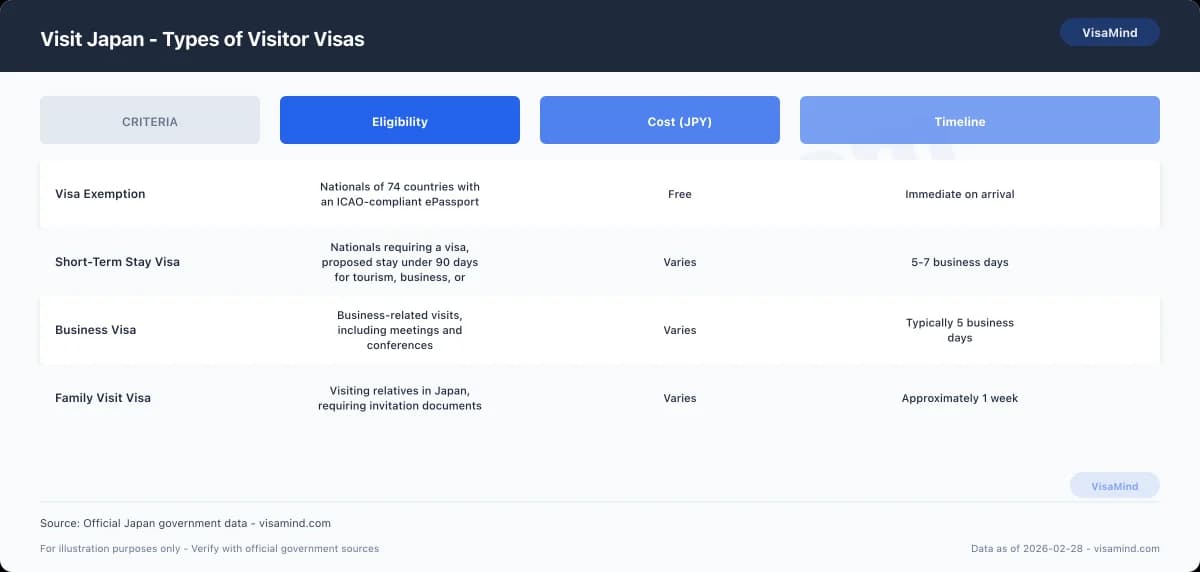
It's essential to determine which visitor visa aligns with your travel purpose. Japan offers various visitor visa categories, each tailored for different needs, such as tourism, business, or visiting relatives. This section will help you understand the key differences between them.
Visitor Visa Options
Here's a comparison of the primary visitor visa types available for short-term stays in Japan:
| Visa Type | Eligibility | Cost | Timeline |
|---|---|---|---|
| Visa Exemption | Nationals of 74 countries with an ICAO-compliant ePassport | No fee | Entry upon arrival, up to 90 days |
| Short-Term Stay Visa | Required for nationals not eligible for visa exemption | Varies by nationality, verify on the official website | Typically processed within 5-10 business days |
| Business Visa | For attending meetings, conferences, or business negotiations | Varies by nationality, verify on the official website | Typically processed within 5-10 business days |
| Family Visit Visa | For visiting relatives residing in Japan | Varies by nationality, verify on the official website | Typically processed within 5-10 business days |
Understanding Visa Exemption
Japan's visa exemption policy allows nationals from 74 countries to visit without a visa for short stays, primarily for tourism or business purposes. However, this exemption requires travelers to hold an ICAO-compliant ePassport. Failure to meet this requirement may result in entry refusal. For more details, check the Short Stay visa guide on the official website.
Important: Carrying a non-compliant passport can lead to refusal of entry, even if you are a national of a visa-exempt country.
Short-Term Stay Visa
If your nationality does not qualify for visa exemption, you must apply for a Short-Term Stay Visa. This visa is suitable for tourism, business, or visiting family but does not permit any paid activities. The application process requires submitting specific documents, including an invitation letter from a host or guarantor in Japan. Refer to the Documents Checklist for detailed requirements.
Business and Family Visit Visas
The Business Visa is tailored for individuals attending business engagements in Japan. It's essential to have documentation proving the purpose of your visit, such as an invitation from a Japanese company.
Similarly, the Family Visit Visa requires proof of relationship to your host in Japan. Supporting documents from your inviting family member are crucial for this application.
Tip: Ensure all documents are complete and accurate to avoid delays in processing. Using the How To Apply guide can streamline your preparation.
Understanding the right visa category is crucial for a seamless entry into Japan. If you need further assistance, consult the Immigration Services Agency of Japan for specific guidelines and updates.
Document Requirements
#When preparing to visit Japan, understanding the specific document requirements is essential for a smooth entry process. Below is a breakdown of the necessary documents and items you should have ready when applying for a visa or utilizing the visa exemption for short-term stays.
General Document Requirements
- Valid Passport: Ensure your passport is valid for the duration of your stay. For visa exemption eligibility, you must have an ICAO-compliant ePassport.
- Visa Application Form: If a visa is required, complete the appropriate application form for a Short-Term Stay Visa.
- Photograph: Provide a recent passport-sized photograph that meets the specific size and quality standards outlined by the Immigration Services Agency of Japan (ISA).
Financial Proof
- Proof of Sufficient Funds: You may be required to demonstrate financial capability to support your stay in Japan. This can include:
- Bank statements from the past three months
- A letter from your employer confirming your salary
- Proof of sponsorship if someone else is financially supporting your visit
Additional Documents for Visa Applicants
- Itinerary: Detailed travel plans including accommodation reservations and a schedule of activities.
- Invitation Letter: If visiting family or friends, an invitation letter from your host in Japan may be required.
- Supporting Documents from Inviting Organization/Guarantor: For business or official visits, documents from the inviting organization or guarantor in Japan should be provided directly to you, not to the Ministry of Foreign Affairs or diplomatic missions.
Entry Process Considerations
- Pre-Registration: Before arriving in Japan, register information necessary for immigration procedures in advance. This can expedite your entry process.
- 2D Code Presentation: Prepare to present a 2D code on your smartphone or tablet during immigration procedures, which confirms your pre-registered information.
Tip: Ensure that all documents are in English or Japanese, or accompanied by a certified translation. This will help avoid delays at the port of entry.
For more detailed guidance, visit the Documents Checklist and review specific requirements for your eligibility category before proceeding with your application. Always verify the most current requirements on the official Immigration Services Agency of Japan website to ensure compliance and a hassle-free entry into Japan.
Submitting Your Visitor Visa
#Determine Your Visa Requirement
Before you start the application process, it’s essential to ascertain whether you need a visa to visit Japan. Nationals from 74 countries and regions may be eligible for visa-exempt entry, provided they hold an ICAO-compliant ePassport. For those not on the visa exemption list, a visitor visa is required. Check the Short-Term Stay Visa guidelines for more details on eligibility.
Choose Your Application Method: Online or Embassy
Japan offers two main pathways to apply for a visitor visa: online applications and in-person submissions at Japanese embassies or consulates.
-
Online Application: If eligible, you can register your information for immigration procedures in advance. This involves completing the necessary online registration and ensuring you have the correct documentation digitally available. Present a 2D code on a smartphone or tablet at the time of immigration.
-
Embassy or Consulate Submission: For those who prefer or need to apply in person, gather your documents and visit the nearest Japanese embassy or consulate. Make sure to review the Documents Checklist to ensure you have all required forms and evidence.
Utilizing VFS Centers for Visa Applications
VFS centers serve as an intermediary for those applying through embassies or consulates. They offer support services for submitting visa applications, including document verification and appointment scheduling. This can be a convenient option if you are unable to visit an embassy directly.
Scheduling an Appointment
When applying through a Japanese embassy or consulate, it’s typically necessary to schedule an appointment. Contact the nearest diplomatic mission to book your visit. Ensure that you have all documents ready and have reviewed the specific instructions for your eligibility category.
Tip: Book your appointment well in advance, especially during peak travel seasons, to avoid delays.
Presenting Required Documents
Whether applying online or in-person, you must present all necessary documents to support your visa application. This includes evidence of travel purpose, financial sufficiency, and any required letters from inviting organizations or guarantors. For detailed guidance, visit the How To Apply page to ensure you meet all requirements.
Receiving Your Visa Decision
After submitting your application, wait for the processing period to conclude. The timeframe can vary, so it's important to check Processing Times for the most accurate estimates. Keep in mind, a visa alone does not guarantee entry into Japan; the final decision is made by an immigration officer at the port of entry.
Important: Ensure your ePassport is ICAO-compliant to avoid potential visa denial or entry refusal.
What to Avoid
#It's crucial to be aware of certain pitfalls that could negatively impact your stay. This section will outline what to avoid to ensure a smooth and enjoyable visit.
Avoid Overstaying
- Visa Duration Awareness: Ensure you are aware of the specific duration allowed by your visa or visa exemption status. Overstaying can lead to fines, detention, and future entry bans. If you need more time, consider applying for a Visa Extension well before your current status expires.
- Landing Permission: Remember that the final decision on the length of your stay is determined by the "landing permission" granted by the immigration officer upon your arrival in Japan. Plan accordingly based on this timeline.
Working on a Tourist Visa
- Prohibited Activities: Engaging in any form of paid work or business activities while on a tourist visa or under visa exemption is strictly prohibited. If you plan to work, consider applying for an appropriate visa like the Highly Skilled Professional Visa.
- Volunteer Work Caution: Even volunteering can sometimes be considered "work" under Japanese law. Always verify whether your planned activities are permissible under your visa category.
Ensuring Sufficient Funds
- Proof of Funds: You may be required to demonstrate sufficient financial means to support yourself during your stay. This can include bank statements or proof of income. Insufficient funds can be grounds for entry refusal.
- Accommodations and Travel Costs: Budget for your entire stay, including accommodation, travel within Japan, and daily expenses. For guidance on financial expectations, check the Financial Requirements Guide.
Tip: Always carry a copy of your onward or return flight ticket to show proof of your departure plans.
By keeping these points in mind, you can avoid common pitfalls that might otherwise disrupt your visit to Japan. For more detailed information on visa types and other immigration processes, explore additional resources such as the Visa Refusal Reasons Guide.
What Happens at Immigration
#Upon arrival in Japan, understanding the immigration procedure is vital for a smooth entry experience. Here's what you can expect at the immigration checkpoint: fingerprinting, interviews, and the use of e-gates.
Fingerprinting and Photography
All foreign nationals entering Japan are subject to fingerprinting and photography. This biometric data collection is mandatory for security purposes and is a standard procedure at all ports of entry. You will be asked to place your fingers on a fingerprint scanner, and a photograph will be taken for identification.
Important: Failure to comply with fingerprinting and photography requirements may result in denial of entry.
Interviews
In certain cases, an immigration officer may conduct a brief interview. This is typically a straightforward process where the officer may ask questions about the purpose of your visit, your intended length of stay, and your accommodation arrangements. Be prepared to present relevant documentation if requested, such as hotel bookings or an invitation letter from a host in Japan.
- Possible Interview Questions:
- What is the purpose of your visit?
- How long do you intend to stay in Japan?
- Do you have a return ticket?
E-Gates
Travelers holding an ICAO-compliant ePassport may use automated e-gates for a quicker immigration process. This system scans your passport and verifies your identity using biometric data. If eligible, using the e-gates can significantly reduce waiting times.
- Eligibility for E-Gates:
- Hold an ICAO-compliant ePassport.
- Nationality eligible for visa exemption or appropriate visa type.
Landing Permission
After completing the necessary checks, you will receive "landing permission" from the immigration officer, allowing you to enter Japan. This permission is granted when all entry requirements are met, as defined by the Immigration Control and Refugee Recognition Act. Remember, having a visa does not automatically guarantee entry; the final decision is made at this point.
For more detailed information on visa types and eligibility, consider exploring guides on Visas or checking the Visa Refusal Reasons to ensure compliance with all requirements.
Options If You Want More Time
#Extending your stay in Japan beyond the initial period allowed for a Short-Term Stay Visa or under a visa exemption can be a straightforward process if you meet specific criteria. The Immigration Services Agency of Japan (ISA) is responsible for handling applications for visa extensions. It's important to begin this process well before your current permission to stay expires to ensure that you remain in compliance with Japanese immigration laws.
Can You Extend a Short-Term Stay?
Extensions for short-term stays are generally limited and are typically granted only under exceptional circumstances. If you are in Japan under a visa exemption or a Short-Term Stay Visa, and you find yourself needing more time—for reasons such as unforeseen travel difficulties or medical emergencies—an extension may be possible. It is crucial to provide documentation supporting your need to extend your stay, such as medical certificates or proof of flight cancellations.
How to Apply for an Extension
To apply for an extension, you must submit an application to the ISA. This can be done by visiting your nearest regional immigration office in Japan. You will need to present the required documents, including your passport and residence card, if applicable. The ISA will assess your application based on the information and supporting documents you provide.
For detailed guidance, you may refer to the Visa Extension Guide, which outlines the steps and documents necessary for extending your stay.
Important Considerations
Important: Ensure that your application is lodged before your current permission to stay expires. Overstaying your visa can lead to serious consequences, including fines or a ban on re-entry into Japan.
Additionally, if your circumstances change significantly during your stay, such as securing employment or enrolling in an educational institution, you may need to apply for a different type of visa. Options include the Student Visa or Specified Skilled Worker 1, depending on your situation. Always verify the latest requirements and processes on the official immigration website or consult with an immigration expert in Japan.
What Other Visitors Experienced
#When I first planned my trip to Japan, I was nervous about my ePassport. I had heard horror stories about people being denied entry because their passports weren't compliant. To ease my worries, I made sure to verify that my passport was indeed ICAO-compliant. After confirming its compliance, I registered my information in advance and saved the 2D code on my smartphone to present during immigration procedures. This preparation paid off, as it ensured a seamless entry experience at the airport.
Another concern I had was the potential for issues due to a past visa overstay in another country. I worried that it might affect my landing permission in Japan. I contacted the Immigration Services Agency of Japan (ISA) to clarify if this would be an issue. They advised me to bring any documentation that could explain the circumstances of my previous overstay. I gathered all relevant documents and was transparent during the immigration interview. The officer appreciated my honesty and documentation, and I was granted smooth entry.
Lastly, I was anxious about visiting Japan for an extended stay to see my family, as I wasn't sure how to justify the length of my visit. I prepared by collecting documentation from my family in Japan, including an invitation letter and proof of my relationship. I also prepared a detailed itinerary and evidence of commitments back home to show that I intended to return. This comprehensive preparation reassured the immigration officer that my visit was genuine, leading to a successful entry.
Important: Ensure your ePassport is ICAO-compliant to avoid any entry issues.
FAQs
Can I switch from a Short-Term Stay Visa to a different visa category while in Japan?
How can I extend my stay in Japan beyond the short-term visit allowed?
What are the document requirements for a Visit Japan trip if I need a visa?
Can I combine business and tourism activities on a Short-Term Stay Visa in Japan?
How long does the Immigration Services Agency of Japan take to process a Short-Term Stay Visa?
How can I ensure my documents meet the standards for a Visit Japan short-term visa?
What should I avoid doing when applying for a Visit Japan visa?
VisaMind provides informational guidance only and is not a government agency. This is not legal advice. Requirements can change and eligibility depends on your specific facts. If your case is complex or high-stakes, consult a licensed immigration attorney.
Next steps
Requirements vary by nationality, purpose, timeline, and case details. Use Find My Visa to get a personalized checklist for Japan with official sources and deadlines.
Find my visa