On this page
Who Should Consider This
#Individuals who have legally resided in Spain for an uninterrupted period of five years are eligible to apply for long-term residence. This status, offered by the State Secretariat for Migration (SEM), allows you to live and work in Spain indefinitely under similar conditions as Spanish nationals.
Who Is Eligible?
To qualify for long-term residence in Spain, you must meet certain criteria:
- Residency Duration: You must have legally and continuously resided in Spain for at least five years. Short absences do not count against this period, but they should not exceed a total of ten months within the five years.
- Legal Status: Your current residency in Spain must be under a valid residence permit.
- Financial Means: You should demonstrate financial stability, ensuring you can support yourself and any dependents without relying on social assistance.
Who Should Consider Applying?
This visa is particularly suited for:
- Non-EU Nationals: Individuals from outside the European Union who wish to establish a more permanent status in Spain.
- Current Residents: Those on temporary residence permits, such as the National Work or Non Lucrative visas, who are nearing the end of their five-year stay.
- Family Members: Relatives of Spanish citizens or other long-term residents who wish to align their residency status.
Tip: If you are considering moving from a temporary to a long-term status, review the PR Pathway Guide to understand the transition process and requirements better.
Who Is Not Eligible?
Certain individuals may not qualify for long-term residence:
- Students: Time spent in Spain under a student visa, such as the National Student visa, generally does not count towards the five-year residency requirement.
- Short-Term Visitors: Those on short-term visas, like the Schengen Tourist visa, are not eligible for long-term residence.
- Non-Continuous Residents: If you have had significant interruptions in your residency in Spain without valid reasons, you may not meet the eligibility criteria.
Understanding the eligibility criteria for long-term residence is crucial for planning your future in Spain. This status not only provides stability but also offers access to a wide range of benefits and opportunities within the Spanish community.
Do You Qualify?
#To qualify for long-term residence in Spain, you must meet specific criteria set by the State Secretariat for Migration (SEM). These requirements ensure that applicants have established ties to Spain and can support themselves while residing in the country.
General Eligibility Criteria
- Residency Duration: You must have legally resided in Spain for at least five consecutive years. Temporary absences are permitted, but they should not exceed ten months within these five years or six consecutive months.
- Legal Status: Throughout the residency period, you must maintain a valid residence permit or visa type, such as a National Work or National Student visa.
Financial and Employment Criteria
- Financial Stability: Demonstrating financial independence is crucial. You should have a stable income or sufficient financial means to support yourself and any dependents. This could include employment income, savings, or pensions. For more details, consult the Financial Requirements guide.
- Employment Status: If applicable, maintain a valid work contract or proof of self-employment. Those who are entrepreneurs might consider the Entrepreneur visa path for additional support.
Language and Integration Requirements
- Spanish Language Skills: While not mandatory, having a basic understanding of Spanish can bolster your application. It demonstrates your ability to integrate and communicate effectively within the community.
- Integration into Spanish Society: Evidence of integration, such as participation in community activities or language courses, might support your application.
Age and Family Considerations
- Minimum Age: Applicants must be at least 18 years old. If applying for dependents, ensure they meet the criteria for family reunification.
- Family Reunification: If you wish to bring family members, they must meet the requirements outlined in the Family Reunification visa category.
Tip: If you have previously held a Non Lucrative visa, ensure you have adhered to its conditions, as this can influence your eligibility for long-term residence.
Meeting these criteria is essential to qualify for long-term residence. Each applicant's situation is unique, so review the Documents Checklist to gather the required evidence before lodging your application with the SEM.
The Application Process
#-
Determine Eligibility and Category
Before beginning the application process for long-term residence in Spain, it's important to confirm your eligibility. The eligibility criteria can vary based on your current residency status, length of stay in Spain, and specific circumstances. Review the instructions provided by the Secretaría de Estado de Migraciones to understand which category applies to you. Common categories include those who have lived in Spain legally for five years, family members of EU citizens, and those with certain humanitarian situations.
-
Gather Required Documents
Once you confirm eligibility, the next step is to gather the necessary documents. This typically includes a valid passport, proof of legal residence in Spain, evidence of financial means, and health insurance. You may also need to provide documentation specific to your category, such as proof of family ties for family reunification or employment contracts for those transitioning from a National Work visa. For a comprehensive list, refer to the Documents Checklist.
-
Complete the Application Form
The official application form for long-term residence in Spain is the spain-long-term-residence form. This document is available on the Secretaría de Estado de Migraciones website. It's crucial to carefully fill out all required sections and ensure the information matches your supporting documents. Incomplete or incorrect information can lead to delays or rejection.
-
Pay the Application Fee
A non-refundable fee is required to process your application. The exact amount can vary, so verify the current fee on the official website. Payment is typically made through a bank transfer or directly at designated banks in Spain. Keep the receipt, as it must be submitted with your application.
-
Submit Your Application
You can lodge your application at the immigration office (Oficina de Extranjería) in your province of residence. Ensure you have all documents organized and the application form completed. If you prefer, many offices also offer the option to apply online through the official portal, which might be more convenient and quicker.
Tip: Submitting your application online can expedite the process and provide you with an immediate confirmation and tracking number.
-
Attend a Biometric Appointment
After submitting your application, you may be required to attend a biometric appointment for fingerprinting and photographs. This step is essential for issuing your residency card. The appointment will be scheduled by the immigration office, so ensure you attend at the designated time and location.
-
Await Decision and Collect Residence Card
The processing time for long-term residence applications can vary, but typically takes several months. You will receive notification of the decision via mail or online. If approved, you will be instructed on how to collect your residency card. It's important to keep your contact information up to date with the immigration authorities to avoid missing important notifications.
For more detailed guidance, you can consult the PR Pathway Guide, which offers a comprehensive overview of transitioning to permanent residency in Spain. Additionally, understanding the differences between various visa types, such as the Non Lucrative and Golden Visa, might help align your long-term plans.
Documents and Evidence
#When applying for long-term residence in Spain, it's crucial to provide the appropriate documentation and supporting evidence to the State Secretariat for Migration (SEM). Below, you'll find an organized breakdown of the necessary documents, certifications, and translations needed for your application.
Identity and Personal Information
- Valid Passport: A copy of your current passport, including all pages with stamps or visas. Ensure your passport is valid for at least one year.
- Passport-Sized Photographs: Two recent color photographs, with a white background, measuring 32mm x 26mm.
Proof of Residence and Employment
- Proof of Continuous Residence: Documentation such as a rental contract, utility bills, or registration certificate (empadronamiento) showing your address in Spain.
- Employment Contract or Proof of Income: If employed, provide a current employment contract. If self-employed, include documentation of your business activity. Refer to the Self Employment visa for more details.
- Tax Declarations: Copies of your tax returns for the past fiscal year, demonstrating financial stability.
Health and Insurance
- Health Insurance: Proof of public or private health insurance that covers you throughout Spain, equivalent to the coverage provided under the Spanish public health system.
- Medical Certificate: A certificate issued by a recognized medical authority confirming you do not have any diseases that could pose a public health risk, as per international health regulations.
Background and Legal Compliance
- Criminal Record Certificate: An official certificate from your home country and any other country where you have resided in the past five years, demonstrating no criminal history.
- Legal Translations: All documents not originally in Spanish must be officially translated by a sworn translator recognized in Spain.
Important: Ensure all documents are recent (no older than three months) and certified where necessary. Delays may occur if documents are outdated or improperly certified.
Application and Supporting Documents
- Application Form: While the specific "Long-Term Residence in Spain" form is required, ensure you gather all necessary supporting documents before applying.
- Supporting Evidence: Depending on your specific circumstances, additional documentation may be required. Consult the How To Apply guide for detailed instructions.
For a comprehensive list and to ensure nothing is overlooked, refer to the Documents Checklist. Remember, thorough preparation and attention to detail can significantly impact the success of your application process.
How Long It Takes
#The processing time for a long-term residence application in Spain typically ranges from 3 to 6 months. This duration is influenced by several factors, including the completeness of your documentation, the specific workload at the State Secretariat for Migration (SEM), and the time of year when you apply. For instance, applications submitted during peak periods, such as summer months, may experience longer processing times due to increased demand.
What Affects Processing Speed?
Several elements can impact the speed of your application process:
- Completeness of Application: Ensuring that your application is complete and includes all required documents can significantly reduce delays. Verify that all information is accurate and up-to-date.
- Workload at SEM: The number of applications being processed at the SEM at any given time can affect how quickly your application is reviewed.
- Time of Year: During certain times of the year, such as holidays or the summer months, there may be delays due to higher application volumes.
Tip: Ensure all required documents are properly organized and submitted to minimize processing delays. Consider consulting the Documents Checklist to ensure nothing is missed.
Are There Expedited Options?
Currently, there are no official expedited processing options for long-term residence applications through the SEM. However, you can potentially accelerate the process by ensuring your application is complete and free of errors.
For specific categories, such as Highly Qualified or EU Blue Card applicants, processing might inherently be faster due to prioritization rules. Always check the latest guidelines on the SEM website for potential updates regarding expedited processing.
How to Follow Up?
Once your application is submitted, you can monitor the progress through the SEM's online portal. It's important to retain any reference numbers provided during the submission for tracking purposes. You might also consider familiarizing yourself with the Processing Times guide to better understand the expected timeline.
Important: Incomplete applications can result in significant delays. Double-check your submission against SEM guidelines to avoid interruptions.
Common Mistakes
#When applying for long-term residence in Spain through the State Secretariat for Migration (SEM), it's crucial to avoid common mistakes that could delay or jeopardize your application. Here are some frequent pitfalls and tips on how to steer clear of them.
Documentation Errors
- Incomplete Documentation: Failing to provide all required documents is a frequent reason for refusals. Ensure you gather all necessary paperwork according to your eligibility category. Refer to the Documents Checklist to verify you've collected everything needed.
- Incorrect Translations: All documents not in Spanish must be officially translated. Using uncertified translations can lead to rejection.
Important: Double-check that all copies are clear and legible before submission.
Eligibility and Application Mistakes
- Inaccurate Information: Providing incorrect or inconsistent information on your application can raise red flags. Review your application thoroughly to ensure accuracy and consistency with your supporting documents.
- Eligibility Misunderstandings: Misunderstanding the specific criteria for eligibility is common. Make sure you have read the guidelines specific to your category. For additional information, consult our How To Apply guide.
Financial and Timing Issues
- Insufficient Financial Proof: Demonstrating financial stability is crucial. Ensure you meet the financial requirements by consulting the Financial Requirements guide.
- Missed Deadlines: Be aware of any deadlines for submitting documents or attending interviews. Missing these can result in your application being dismissed.
Tip: Set reminders for key dates and consider filing online to gain immediate confirmation of your submission.
Administrative Oversights
- Failure to Attend Appointments: If an in-person appointment is required, missing it without a valid reason can lead to delays or denial. Ensure you attend all such appointments promptly.
- Not Keeping Copies: Always keep copies of all documents submitted. This can be invaluable if any issues arise during processing.
By avoiding these common mistakes, you can improve your chances of a successful application for long-term residence in Spain. For more detailed advice, check out our Visa Refusal Reasons guide.
This Program vs Other Options
#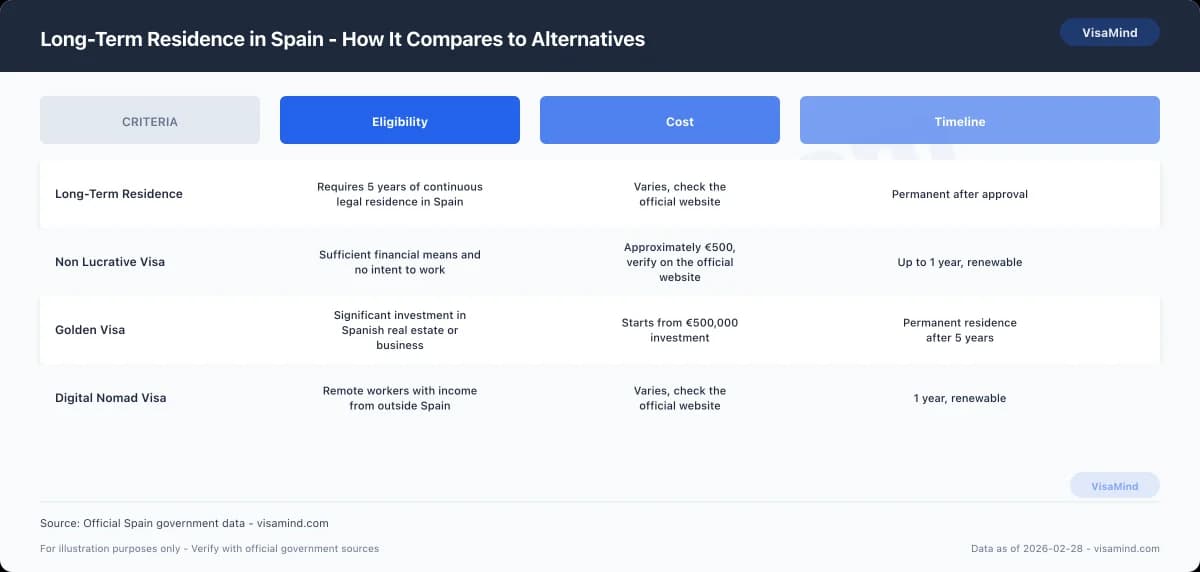
When considering long-term residence in Spain, it's important to understand how it compares to other visa options available in the country. Each program has its specific purpose, eligibility requirements, and benefits. Below is a comparison of the "Long-Term Residence" option with other popular residence or visa types available in Spain.
How Does Long-Term Residence Compare?
| Visa Type | Purpose | Eligibility | Benefits | Renewal |
|---|---|---|---|---|
| Long-Term Residence | Stay indefinitely after 5 years of legal residence | 5 years continuous legal residence in Spain | Access to social services, work in any sector | Every 5 years, with proof of continued residence |
| Golden Visa | For investors in Spanish real estate or businesses | Significant financial investment in Spain (e.g., €500,000 in real estate) | Fast-track residency, no minimum stay | Every 5 years, maintain investment |
| Non Lucrative Visa | Long-term stay without working | Sufficient financial means, health insurance | Reside without working, access to healthcare | Annually for the first five years, then every 5 years |
| EU Blue Card | Work in high-skilled jobs | Higher education degree, job offer with high salary | Work and live in Spain, family reunion | Annually for the first two years, then every 5 years |
Key Differences
Eligibility and Purpose
The Long-Term Residence is ideal for those who have legally resided in Spain for five continuous years and plan to stay indefinitely. Unlike the Golden Visa, which requires substantial financial investment, long-term residence focuses on the duration of legal stay without specific investment criteria.
The Non Lucrative Visa caters to those who wish to live in Spain without working and can demonstrate sufficient financial means. This is distinct from the Long-Term Residence, which allows unrestricted work rights once granted.
Benefits and Renewal
Once you obtain Long-Term Residence, you enjoy benefits similar to Spanish nationals, including access to social services and the ability to work in any sector. The permit needs renewal every five years, ensuring you maintain continuous residence. In contrast, the EU Blue Card focuses on skilled employment and requires maintaining a high-salary job.
Tip: If your goal is to work in Spain without investing, consider applying for an EU Blue Card if you meet the qualifications for high-skilled employment.
Considerations
When deciding between these options, evaluate your long-term plans, financial situation, and employment prospects in Spain. Each program offers unique pathways and benefits, catering to different needs and circumstances.
For further detailed comparison and guidance, you can explore the PR Pathway Guide and other resources provided by the State Secretariat for Migration (SEM).
Costs and Financial Thresholds
#When considering long-term residence in Spain, understanding the financial implications is crucial. From application fees to investment minimums, this section will detail the costs and financial thresholds involved in securing your status.
Application Fees and Financial Proof
| Element | Description |
|---|---|
| Application Fee | The fee for applying for long-term residence is approximately €80. Verify on the official website for any changes. |
| Financial Proof | Applicants must demonstrate sufficient financial resources. This can include employment contracts, bank statements, or a combination of both. |
| Self-Sufficiency | Proof of self-sufficiency is required, which may include a regular income or substantial savings. |
Tip: Ensure your financial documents are current and comprehensive to avoid delays in processing.
Salary Thresholds and Investment Minimums
| Requirement | Description |
|---|---|
| Salary Threshold | If you are employed, your salary should meet or exceed the Spanish minimum wage, which is €1,080 per month as of 2023. |
| Investment Minimums | For those seeking residence through investment, the Golden Visa requires a minimum investment of €500,000 in real estate or other qualifying investments. |
Related Visa Options
Various visa options might fit your financial situation better, such as the Digital Nomad or Entrepreneur visas, which may have different financial requirements.
For detailed guidance on financial requirements, refer to the Financial Requirements guide. Understanding these thresholds is essential for a successful application, so ensure all financial documentation meets the specified standards.
Your Rights Under This Program
#With a long-term residence status in Spain, you gain access to a variety of rights and privileges that facilitate a stable and integrated life in the country. Here’s what you need to know about your rights under this program:
Work and Employment Rights
Holding a long-term residence status grants you the right to work in Spain without needing additional work permits. You can take up employment or pursue self-employment opportunities, providing you with flexibility in your professional endeavors. This is a significant advantage compared to other visas, such as the National Student visa, which may have more restrictive work conditions.
Travel Freedom
As a long-term resident, you enjoy the freedom to travel within the Schengen Area for short stays, typically up to 90 days within a 180-day period. This enables you to explore and conduct business across various European countries without needing additional visas. However, always check the specific entry requirements of each country before traveling.
Family Reunification
Long-term residence status also paves the way for easier family reunification. Your spouse, children, and dependent family members can apply to join you in Spain under the Family Reunification process. Once they join you, your family members may also have the right to work and study in Spain, enhancing their integration into Spanish society.
Restrictions and Considerations
Despite the numerous benefits, some restrictions apply:
- Residency Requirements: You must maintain your primary residence in Spain. Extended absences could jeopardize your long-term residence status.
- Renewal Obligations: Long-term residence permits require periodic renewals. Ensure you keep track of renewal dates and comply with any conditions to avoid losing your status.
- Criminal Records: Engaging in criminal activities could lead to the revocation of your long-term residence.
Important: Ensure you stay informed about any changes in legislation related to long-term residency by consulting the How To Apply guide or the official State Secretariat for Migration website.
Understanding these rights and responsibilities will help you make the most of your long-term residence in Spain and ensure you remain compliant with Spanish immigration laws.
What Others Have Done
#An entrepreneur from Argentina, who had been running a successful startup in Madrid, was ready to make Spain his permanent home. He had initially moved to Spain on an Entrepreneur Visa and was now eligible to apply for long-term residence after several years of successful business operations. To transition, he needed to demonstrate the stability and viability of his business to the State Secretariat for Migration (SEM). He gathered comprehensive financial records, business performance reports, and proof of tax compliance, all crucial for his application. By carefully preparing his documents and evidence, he was able to secure his long-term residence status within six months, allowing him to continue focusing on expanding his business in Spain.
Scenario: Academic Transitioning to Permanent Residency
A university professor from India had been living in Spain under a National Work Visa while teaching at a prestigious university in Barcelona. After five years, she was eager to apply for long-term residence to solidify her ties to the country and pursue academic collaborations without immigration constraints. She meticulously followed the guidelines provided by the State Secretariat for Migration (SEM), ensuring she met all the eligibility criteria. This included providing proof of continuous residence and stable employment. Her application was processed smoothly, and within four months, she received her long-term residence permit, granting her greater freedom in her professional and personal life in Spain.
Scenario: Freelancer Establishing Roots
A freelance graphic designer from Canada, who had been living in Valencia on a Digital Nomad Visa, decided to apply for long-term residence. Over the years, she had built a robust client base in Spain and felt ready to establish permanent roots. She consulted the Digital Nomad Guide to ensure that her freelance income met the financial requirements set by the State Secretariat for Migration (SEM). By providing detailed contracts and bank statements that verified her income, she successfully transitioned to long-term residence. Her application was approved in about five months, allowing her to continue her work seamlessly while enjoying the benefits of permanent residency in Spain.
FAQs
What documents are required for the Long-Term Residence in Spain application?
What is the fee for applying for Long-Term Residence in Spain?
Can I apply for Long-Term Residence in Spain if I have a student visa?
What are common mistakes to avoid when applying for Long-Term Residence in Spain?
What are the financial requirements for Long-Term Residence in Spain?
What rights do I gain with Long-Term Residence in Spain?
How does Long-Term Residence in Spain differ from other visa types?
Sources
Last reviewed: March 1, 2026
VisaMind provides informational guidance only and is not a government agency. This is not legal advice. Requirements can change and eligibility depends on your specific facts. If your case is complex or high-stakes, consult a licensed immigration attorney.
Next steps
Requirements vary by nationality, purpose, timeline, and case details. Use Find My Visa to get a personalized checklist for Spain with official sources and deadlines.
Find my visa