On this page
- Paths to Working Legally
- Does Your Employer Need to Do Anything?
- The Application Process
- Your Rights as a Worker
- Transitioning to Permanent Residence
- Why Work Visa Applications Fail
- Skills and Qualifications
- Salary and Cost Considerations
- Your Tax Situation Abroad
- Real-World Work Visa Stories
- Visa options for this goal
- Guides for Thailand
- Other goals for Thailand
Paths to Working Legally
#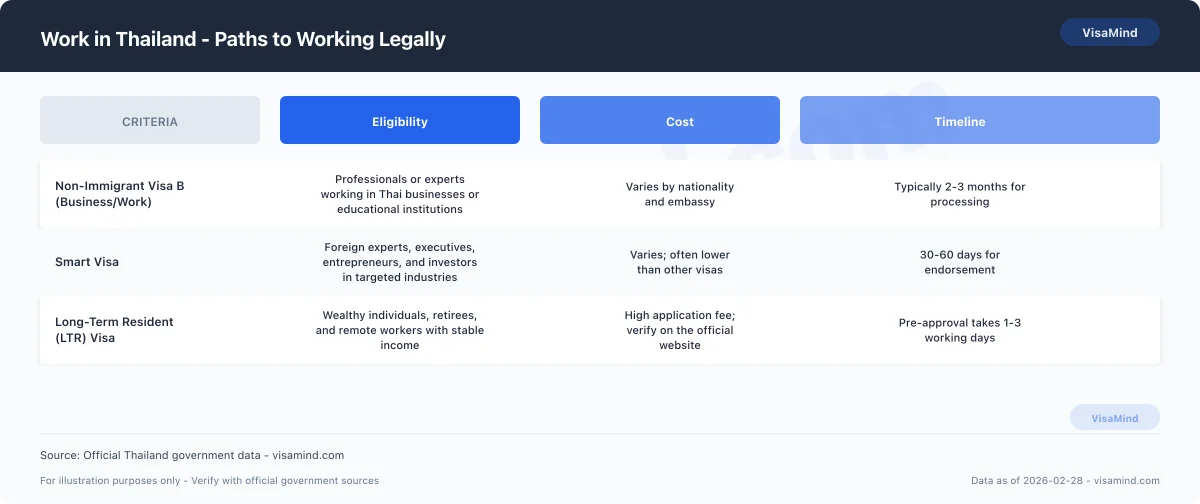
To work legally in Thailand, it's essential to understand the various visa categories that allow foreign nationals to engage in employment within the country. The Immigration Bureau of Thailand manages these categories, each catering to different types of workers and professionals. Here, we provide an overview of the primary work visa categories available in Thailand.
| Visa Type | Eligibility | Cost | Timeline |
|---|---|---|---|
| Non-Immigrant Visa B (Business/Work) | Professionals working for a Thai company | Varies based on nationality | Typically 1-3 months |
| Smart Visa | Investors, executives, startup entrepreneurs, and skilled professionals in targeted industries | THB 10,000 per year | 60 days for processing |
| Long-Term Resident (LTR) Visa | Wealthy individuals, retirees, professionals in targeted industries, and remote workers | USD 1,000 application fee | Approximately 20 working days |
Non-Immigrant Visa B (Business/Work)
This visa is suitable for professionals employed by Thai companies. It is the most common visa for those intending to work in Thailand. The application typically requires:
- A job offer from a Thai employer
- Completed Form WP.3 and employment certification
- Copy of the first page of your passport
- Copy of your education certificate
Smart Visa
Designed to attract talent in targeted industries, the Smart Visa caters to investors, executives, entrepreneurs, and highly skilled professionals. Individuals with expertise in areas such as technology or healthcare are encouraged to apply. Key benefits include:
- No requirement for a separate work permit
- Extended stay periods for spouses and children
Long-Term Resident (LTR) Visa
The LTR Visa supports four main categories: wealthy individuals, retirees, professionals working in targeted industries, and remote workers with overseas employers. This visa offers a longer stay and is an excellent choice for those looking to settle in Thailand for an extended period. Applicants must ensure:
- Their assets or income meet the minimum thresholds
- They maintain all conditions and requirements throughout the visa duration
Important: Ensure all documents are translated into Thai and certified by an academic Thai native speaker to avoid delays in processing.
Requirements and Application Process
Regardless of the visa type, all applicants should prepare to submit a set of core documents, such as:
- A completed application form
- Passport and copies of relevant pages
- Proof of qualifications or expertise
- Any additional documentation specific to the visa category
Applicants should begin by reviewing the eligibility criteria and requirements for their selected visa category. It is crucial to lodge applications well in advance, considering the processing times, which range from 20 working days for the LTR Visa to 60 days for the Smart Visa.
Tip: To ensure a smooth application process, consider consulting the How To Apply guide for detailed instructions and helpful tips.
By understanding the different work visa options available in Thailand, you can better prepare for your move and ensure compliance with the Immigration Bureau's regulations.
Does Your Employer Need to Do Anything?
#When hiring a foreign worker in Thailand, employers play a crucial role in facilitating the work permit process. Certain actions are required from employers to ensure compliance with Thailand's immigration laws and regulations. Here's what employers need to know:
Employer Requirements
Employers must first ensure that they are eligible to employ foreign nationals. This involves verifying that the job position cannot be filled by a Thai national and that hiring a foreign worker is justified. Employers should also be aware of the specific documentation required to support the foreign national's work permit application.
Key documents and actions include:
- Completed Form WP.3: This is a crucial document for the work permit application. Employers must ensure it is accurately completed and submitted.
- Employment Certification: A formal letter certifying the employment, job description, and the necessity of hiring a foreign worker.
- VAT Registration: Employers must provide Form Phor Por 01 to confirm their business type and Form Phor Por 09 if there are any changes or additions to the business.
Important: All company documents must be certified by an authorized person or an appointee with the company seal. Failing to do so can delay the application process.
Are There Additional Steps for Specific Visas?
Depending on the type of visa the employee holds or is applying for, additional steps may be necessary. For instance, the Long-Term Resident (LTR) Visa requires the employer to assist in the online application for qualifications endorsement, which includes submitting relevant supporting documents.
For specific visa types like the Non-Immigrant B Visa or the Smart Visa, employers may also need to provide additional information that supports the applicant's eligibility and aligns with the visa's intent.
Pre-Approval Process
Before a work permit can be issued, there may be a pre-approval process that requires additional documents to be submitted. This process typically takes 1-3 working days, but it can take longer if more documents are requested. Employers should be prepared for this possibility and gather the necessary documents in advance.
- Supporting Documents: Employers may need to provide additional documentation during this stage, such as proof of business operations, financial statements, or evidence of previous compliance with Thai labor laws.
Tip: Employers should maintain open communication with the applicant to ensure all documents are prepared and submitted promptly to avoid unnecessary delays.
By understanding these employer responsibilities and preparing the necessary documentation, businesses can effectively support their foreign employees in obtaining the required work permits in Thailand. For more details on visa types and application processes, consider reviewing the How To Apply Guide and Documents Checklist.
The Application Process
#To work legally in Thailand, you must navigate a specific application process managed by the Immigration Bureau of Thailand (สำนักงานตรวจคนเข้าเมือง). Here’s a step-by-step guide to help you through:
-
Eligibility Check and Documentation Preparation
Before initiating the application, ensure you meet the eligibility criteria. These include being a professional in a targeted industry, a remote worker for an overseas company, a wealthy individual, or a retiree with stable income streams. Gather necessary documents such as:
- Completed Form WP.3
- Employment certification
- Copy of the first page of your passport
- Educational certificates
- Business Operation documents and evidence of money import
- VAT Registration documentation (Form Phor Por 01 and Form Phor Por 09 if applicable)
- Employment contracts or assignment letters for teaching positions
Important: Any documents not in Thai must be translated and certified by an academic Thai native speaker.
-
Online Application for Qualifications Endorsement
Begin your application by registering and submitting your qualifications endorsement online. This includes uploading all supporting documents. The online portal facilitates the initial review and ensures that your qualifications align with the visa requirements.
Tip: File online to avoid mail delays and get a receipt number immediately.
-
Pre-Approval Process
Once your qualifications are submitted, additional information and documents may be required for pre-approval. This stage generally takes 1-3 working days, but processing can take longer if more documents are requested. Stay responsive to any communication from the Immigration Bureau to prevent delays.
-
Apply for the Work Permit After Receiving the LTR Visa
After receiving your Long-Term Resident (LTR) Visa, proceed to apply for a work permit as soon as possible. Delaying this step can result in complications with your employment status.
Important: Not applying for a work permit immediately after receiving the LTR Visa can jeopardize your ability to legally work in Thailand.
Understanding Fees and Timelines
The cost and processing times for the work permit and visa applications can vary. It's important to verify current fees and timelines on the official Immigration Bureau website. Keep in mind that maintaining every condition and requirement during the length of your visa, including your employment status and financial conditions, is mandatory.
For more detailed guides on specific visa types, consider looking into the Non Immigrant B or Smart Visa options, as each has unique requirements and benefits.
By carefully following these steps and remaining vigilant about documentation and timelines, you can successfully navigate the process of obtaining permission to work in Thailand.
Your Rights as a Worker
#Working in Thailand offers exciting opportunities, but it is essential to understand your rights as a foreign worker.
Can You Change Employers?
If you wish to change employers while holding a work permit in Thailand, you can do so, but you must follow certain procedures. The new employer must be approved by the Immigration Bureau of Thailand, and you must apply for a new work permit. It is crucial to ensure that all documents are correctly translated into Thai and certified by an academic Thai native speaker to avoid any delays.
Important: Failing to maintain the conditions and requirements of your visa, such as employment status, can result in visa revocation or complications.
Can Your Family Join You?
As a foreign worker in Thailand, your family can join you under certain conditions. If you hold a Long-Term Resident (LTR) Visa or any of the four types of visas that allow dependents, your spouse and children are eligible to apply for a dependent visa. This allows them to live in Thailand with you, though they may need separate permits if they wish to work or study.
For more information on visa types that support family members, you might consider looking into the Non Immigrant O visa and Marriage Visa.
Can You Study?
Foreign workers in Thailand are permitted to study while holding a work permit. However, the type of visa you hold may require you to apply for a specific study visa, such as the Non Immigrant Ed. This ensures that your educational pursuits are officially recognized and that you comply with immigration regulations. It’s advisable to consult with the Immigration Bureau to understand the specific requirements and procedures involved.
Tip: If you plan to study while working, keep track of the different visa requirements to ensure compliance.
Understanding these aspects of your rights as a worker in Thailand helps you make informed decisions about employment, family, and educational opportunities. For further guidance, you may want to explore How To Apply for detailed application procedures and Documents Checklist to ensure you have all necessary documentation ready.
Transitioning to Permanent Residence
#Transitioning from a work visa to permanent residence in Thailand can be a strategic move for those looking to establish long-term roots in the country. Understanding how your work visa can lead to permanent residency and the timeline involved is essential for planning your future in Thailand.
How Work Visas Lead to Permanent Residence
In Thailand, holding a work visa, such as the Non-Immigrant B (Business/Work) Visa or the Smart Visa, can be an important step toward achieving permanent residency. The Immigration Bureau of Thailand allows certain visa holders to apply for permanent residency if they meet specific criteria, including a continuous stay, employment stability, and contributions to the Thai economy.
Key pathways include:
-
Non-Immigrant B (Business/Work) Visa: Typically granted to professionals working in Thailand, this visa requires a work permit and can be renewed annually. After three consecutive renewals, you may be eligible to apply for permanent residency.
-
Smart Visa: Designed for skilled professionals, investors, and startup entrepreneurs, this visa offers a longer initial stay of up to four years. Smart Visa holders who have maintained their status may apply for permanent residency.
-
Long-Term Resident (LTR) Visa: While primarily for wealthy individuals and retirees, LTR visa holders can also transition to permanent residency, provided they adhere to the investment and income requirements.
Timeline for Transitioning to Permanent Residence
The process of transitioning from a work visa to permanent residence is structured but requires careful timing and documentation.
-
Eligibility Check: Ensure that you have maintained continuous residence in Thailand for at least three years on a work-related visa. Your employment and financial commitments must meet the requirements set by the Immigration Bureau.
-
Document Preparation: Gather all necessary documents, including proof of employment, tax payments, and contributions to the Thai economy. Ensure all documents are translated into Thai and certified by an academic Thai native speaker.
-
Application Submission: Lodge your application for permanent residency through the Immigration Bureau. This step requires a thorough review of your history in Thailand, including your work and contributions.
-
Processing Time: The processing period for permanent residency applications can vary, typically taking several months. It's important to maintain your current visa status during this time.
Important: Failing to maintain the conditions and requirements of your current visa can jeopardize your permanent residency application.
Challenges and Considerations
Transitioning to permanent residency involves maintaining strict compliance with visa conditions. Common pitfalls include:
-
Not Meeting Income or Investment Requirements: Ensure that your financial circumstances align with the thresholds set by the Immigration Bureau.
-
Incomplete Documentation: All required documents must be complete, accurately translated, and certified.
-
Failure to Maintain Visa Conditions: Continuous employment and adherence to the terms of your work visa are critical.
For more details on the specific requirements and processes, you can refer to our Documents Checklist and Visa Extension Guide.
By understanding these pathways and timelines, you can better navigate the transition from a work visa to permanent residence in Thailand, laying the groundwork for a stable and long-term future in the country.
Why Work Visa Applications Fail
#Foreign nationals seeking employment in Thailand often need to navigate a complex visa application process. Here are some common reasons why work visa applications may be denied by the Immigration Bureau of Thailand and how to avoid these pitfalls.
Missing or Incorrect Documentation
- Failure to Translate Documents: All documents in foreign languages must be translated into Thai and certified by an academic Thai native speaker. Ensure every document is properly translated and certified.
- Incomplete Certification: Every page of company-related documents should be certified by an authorized person or appointee with the company seal. Missing this can lead to rejection.
Eligibility Issues
- Not Meeting Eligibility Criteria: Ensure that you are eligible under one of the specific categories, such as professionals in targeted industries, remote workers, or wealthy individuals. Verify your eligibility based on your circumstances.
- Failure to Maintain Conditions: During the visa's validity, applicants must maintain specific conditions like employment status, bank account balances, and insurance coverage. Non-compliance can result in visa revocation.
Application Process Errors
- Delayed Work Permit Application: After obtaining an LTR Visa, you must apply for a work permit immediately. Delays in this step can result in complications or denial of the work permit.
- Not Providing Additional Documents: If additional documents are requested during the qualifications endorsement process, provide them promptly to avoid delays or rejection.
Tip: Use the Documents Checklist to ensure you have all necessary paperwork before submission.
Employer Requirements
- Lack of Proper Employer Support: Ensure your employer provides the necessary documentation, such as employment certification and VAT registration. This includes forms like Phor Por 01 and Phor Por 09 if applicable.
- Incorrect Employment Details: Ensure that your employment details align with what is stated in the application and supporting documents. Any discrepancies can lead to denial.
By paying close attention to these areas, you can significantly reduce the chances of your work visa application being rejected. For more detailed guidance, refer to the Visa Refusal Reasons guide.
Skills and Qualifications
#To work in Thailand, understanding the necessary skills and qualifications is key for a successful application process. Here, we break down the essentials for skills assessments, qualification recognition, and degree requirements to help you navigate the system effectively.
Skills Assessments
When applying for a work permit in Thailand, your skills and professional background play a crucial role. Here’s what you need to know:
- Targeted Industries: Professionals or experts in industries such as technology, engineering, and education are highly sought after. If you belong to these sectors, ensure your skills align with industry standards.
- Remote Workers: If you work for a well-established overseas company, it's essential that your qualifications are recognized to continue your work remotely in Thailand.
- Wealthy Individuals and Retirees: While specific skills assessments may not be required for wealthy individuals or retirees seeking residency, maintaining the required financial thresholds is mandatory.
Tip: For a smoother application, ensure that all your professional credentials are current and relevant to the industry you are entering.
Qualification Recognition
Having your qualifications recognized is an important step in securing a work permit. Consider the following:
- Education Certificates: A copy of your education certificate is needed. If your documents are in a foreign language, they must be translated into Thai and certified by an academic Thai native speaker.
- Employment Certification: This includes documentation of your current or previous employment roles that correspond to your qualifications.
- Supporting Documents for LTR Visa: For those applying for the Long-Term Resident (LTR) Visa, qualifications endorsement and supporting documents must be submitted online.
Important: Failing to provide properly translated and certified documents can delay your application process significantly.
Degree Requirements
Your educational background is critical in obtaining a work permit. Here’s what you need to be aware of:
- Minimum Degree Levels: For many professional roles, a bachelor's degree or higher is often required. It's crucial to verify the specific degree requirements for your intended industry.
- Certification for Educators: If you're applying as a teacher or instructor, you must provide a letter of assignment and an employment contract. Private university educators must also show a certificate letter from the Ministry of Education.
- LTR Visa: For those seeking the LTR Visa, further endorsement of qualifications is necessary, and additional documentation may be required during the pre-approval process.
Next Steps
To proceed with your application, ensure you have gathered all the necessary documents and understand the requirements specific to your visa type. For more guidance, explore related topics such as the Digital Nomad Guide or the Retirement Guide if applicable to your situation.
Navigating the qualifications and skills requirements for working in Thailand can be complex, but with the right preparation and understanding of the process, you can successfully meet the Immigration Bureau's standards.
Salary and Cost Considerations
#Important: Ensure all documents are translated into Thai and certified by an academic Thai native speaker. This is crucial for successful application processing.
Salary Thresholds and Minimum Income Requirements
Working in Thailand often involves meeting specific income criteria. For professional positions, particularly those requiring a Non-Immigrant Visa B (Business/Work), applicants generally need to demonstrate a stable income that satisfies the Immigration Bureau’s thresholds. The exact minimum income requirement can vary based on the type of visa and employment sector, so it's vital to verify the current standards on the official website or with the Immigration Bureau directly.
Application Fees for Work-Related Visas
When applying for a work permit in Thailand, different visas come with varying fee structures. Below is a comparison of some common work-related visas:
| Visa Type | Application Fee | Renewal Fee | Validity |
|---|---|---|---|
| Non-Immigrant Visa B | THB 2,000 (single entry) | THB 1,900 | 90 days, extendable |
| Smart Visa | THB 10,000 | THB 7,000 | 1-4 years |
| Long-Term Resident (LTR) Visa | THB 50,000 | THB 20,000 | 10 years |
Key Considerations for Cost and Compliance
While fees are a critical component, maintaining compliance with all immigration requirements throughout the visa's duration is equally important. This includes keeping a valid work permit, upholding income thresholds, and ensuring all financial obligations are met.
Tip: Regularly review the Financial Requirements to ensure you meet ongoing obligations, particularly if your employment situation changes.
For more information on processing times and specific document requirements, refer to our Processing Times guide.
Your Tax Situation Abroad
#When you work in Thailand, understanding your tax situation is vital. As a foreign worker, you need to be aware of your income tax obligations, social security contributions, and any applicable double taxation treaties that Thailand has with your home country.
Income Tax Obligations
In Thailand, personal income tax is progressive, with rates ranging from 0% to 35%. If you reside in Thailand for more than 180 days in a calendar year, you are considered a tax resident and are liable to pay taxes on your global income. Non-residents are taxed only on their Thai-sourced income. It's important to report your income accurately and submit necessary documentation to the Thai Revenue Department.
Social Security Contributions
As an employee in Thailand, you are required to contribute to the Social Security Fund. Contributions are typically 5% of your salary, capped at a maximum monthly salary of THB 15,000. Both you and your employer will make contributions to this fund. These contributions provide coverage for benefits such as healthcare, maternity, unemployment, and retirement.
Double Taxation Treaties
Thailand has double taxation agreements with many countries to prevent being taxed twice on the same income. These treaties generally allow for credits or exemptions on taxes paid in Thailand. It's crucial to consult the specific treaty between Thailand and your home country to understand the applicable provisions. You can find more information on the treaties through the Thailand Revenue Department.
Tip: Consult a tax advisor familiar with Thai regulations to ensure you leverage any benefits from double taxation treaties effectively.
Key Considerations
- Tax Residency: Determine your tax residency status, as it affects your tax obligations.
- Income Reporting: Ensure all income is reported accurately to avoid penalties.
- Documentation: Keep detailed records of all income, deductions, and taxes paid, both in Thailand and abroad.
To better understand your visa options that may affect your tax situation, explore the Long-Term Resident Visa or the Non Immigrant O for specific requirements and benefits.
Important: Failing to comply with tax obligations can lead to penalties and affect your ability to renew your visa. Always verify the latest rules on the official website.
Real-World Work Visa Stories
#A software developer, employed by a prominent tech firm in the United States, decided to move to Thailand to enjoy a change of environment while continuing to work remotely. Aware of Thailand's openness to remote workers, the developer began by exploring the Long-Term Resident (LTR) Visa option. This visa category was particularly appealing as it caters to professionals working for established overseas companies. The developer registered and submitted an online application for qualifications endorsement through the Immigration Bureau of Thailand's portal, including all necessary documents such as employment certification and a copy of their passport. After receiving the LTR Visa, they promptly applied for a work permit, a crucial step often overlooked. Within a few weeks, the developer was legally allowed to work from Thailand, enjoying the vibrant culture and lifestyle while maintaining their career abroad.
Scenario: Academic Joining a Thai University
An experienced professor specializing in environmental studies was offered a position at a well-respected Thai university. Understanding that their role required a valid work permit, the professor initiated the application process by gathering essential documents, such as their educational certificates and a letter of employment from the university. Additionally, they needed a certification letter from the Ministry of Education, a unique requirement for academic positions. After ensuring all documents were translated into Thai and certified, the professor submitted their application through the Immigration Bureau. The pre-approval process took about two weeks, and upon receiving the green light, the professor was able to join the university staff, contributing to research and education in Thailand.
Scenario: Wealthy Investor Establishing a Business in Thailand
A successful entrepreneur with over USD 1 million in assets decided to expand their business operations to Thailand. Familiar with the Non-Immigrant Visa B (Business/Work), they began by preparing a comprehensive business plan and financial documentation, including their VAT registration and other business operation forms. The entrepreneur worked closely with a local legal advisor to ensure compliance with Thai regulations, submitting their application to the Immigration Bureau. Within a month, they received approval, allowing them to establish their business presence in Thailand. This move not only facilitated their business expansion but also opened up opportunities within the Southeast Asian market.
FAQs
What happens if I fail to maintain visa conditions while working in Thailand?
Is a work permit necessary after receiving an LTR Visa in Thailand?
What documents are needed for the Thailand work permit application?
Can remote workers apply for a work visa in Thailand?
What is the process to switch from a Non-Immigrant Visa B to a Smart Visa in Thailand?
How much wealth is required for wealthy individuals to get a visa to work in Thailand?
What are common reasons for work visa application failures in Thailand?
Sources
Last reviewed: March 1, 2026
VisaMind provides informational guidance only and is not a government agency. This is not legal advice. Requirements can change and eligibility depends on your specific facts. If your case is complex or high-stakes, consult a licensed immigration attorney.
Next steps
Requirements vary by nationality, purpose, timeline, and case details. Use Find My Visa to get a personalized checklist for Thailand with official sources and deadlines.
Find my visa