On this page
- What the K-3 Spouse of USC Visa Covers
- Required Documents
- Path to Permanent Residence
- How to Apply
- What You Can Do
- When to Consult a Professional
- Extending Your Family Visa
- Fees and Processing Times
- Eligibility Requirements
- Relationship Scrutiny Red Flags
- Prepare Before You Apply
- Fees
- Required forms
- Related visa types
- Related guides
- Related goals
- Next steps
What the K-3 Spouse of USC Visa Covers
#
The K-3 visa allows you to enter the United States as the spouse of a U.S. citizen while your immigrant petition moves through the family-based immigration process.
It serves a specific, temporary role and connects directly to forms filed with USCIS and visa processing through the Department of State.
Purpose
The K-3 visa exists to reduce the time you and your U.S. citizen spouse spend living apart while USCIS reviews the Form I-130.
Your spouse files Form I-130 with USCIS as part of the family-based immigration process. Instead of waiting abroad for immigrant visa approval, you may apply for a K-3 nonimmigrant visa to enter the United States.
Processing typically takes 12–18 months. Always check for updates directly from USCIS.
The K-3 visa does not replace the immigrant visa process. It works alongside it.
You still complete required consular steps, including submitting the Form DS-160 Online Nonimmigrant Visa Application to the Department of State and attending a visa interview.
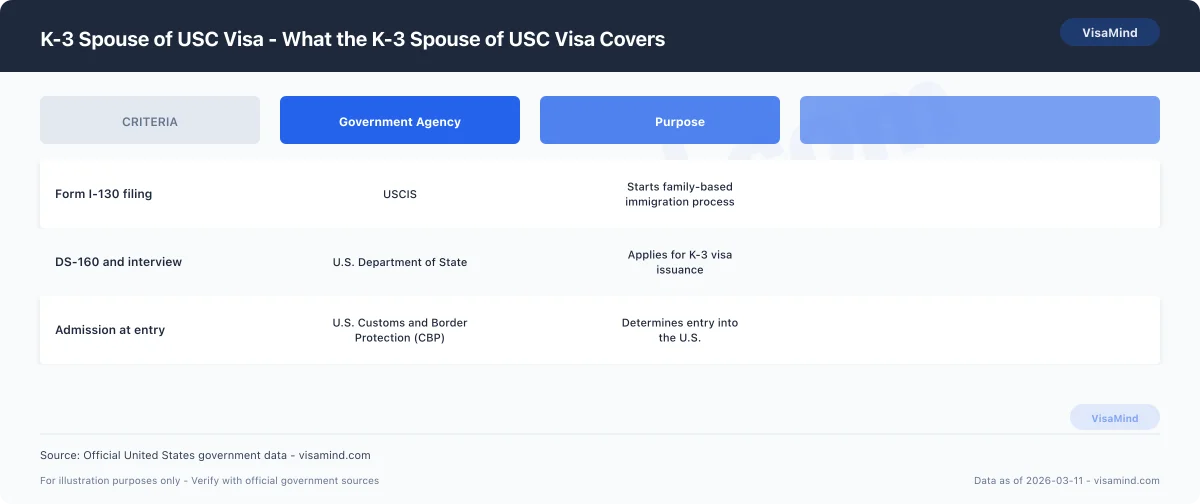
| Stage | Government Agency | Purpose |
|---|---|---|
| Form I-130 filing | USCIS | Starts family-based immigration process |
| DS-160 and interview | U.S. Department of State | Applies for K-3 visa issuance |
| Admission at entry | U.S. Customs and Border Protection (CBP) | Determines entry into the U.S. |
Who qualifies
You qualify for a K-3 visa only if you’re legally married to a U.S. citizen and that citizen has already filed Form I-130 on your behalf with USCIS.
Eligibility depends on:
- A valid marriage to a U.S. citizen
- A properly filed Form I-130 with USCIS
- Completion of required nonimmigrant visa processing steps, including Form DS-160
- Approval of the K-3 visa by a U.S. consular officer
This visa does not apply to spouses of lawful permanent residents. It’s limited to marriages involving U.S. citizens.
You must also follow all instructions from the Department of State for visa issuance. The consular officer decides whether to issue the K-3 visa after reviewing your application and supporting documentation.
What it allows the spouse to do
The K-3 visa allows you to travel to the United States as a nonimmigrant spouse of a U.S. citizen.
Once admitted by CBP at a U.S. port of entry, you may reside in the United States while USCIS continues processing your immigrant petition.
You can remain with your U.S. citizen spouse during the pending I-130 process.
The visa functions as a temporary bridge. It does not grant immigrant status by itself.
You continue through the family-based immigration process until USCIS completes review of your Form I-130 and the immigrant visa process moves forward.
Required Documents
#You must submit primary civil documents and evidence that your marriage is real. USCIS reviews these records with your Form I-130 petition, and the Department of State reviews supporting documents during consular processing, including the Form DS-160 application.
Proof of relationship and marriage
You must prove that you and your spouse have a legally valid marriage and a genuine relationship.
Start with primary civil records:
- Marriage certificate issued by the appropriate government authority
- Proof that any prior marriages ended, such as divorce decrees or death certificates
- If applicable, birth certificates for children born to you and your spouse
USCIS expects both primary and secondary evidence in family-based immigration cases. Primary documents confirm the legal marriage.
Secondary evidence shows that the marriage is bona fide. Examples include:
- Joint bank account statements
- Joint property ownership or lease agreements
- Shared financial obligations
If primary documents are unavailable, you may include affidavits and other credible evidence. Weak documentation often leads to a Request for Evidence (RFE), which delays processing.
Petitioner identity and status
The U.S. citizen petitioner must prove identity and citizenship when filing Form I-130 with USCIS.
Submit clear copies of one of the following:
- U.S. birth certificate
- U.S. passport (biographic page)
- Naturalization certificate
If you’re including Form I-130A for your spouse, ensure all biographic information matches the civil records exactly.
Inconsistencies in names, dates of birth, or prior marital history trigger delays.
| Requirement | Acceptable Evidence |
|---|---|
| U.S. citizenship | Birth certificate, U.S. passport, or naturalization certificate |
| Legal marriage | Government-issued marriage certificate |
| Termination of prior marriages | Divorce decree or death certificate |
Copies must be complete and legible. Missing pages or unclear scans often result in follow-up notices from USCIS.
Supporting evidence and photos
Provide passport-style photos and relationship documentation that supports the DS-160 and consular interview process handled by the Department of State.
Prepare compliant passport-style photos before filing.
Include evidence that shows shared life activities and ongoing contact, such as:
- Photographs of you together at different times and locations
- Evidence of joint financial responsibilities
- Records showing continued communication
Focus on quality over quantity. Submit documents that clearly demonstrate shared residence, financial integration, or long-term commitment.
Well-organized evidence helps officers review your case efficiently and reduces the risk of additional document requests.
Path to Permanent Residence
#A K-3 spouse visa allows you to enter the United States while your immigrant petition moves forward.
Your Green Card process depends on how you pursue permanent residence and how your Form I-130 supports that process.
Adjustment of status vs consular processing
When you file Form I-130 with USCIS, you must indicate whether your spouse will apply for permanent residence inside the United States or through consular processing abroad. You select only one option in Part 4 of the petition.
If your spouse is in the United States in valid status, you may choose adjustment of status by filing Form I-485 with USCIS.
Include a copy of the I-130 receipt notice in the adjustment packet.
If your spouse will complete the process abroad, choose consular processing. The Department of State handles visa applications, including Form DS-160 and the immigrant visa interview.
| Process | Where It Happens | Government Agency | Key Form |
|---|---|---|---|
| Adjustment of Status | Inside the U.S. | USCIS | Form I-485 |
| Consular Processing | U.S. embassy or consulate abroad | U.S. Department of State | Form DS-160 |
You must choose the correct path early because USCIS uses your selection to route the case.
Including other family members
Family-based immigration requires a separate petition for each qualifying relative.
File:
- One Form I-130 for your spouse
- A separate Form I-130 for each child, including biological children, stepchildren, or adopted children you share
USCIS treats each petition as its own case. Each child must independently qualify and have an approved petition before seeking permanent residence.
If a child will apply for adjustment of status in the United States, include a copy of the I-130 receipt notice in that child’s Form I-485 packet.
If processing occurs abroad, the Department of State manages the immigrant visa application after petition approval.
Careful petition filing prevents delays and avoids the need to restart the process.
How the immigrant petition leads to a Green Card
Form I-130 establishes that you have a qualifying relationship with your spouse. USCIS reviews the petition to confirm the validity of your marriage and your eligibility as a U.S. citizen petitioner.
Once USCIS approves the I-130:
-
Your spouse may file Form I-485 if applying inside the United States.
-
Or the case proceeds to the Department of State for immigrant visa processing abroad.
Approval of the I-130 does not grant permanent residence by itself. It creates the legal basis for your spouse to apply for a Green Card through adjustment of status or an immigrant visa.
You must indicate whether your spouse will remain in the United States for adjustment or complete processing abroad. USCIS relies on that selection to move the case forward under the correct procedure.
How to Apply
#You begin the K-3 process by filing the correct petitions with USCIS and then completing the required visa application steps through the Department of State.
Accuracy, complete documentation, and matching information across all forms prevent delays and rejections.
Start with Form I-130
You must first file Form I-130, Petition for Alien Relative, with USCIS as part of the family-based immigration process. This petition establishes your qualifying relationship with your spouse.
For a spouse petition, you must also submit:
- Form I-130A, Supplemental Information for Spouse Beneficiary
- Required supporting documents listed in the form instructions
- The correct filing fee (review current amounts with USCIS)
If you have children, file a separate Form I-130 for each child. Include a photocopy of your spouse’s I-130 receipt notice with each child’s petition.
USCIS will issue a receipt notice after you properly file. Keep this document. You will need it for later filings and correspondence.
List all family members accurately. Omissions or inconsistent information can lead to rejection or delays.
Supplemental forms, receipts and uploads
After filing Form I-130, you must file Form I-129F, Petition for Alien Fiancé(e), with USCIS to pursue the K-3 classification for your spouse. Submit it only after you receive the I-130 receipt notice.
When your case moves to consular processing, your spouse must complete Form DS-160, Online Nonimmigrant Visa Application, through the Department of State.
Before leaving the Consular Electronic Application Center (CEAC), print the DS-160 confirmation page and upload it as instructed for the visa application.
Use this checklist to stay organized:
| Requirement | Key Action |
|---|---|
| I-130 Receipt | Keep copy for future filings |
| Form I-130A | File together with I-130 |
| Form I-129F | File after I-130 receipt |
| DS-160 | Complete fully and print confirmation |
All information must match your passport and civil documents exactly. Even minor discrepancies can cause delays or denial.
Application completion and adjudication
USCIS will only adjudicate forms that you properly file and complete. Incomplete answers, especially in security and background sections, often trigger a Request for Evidence (RFE) or denial.
Follow these steps:
-
Complete every field on each form.
-
Answer all security and background questions fully.
-
Ensure names, dates of birth, and passport numbers match across all documents.
-
Upload or submit every required supporting document.
USCIS reviews the petitions. The Department of State handles visa interviews and issuance abroad.
You control much of the timeline by filing complete, accurate forms the first time.
What You Can Do
#You can take practical steps to strengthen your K-3 spouse visa filing, but you must understand the limits of what any application can achieve. Careful preparation helps, yet no filing guarantees approval.
Limitations and expectations
You control the accuracy and completeness of your filing, but you don't control the decision. When you submit Form I-130 with U.S. Citizenship and Immigration Services (USCIS) and pursue the K-3 process, you're asking for consideration under family-based immigration rules.
You also have to complete visa application steps, including Form DS-160, through the U.S. Department of State. Each stage lands with a different authority for review.
Use this checklist to keep your case on track:
- File Form I-130 correctly with USCIS.
- Provide complete and consistent information across all forms.
- Follow current form instructions on the USCIS website.
- Prepare for consular processing through the U.S. Department of State.
Even if you follow every instruction, approval is discretionary. Officers review your petition and visa application based on the law and the facts in your case.
| Stage | Government Authority | What Your Filing Means |
|---|---|---|
| Petition (Form I-130) | USCIS | You request recognition of a qualifying marital relationship. |
| Visa Application (Form DS-160) | U.S. Department of State | You request a K-3 visa for travel to the United States. |
Where filings don’t guarantee outcomes
Submitting a K-3-related filing doesn't ensure that USCIS or the U.S. Department of State will approve your case. A properly filed application guarantees review, not a specific outcome.
USCIS examines whether your Form I-130 meets legal requirements under family-based immigration law. The Department of State separately evaluates the DS-160 and determines visa eligibility during consular processing.
You should be ready for:
- Requests for additional evidence from USCIS.
- Additional questions during the visa interview.
- A decision that may not match your expectations.
Admission to the United States is determined separately by U.S. Customs and Border Protection (CBP) at the port of entry. A visa allows you to seek entry but doesn't promise admission.
When to Consult a Professional
#You might need legal guidance if your case doesn't follow a standard K-3 process or if prior filings affect your current petition. Complications often involve overlapping petitions, different visa categories, or timing issues between USCIS and the U.S. Department of State.
Complex or non-standard visa categories
If your situation involves more than a straightforward K-3 filing tied to a pending Form I-130, it's time to talk to a professional. Cases that mix employment-based and family-based immigration require careful coordination.
Certain employment classifications like H-1b visa or L-1 require an approved Form I-129 before you complete Form DS-160 for consular processing. The consulate checks petition approval before issuing a visa. Filing the DS-160 too early can cause delays or confusion at the interview stage handled by the U.S. Department of State.
A professional helps you:
- Confirm which petition must be approved before DS-160 submission
- Align USCIS petition status with consular processing steps
- Avoid conflicting information across applications
| Situation | Why Legal Review Helps |
|---|---|
| Multiple visa categories involved | Prevents filing steps out of order |
| Pending employment petition | Ensures approval before DS-160 submission |
| Concurrent family-based immigration process | Coordinates I-130 and visa processing timing |
You lower risk when you confirm that each petition and application matches your current immigration category.
Issues involving other petition types or prior petitions
Seek guidance if you've previously filed other petitions with USCIS or have more than one active filing. A K-3 visa depends on a properly filed Form I-130, and inconsistencies between filings can trigger delays.
Problems can arise when:
- You filed more than one I-130
- You withdrew or replaced a prior petition
- Information differs between your I-130 and DS-160
- You changed visa categories after an earlier filing
USCIS reviews petition history, and the U.S. Department of State reviews your DS-160 during consular processing. Mismatched dates, marital history, or prior filings can lead to administrative processing or requests for clarification.
A professional reviews your full filing history and confirms that:
- All prior petitions align with your current K-3 strategy
- Biographic and marital information is consistent
- Your family-based immigration path supports, rather than conflicts with, your visa application
You protect your case by catching conflicts before USCIS or the consulate does.
Extending Your Family Visa
#You may need to take further steps to remain in the United States permanently after entering on a K-3 spouse visa. Your options depend on whether you are physically present in the United States and eligible to apply for adjustment of status through a pending Form I-130.
Concurrent filings and adjustment
If you're in the United States and eligible, you can file Form I-130 (Petition for Alien Relative) and Form I-485 (Application to Register Permanent Residence or Adjust Status) at the same time with USCIS.
Concurrent filing can reduce overall processing time since USCIS reviews both forms together. If you filed Form I-130 online, USCIS can adjudicate a properly submitted Form I-485 that you include as supporting evidence.
Consider concurrent filing if:
- You are in the United States.
- You qualify to adjust status.
- Your U.S. citizen spouse files or has filed Form I-130.
| Form | Purpose | Filed With |
|---|---|---|
| I-130 | Establishes qualifying family relationship | USCIS |
| I-485 | Requests permanent resident status | USCIS |
Next steps after arrival
After you enter the United States on a K-3 visa, you have to decide whether to pursue adjustment of status or complete consular processing.
If you remain abroad, you will complete visa processing through the U.S. Department of State, including submitting Form DS-160 and attending a visa interview. The Department of State handles visa issuance, while U.S. Customs and Border Protection (CBP) determines admission at entry.
If you are in the United States and eligible, adjustment of status through USCIS keeps your case within the country under the family-based immigration process.
Action plan:
-
Confirm the status of your Form I-130.
-
Determine whether you qualify to file Form I-485.
-
Follow the official instructions from USCIS or the U.S. Department of State, depending on your location.
Fees and Processing Times
#You pay separate fees to USCIS and to the U.S. Department of State. processing times depend on the family-based immigration category on your Form I-130 and the consulate handling your visa.
Filing and visa fees
You start the K-3 process by filing Form I-130, Petition for Alien Relative with USCIS. As of February 2026, the filing fee for Form I-130 is $675.
After USCIS processes the petition and the case moves to consular processing, you complete Form DS-160, Online Nonimmigrant Visa Application. The K-3 visa application (MRV) fee is $265, which you pay to the U.S. Department of State at the embassy or consulate.
| Fee Type | Form | Government Agency | Amount (USD) |
|---|---|---|---|
| Petition filing fee | I-130 | USCIS | $675 |
| K-3 visa application (MRV) fee | DS-160 | U.S. Department of State | $265 |
You must pay each fee separately. Always confirm the current amount using the official USCIS fee schedule and the Department of State’s visa fee page before you file.
USCIS processing times (I-130 categories)
USCIS processing times for Form I-130 vary by eligibility category and service center. For K-3 purposes, the most relevant category is “U.S. citizen filing for a spouse.”
As of January 2026, reported processing ranges include:
| I-130 Category | Processing Time Range |
|---|---|
| U.S. citizen filing for a spouse, parent, or child under 21 | 17 to 87 months |
| Permanent resident filing for a spouse or child under 21 | 49.5 to 213.5 months |
| U.S. citizen filing for unmarried son/daughter 21 or older | 50 to 198 months |
| Permanent resident filing for unmarried son or daughter 21 or older | 48 to 240 months |
| U.S. citizen filing for a married son or daughter | 47.5 to 178.5 months |
| U.S. citizen filing for a brother or sister | 95 to 240 months |
You need to check the USCIS Processing Times tool for your specific service center and category. Family-based immigration timelines shift frequently and can change without notice.
Consular/DS-160 processing windows
After USCIS handles the petition stage, the U.S. Department of State manages visa processing abroad. You complete and submit Form DS-160 and attend a visa interview at a U.S. embassy or consulate.
Processing windows for DS-160 cases vary by visa classification and location. As of February 2026, reported ranges include:
| Visa Classification | Processing Time Range |
|---|---|
| Visitor (B1/B2) | 0.5 to 23 months |
| Student/Exchange (F, M, J) | 0.5 to 7.5 months |
| Petition-based (H, L, O, P, Q) | 0.5 to 4.5 months |
| Crew and Transit (C, D, C1/D) | 0.5 to 14 months |
K-3 is a petition-based nonimmigrant visa, so timing depends on the embassy’s workload and local procedures. You must verify current wait times directly with the U.S. Department of State through the appropriate embassy or consulate.
Eligibility Requirements
#You must meet specific citizenship, marriage, and filing requirements to qualify for a K-3 spouse visa. Both you and your spouse need to satisfy clear criteria, and you must submit proper documentation to USCIS and the U.S. Department of State.
Sponsor (petitioner) criteria
You need to be a U.S. citizen to petition for a K-3 spouse visa. Lawful permanent residents don't qualify for this category.
You must also be at least 21 years old at the time of filing. USCIS checks eligibility based on your citizenship status and age.
As the petitioner, you're responsible for starting the family-based immigration process. This includes filing Form I-130 (Petition for Alien Relative) with USCIS for your spouse.
You need to provide proof of:
- U.S. citizenship (such as a U.S. birth certificate or certificate of naturalization)
- A legally valid marriage
- Your identity
Your status as a U.S. citizen determines eligibility for this category. If you file under the wrong category, USCIS may reject or delay your case.
Applicant (beneficiary) criteria
Your spouse must be legally married to you, the U.S. citizen petitioner. The marriage has to be valid under the law where it took place.
The K-3 visa isn't available to fiancés. Couples not yet married must consider the K-1 visa Fiancé(e) Visa instead.
Your spouse must complete the required consular processing steps through the U.S. Department of State. This includes submitting Form DS-160 (Online Nonimmigrant Visa Application) and attending a visa interview at a U.S. embassy or consulate.
Key applicant requirements:
- A valid marriage to a U.S. citizen
- A properly filed Form I-130 by the U.S. citizen spouse
- Submission of Form DS-160
- Compliance with Department of State interview procedures
The Department of State decides whether to issue the visa. U.S. Customs and Border Protection (CBP) determines admission at the port of entry.
Relationship proof expectations
You must prove your marriage is legally valid. USCIS reviews documentation to confirm that a real marital relationship exists.
Submit clear evidence such as:
- A government-issued marriage certificate
- Proof that any prior marriages were legally terminated
- Identification documents for both spouses
USCIS evaluates whether the marriage supports a legitimate family-based immigration petition. Incomplete or inconsistent records can delay adjudication.
| Requirement | Who Provides It | Reviewed By |
|---|---|---|
| Proof of U.S. citizenship | Petitioner | USCIS |
| Marriage certificate | Both spouses | USCIS / Department of State |
| Form I-130 | Petitioner | USCIS |
| Form DS-160 | Beneficiary | Department of State |
Provide accurate, consistent information across all filings. Discrepancies between Form I-130 and Form DS-160 can raise questions during review.
Relationship Scrutiny Red Flags
#USCIS and the U.S. Department of State closely review K-3 filings for accuracy and proof of a real marriage. Small technical errors or weak documentation often trigger rejections, Requests for Evidence (RFEs), or delays in family-based immigration cases.
Common technical mistakes
Technical errors often result in avoidable rejections before USCIS even reviews your relationship.
You need to sign and date every required section of Form I-130 and any related forms. An unsigned petition gets rejected and sent back.
Always use the current edition of each form and submit the correct filing fee. Check the edition date and fee schedule before mailing your packet.
Include clear proof of your U.S. citizenship or lawful permanent resident status. Acceptable documents include:
- U.S. birth certificate
- Naturalization certificate
- Copy of your green card (if applicable)
If you’re filing for a spouse, add Form I-130A (Supplement A) with Form I-
- Omitting it leads to rejection.
At the visa stage, complete Form DS-160 carefully. Errors like inconsistent passport details, skipped security questions, or poor-quality visa photos can slow down processing at the consulate.
| Mistake | Likely Result | How to Prevent It |
|---|---|---|
| Missing signature | Rejection | Sign and date all forms |
| Outdated form edition | Rejection | Verify edition date on USCIS website |
| Incorrect fee | Rejection | Confirm fee before filing |
| Incomplete DS-160 | Delay | Review every answer before submission |
Insufficient relationship evidence
USCIS examines whether your marriage is genuine and not just for immigration. Weak documentation often triggers a request for evidence.
Submit proof showing your shared life and financial ties. Strong examples:
- Joint bank account statements
- Joint lease or mortgage documents
- Photos together over time
- Affidavits from people who know your relationship
A marriage certificate alone doesn’t cut it. USCIS wants proof that you’ve combined your lives in practical ways.
Organize your evidence and label each exhibit. Disorganized submissions make it harder for an officer to verify your relationship and can increase scrutiny.
If your evidence is limited, provide what you have and make sure it matches the information on Form I-130 and later on Form DS-
- Inconsistencies can raise credibility concerns.
Wrong form/selection mistakes
Choosing the wrong category or visa type causes serious delays.
When filing Form I-130, select the correct relationship classification for your spouse. The wrong category can end in denial or rejection.
Select the right visa type when completing DS-160 for consular processing through the U.S. Department of State. Picking the wrong visa classification may require refiling or extra review.
Ensure all information matches across:
-
Form I-130
-
Form I-130A
-
Form DS-160
-
Your passport and civil documents
Even small discrepancies in names, birth dates, or travel history can lead to additional questioning.
Accuracy across every form is essential in K-3 and other family-based immigration filings handled by USCIS and the Department of State.
Prepare Before You Apply
#Start with the correct forms and official instructions. Complete every required section and gather supporting documents before you submit.
Careful preparation reduces delays and helps avoid rejections in the K-3 spouse visa process.
Download and review current instructions
Download the current version of each required form and its instructions directly from U.S. Citizenship and Immigration Services (USCIS). For a K-3 spouse visa, this includes Form I-130, Petition for Alien Relative, and any related filings.
Read the instructions for your eligibility category before filling out anything. Instructions clarify who qualifies, which sections apply, and what evidence you need.
Use the table below to organize your review:
| Document | Why It Matters | Where to Confirm Details |
|---|---|---|
| Form I-130 | Establishes qualifying family relationship | USCIS website |
| Form DS-160 | Required for visa processing with the U.S. Department of State | U.S. Department of State |
| Form Instructions | Explain eligibility and required evidence | USCIS website |
Don’t rely on old copies saved to your computer. Always confirm you’re using the most recent edition listed by USCIS.
Complete, sign, and assemble evidence
Fill out every required section of each form. Don’t leave required fields blank unless the instructions allow it.
Sign where required. USCIS rejects forms missing a signature.
Submit the petition with all required supporting evidence together. The instructions for Form I-130 list the documentation needed to establish the marital relationship and eligibility under family-based immigration rules.
Run through this checklist before filing:
- All required sections completed
- All required signatures included
- Supporting evidence assembled
- Correct edition of each form confirmed
For consular processing, you’ll later complete Form DS-160 with the U.S. Department of State. Follow the Department of State’s instructions when you reach that stage.
Practical filing and saving tips
Save your application ID if you complete any form online, including Form DS-
- Usually, you can retrieve saved data for up to 30 days.
Completing the form in one sitting helps avoid losing information and reduces inconsistencies between sessions.
Before submitting, review your answers for accuracy and consistency across forms. Names, dates, and biographical details need to match exactly between Form I-130 and Form DS-160.
Keep copies of everything you submit to USCIS and later to the U.S. Department of State. Store both digital and paper copies in a secure place for reference during later stages.
Fees
#| Component | Amount |
|---|---|
| Filing fee (I-130)Filing fee (I-130): $675 (as of 2026-02). Verify the current fee on the official schedule before filing. | $675 |
| Application fee (MRV)Paid at consulate for K-3 visa | $265 |
Fees change; always verify on USCIS.
Next steps
#Use Find My Visa to build a sequenced plan with official sources and deadlines.
FAQs
How long does K-3 processing take?
processing times vary. USCIS reviews the petition, and the U.S. Department of State schedules the visa interview.
Check the USCIS website for petition processing times and the U.S. Department of State for consular timelines.
What happens after visa approval?
If approved, the Department of State issues the visa.
At entry, U.S. Customs and Border Protection (CBP) decides whether to admit you.
What is the K-3 visa and what does it do?
The K-3 visa is for a spouse of a U.S. citizen to shorten the physical separation between the couple; it allows the foreign spouse to enter the United States as a non-immigrant and await approval of the immigrant visa petition.
Who must file the petition for a K-3 applicant?
The petitioner must be a U.S. citizen filing on behalf of their spouse; the petitioning citizen must be 21 or older.
Does the applicant need to be legally married to a U.S. citizen?
Yes. The applicant must be legally married to a U.S. citizen and you should provide evidence of a bona fide marriage (for example, joint financial statements or property ownership).
What forms start the K-3 application process?
The first step is submitting Form I-130, Petition for Alien Relative. When petitioning for a spouse, you must also submit Form I-130A (Supplemental Information for Spouse Beneficiary); expert guidance recommends filing I-130A together with I-130.
What fees will I need to pay?
The filing fee for Form I-130 is $675 (as of 2026-02). The MRV (visa application) fee paid at the consulate for the K-3 visa is $265 (as of 2026-02).
How long does processing usually take?
processing times vary, so check the USCIS Processing Time Information page and the Visa Bulletin for current estimates. A commonly cited processing window is 12–18 months.
What are common mistakes that cause rejections or RFEs?
Common errors include submitting unsigned forms, failing to include evidence of the petitioner’s U.S. citizenship, failing to provide sufficient evidence of a bona fide marriage, and submitting a form edition that is not current.
If I file a K-3, does that guarantee approval or entry?
No. Filing a K-3 does not guarantee approval.
What should I do after submitting an online I-130?
After filing your Form I-130 online you will receive a receipt notice. Save your application ID and, when possible, complete the online form in one sitting since data can be retrieved for 30 days; ensure you complete all required sections and sign the form.
Official sources referenced
Last reviewed: 2026-03-11
VisaMind provides informational guidance only and is not a government agency. This is not legal advice. Requirements can change and eligibility depends on your specific facts. If your case is complex or high-stakes, consult a licensed immigration attorney.
Next steps
Every United States visa case depends on your nationality, purpose, and timeline. Get a personalized plan with official sources and deadlines.
Find my visa