
On this page
- What the TD USMCA Dependent Visa Covers
- When to Get Help
- Fees and Processing Times
- Path to Permanent Residence
- Conditions and Rights
- Required Documents
- Renewal and Extension
- Application Process
- Eligibility Requirements
- Relationship Scrutiny Red Flags
- Fees
- Required forms
- Related visa types
- Related guides
- Related goals
- Next steps
What the TD USMCA Dependent Visa Covers
#The TD classification allows certain family members of a TN professional to enter or remain in the United States.
It exists only because of the TN worker’s status under the United States–Mexico–Canada Agreement (USMCA).
Who is covered
You may qualify for TD status only if you are the spouse or unmarried child under 21 of a TN nonimmigrant.
Eligible dependents include:
- Spouses of TN professionals
- Unmarried children under age 21
No other relatives qualify under this category.
Parents, married children, and children age 21 or older do not qualify for TD status.
Your eligibility depends entirely on the TN principal’s status.
If the TN professional loses or changes status, your TD classification is affected as well.
| Relationship to TN Principal | Eligible for TD Status |
|---|---|
| Spouse | Yes |
| Unmarried child under 21 | Yes |
| Married child | No |
| Child 21 or older | No |
| Parent or sibling | No |
If you want to immigrate permanently through a relative, you’ll need to look at family-based immigration options separately.
TD status is temporary, nonimmigrant, and tied to the TN worker.
Legal basis
The TD visa exists under the United States–Mexico–Canada Agreement (USMCA), which created special trade-based entry categories for certain Canadian and Mexican professionals and their families.
Canadian and Mexican citizens may qualify for TN status to perform professional-level business activities in the United States.
As their dependent, you may apply for TD classification to enter the country or extend your stay.
If you apply for a visa at a U.S. consulate, you must complete Form DS-160, and the U.S. Department of State handles visa issuance.
If you apply for an extension or change of status inside the United States, U.S. Citizenship and Immigration Services (USCIS) processes the request.
Relation to TN principals
Your TD status does not stand alone. It depends entirely on the TN principal’s approved classification.
You cannot obtain or keep TD status unless:
- The TN professional qualifies under USMCA
- The TN professional maintains valid TN status
- Your relationship to the TN professional remains valid
If the TN worker applies to extend status, you must also request an extension to remain in the United States.
If the TN worker departs permanently or changes to another nonimmigrant category, your TD status may no longer apply.
TD status allows you to accompany or follow to join the TN professional. It does not create an independent employment-based category or replace a separate immigration path.
When to Get Help
#
TD status often turns on small but important details.
Prior denials, inconsistent forms, or unclear eligibility can delay approval or lead to refusal by USCIS, the U.S. Department of State, or U.S. Customs and Border Protection (CBP).
Prior denials and RFEs
Seek legal help if you have a prior denial, refusal, or Request for Evidence (RFE).
A past issue does not disappear, and officers will review your history when you apply again.
You must be ready to explain:
- Why USCIS issued the RFE or denial
- What documents you submitted before
- What has changed since that decision
- How you now meet TD requirements
If you completed Form DS-160 more than once, confirm that every version matches your passport and prior filings.
Inconsistent answers across DS-160 submissions or between your form and passport commonly lead to refusal.
If USCIS previously questioned your eligibility, bring copies of all supporting documents you filed.
You should also review every security and background question and answer each one fully. Skipped or incomplete sections often trigger another RFE.
Documentation gaps and mismatches
Many TD problems stem from missing or inconsistent documents.
Even small discrepancies can delay a decision.
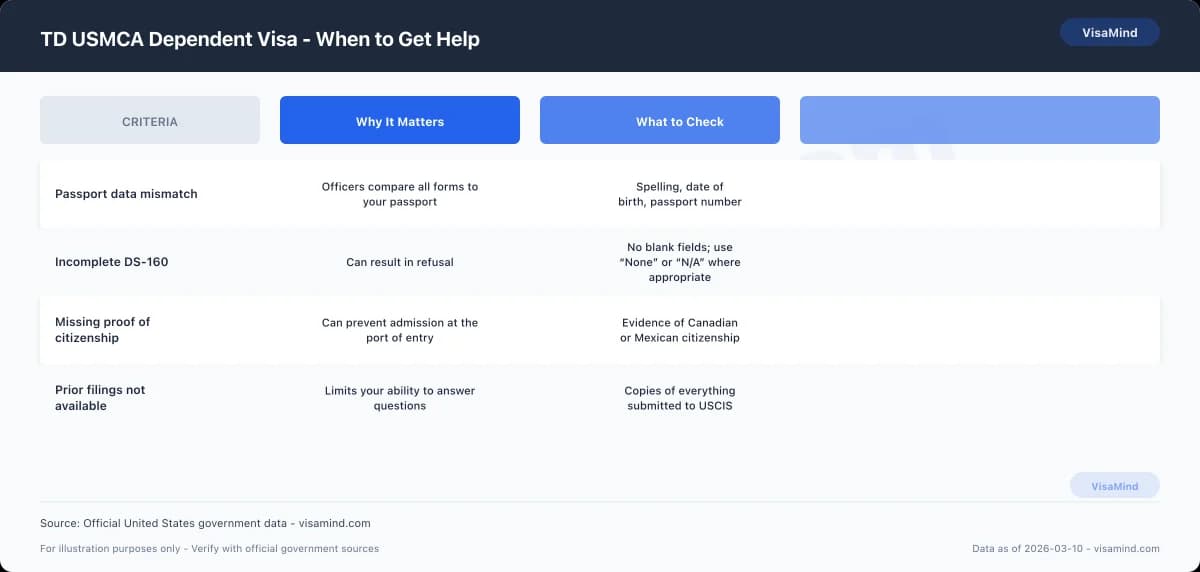
Focus on these high-risk areas:
| Issue | Why It Matters | What to Check |
|---|---|---|
| Passport data mismatch | Officers compare all forms to your passport | Spelling, date of birth, passport number |
| Incomplete DS-160 | Can result in refusal | No blank fields; use “None” or “N/A” where appropriate |
| Missing proof of citizenship | Can prevent admission at the port of entry | Evidence of Canadian or Mexican citizenship |
| Prior filings not available | Limits your ability to answer questions | Copies of everything submitted to USCIS |
Canadian citizens must present proof of Canadian citizenship when seeking entry.
Mexican citizens must obtain a TN visa before applying for admission.
Applying at a U.S. consulate when not required can complicate your case.
If your information does not match exactly across documents, fix the issue before you apply again.
Complex sponsor or eligibility issues
You should consult an attorney if the TN principal’s status is unclear or recently changed.
Your TD eligibility depends on the TN professional’s valid status.
Situations that require careful review include:
- Questions about whether the TN principal properly obtained status
- Gaps in the TN principal’s documentation
- Confusion about whether you qualify as an eligible family member
- Plans to change from TD to another category, such as a family-based immigration process
You cannot work in TD status.
If you intend to work in the United States, you must explore another lawful status through USCIS.
If a consular officer or CBP officer questions your relationship or eligibility, you must respond clearly and consistently with prior filings.
When your case involves prior complications, detailed review before submission reduces the risk of delay or denial.
Fees and Processing Times
#You’ll pay a standard visa fee and complete the online Form DS-160 before scheduling a consular interview.
processing times depend on the visa category selected in the system and the specific U.S. embassy or consulate handling your case.
Application and visa fees
Most TD visa applicants pay a Machine Readable Visa (MRV) fee of $185.
You pay this fee to the U.S. Department of State when you schedule your consular interview.
Use the Department of State’s official fee payment system to confirm accepted payment methods in your country.
Fee collection procedures vary by location.
Key points:
- MRV fee: $185
- Who pays: Each TD applicant
- Paid to: U.S. Department of State
- Refundable: Generally no, even if the visa is refused
If you apply for a change or extension of TD status inside the United States, U.S. Citizenship and Immigration Services (USCIS) may charge separate filing fees.
Check the USCIS website and fee calculator for current amounts before filing.
TD status does not authorize work.
If you later pursue employment-based or family-based immigration benefits, separate petitions and government filing fees will apply.
DS-160 and consular processing windows
You must complete Form DS-160, Online Nonimmigrant Visa Application, before booking your interview.
The DS-160 itself is electronic, but overall wait times depend on interview availability and case workload at your selected consulate.
As of February 2026, reported processing windows by visa grouping range widely:
| Visa Category Grouping | Reported Time Range |
|---|---|
| Visitor (B1/B2) | 0.5 to 23 months |
| Student/Exchange (F, M, J) | 0.5 to 7.5 months |
| Petition-based (H, L, O, P, Q) | 0.5 to 4.5 months |
| Crew and Transit (C, D, C1/D) | 0.5 to 14 months |
TD visas fall under nonimmigrant processing handled by the U.S. Department of State.
In many locations, applicants see overall processing periods of about 2 to 8 weeks, but actual timing depends on local demand and staffing.
Always review the specific embassy or consulate’s posted interview wait times before you finalize travel plans.
Variability and how to verify times
Processing times change frequently.
Workload, staffing levels, and local conditions at each U.S. embassy or consulate directly affect how quickly you receive an interview and visa decision.
You should verify timing in three steps:
-
Check interview wait times on the U.S. Department of State website for your specific city.
-
Confirm appointment availability through the consulate’s scheduling system after submitting the DS-160.
-
Review any case-specific instructions sent after your interview.
If you apply for a TD extension or change of status inside the United States, USCIS publishes separate case processing times on its website.
Do not rely on general averages when planning travel, school enrollment, or family-based immigration filings.
Path to Permanent Residence
#A TD visa does not provide a direct path to permanent residence.
You must qualify independently through a petition-based or family-based immigration process, and most employment-based options require a petition filed with U.S. Citizenship and Immigration Services (USCIS).
Forms filed with USCIS
If you pursue permanent residence through employment or certain family relationships, a petition must be filed with USCIS.
In employment-based cases, the employer typically files Form I-129 for a qualifying nonimmigrant worker before you apply for a visa at a U.S. consulate.
If a petition is required, you must wait for USCIS approval before completing the Form DS-160 for visa processing abroad.
The U.S. Department of State will verify that the petition is approved at the time of your interview.
| Step | Agency | Purpose |
|---|---|---|
| Petition filing (e.g., Form I-129) | USCIS | Reviews and approves employer’s request |
| Visa application (Form DS-160) | U.S. Department of State | Processes visa issuance at consulate |
| Admission to the U.S. | U.S. Customs and Border Protection (CBP) | Determines entry at port of entry |
Employer petitions and petition-based categories
If you seek permanent residence through work, your employer usually starts the process.
Petition-based categories require the employer to file the appropriate petition with USCIS before you can move forward with visa processing.
You cannot rely on TD status alone to transition to permanent residence.
Instead, you must qualify under an employment-based or family-based immigration category.
When a petition is required:
- The employer files with USCIS.
- USCIS must approve the petition.
- You then complete Form DS-160 for consular processing, if applying abroad.
- The consulate confirms petition approval during the interview.
For family-based immigration, a qualifying relative files the required petition with USCIS.
USCIS approval is a required step before immigrant visa processing through the U.S. Department of State.
Practical tips when petitions apply
Timing matters.
If your case requires an approved Form I-129 or other petition, do not submit Form DS-160 until USCIS has approved the petition.
Keep copies of:
- The USCIS approval notice.
- The full petition package filed on your behalf.
- Your current TD status documents.
Before any filing:
-
Confirm which petition applies to your situation.
-
Review the most recent form instructions on the USCIS website.
-
Verify visa application steps with the U.S. Department of State.
You cannot work in TD status.
If your path to permanent residence depends on employment, make sure the proper petition is filed and approved before you take any steps tied to work authorization.
Conditions and Rights
#Your TD status depends entirely on the TN principal’s eligibility and admission.
You may enter and stay in the United States only while the TN professional maintains valid status and continues qualifying employment.
Work-related eligibility for TN principals
Your TD status exists because of the TN principal’s employment.
If the TN professional does not qualify, you cannot qualify as a dependent.
To qualify for TN classification, the principal must meet all of the following:
- Be a citizen of Canada or Mexico
- Have a profession listed under the United States–Mexico–Canada Agreement (USMCA)
- Have a U.S. position that requires a USMCA professional
- Work in a prearranged full-time or part-time job for a U.S. employer
The TN professional presents required documentation to a U.S. Customs and Border Protection (CBP) officer at a designated port of entry.
If U.S. Citizenship and Immigration Services (USCIS) denies or revokes the TN worker’s status, your TD status ends as well.
TD classification does not provide independent work authorization and does not convert into a family-based immigration category.
Entry and port-of-entry conditions
Approval for a TD visa doesn't replace inspection at entry. CBP officers make the final decision on admission each time you seek entry to the United States.
If you apply for a TD visa at a U.S. consulate, you must complete Form DS-160, Online Nonimmigrant Visa Application, through the U.S. Department of State. Visa issuance allows you to travel to a U.S. port of entry and request admission.
At the port of entry, CBP may review:
- Proof of your relationship to the TN principal
- Evidence of the TN principal’s valid status
- Your identity and citizenship documents
CBP can admit you, limit your stay, or refuse admission. You must comply with the period of stay granted at entry.
What approval does and does not guarantee
TD approval allows you to accompany or follow to join a TN professional. It does not grant employment authorization in the United States.
| TD Approval Allows | TD Approval Does Not Allow |
|---|---|
| Travel to a U.S. port of entry | Automatic admission into the United States |
| Stay during the TN principal’s valid period | Employment or self-employment |
| Apply for a visa through the U.S. Department of State (if required) | Independent immigration status separate from the TN principal |
Filing an application or appearing at a port of entry doesn't guarantee approval. USCIS may adjudicate related benefits, but CBP determines admission, and the U.S. Department of State handles visa issuance.
TD status is temporary and tied to the TN worker’s authorized employment. It does not provide a direct path to permanent residence through family-based immigration.
Required Documents
#You must present clear proof of identity, citizenship, and the principal TN worker’s qualifying employment. CBP reviews your documents at entry, and the U.S. Department of State reviews them during visa processing, if required.
Identity and citizenship evidence
You must prove your identity and citizenship before admission in TD status.
Prepare the following:
- Valid passport showing your citizenship
- Proof of Canadian citizenship, if applicable
- Any required visa documentation issued through the U.S. Department of State, if you apply through consular processing
CBP officers determine admission at the port of entry. They'll review your passport and confirm your eligibility as a dependent of a TN professional.
If you complete online visa processing, download the current TD form and instructions from the USCIS website and review them carefully before submission. Follow all form instructions and sign where required.
Use this checklist to stay organized:
| Document | Who Reviews It | Purpose |
|---|---|---|
| Passport | CBP / Department of State | Confirms identity and nationality |
| Proof of citizenship | CBP | Establishes eligibility |
| Completed required forms (if applicable) | USCIS / Department of State | Supports visa processing |
Employment and qualification evidence
Your eligibility depends on the TN principal’s qualifying employment.
You must carry documentation that confirms:
- The professional role the TN worker will perform in the United States
- The purpose of employment
- The intended length of stay
- The TN worker’s educational qualifications
- Any required credentials evaluation, if applicable
A detailed employer letter should describe the professional capacity in which the TN worker will operate. The letter must state how long the employment will last and explain the purpose of the position.
CBP officers review this information to confirm that the TN worker meets professional requirements. Without clear documentation, you risk delays or refusal of admission.
Use this reference table:
| Evidence Type | What It Must Show |
|---|---|
| Employer letter | Role, purpose, length of stay |
| Degree or diploma | Required educational background |
| Credentials evaluation (if needed) | U.S. equivalency of education |
How to prepare and submit supporting evidence
You must follow official instructions exactly when preparing your application.
-
Download the current TD form and instructions from the USCIS website.
-
Review eligibility requirements carefully before completing the form.
-
Complete all required sections accurately.
-
Sign the form where required.
-
Submit it with all required supporting documents and applicable fees.
Do not leave sections blank unless the form specifically allows it. Incomplete submissions can cause delays.
For visa interviews and issuance, follow guidance from the U.S. Department of State. For admission at entry, present your documents directly to CBP.
Each agency reviews your evidence for a different purpose. Ensure your documents are complete and consistent.
Renewal and Extension
#You must keep your TD status valid at all times. You can request an extension through U.S. Citizenship and Immigration Services (USCIS) or apply for a new visa through a U.S. consulate abroad, depending on your situation.
Filing with USCIS vs. consular routes
You have two primary options: file for an extension inside the United States with USCIS or apply for a new TD visa through consular processing with the U.S. Department of State.
If you remain in the United States and want to extend your stay, you file the appropriate application with USCIS before your current status expires. USCIS decides whether to approve the extension of stay.
If you travel abroad, you may apply for a new TD visa stamp at a U.S. consulate by submitting Form DS-160 and attending a visa interview, if required. The Department of State issues the visa, and U.S. Customs and Border Protection (CBP) determines admission at the port of entry.
| Option | Who Decides | When to Use | Key Form |
|---|---|---|---|
| Extension in U.S. | USCIS | You remain in the U.S. and need more time | Check USCIS website |
| New visa abroad | U.S. Department of State | You travel internationally and need a visa stamp | DS-160 |
Your TD status depends on the TN principal’s valid status. If the TN worker changes employers or extends status, you must ensure your own status remains valid.
Keeping records and privacy considerations
You must keep copies of every filing and approval notice. Maintain:
- USCIS receipt and approval notices
- Copies of your DS-160 confirmation page
- Passport biographic page and visa stamp
- I-94 admission record
- Proof of your relationship to the TN principal
Store these records securely. They contain personal information that USCIS and the Department of State use to verify identity and eligibility.
If you later pursue family-based immigration, these documents help confirm lawful entry and continuous status.
Avoid sharing immigration documents through unsecured email or public platforms. Provide copies only when required by USCIS, the Department of State, or legal counsel.
Responding to requests for evidence
USCIS may issue a Request for Evidence (RFE) if it needs more documentation. You must respond by the stated deadline.
Read the notice carefully and provide exactly what USCIS requests. Common issues include:
- Proof of the TN principal’s valid status
- Evidence of your qualifying family relationship
- Clarification of prior immigration history
Submit organized copies, not originals, unless USCIS specifically requests originals. Include a clear cover letter that lists each item in the RFE and where you address it in your response packet.
Failure to respond on time can result in denial. Always keep proof of delivery for your records.
Application Process
#You apply for TD status after the TN principal takes action on their own status. The process involves completing the Form DS-160, preparing for a visa interview if required, and presenting documents either at a U.S. consulate or a U.S. port of entry.
Two-stage steps (principal + dependent)
You cannot obtain TD status unless the principal qualifies for or already holds TN status. The process moves in two coordinated stages.
TN principal applies first
Applies for TN status at a U.S. Embassy or Consulate (for Mexican citizens)
-
Or presents required documentation to a U.S. Customs and Border Protection (CBP) officer at a designated U.S. port of entry
TD dependent applies after or with the principal
Completes Form DS-160, Online Nonimmigrant Visa Application
-
Schedules a visa interview, if required
-
Presents proof of the qualifying relationship
Your eligibility as a TD applicant depends on:
- A valid TN principal
- A qualifying family relationship
- Intent to remain in the United States only temporarily
- No plan to engage in work
TD status does not provide employment authorization. It also does not convert into a family-based immigration benefit.
| Step | TN Principal | TD Dependent |
|---|---|---|
| Status Application | Applies for TN classification | Applies for TD classification |
| Government Authority | U.S. Department of State or CBP | U.S. Department of State or CBP |
| Work Authorization | Authorized under TN | Not authorized |
DS-160 completion and interview preparation
You must submit a separate DS-160 for each TD applicant, including children. Complete the form online before scheduling your visa interview.
Follow these practical steps:
- Save your application ID before exiting the system
- Complete the form in one sitting when possible
- Upload a compliant passport-style photo
- Print the DS-160 barcode confirmation page
If you fail to upload a compliant photo, processing may slow down. The system allows you to retrieve saved data for a limited time.
After submitting the DS-160:
-
Schedule your visa interview at a U.S. Embassy or Consulate.
-
Bring the printed confirmation page.
-
Prepare documentation showing your relationship to the TN principal.
The U.S. Department of State manages visa interviews and issuance.
Port-of-entry and consular application differences
Your location and nationality determine whether you apply at a U.S. consulate or at a port of entry.
For example, Mexican citizens applying for TN status must first obtain a visa from a U.S. Embassy or Consulate. After visa issuance, they may seek admission by presenting documentation to a CBP officer at a designated port of entry.
At a port of entry:
- A CBP officer reviews your documents
- CBP determines whether to admit you in TD status
At a consulate:
- You attend a visa interview
- A consular officer decides whether to issue the TD visa
- CBP makes the final admission decision when you arrive in the United States
| Location | Who Decides Visa | Who Decides Admission |
|---|---|---|
| U.S. Embassy/Consulate | U.S. Department of State | CBP at entry |
| Port of Entry | Not applicable (visa already issued or not required) | CBP |
Eligibility Requirements
#To qualify for TD status, your eligibility depends entirely on the TN principal worker’s status and your qualifying family relationship. You must meet specific citizenship, relationship, and classification limits to receive approval.
Who the principal must be
Your eligibility starts with the TN principal. If the principal does not qualify, you cannot obtain TD status.
The principal must:
- Be a citizen of Canada or Mexico
- Seek temporary entry to the United States in TN nonimmigrant classification
- Work in a profession listed under the United States–Mexico–Canada Agreement (USMCA)
- Have a position in the United States that requires a USMCA professional
- Have a prearranged full-time or part-time job with a U.S. employer
TD status is entirely dependent on the TN worker’s lawful admission and maintenance of status. If the principal falls out of status, your TD classification ends as well.
USCIS handles status-related benefits inside the United States. The U.S. Department of State manages visa applications abroad, including submission of Form DS-160 for Mexican applicants.
| Requirement | TN Principal Must Meet |
|---|---|
| Citizenship | Canada or Mexico |
| Profession | Listed under USMCA |
| Job Offer | Prearranged U.S. employment |
| Classification | TN nonimmigrant |
Who the dependent must be
You must qualify as an immediate family member of the TN professional. TD status is limited to specific relationships.
You may qualify if you are:
- The spouse of a TN nonimmigrant, or
- An unmarried child under 21 years of age
No other relatives qualify. Parents, married children, and siblings are not eligible under this category.
TD status does not authorize employment in the United States. If you want to work, you must independently qualify for a separate nonimmigrant classification.
TD status also does not provide a direct path to permanent residence through family-based immigration. It remains a temporary, dependent classification tied to the TN worker’s stay.
| Eligible Dependent | Qualifies for TD? |
|---|---|
| Spouse | Yes |
| Unmarried child under 21 | Yes |
| Married child | No |
| Parent | No |
Nationality and category limits
Nationality rules apply differently to the principal and the dependent.
The principal must be a citizen of Canada or Mexico to qualify for TN status. Without this citizenship, TN classification is not available.
TD classification is limited to dependents of TN nonimmigrants. It does not apply to dependents of other employment categories.
Mexican dependents generally apply for a visa through the U.S. Department of State using Form DS-160 before seeking admission. Canadian citizens follow the applicable admission procedures for their nationality.
TD status remains temporary. It does not convert into work authorization, and it does not function as a substitute for an employment-based or family-based immigration category.
Relationship Scrutiny Red Flags
#Consular officers and U.S. Citizenship and Immigration Services (USCIS) review your application for accuracy and consistency. Small errors in documents, forms, or visa category selection can delay or derail a TD visa.
Common documentary problems
Officers expect clear, consistent proof of your qualifying relationship to the principal TN professional. Incomplete or inconsistent documents cause delays.
Every document should match the information in your Form DS-160 and any filings with USCIS. Names, dates, and biographical details need to align exactly across all records.
Focus on these basics:
- Provide complete civil documents that clearly show the family relationship.
- Ensure spellings and dates match your passport and DS-160.
- Avoid submitting unclear or low-quality copies.
If your documents conflict with prior immigration filings, including past work or family-based immigration applications, the officer may question credibility. Review your full immigration history before you apply.
Application and photo specification mistakes
A non-compliant visa photo frequently causes problems. The U.S. Department of State sets strict photo standards for visa applications.
You must follow the official photo specifications exactly. Don’t reuse an old photo or submit a guess.
| Issue | Likely Result | What You Should Do |
|---|---|---|
| Poor-quality photo | Processing delay | Use a professional service familiar with U.S. visa standards |
| Photo that does not meet State Department rules | Application refusal or request for new photo | Verify requirements with the U.S. Department of State before submission |
Make sure the photo you upload with the DS-160 meets current specifications. If the system rejects your image, fix it before scheduling your interview.
Choosing the correct visa category
Selecting the wrong visa category usually leads to rejection. You must choose a category that matches your actual purpose in the United States.
A TD visa allows you to accompany or follow to join a TN professional. It does not authorize employment.
If you intend to:
- Work in the United States, you need a work-authorized visa classification.
- Immigrate permanently through family-based immigration, you must pursue the appropriate immigrant visa process.
- Visit temporarily for tourism or business, a visitor category may apply instead.
Choosing the correct classification from the start prevents unnecessary denials and repeat filings.
Fees
#| Component | Amount |
|---|---|
| Application fee (MRV)MRV fee (TN/TD NAFTA dependent) | $185 |
Fees change; always verify on USCIS.
Required forms
#Next steps
#Use Find My Visa to build a sequenced plan with official sources and deadlines.
FAQs
Can you apply for family-based immigration while on a TD visa?
Yes. You may pursue family-based immigration if you qualify.
You’ll need to file the required immigrant petition with USCIS. The process depends on your specific situation.
Refer to USCIS for the latest filing instructions and fee information.
Who qualifies for a TD USMCA dependent visa?
The TD dependent visa is used by spouses and unmarried minor children of TN nonimmigrants to enter or extend their stay in the U.S. Spouses and unmarried children under 21 of TN nonimmigrants may be eligible. TN nonimmigrants are qualified Canadian and Mexican citizens seeking temporary entry for professional-level business activities under USMCA.
What proof should Canadian dependents present at the U.S. port of entry?
You must provide proof of Canadian citizenship and any required documentation the CBP officer requests (for example, employer letter or other evidence related to the principal's TN status).
Do Mexican citizens need a visa to enter as TN nonimmigrants?
Yes. Mexican citizens must apply for a TN visa at a U.S. Embassy or Consulate before seeking entry; there are specific consular TN visa application requirements for Mexican nationals.
What application form is commonly required for nonimmigrant visas?
Visa applicants must submit a completed Form DS-160, the Online Nonimmigrant Visa Application, and should print and keep the DS-160 barcode/confirmation page as part of the process.
How much is the MRV (visa application) fee?
The application fee (MRV) is $185 (as of 2026-02).
How long can processing take for DS-160-based visa categories?
processing times vary by category and location. Published Form DS-160 processing ranges include examples such as 0.5 to 23 months for Visitor (B1/B2), 0.5 to 7.5 months for Student/Exchange (F, M, J), 0.5 to 4.5 months for petition-based categories (H, L, O, P, Q), and 0.5 to 14 months for Crew and Transit; verify current times with the issuing authority.
Does filing the required form guarantee approval?
No. Filing the form does not guarantee approval.
What common application mistakes should I avoid?
Avoid not providing proof of Canadian citizenship at the port of entry, applying for a TN visa at a U.S. consulate when Canadians are not required to, failing to obtain a TN visa when required for Mexican citizens, inconsistent information across forms (especially Form DS-160 and passport), poor-quality or non-compliant visa photos, choosing the wrong visa category, and leaving security/background questions incomplete.
Where can I download the current forms and instructions?
You can download the current TD form and instructions from the official USCIS website and should review the instructions for your eligibility category before starting.
Any practical tips for completing DS-160 and visa materials?
Save your application ID and, if possible, complete Form DS-160 in one sitting (data retrievable for 30 days); upload and print the DS-160 confirmation page to include with your visa application; prepare passport-style photos to the State Department specifications; and ensure all information matches your passport and supporting documents exactly.
Official sources referenced
Last reviewed: 2026-03-10
VisaMind provides informational guidance only and is not a government agency. This is not legal advice. Requirements can change and eligibility depends on your specific facts. If your case is complex or high-stakes, consult a licensed immigration attorney.
Next steps
Every United States visa case depends on your nationality, purpose, and timeline. Get a personalized plan with official sources and deadlines.
Find my visa