Who This Is For
#Foreign nationals seeking medical treatment in India can apply for a Medical Visa, which is specifically designed for individuals whose primary purpose of visiting India is to undergo medical procedures. Managed by the Bureau of Immigration, this visa caters to a wide range of treatments, including those under traditional Indian systems of medicine.
Eligibility Criteria
To qualify for a Medical Visa, you must meet several key requirements:
- Sole Purpose: Your visit to India should be exclusively for medical treatment.
- Passport Validity: Your passport must be valid for at least six months from the date of application.
- Financial Stability: You need to have a return or onward journey ticket and sufficient funds for your stay in India.
- Eligible Nationalities: Nationals from countries listed on the e-Visa website are eligible to apply. However, individuals of Pakistani origin or those holding Pakistani passports are not eligible for the e-Visa.
- Medical Attendant Visas: Up to two e-Medical Attendant Visas can be granted for individuals accompanying the patient on a Medical Visa.
Who Should Consider This Visa?
This visa is ideal for those seeking medical procedures in India, whether they involve complex surgeries or specialized treatments. India's healthcare system is renowned for its advanced technology and experienced medical professionals, making it a popular choice for international patients. If you require treatment under traditional Indian systems, such as Ayurveda or Yoga, this visa also accommodates those needs.
Tip: Ensure that you have a letter from the Indian hospital confirming your admission for treatment. This document is crucial for your visa application.
Important Considerations
- Entry Points: You must enter India through designated international airports or seaports.
- FRRO Registration: If your stay exceeds 180 days, you must register with the Foreigners Regional Registration Office (FRRO) within two weeks of the 180-day period ending.
- e-Medical Visa: If you prefer the convenience of applying online, consider the e-Medical Visa option, which streamlines the process.
For those planning to seek medical attention in India, the Medical Visa provides a structured pathway to access the country's healthcare facilities. Ensure that all requirements are met to facilitate a smooth application process. For more detailed guidance on application procedures, you may refer to the How To Apply guide.
Requirements to Meet
#To apply for a Medical Visa for India, there are specific requirements you need to meet. This visa is intended for international travelers whose primary purpose is to seek medical treatment in India, including traditional Indian systems of medicine.
Eligibility Criteria
- Medical Purpose: Your visit to India must be solely for medical treatment. This includes treatments across various medical systems offered in India.
- Passport Validity: Your passport should have at least six months of validity at the time of applying for the visa.
- Return or Onward Ticket: You should have a return ticket or an onward journey ticket to demonstrate your planned departure from India after treatment.
- Financial Means: You must have sufficient financial means to cover your expenses during your stay in India.
- Nationality Restrictions: The e-Medical Visa service is available to nationals of specific countries as listed on the e-Visa website. Nationals of Pakistani origin or those holding a Pakistani passport are not eligible for the e-Visa.
Documentation Requirements
- Hospital Letter: A letter from the hospital in India is mandatory. This letter should be printed on the hospital's letterhead and must include the tentative date of admission/treatment, your name, nationality, and passport number.
- Passport Bio Page: A scanned copy of the bio page of your passport showing your photograph and personal details.
- Entry and Exit Points: You must enter India through designated international airports or seaports as specified for e-Visa holders.
Additional Considerations
- Accompanying Attendants: If you require assistance during your medical treatment, up to two e-Medical Attendant Visas can be granted for individuals accompanying you.
- FRRO Registration: If your stay in India extends beyond 180 days, you must register with the Foreigners Regional Registration Office (FRRO) within two weeks after the expiry of those 180 days. If your stay is less than 180 days, registration is not required.
Important: Make sure your passport has a validity of at least six months at the time of application to avoid any processing issues.
For more detailed guidance on how to proceed with your application, you can refer to the How To Apply guide. Additionally, ensure you have all the necessary documents ready by checking the Documents Checklist.
By meeting these requirements and preparing your documents accurately, you can facilitate a smoother application process for your Medical Visa to India.
How to Apply
#Begin Your Application Online
To apply for a Medical Visa for India, start by accessing the official e-Visa portal. Ensure you apply at least four days before your intended date of arrival in India to allow for processing time. You will need to upload a recent front-facing photograph with a white background and a scanned copy of the bio page of your passport showing your photograph and personal details. Make sure your passport has at least six months of validity remaining at the time of application.
Gather and Upload Required Documents
Prepare the necessary documentation, including a letter from the hospital in India where you plan to receive treatment. This letter should be on the hospital's letterhead and include the tentative date of admission, your name, nationality, and passport number. Upload these documents to the online portal as part of your application. It's important to provide clear and legible copies to avoid delays.
Pay the Visa Fee
Once your application and documents are uploaded, proceed to pay the e-Visa fee. You can pay using a credit/debit card or a payment wallet. The fee varies depending on your nationality and the duration of the visa. Make sure to verify the payment and keep a copy of the confirmation for your records.
Receive and Print the Electronic Travel Authorization (ETA)
After the successful submission of your application and payment, you will receive an Electronic Travel Authorization (ETA) via email. Print a copy of the ETA, as you will need to present it at the Immigration Check Post upon your arrival in India. The e-Visa will be stamped on your passport at the designated entry point.
Travel to India and Immigration Check
When traveling to India, enter through one of the designated international airports or seaports. Present your ETA at the Immigration Check Post, where it will be verified, and your e-Medical Visa will be stamped into your passport. Make sure to carry all relevant documentation, including your ETA and hospital letter, to ensure a smooth entry process.
Important: Ensure that your ETA status is marked as 'GRANTED' before travel. Attempting to enter India with an unapproved ETA will result in denial of entry.
For additional guidance, you may refer to the How To Apply guide and the Documents Checklist to ensure you have all necessary information and documents ready for your application.
What You Need to Submit
#You'll need to gather a comprehensive set of documents to support your application. This visa is specifically for those seeking medical treatment in India, and it's essential to ensure that you have everything in order before you apply.
Essential Documents
-
Passport: Ensure your passport has at least six months of validity from the date of your application.
-
Photograph: A recent front-facing photograph with a white background is required.
-
Hospital Letter: Obtain a letter from the concerned hospital in India. This letter should be on the hospital's letterhead and include details like the tentative date of admission, treatment plans, and your personal information such as name, nationality, and passport number.
-
Proof of Financial Means: Evidence that you have sufficient funds to support your stay in India, such as bank statements or proof of income.
Additional Requirements
-
Return or Onward Journey Ticket: Provide proof of a return ticket or onward travel arrangements.
-
Electronic Travel Authorization (ETA): After applying online, you will receive an ETA that must be presented upon arrival in India.
-
Entry and Exit Points: Be aware of the designated international airports or seaports for entry and exit with an e-Visa. This information is crucial to ensure a smooth arrival and departure.
Supporting Documents
-
Medical History: While not always mandatory, having your medical history and any relevant reports can be beneficial.
-
Visa for Attendants: If applicable, note that only two e-Medical Attendant Visas can be granted against one e-Medical Visa for those accompanying the patient.
Tip: Make sure all documents, especially the hospital letter, are clear and legible to avoid delays in processing.
Translation and Certification
-
Language Requirements: If your documents are not in English, certified translations may be necessary. Ensure translations are accurate and certified by an authorized body.
-
Certifications: Some documents might require notarization or certification by relevant authorities, particularly if they involve legal or official matters.
For a detailed checklist of documents, you can refer to our Documents Checklist. Additionally, ensure you are aware of the Visa Refusal Reasons to avoid common pitfalls during your application process.
As you prepare your application, remember to apply online well in advance of your planned travel date. The E Medical Visa process includes uploading necessary documents, so having them ready in digital format is crucial.
Processing Times and Milestones
#Processing times for the Medical Visa for India can vary based on several factors, including the applicant's nationality, the completeness of the application, and the time of year. Here’s what you can generally expect regarding processing times and milestones:
Standard Processing Times
- e-Medical Visa: Typically, the processing time for an e-Medical Visa is around 72 hours, but applicants are advised to apply at least four days in advance of their intended travel date to account for any delays.
- Regular Medical Visa: The processing time for a regular Medical Visa, applied through Indian missions abroad, can range from 3 to 7 working days. This may vary based on the specific mission and current workload.
Factors Affecting Processing Speed
Several factors can influence how quickly your application is processed:
- Completeness of Application: Ensure all required documents, such as the letter from the hospital and a clear scanned copy of the passport, are submitted. Missing or unclear documents can delay processing.
- Nationality: Applicants from certain countries may experience different processing times due to additional verification requirements.
- Time of Year: Peak travel seasons can result in longer processing times due to increased application volumes.
Tip: For the quickest processing, apply for an e-Medical Visa online and ensure all documents are clear and meet the specified criteria.
Expedited Options
While there are no formal expedited processing options available for Medical Visas, applying for an e-Medical Visa can be a faster alternative due to its online application process. Ensure you have a stable internet connection to complete the process efficiently.
Key Milestones in the Process
- Application Submission: After submitting your application and documents online, you'll receive an acknowledgment.
- Payment Confirmation: Ensure your e-Visa fee payment is confirmed to avoid delays.
- ETA Reception: You will receive an Electronic Travel Authorization (ETA) via email, which you need to print and carry when traveling.
- Visa Stamping: Upon arrival in India, present your ETA at the Immigration Check Post to have your visa stamped.
For detailed guidance on the application process, visit How To Apply and Processing Times.
Pitfalls to Avoid
#-
Incomplete or Incorrect Documentation: Ensure that all required documents are uploaded clearly and accurately. This includes a properly formatted letter from the hospital in India with the tentative treatment date, patient's name, nationality, and passport number on the hospital's official letterhead.
-
Incorrect Passport Details: Double-check that the passport information entered matches exactly with the passport bio page. Incorrect details can lead to application refusal.
-
Photograph Issues: Upload a recent, front-facing photograph with a white background. Failure to do so can result in delays or rejection.
Entry and Travel Mistakes
-
Designated Entry Points: You must enter India through the designated international airports or seaports specified for e-Visa holders. Attempting to enter through a non-designated port can result in denial of entry.
-
Electronic Travel Authorization (ETA): Always carry a copy of your ETA during travel. Not having this document accessible can cause complications at the border.
Important: Ensure your ETA status is 'GRANTED' before traveling to India. Without confirmation, you may be denied entry.
Passport and Nationality Issues
-
Passport Validity: Your passport must be valid for at least six months from the date of e-Visa application. Applications with insufficient passport validity will be rejected.
-
Nationality Restrictions: Nationals of certain countries, such as those with Pakistani origin or Pakistani passports, are not eligible for an e-Visa. Verify your eligibility based on your nationality before applying.
Financial and Support Requirements
-
Return Ticket and Financial Proof: You must have a confirmed return or onward journey ticket and sufficient funds for your stay in India. Failure to demonstrate these can lead to visa refusal.
-
Medical Attendant Visas: If you require assistance, note that only two e-Medical Attendant Visas can be issued against one e-Medical Visa. Plan accordingly to avoid issues with bringing necessary support.
For more detailed information on potential visa refusal reasons, you can refer to the Visa Refusal Reasons guide. Additionally, ensure you have a comprehensive understanding of the Processing Times to plan your travel effectively.
Should You Consider Something Else?
#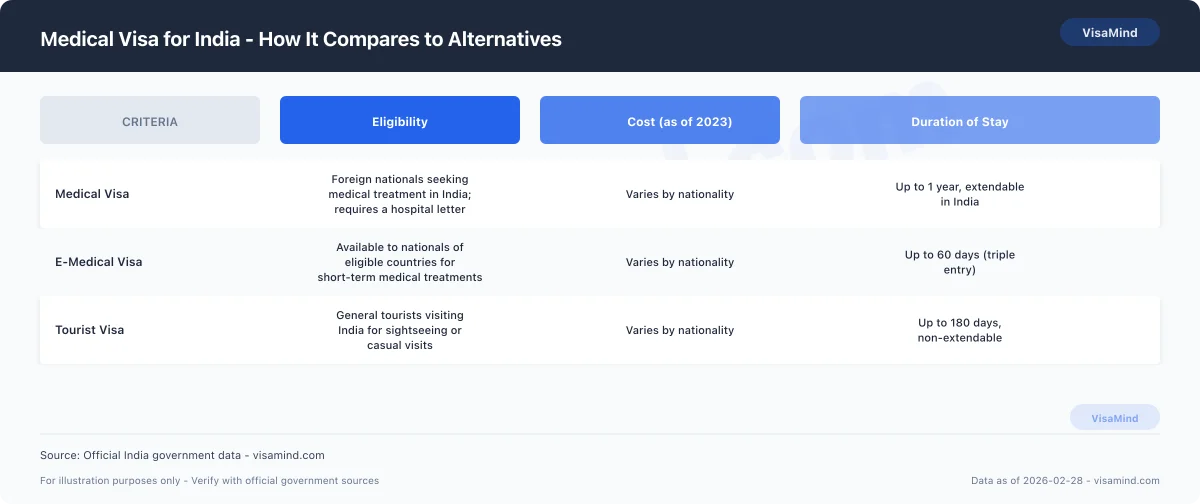
It is essential to understand the key differences between this visa type and other similar visas or programs. Below is a comparison of the Medical Visa with the e-Medical Visa and Tourist Visa, highlighting their eligibility, cost, and timeline.
| Visa Type | Eligibility | Cost | Timeline |
|---|---|---|---|
| Medical Visa | Available for foreign nationals visiting India for medical treatment, including traditional Indian medicine. | Varies by nationality; check with local consulate. | Typically issued for 1 year, extendable depending on treatment duration; registration with FRRO is required after 180 days. |
| e-Medical Visa | Available for nationals of countries listed on the e-Visa website, aiming for short-term medical treatment. | Fees vary; payment online. | Valid for 60 days from the date of arrival in India, with a triple entry permitted. No registration required if stay is less than 180 days. |
| Tourist Visa | Designed for international travelers visiting India for tourism. Not intended for medical purposes. | Varies by nationality; consult local embassy. | Typically valid for 6 months to 1 year with multiple entries, depending on nationality. No registration needed if stay is less than 180 days. |
Is the Medical Visa Right for You?
If your primary reason for visiting India is medical treatment, the Medical Visa or e-Medical Visa is the most appropriate choice. The Medical Visa is better suited for those who anticipate needing an extended stay due to ongoing or long-term treatment. This visa requires registration with the Foreigners Regional Registration Office (FRRO) for stays longer than 180 days, which can facilitate visa extensions if your treatment requires more time.
In contrast, the e-Medical Visa is more convenient for short-term visits, providing flexibility with a 60-day validity and triple entry, which is ideal for treatments that might require multiple visits within a short period.
Tip: Ensure you have a letter from the hospital in India detailing your treatment plan, as this is a key requirement for both the Medical Visa and e-Medical Visa applications.
When to Consider a Tourist Visa Instead
If you plan to undertake minor procedures or wish to combine medical consultations with leisure travel, a Tourist Visa may suffice for short visits. However, this visa does not support extensive medical treatments and lacks the extended stay provisions needed for comprehensive care.
For more detailed information on each visa type and the application process, you can explore guides like the How To Apply and Documents Checklist to ensure you gather the necessary documents and understand the requirements specific to your situation.
What It Costs
#Understanding the associated costs is essential. Here, we provide a breakdown of the application fees and financial requirements for this visa type.
What Are the Costs?
| Item | Description | Cost (USD) |
|---|---|---|
| e-Medical Visa Fee | The fee for applying for an e-Medical Visa, payable online during the application process | Varies by country |
| Proof of Financial Means | Evidence showing sufficient funds to cover stay and treatment in India | Amount not specified |
The cost of the e-Medical Visa can vary depending on your nationality, so it's crucial to check the specific fee applicable to your country. This fee must be paid online when you lodge your application.
Financial Requirements
When applying for a Medical Visa, you must demonstrate that you have adequate financial resources to cover your expenses during your stay in India. This includes the cost of medical treatment and living expenses. Although there is no specified amount, it is advisable to have a detailed plan and documentation ready to prove your financial capability.
Tip: Ensure that your passport is valid for at least six months at the time of your visa application. This is a common requirement for entry into India and can prevent unnecessary delays.
For more detailed information on financial requirements, you can consult the Financial Requirements guide.
Additional Considerations
In addition to the visa fee, you may incur other costs related to your travel and stay. These can include travel insurance, accommodation, and any additional medical services not covered by the primary treatment plan.
It is advisable to plan your finances carefully and ensure you have access to funds during your stay. This will help avoid any issues with the Foreigners Regional Registration Office (FRRO) upon your arrival in India.
For more insights on application processes and timelines, visit the How To Apply guide and Processing Times overview.
Rights and Conditions
#As a medical visa holder entering India for treatment, you will have specific rights and conditions to be aware of. These are designed to facilitate your stay and ensure you receive the necessary medical care while adhering to Indian immigration regulations. #
Work and Employment Rights
It is important to note that a medical visa does not grant you the right to work in India. The primary purpose of this visa is to receive medical treatment, and engaging in employment or business activities is prohibited. For work-related activities, you would need to explore other visa options such as the Employment Visa or Business Visa. #
Travel Flexibility
While on a medical visa, you can travel within India to attend medical appointments and receive treatment. However, your travel is generally restricted to activities related to your medical care. Ensure your travel itinerary aligns with the locations of your medical facilities and any follow-up care required. #
Accompanying Family Members
You are allowed to have up to two family members accompany you as medical attendants. They must obtain an e-Medical Attendant Visa, which is directly linked to your e-Medical Visa. This ensures that your family can support you during your treatment. For more information on visa options for family members, consider the Entry Visa. #
Registration with FRRO
For stays exceeding 180 days, registration with the Foreigners Regional Registration Office (FRRO) is mandatory within two weeks after the 180-day period. This is crucial to remain compliant with Indian immigration laws during extended treatments. > Tip: Keep a copy of your Electronic Travel Authorization (ETA) and relevant documents handy at all times to streamline your interactions with immigration authorities. #
Restrictions and Compliance
Be mindful of the following restrictions:
- Entry and Exit Points: You must enter and exit India through designated international airports or seaports as specified on your visa. - Validity of Documents: Ensure your passport has a minimum validity of six months from the date of your application. - Financial Preparedness: You should have sufficient funds to cover your stay and medical expenses in India, alongside a return or onward journey ticket. For further guidance on extending your stay or addressing other visa-related queries, consult the Visa Extension Guide or visit the Foreigners Regional Registration Office (FRRO) website.
Real Scenarios
#A Canadian citizen, John, was experiencing chronic pain that Western medicine could not alleviate. He decided to explore alternative treatments and learned about Ayurveda, a traditional Indian medicine system. John applied for a Medical Visa for India through the Bureau of Immigration's online portal, ensuring his passport had over six months of validity. He gathered necessary documents, including a letter from an Ayurvedic hospital in Kerala, detailing his expected treatment and stay. After submitting his application and paying the fee online, he received the Electronic Travel Authorization (ETA) confirmation within three days. John scheduled his travel to coincide with his treatment dates, entering India through a designated international airport. His treatment was successful, and he returned to Canada with significant improvements in his condition.
Scenario: Emergency Medical Treatment for a British National
Emma, a British software engineer, was diagnosed with a rare condition requiring immediate surgery. Her doctors recommended a specialized hospital in Mumbai known for its expertise in treating her ailment. Faced with time constraints, Emma quickly applied for an e-Medical Visa via the official Indian government website. She uploaded all necessary documents, including a detailed letter from the Indian hospital and her travel itinerary showing a return ticket. Aware of the urgency, she applied four days before her intended travel date and received her ETA promptly. Upon arrival in India, she presented the ETA at the immigration check post, where it was stamped onto her passport. Emma underwent the surgery successfully and stayed in India for the recommended recovery period before returning home.
FAQs
Can I switch from a Medical Visa to a Tourist Visa while in India?
How long can I stay in India on a Medical Visa before registering with FRRO?
What are the processing times for a Medical Visa for India?
What are common pitfalls to avoid when applying for a Medical Visa for India?
What is the application fee for a Medical Visa for India?
Are there any restrictions for Pakistani nationals applying for a Medical Visa for India?
Can I apply for an e-Medical Visa if I have a diplomatic passport?
Sources
Last reviewed: March 1, 2026
VisaMind provides informational guidance only and is not a government agency. This is not legal advice. Requirements can change and eligibility depends on your specific facts. If your case is complex or high-stakes, consult a licensed immigration attorney.
Next steps
Requirements vary by nationality, purpose, timeline, and case details. Use Find My Visa to get a personalized checklist for India with official sources and deadlines.
Find my visa