Official sources referenced
What Reviewers Look For
#For those applying to visit India, understanding the document requirements is crucial for a successful visa application. The Bureau of Immigration places a significant emphasis on thorough documentation to ensure applicants meet the necessary criteria for entry. Whether you're applying for an e-Tourist Visa, Business Visa, or Employment Visa, the specific documents required can vary, but certain principles guide all applications.
The Philosophy Behind Document Requirements
The Indian visa application process is designed to ensure that every applicant presents a complete and truthful depiction of their intent to visit. The Bureau of Immigration requires documentation that establishes your identity, purpose of visit, and ties to your home country. This approach helps in distinguishing genuine applicants and facilitates smoother processing at entry points managed by the Bureau.
Common Documents Required
To apply for any Indian visa, you generally need to provide:
- A valid passport with at least six months of validity from the date of arrival in India.
- A recent passport-sized photograph.
- A completed visa application form, which can be accessed through official channels.
- Proof of financial means to support yourself during your stay.
For certain categories, additional documentation might be necessary. For instance, applicants who are Persons of Indian Origin must provide a surrendered Indian passport with a surrender certificate if the surrender occurred on or after 2010. If you're applying for an e-Business Visa, you will need to present documents such as a business card or an invitation letter that reflects the business purpose of your visit.
What Reviewers Focus On
Visa officers at the Bureau of Immigration focus on verifying the authenticity and completeness of the documents provided. They look for documentation that clearly supports the stated purpose of your visit. For example, if you're seeking a Student Visa, they will expect to see a letter of admission from an Indian educational institution. Similarly, those applying for a Medical Visa should provide medical records or letters from the hospital where treatment is intended.
Tip: Pay close attention to the specific documentation requirements for your visa type to avoid delays or rejections. Each visa category has tailored requirements that must be met.
Avoiding Common Pitfalls
One of the most common reasons for visa application delays or rejections is incomplete or incorrect documentation. It's important to review the specific requirements for your visa category as outlined by the Bureau of Immigration. Missing key documents such as a marriage or birth certificate when required can lead to significant delays.
Important: Ensure that all documents are up-to-date and accurately reflect the information provided in your application. This is especially crucial for applicants who have changed their name or marital status recently.
By adhering to these guidelines and ensuring your documentation is thorough and accurate, you can enhance your chances of a successful visa application process. For more detailed guidance on the application process, you may want to explore our How To Apply guide.
Passport and ID Requirements
#When preparing to apply for an Indian visa, ensuring your passport and ID meet the necessary requirements is crucial. Below is a detailed checklist to guide you through the essential passport validity rules and identification requirements.
Passport Validity Rules
- Minimum Validity: Your passport must be valid for at least six months from the date of your intended arrival in India.
- Blank Pages: Ensure that your passport has a minimum of two blank pages for stamping by the immigration authorities.
Important: Passports nearing expiration may lead to visa application rejections or entry refusals upon arrival in India. Always double-check your passport’s expiration date before initiating any visa application process.
Identification Requirements
- Current Passport: You must provide a copy of your current passport. This should include the photo page and any pages with amendments.
- Cancelled/Surrendered Indian Passport: If you are a person of Indian origin who has surrendered your Indian passport in or after 2010, include a copy of the cancelled passport along with the surrender certificate.
- Photograph: A recent photograph that matches the one in your passport should be enclosed with your application, especially for e-Visa applications.
Additional Documentation for Specific Situations
- Birth/Marriage Certificate: While not always mandatory, having these documents ready can be beneficial, especially for those applying for Entry or OCI visas.
- International Document Holders: Note that the e-Visa facility is unavailable for holders of Diplomatic/Official passports, UNLP (UN Passport) holders, and international travel document holders.
Tip: For a seamless application experience, use the How To Apply guide to ensure all your documents are in order before lodging your application.
By ensuring your passport and identification documents meet these criteria, you position yourself for a more straightforward visa application process. Always refer to the Bureau of Immigration's official guidelines and verify current requirements to avoid any last-minute complications.
Photo Requirements
#It's crucial to meet the specific photo requirements set by the Bureau of Immigration. These specifications ensure your application is processed smoothly and without unnecessary delays. Here’s a detailed comparison of the photo specifications you need to adhere to:
| Specification | Requirement |
|---|---|
| Photo Dimensions | 2 inches x 2 inches (51 mm x 51 mm) |
| Background Color | Plain white or light background |
| Format | JPEG format |
Photo Dimensions
Your visa photo must be exactly 2 inches x 2 inches (51 mm x 51 mm). This is a standard size for many international visa applications, but it's important to verify this specific requirement when preparing your documents.
Background Color
The background of your photo should be plain white or light-colored. Avoid busy patterns or dark backgrounds, as these can lead to your application being rejected. A light background ensures clarity and focus on your facial features.
Format
The photo should be in JPEG format, a common digital image format that maintains quality while allowing for easy handling and transmission. Be sure to use a high-resolution image to avoid blurriness, ensuring your photo meets the required standards.
Important: Non-compliance with these photo specifications can result in delays or rejection of your application. Always double-check your photos before submission.
For more detailed guidance on the application process, consider reviewing our guides on How to Apply and understanding Visa Refusal Reasons to avoid common pitfalls.
Proof of Funds
#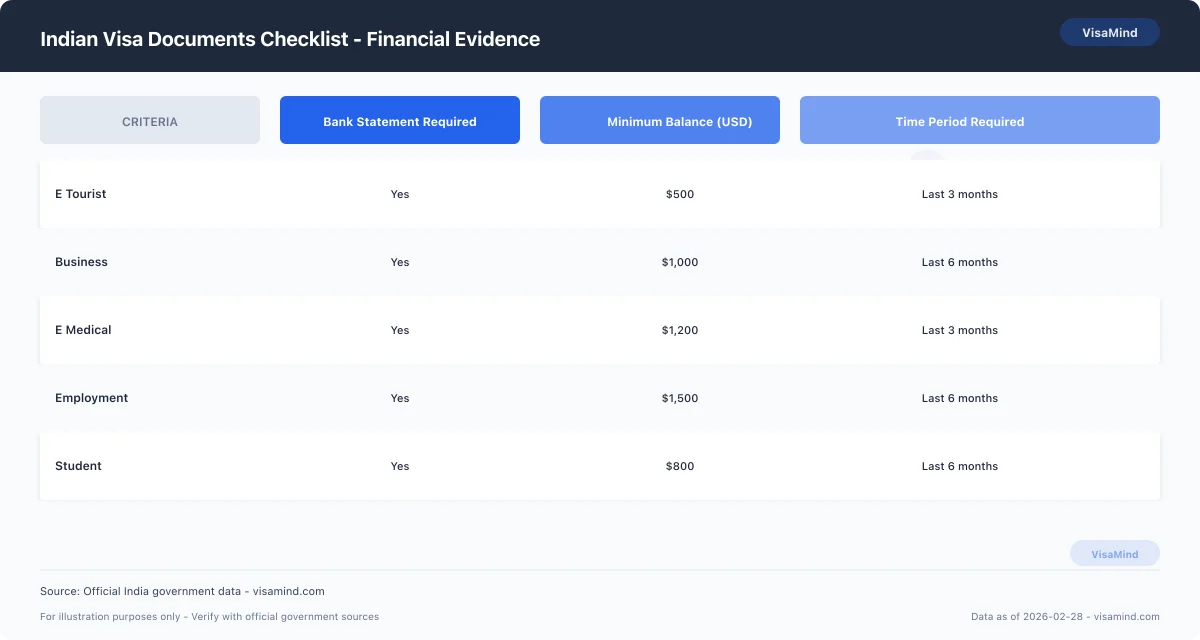
Demonstrating sufficient financial resources is a crucial step. This ensures that you can support yourself during your stay in India without requiring public funds. Here's what you need to know about the proof of funds requirements for different visa types.
Bank Statement Requirements
For most Indian visas, bank statements are a fundamental document required to prove financial stability. These statements should be recent, covering a specified period, typically the most recent 3-6 months. Ensure that your bank statements are in English or accompanied by a certified translation.
Required Amounts and Documentation
The required proof of funds may vary depending on the visa type. Below is a table comparing financial requirements for various visas:
| Visa Type | Proof of Funds Required | Time Period |
|---|---|---|
| E-Tourist Visa | $1,000 USD minimum balance (as of 2023) | Last 3 months |
| Employment Visa | $25,000 USD annual salary (as of 2023) | Employment contract duration |
| Student Visa | Tuition fees plus $10,000 USD for living expenses (as of 2023) | Full course duration |
| Business Visa | Business financial statement showing $50,000 USD annual turnover | Last fiscal year |
| Medical Visa | Proof of funds for treatment and $5,000 USD for additional expenses | Duration of treatment |
Important: These amounts are indicative as of 2023. Verify the most up-to-date requirements on the official Bureau of Immigration website.
Considerations for Different Visa Types
For an E Tourist visa, the emphasis is on ensuring you have enough funds for travel and accommodation. Meanwhile, an Employment Visa requires proof of a stable income, often verified through salary slips and employment contracts.
For Student Visas, you need to demonstrate your ability to cover tuition and living expenses, often through bank statements or scholarship letters. Business visa applicants must provide evidence of their business's financial health, which can include profit and loss statements and tax returns.
Tips for Submitting Financial Documents
- Ensure Clarity: Bank statements should clearly show your name and account details. Redacted statements are not accepted.
- Conversion to INR: If your bank statements are in a foreign currency, provide a conversion to Indian Rupees.
- Supplemental Documents: Consider including a cover letter explaining any large deposits or transactions.
Tip: Lodging your application with complete financial documents can prevent delays. If you're uncertain about the requirements, consult the Visa Refusal Reasons guide.
Remember, providing accurate and complete financial documents is essential for a smooth visa application process. Ensure your documents are up-to-date, and reach out to the relevant authorities if you have specific questions regarding your financial proof requirements.
Category-Specific Requirements
#Certain documents are required based on the category of visa being sought. These documents help verify your purpose of travel and ensure compliance with immigration regulations. Below, you'll find specific requirements for work, study, and family-related visas.
Work Visa Requirements
For those seeking an Employment Visa, documentation related to your job offer and qualifications is essential. Ensure you have the following:
- Contract of Employment: A signed contract from the Indian employer, detailing your role, salary, and duration of employment.
- Company Details: A letter from the Indian company, outlining its nature of business and confirming your employment.
- Professional Qualifications: Copies of your educational certificates and professional qualifications relevant to the job.
- Proof of Experience: Documentation of previous work experience in the related field.
Important: Employment visas are typically granted to highly skilled and qualified professionals. Ensure your documents reflect your expertise.
Student Visa Requirements
If you are applying for a Student Visa, you will need to present documents that confirm your enrollment and academic intentions:
- Admission Letter: An official acceptance letter from a recognized Indian educational institution.
- Proof of Funds: Evidence of sufficient financial resources to cover tuition and living expenses.
- Academic Records: Copies of previous educational certificates and transcripts.
- Student ID: If applicable, a student ID card or similar documentation from your institution.
Family and Relationship Visa Requirements
For those visiting family or joining a spouse in India on an Entry Visa, you must provide proof of relationship:
- Marriage Certificate: If joining a spouse, present a certified copy of your marriage certificate.
- Birth Certificate: For children joining parents, a certified copy of the birth certificate is required.
- Invitation Letter: A letter from your family member in India, including their contact information and address.
- Proof of Indian Origin: If applicable, documentation such as a cancelled Indian passport with a surrender certificate.
Tip: Ensure all your documents are translated into English if they are in another language, as this is a common requirement by the FRRO.
Always double-check the specific requirements for the type of visa you are applying for, as they may vary slightly. For more detailed guidance on visas, consider visiting our Visa Extension Guide and Employment Vs Project Visa pages.
Common Document Mistakes
#Applicants often encounter common document mistakes that can delay or complicate the process. Here are some of the most frequent errors to watch out for:
Incorrect Photos
- Wrong Size or Format: Ensure your photograph meets the specific requirements for your visa type. Generally, a 2x2 inch photo with a white background is needed.
- Poor Quality: Avoid blurry, dark, or overexposed photos. The image should be clear and show your face prominently.
- Old Photos: Use a recent photo, ideally taken within the last six months, to reflect your current appearance.
Expired or Invalid Documents
- Outdated Financial Statements: When required to show proof of funds, ensure that bank statements are current, typically from the past three months.
- Expired Passports: Your passport should be valid for at least six months beyond your intended stay in India. Check expiration dates carefully.
- Invalid Certificates: For those of Indian origin, ensure your cancelled or surrendered Indian passport is accompanied by the appropriate surrender certificate if applicable.
Missing Translations
- Non-English Documents: All documents not originally in English must be translated. This includes birth or marriage certificates if they are in a different language.
- Certified Translations: Ensure translations are certified. Non-certified translations may not be accepted by the Bureau of Immigration.
Important: Double-check that all your documents are complete and correct before submitting your application. Missing or incorrect documents can lead to delays or even rejection of your visa application.
For more information on visa types and their specific requirements, consider exploring guides like E Tourist Vs Tourist and Visa Refusal Reasons. Additionally, if you're planning an extended stay, the Visa Extension Guide can be a valuable resource.
Health and Character Requirements
#Important: When applying for an Indian visa, meeting the health and character requirements is crucial to ensure a successful application process.
Health Requirements
- Tuberculosis (TB) Test: If you are traveling from a country with a high incidence of TB, you may be required to undergo a TB test before lodging your application.
- Medical Examination: Depending on the type of visa you are applying for, a comprehensive medical examination may be required. This is particularly relevant for long-term visas such as the Employment Visa or Student Visa.
- Vaccination Records: While not always mandatory, having up-to-date vaccination records can be beneficial, especially if you are applying for a Medical Visa or E Medical Visa.
Character Requirements
- Police Clearance Certificate (PCC): A PCC from your home country may be required to demonstrate good character. This document is often necessary for long-term visas or any visa involving employment in India.
- Previous Visa History: Ensure that your past visa and travel history are clear of any violations. Any previous issues with Indian visas or entry could impact your current application.
- Legal Compliance: Adhering to local laws prior to your application is essential. Any legal infractions could hinder your ability to obtain a visa.
How to Obtain Required Documents
- TB Test and Medical Examination: You can arrange these through a certified medical facility recognized by the Indian authorities. It is advisable to carry copies of any reports during your travel.
- Police Clearance Certificate: Acquire a PCC well in advance from your local police department or a relevant government body. The process and time required to obtain a PCC can vary significantly by country.
Tip: Contact the nearest Indian embassy or consulate to confirm specific document requirements for your visa type. This can help avoid any last-minute issues during the application process.
For more detailed guidance on application procedures, visit our How To Apply guide. To understand processing times, you may refer to our Processing Times page.
Additional Local Requirements
#It's important to be aware of specific local requirements that might affect your application process. These requirements can vary depending on your visa type and personal circumstances, so it’s crucial to be well-prepared.
Documents for Persons of Indian Origin
If you're a Person of Indian Origin who has surrendered your Indian passport, you must present additional documentation:
-
Cancelled or Surrendered Indian Passport: Include your old Indian passport along with the surrender certificate if you surrendered your passport in or after 2010. This is essential to verify your previous nationality.
-
Birth or Marriage Certificate: These documents may be required to establish your identity and relationship status.
Important: Ensure that all documents are in English or are accompanied by a certified translation to avoid processing delays.
Special Requirements for Lodging Arrangements
If you are staying at a private residence during your visit to India, the host must comply with specific registration procedures:
- Form C (Appendix V): Hosts providing lodging to foreign nationals must submit Form C to the Foreigners Regional Registration Office (FRRO). This form includes the details of the foreign national staying at the premises.
Confirmation and Application Processing
Once you have gathered all the necessary documents and submitted your application, expect to receive a confirmation via email. This confirmation indicates that your application has been successfully lodged and is under review.
- E-Visa Confirmation: After applying for an e-Visa, you will receive an email confirmation on the email ID provided. This is an essential step in the process and confirms your application has been received for processing.
For more detailed guidance on types of visas, you might want to explore the differences between E Tourist Vs Tourist visas or consider options like the E Business Visa depending on your travel purpose.
Tip: To expedite the process, consider applying for your visa online. This can help you avoid mail delays and gives you a receipt number immediately for tracking your application status.
Understanding these local requirements and ensuring that all documentation is prepared and submitted correctly can significantly enhance your visa application experience. Always verify the latest requirements on the official Bureau of Immigration website to stay updated with any changes.
FAQs
What are the additional local requirements mentioned in the Indian Visa Documents Checklist?
Can you combine a business visit with sightseeing on an e-Visa to India?
What are the proof of funds requirements for the Indian Visa Documents Checklist?
How does the Indian Visa Documents Checklist address health and character requirements?
Can a student switch from a Student Visa to a Business Visa in India?
What is the procedure to download the Indian Visa Documents Checklist?
Is a birth or marriage certificate mandatory for the Indian Visa Documents Checklist?
Sources
Last reviewed: March 1, 2026
VisaMind provides informational guidance only and is not a government agency. This is not legal advice. Requirements can change and eligibility depends on your specific facts. If your case is complex or high-stakes, consult a licensed immigration attorney.
Next steps
Requirements vary by nationality, purpose, timeline, and case details. Use Find My Visa to get a personalized checklist for India with official sources and deadlines.
Find my visa