Official sources referenced
Who This Helps
#With over 10 million foreign tourists visiting India annually, determining the right type of visa is crucial for a seamless travel experience. The e-Tourist Visa and the traditional Tourist Visa cater to different traveler needs and scenarios. Understanding this distinction can significantly impact your travel plans.
Who Benefits from Comparing These Visa Types?
This comparison is particularly beneficial for international travelers who are eligible to apply for an e-Tourist Visa through the online platform. The e-Tourist Visa simplifies the process by allowing electronic submission and processing, making it an attractive option for eligible nationalities. If your travel plans include activities such as recreation, sightseeing, or attending short-term yoga programs, the e-Tourist Visa could be the ideal choice for you. However, if you are planning a longer stay or come from a country not listed for e-Visa eligibility, the traditional Tourist Visa may be necessary.
Key Considerations for Different Travelers
For those whose stay in India is expected to exceed 180 days, it's important to note that registration with the Foreigners Regional Registration Office (FRRO) is required. This requirement applies to both e-Tourist and Tourist Visas if the stay exceeds the 180-day threshold. Additionally, travelers of Pakistani origin or those holding a Pakistani passport should be aware that they are not eligible for the e-Visa option and must apply for a regular Tourist Visa.
Tip: Ensure your passport has at least six months of validity when applying for either visa to avoid processing issues.
For further details on visa types and application processes, visit the pages for E Tourist Visa and Tourist Visa. Also, check the How To Apply guide for comprehensive instructions.
Quick Comparison Table
#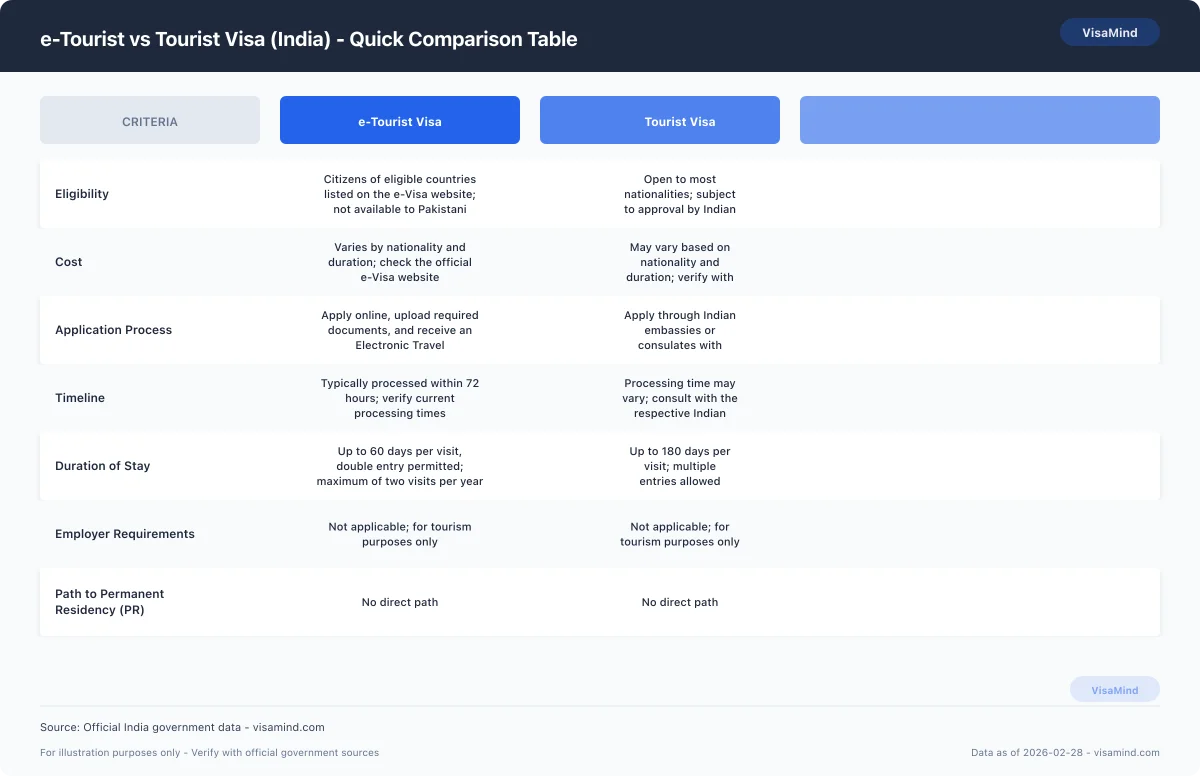
Understanding the differences between an e-Tourist Visa and a Tourist Visa can help you choose the right option for your travel needs. Here's a quick comparison of these two visa types:
| Criteria | e-Tourist Visa | Tourist Visa |
|---|---|---|
| Eligibility | Nationals of eligible countries listed on the e-Visa website | Available to citizens of most countries, subject to consular approval |
| Cost | Varies by nationality, generally lower than Tourist Visa | Varies by nationality and duration of stay |
| Application Process | Apply online through the eVisa application portal | Apply at an Indian Embassy or Consulate |
| Timeline | Processing typically takes 3-5 business days | Processing can take several weeks, depending on the consulate |
| Duration of Stay | 60 days per visit, non-extendable | Up to 180 days per visit; longer durations may require registration with the FRRO |
| Entry Points | Valid only at designated airports and seaports | Valid at all points of entry into India |
| Path to PR | Does not lead to Permanent Residency (PR) | Does not lead to Permanent Residency (PR) |
Eligibility Criteria
The e-Tourist Visa is designed for nationals of specific countries, aimed at facilitating short-term visits for tourism, recreation, or casual business activities. Your passport should be valid for at least six months at the time of application. If you're of Pakistani origin or hold a Pakistani passport, you are not eligible for the e-Visa.
The Tourist Visa, by contrast, is available to citizens of most countries, though it requires in-person application processes at an Indian consulate or embassy. It's suitable for longer stays and offers more flexibility regarding entry points.
Cost Differences
The cost of an e-Tourist Visa is generally lower than that of a Tourist Visa and varies by nationality. You can make payments online using a credit/debit card. In contrast, the Tourist Visa cost also varies depending on the applicant's nationality and the length of the intended stay. Be sure to verify costs on the official website for the most accurate information.
Important: Always ensure your passport has at least six months of validity when applying for either visa type to avoid any application issues.
Application Process and Timeline
The e-Tourist Visa application process is straightforward and can be completed entirely online. After filling out the necessary information and uploading required documents, you typically receive the Electronic Travel Authorization (ETA) within 3-5 business days.
For the Tourist Visa, the process involves submitting your application at an Indian Embassy or Consulate, which can take several weeks. This visa type is more suitable if you require a longer stay or plan to enter India through non-designated points.
Path to Permanent Residency
Neither the e-Tourist Visa nor the Tourist Visa provides a direct path to Permanent Residency (PR) in India. If your visit is short-term and strictly for tourism or casual purposes, these visas are ideal. For long-term stays or residency, explore other options like the Entry Visa or OCI.
Tip: Always check the Documents Checklist to ensure you have all necessary documents before applying.
Choose Option A If...
#A business consultant who frequently travels for short trips encountered a situation where she needed to visit India for a mix of business meetings and leisure activities. With a tight schedule and the need for a swift entry, she opted for the e-Tourist Visa. By applying through the e-Visa portal, she was able to submit her application along with a scanned copy of her passport and a recent photograph. The electronic submission process significantly reduced the time needed for visa processing, and she received her Electronic Travel Authorization (ETA) within a few days. Upon arrival at the designated Indian airport, her e-Tourist Visa was swiftly stamped at the immigration counter, allowing her to commence her business meetings and enjoy some sightseeing. This streamlined process suited her need for efficiency and allowed her to focus on her trip itinerary without concerns about visa delays.
Scenario: A Casual Visitor Seeking Flexibility
An artist planning a leisurely tour of India's cultural festivals found the e-Tourist Visa particularly advantageous due to its flexibility and convenience. His travel plans included attending various short-term workshops and yoga sessions, fitting perfectly within the e-Tourist Visa's scope. He applied online, ensuring his passport had the requisite six months validity, and included all necessary documentation, such as his travel itinerary. The online application process allowed him to avoid lengthy paperwork and visit the Foreigners Regional Registration Office (FRRO) upon reaching India if his stay extended beyond 180 days. His visa was granted within a week, and with the ETA in hand, he entered India without any hitches, enjoying a seamless travel experience as he explored different regions and absorbed the local culture.
Scenario: Family Reunion Made Simple
A college professor residing abroad was planning a family reunion in India after several years. Given her limited time for preparation, she opted for the e-Tourist Visa to ensure a hassle-free experience. The process required her to provide detailed information about her visit and upload necessary documents via the e-Visa application portal. She found the step-by-step instructions on the application page particularly helpful, minimizing any potential errors in her submission. As her visit was primarily for a casual family meet-up and included some sightseeing, the e-Tourist Visa was ideal. After receiving her ETA within the stipulated period, she arrived in India and passed through immigration efficiently, allowing her to enjoy her family reunion without any administrative burdens.
Option B Is Better When...
#An adventure travel blogger who frequently visits India for short trips faced a dilemma. They wanted the flexibility to enter India multiple times throughout the year without the hassle of frequent visa applications. The solution was to opt for the Tourist Visa, which offers a long-term validity of one or five years with multiple entries, allowing stays of up to 180 days per visit. By visiting the Indian embassy in their home country, they were able to secure this visa. As a result, they could travel to India multiple times within the visa's validity period without needing to apply for a new visa each time, significantly simplifying their travel logistics.
Scenario: Last-Minute Travel Plans
A freelance photographer received an unexpected assignment to cover a cultural festival in India, requiring immediate travel. Given the urgency, they chose the e-Tourist Visa option due to its quick processing time. The photographer applied online through the official e-Visa portal, uploading the necessary documents, including a recent passport-sized photo and a scanned copy of their passport's bio page. Within 72 hours, they received the Electronic Travel Authorization (ETA) via email. Upon arrival, they presented the ETA at the designated Immigration Check Post, where it was stamped on their passport. This swift process allowed them to meet their tight deadline and fulfill the photography assignment on time.
Scenario: First-Time Visitor with Extended Travel Plans
A university student on a gap year planned an extended cultural exploration of India, intending to stay for several months. They initially considered the e-Tourist Visa for convenience but realized its 60-day stay limit would not suffice for their six-month itinerary. Instead, they applied for the Tourist Visa through their local Indian consulate, which allowed for a longer stay. After submitting the necessary documents, including proof of financial means and a detailed travel itinerary, they were granted a one-year Tourist Visa with multiple entry privileges. This enabled them to explore India at a leisurely pace, with the option to exit and re-enter the country as needed within the visa's validity period.
The Critical Differences
#The primary distinction between an e-Tourist Visa and a Tourist Visa for India lies in the eligibility criteria and the mode of application. The e-Tourist Visa is available to nationals of specific countries listed on the e-Visa website. It's designed for those whose visits are for recreation, sightseeing, meeting friends or relatives, or attending short-term yoga programs or courses. Notably, nationals of Pakistani origin or those holding a Pakistani passport are not eligible for the e-Visa option.
In contrast, the Tourist Visa offers a broader range of eligibility, allowing anyone who can apply through an Indian mission or embassy the opportunity to visit India. This option is more traditional, requiring physical submission of documents and potentially more comprehensive eligibility criteria.
Important: Ensure your passport has at least six months' validity at the time of application for any visa type.
Application Process: Online vs. Offline
One of the most significant differences between the two visas is the application process. The e-Tourist Visa offers a streamlined online application process, which simplifies the experience for eligible travelers. This involves applying online, uploading a photo and passport page, and paying the fee through a secure payment gateway. Once processed, an Electronic Travel Authorization (ETA) is sent via email, which must be printed and presented upon arrival in India. This process eliminates the need for physical document submission and face-to-face interviews, making it a quicker option for eligible travelers.
| Feature | e-Tourist Visa | Tourist Visa |
|---|---|---|
| Application Mode | Online | Offline (at Indian missions/embassies) |
| Submission Method | Electronic upload of documents | Physical submission of documents |
| Processing Time | Typically faster due to electronic handling | May take longer due to manual processing |
The Tourist Visa, however, requires applicants to visit an Indian mission or consulate in person or through an authorized application center like BLS or VFS. This traditional method may involve longer processing times and the necessity for physical document submissions.
Duration and Registration Requirements
Another critical difference is the duration of stay and the registration requirements with the Foreigners Regional Registration Office (FRRO). The e-Tourist Visa allows for a stay up to 60 days per visit, with multiple entries permitted over one year, but does not require registration with the FRRO, provided the stay is less than 180 days.
In contrast, a Tourist Visa can offer longer validity, such as one year or five years, allowing stays of up to 180 days at a time. If you plan to stay for more than 180 days on a Tourist Visa, you must register with the FRRO within two weeks of the completion of 180 days.
Tip: Avoid potential pitfalls by ensuring that your passport is valid for at least six months from your planned arrival date in India and entering through designated immigration checkposts.
Understanding these differences can help you decide which visa option best suits your travel plans to India. For more information, check the detailed guides on E Tourist and Tourist visas.
Myths and Misunderstandings
#Misunderstandings about India's e-Tourist and Tourist Visas can lead to confusion and misapplication. To ensure a clear understanding, let's tackle some common myths.
Eligibility and Purpose Myths
-
Myth: Anyone can apply for an e-Tourist Visa.
Only nationals of eligible countries listed on the e-Visa website can apply. Additionally, those of Pakistani origin or holding a Pakistani passport are not eligible for an e-Visa. -
Myth: You can use a Tourist Visa for any purpose of travel.
Tourist Visas are strictly for recreation, sightseeing, meeting friends and family, or attending short-term yoga programs and courses. Activities outside these purposes require different visa types, such as the E Business Visa or E Medical Visa.
Application Process Myths
-
Myth: You need to apply for an e-Visa through a physical submission.
The e-Visa process is entirely online. Applications, including uploading a passport bio page and photograph, are submitted electronically. -
Myth: All travel entry points in India accept e-Visas.
Travelers must enter through designated entry points authorized for e-Visa holders. Attempting to enter through unauthorized points can lead to entry denial.
Important: Ensure your passport has at least six months of validity at the time of your e-Visa application. Applying with a shorter validity can result in rejection.
Duration and Registration Myths
-
Myth: E-Tourist Visa holders must register with the FRRO regardless of stay duration.
Registration with the Foreigners Regional Registration Office (FRRO) is only required if your stay exceeds 180 days. Stays under 180 days do not require registration. -
Myth: Tourist Visas offer the same duration as e-Tourist Visas.
While both visas allow for stays of up to 180 days, specific conditions and extensions need careful review on the Tourist Visa page. Longer stays may require additional processing with the FRRO.
Understanding these distinctions helps ensure a smooth travel experience. For a comprehensive list of required documents, consult the Documents Checklist to prepare effectively.
Changing Your Mind After Applying
#Tip: If you are considering a switch between an e-Tourist Visa and a Tourist Visa, it's crucial to understand the procedures and limitations set by Indian immigration authorities.
Can You Convert an e-Tourist Visa to a Tourist Visa?
Converting an e-Tourist Visa to a regular Tourist Visa while in India is typically not permissible. The e-Tourist Visa is intended for short-term travel and is electronically linked to your passport. It is designed for those whose stay does not exceed 60 days. If you plan to stay longer or require multiple entries, you should apply for a Tourist Visa from an Indian mission abroad before arrival.
Converting a Tourist Visa to an e-Tourist Visa
Converting a Tourist Visa to an e-Tourist Visa is also not feasible. The e-Tourist Visa is applied for online before traveling to India and requires specific eligibility criteria, such as being from a visa-eligible country with a passport validity of at least six months. If you have a Tourist Visa and wish to switch to an e-Tourist Visa, you must exit India and apply from your home country.
Steps to Follow if You Change Your Mind
If you realize that your current visa does not meet your needs, here are steps to consider:
-
Assess Your Requirements: Determine if a different visa type is more suitable for your travel plans. For example, if you plan to attend a business meeting, consider the E Business Visa.
-
Exit and Reapply: If a different visa is necessary, you may need to leave India and lodge a new application from abroad. Use the How To Apply guide for detailed instructions.
-
Consider Visa Extension: If your stay needs to be extended, a visa extension might be an option. Visit the Visa Extension Guide for more information on eligibility and procedures.
Important: Always verify the latest conversion policies on the official Bureau of Immigration website before making any changes to your travel plans.
Decision Scenarios
#An adventure traveler from Australia planned a backpacking trip across India, visiting various historic sites and remote areas. He opted for an e-Tourist Visa due to its convenience and quick processing through the online portal. However, upon reviewing the guidelines on the Bureau of Immigration’s website, he realized that entry into India with an e-Tourist Visa is restricted to certain designated entry points. To ensure a smooth entry, he adjusted his travel itinerary to arrive through one of the authorized entry airports. By doing so, he avoided any potential complications at immigration and was able to embark on his Indian adventure without delay.
Scenario: Long-term Visitor Considering Registration
A freelance writer from Canada decided to spend a few months in India to work on a travel book. Given her planned stay of around six months, she applied for a Tourist Visa, which allows for extended visits. Familiar with the requirement to register with the Foreigners Regional Registration Office (FRRO) if staying beyond 180 days, she prepared accordingly. As her stay approached the 180-day mark, she visited the FRRO office in New Delhi to complete her registration. This proactive step ensured her compliance with Indian immigration regulations, allowing her to focus on her writing without any legal concerns.
Scenario: Family Visit with Indian Origin Concerns
An individual of Indian origin, now a UK citizen, planned to visit family in India. He chose a Tourist Visa due to his extended stay plans. However, during the application process, he encountered issues related to his previous Indian citizenship. On consulting the Documents Checklist, he realized he needed to provide his surrendered Indian passport and surrender certificate. After submitting these documents, his Tourist Visa was granted without further issues. This enabled him to enjoy his family reunion, confident in his understanding of the necessary documentation for Indian-origin applicants.
FAQs
What happens if I overstay my e-Tourist Visa in India?
Is it possible to combine business objectives with an e-Tourist Visa in India?
Do I need to register with the FRRO if I have an e-Tourist Visa for less than 180 days?
Can I apply for an e-Tourist Visa if my passport has less than six months validity?
What is the process for applying for an e-Tourist Visa to India?
Can I enter India on an e-Tourist Visa through any airport?
What should I do if my e-Tourist Visa application is not granted before my travel date?
Sources
Last reviewed: March 1, 2026
VisaMind provides informational guidance only and is not a government agency. This is not legal advice. Requirements can change and eligibility depends on your specific facts. If your case is complex or high-stakes, consult a licensed immigration attorney.
Next steps
Requirements vary by nationality, purpose, timeline, and case details. Use Find My Visa to get a personalized checklist for India with official sources and deadlines.
Find my visa