On this page
- How to Work in This Country Legally
- What Your Employer Must Provide
- Step-by-Step Work Visa Application
- Worker Rights and Restrictions
- The Long-Term Path
- Common Refusal Reasons for Work Visas
- Getting Your Qualifications Recognized
- The Financial Side of Working Abroad
- Tax Obligations for Workers
- What Other Workers Experienced
- Visa options for this goal
- Guides for India
- Other goals for India
How to Work in This Country Legally
#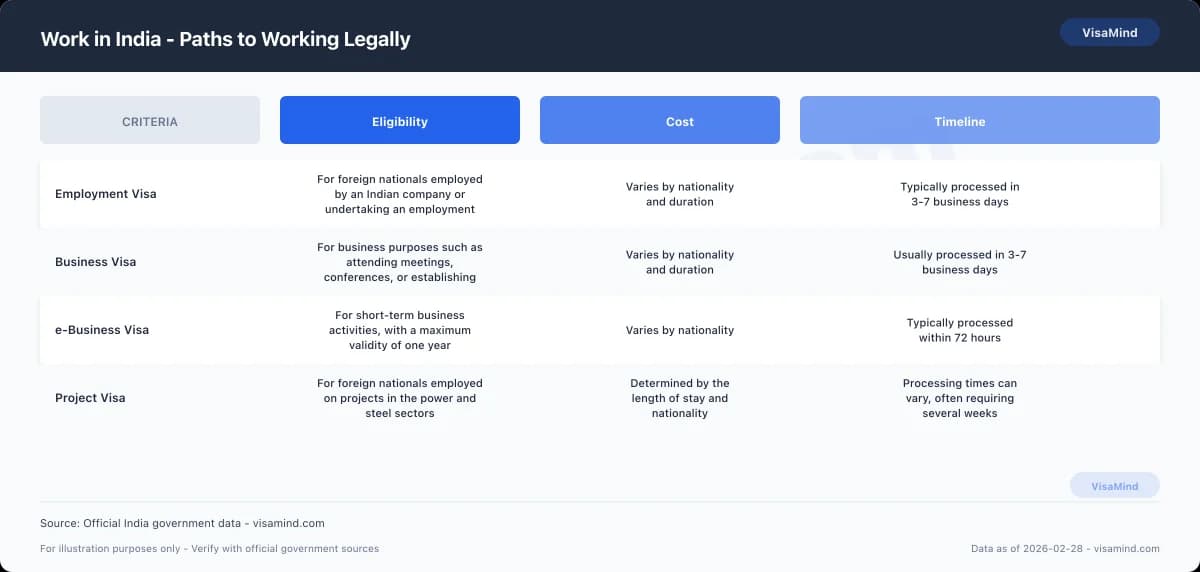
To work legally in India, understanding the available work visa categories and their specific requirements is crucial. The primary pathways include the Employment Visa, Business Visa, and e-Business Visa. Here's a comparative overview to help you determine the most suitable option for your situation:
| Visa Type | Eligibility | Cost | Timeline |
|---|---|---|---|
| Employment Visa | Professionals engaged in an employer-employee relationship with an Indian company. Must have a contract and salary above a specified threshold. | Varies by nationality and duration. Verify on the official website. | Typically issued for 1 year, extendable up to 5 years. |
| Business Visa | Individuals engaging in business activities such as meetings or setting up a business. Not for employment purposes. | Varies by nationality. Verify on the official website. | Generally granted for up to 6 months to 1 year. Multiple entries allowed. |
| e-Business Visa | Short-term business activities including attending conferences or workshops. Available for nationals of eligible countries. | $80 as of 2023. Verify on the official website. | Valid for 60 days with double entry. |
Key Requirements for Each Visa
Each visa category has its own set of requirements. Here’s a brief rundown:
-
Employment Visa:
- A valid employment contract with an Indian company.
- Evidence of professional qualifications and experience.
- Proof of salary meeting the prescribed threshold.
-
Business Visa:
- Invitation from a business organization based in India.
- Documents substantiating the business activities.
- Evidence of financial standing and intent to return.
-
e-Business Visa:
- Passport validity of at least 6 months from the date of arrival.
- A recent front-facing photograph with white background.
- An invitation letter from the host company in India.
Registration and Compliance
Important: If your stay in India exceeds 180 days, you must register with the Foreigners Regional Registration Office (FRRO) within two weeks after the expiry of 180 days.
Registration ensures compliance with Indian immigration laws and is crucial for any further visa extension or change in visa status. For stays under 180 days, registration is not required.
Which Visa is Right for You?
Choosing the right visa depends on your intended activities in India:
- Opt for an Employment Visa if you are entering into a formal employment contract with an Indian entity.
- Select a Business Visa if your purpose is to explore business opportunities, attend meetings, or set up a business.
- Consider an e-Business Visa for short-term business visits, such as conferences, where a quick processing time is beneficial.
For detailed guidance on how to apply, check the How To Apply guide, and for document preparation, refer to the Documents Checklist.
By understanding the distinctions among these visas, you can make an informed decision that aligns with your professional objectives in India. Always verify the latest requirements and fees on the official Bureau of Immigration website to ensure compliance with current regulations.
What Your Employer Must Provide
#When seeking to work in India, your employer plays a significant role in facilitating the visa application process. They must provide specific documentation and fulfill certain obligations to ensure your visa application is successful. Below, we outline what employers need to provide for the work visa process in India.
Employer Documentation Requirements
Employers in India must furnish several key documents and information to support your work visa application. These include:
- Sponsorship Declaration: The employer must issue a letter indicating their intention to hire you, detailing the job role and duration of employment.
- Employment Contract: A formal contract outlining your job title, responsibilities, salary, and terms of employment is necessary.
- Company Registration: Proof of the employer's legal status, such as registration certificates, to demonstrate the company's legitimacy.
- Tax Compliance: Documents showing the employer's compliance with Indian tax laws, such as recent tax filings.
Employer Obligations
Employers must comply with several obligations to ensure a smooth work visa process:
- Salary Thresholds: Employers must adhere to the salary thresholds set for foreign workers. These thresholds vary based on the job role and industry.
- Job Justification: Employers may need to justify hiring a foreign national over an Indian citizen, ensuring there is a genuine requirement for foreign expertise.
Important: Employers should maintain transparency throughout the process to avoid any delays or complications with the FRRO or Bureau of Immigration.
Can Employers Change During Your Stay?
While working in India, you might wonder if it's possible to change employers. If you decide to switch jobs, the new employer must provide the same documents and meet the obligations outlined above. Additionally, you must inform the FRRO about your job change and obtain the necessary approvals.
Tip: Always ensure your new employer is aware of the visa transfer requirements to prevent any legal issues during your transition.
For more detailed guidance on the work visa application process, including documents you need to gather, refer to our Documents Checklist and How To Apply guides.
Step-by-Step Work Visa Application
#Determine Your Visa Type
To work legally in India, you'll first need to determine the appropriate visa type based on your employment situation. The most common visas for employment include the Employment Visa and the Business Visa. If you're involved in specific projects, you might consider the Project Visa. Each visa type has distinct eligibility criteria and documentation requirements.
Gather Required Documents
Once you've identified the correct visa, gather the necessary documents. Typically, you'll need:
- A valid passport with a minimum of six months validity from your planned date of entry into India.
- Recent passport-sized photographs.
- An employment contract or job offer letter from the Indian company.
- Proof of your professional qualifications and work experience.
- A completed visa application form, which can be found on the Bureau of Immigration's portal.
For a comprehensive list of documents, refer to the Documents Checklist.
Lodge Your Application
After assembling your documents, lodge your visa application through the appropriate channel. If you are applying from outside India, submit your application to the nearest Indian mission or consulate. In some countries, BLS or VFS centers facilitate the submission process. Remember, these centers do not make decisions; they only handle submissions.
Tip: Lodge your application well in advance of your planned travel date to account for processing times. Check the Processing Times for more information.
Pay the Visa Fee
Visa fees vary based on the type of visa and your nationality. The fee must be paid as part of the application process. Ensure you have the correct payment method available, as some centers may not accept cash. Always verify the current fee structure on the official Bureau of Immigration website.
Attend an Interview (If Required)
Depending on your specific circumstances and the discretion of the visa officer, you may be required to attend an interview at the Indian mission. Be prepared to discuss your employment plans, the details of your employer in India, and other relevant aspects of your application.
Await the Decision
After submitting your application, await the decision from the Indian mission. Processing times can vary, so patience is crucial. Once approved, your visa will be stamped in your passport, allowing you to enter India for work.
Important: If your stay in India exceeds 180 days, you are required to register with the Foreigners Regional Registration Office (FRRO) within two weeks after your arrival. Failure to comply may result in penalties or complications with your visa status.
Worker Rights and Restrictions
#Important: If your stay exceeds 180 days, you must register with the Foreigners Regional Registration Office (FRRO) within two weeks of the expiry of this period.
Can You Change Employers?
- You may change employers while working in India, but this requires a new Employment Visa. The process involves:
- Applying for a new visa through the Employment Visa category.
- Providing documentation from both your current and prospective employers.
- Ensuring that your new employment aligns with the terms of your existing visa.
Tip: Always consult the Visa Extension Guide if you anticipate a transition period between jobs.
Can Family Join You?
-
Family members can join you in India on a dependent visa, typically known as the Entry Visa.
- Spouses and children are eligible to apply for this visa.
- The Entry Visa is linked to the primary visa holder’s employment status.
- Family members must independently adhere to registration requirements if staying over 180 days.
-
It is important to coordinate your family’s visa applications to ensure they are processed simultaneously with your employment visa.
Can You Study While Working?
-
Studying while on a work visa in India is generally permitted, but there are restrictions:
- You may enroll in short-term courses that do not interfere with your employment.
- For long-term or degree programs, you should apply for a Student Visa.
-
If you decide to pursue education that extends beyond your current visa's scope, transitioning to a Student Visa is necessary. This transition requires:
- Lodging a separate application for a Student Visa.
- Complying with the educational institution's requirements and obtaining an admission offer.
To explore more about the different visa categories and their specific requirements, consider visiting the How To Apply guide.
The Long-Term Path
#Navigating the path from a work visa to permanent residency in India involves understanding the steps and timelines involved. Here's how a work visa can potentially lead to long-term residence and eventually, permanent residency (PR).
Transitioning from Work Visa to Permanent Residency
For those who enter India on a work visa, the journey to permanent residency typically involves several stages. The process is not direct, and the Indian immigration system does not currently offer a straightforward PR pathway linked directly from work visas. However, gaining long-term residency status can be achieved through registered stays and extensions.
-
Initial Work Visa: Most foreign nationals begin their journey with an Employment Visa, valid for a specific period, usually up to one year. It is essential to register with the Foreigners Regional Registration Office (FRRO) if your stay exceeds 180 days.
-
Extensions and Renewals: After the initial period, you may apply for extensions. Each extension requires FRRO approval, and you must provide evidence of continued employment and other relevant documents. Extensions might be granted in increments, adding up to five years in total.
-
Long-Term Residency Options: After several years of extended residency, some foreign nationals may qualify for an OCI (Overseas Citizen of India) card if they meet specific criteria, such as having Indian ancestry or a spouse who is an Indian national. While OCI is not the same as permanent residency, it offers many of the same benefits, including multiple entries and indefinite stay in India.
Tip: Regularly check the Visa Extension Guide for updates on requirements and processes for extending your stay in India.
Timeline and Key Considerations
The timeline for transitioning from a work visa to a long-term residency status in India can vary significantly based on individual circumstances and legal amendments. Here are some key milestones and considerations:
- Year 1: Obtain an employment visa and register with the FRRO if staying beyond 180 days.
- Years 2-5: Apply for and secure extensions of your employment visa through the FRRO. Gather necessary documentation for each application, including proof of ongoing employment.
- Beyond Year 5: Evaluate eligibility for long-term residency options like the OCI card, especially if you have familial ties to India.
Important: Ensure that all visa renewals and registrations with the FRRO are promptly handled to avoid any legal issues with your residency status.
Practical Steps and Resources
While the path to permanent residency may not be direct through a work visa, it is crucial to maintain compliance with all visa requirements and explore alternative residency options over time. Here are some practical steps and resources:
- Stay Informed: Regularly review updates on Indian immigration policies through the Bureau of Immigration and the FRRO website.
- Consult Legal Experts: Consider consulting with immigration experts who specialize in Indian residency to explore all available options.
- Utilize Available Guides: Make use of resources such as the Visa Refusal Reasons guide to understand common pitfalls and enhance your application success rate.
Understanding the intricacies of India's immigration system is key to navigating the long-term path from a work visa to more permanent residency options.
Common Refusal Reasons for Work Visas
#Understanding the common reasons for work visa refusals can help you avoid unnecessary delays and ensure a smoother application process. Here are some key factors that can lead to refusal of work visas for India:
Incomplete or Incorrect Documentation
- Missing Documents: Ensure you have all required documents, including a valid passport, employment contract, and proof of qualifications. Double-check against the Documents Checklist to avoid omissions.
- Incorrect Information: Inaccuracies in your application can lead to immediate disqualification. Ensure all personal and employment details are accurate and consistent.
Employment and Qualification Issues
- Unqualified Position: Your job position must align with your qualifications and experience. Applying for a role that seems beyond your expertise may result in refusal.
- Employer's Credentials: The employing company must be registered and recognized by Indian authorities. Applications tied to unverified or new companies might face additional scrutiny.
Immigration Status and Compliance
- Overstaying Previous Visas: If you have previously overstayed a visa in India, this may adversely affect your current application. Adherence to visa conditions is crucial.
- Registration Requirements: For stays exceeding 180 days, failure to register with the FRRO can result in visa issues. Ensure timely compliance with registration requirements.
Tip: Always verify the most current guidelines on the official Bureau of Immigration website to ensure compliance with any updates in policy or procedure.
Financial and Security Concerns
- Insufficient Financial Proof: Demonstrating financial stability is essential. Provide clear evidence of your ability to support yourself during your stay in India.
- Security Concerns: Background checks are conducted, and any history of criminal activity or security concerns can lead to visa denial.
By understanding these common pitfalls and preparing thoroughly, you can enhance your chances of a successful work visa application. If you face issues, consider reviewing the Visa Refusal Reasons guide for further insights.
Getting Your Qualifications Recognized
#Recognizing your qualifications is a crucial step when planning to work in India. This process involves validating your skills, degrees, and professional experiences to align with Indian standards. Here’s a breakdown of what you need to know:
Skills Assessments
- Professional Bodies: Certain professions, like medicine or engineering, require assessments by specific Indian professional bodies. Ensure you contact the relevant organization to understand their requirements.
- Industry-Specific Tests: Some industries might require you to pass specific skills tests. Check with potential employers or industry groups in India for any necessary assessments.
Tip: Reach out to professional associations in India related to your field for tailored advice on skill recognition.
Qualification Recognition
- Degree Equivalence: You may need to have your foreign degrees evaluated for equivalency to Indian degrees. This can be done through the Association of Indian Universities (AIU).
- Document Verification: Ensure that all your educational documents, like transcripts and diplomas, are authenticated and translated into English if originally in another language.
- Professional Certifications: If you hold any professional certifications, verify whether they are recognized in India or if additional certification is required.
Degree Requirements
- Minimum Educational Standards: Different work visas, such as the Employment Visa, might have specific educational requirements. It's essential to meet these standards for successful visa application.
- Specialized Degrees: For specialized roles, ensure your degree aligns with the job description and industry standards in India.
- Academic Institutions: Degrees from reputed universities or institutions may have a smoother recognition process.
Registration with FRRO
- Duration of Stay: If your stay in India exceeds 180 days, you must register with the Foreigners Regional Registration Office (FRRO) within two weeks after the 180-day period.
- Required Documentation: Keep all necessary documents ready for FRRO registration, including your degree equivalency confirmations and professional assessments.
Important: Failing to register with the FRRO within the specified timeframe can lead to penalties or affect your visa status.
For more detailed guidance on the necessary documents, refer to the Documents Checklist related to your visa type. Understanding the nuances of qualification recognition will help streamline your transition into the Indian workforce.
The Financial Side of Working Abroad
#Understanding the financial requirements and costs associated with different work-related visas is crucial. Here’s a detailed look at the key financial aspects you need to consider.
Visa Types and Financial Requirements
| Visa Type | Minimum Salary Threshold | Application Fee (as of 2023) | Duration Before Registration Required |
|---|---|---|---|
| Employment Visa | $25,000 per annum | Varies by nationality, verify on official website | 180 days |
| Business Visa | No specific requirement | Varies by nationality, verify on official website | 180 days |
| Project Visa | $40,000 per annum | Varies by nationality, verify on official website | 180 days |
Key Financial Considerations
Salary Thresholds
For most foreign nationals applying for an Employment Visa, meeting a minimum salary threshold of $25,000 annually is mandatory. This requirement ensures that applicants are employed in sectors with a demand for specialized skills.
Important: Ensure your employment contract meets the salary threshold before applying to avoid visa refusal.
Application Fees
Application fees for visas are not fixed and vary based on the applicant's nationality and the specific type of visa. It is advisable to verify the current fees on the official website to ensure you have the latest information.
Registration Requirements
For stays exceeding 180 days, registration with the Foreigners Regional Registration Office (FRRO) is compulsory. This step is crucial for maintaining legal status during your stay. You can find more details on the Visa Extension Guide.
Tip: Register with the FRRO within two weeks after your 180-day stay if you're planning to extend your stay beyond 180 days.
By understanding these financial requirements and planning accordingly, you can better prepare for your work experience in India. For comparison and further details between different visa options, consider reviewing the Employment Vs Project Visa guide.
Tax Obligations for Workers
#When working in India, understanding your tax obligations is crucial to ensure compliance with Indian laws. As a foreign worker, you will need to adhere to India's income tax regulations, consider social security contributions, and be aware of any applicable double taxation treaties.
Income Tax Obligations
In India, income tax is imposed on the income earned by individuals at progressive rates. If you are residing in India for more than 182 days during a financial year, you will be considered a tax resident, and your global income may be subject to tax. However, if your stay is less than 182 days, only the income earned within India is taxable.
Important: Tax residency status significantly affects your tax liability. Ensure you understand the criteria to plan your finances accordingly.
Social Security Contributions
Foreign workers are generally required to contribute to the Indian social security system, known as the Employees' Provident Fund (EPF), if they work for an establishment that is covered under the EPF Act. The contribution rate is typically 12% of your salary, which is matched by your employer. However, certain exemptions may apply based on bilateral social security agreements between India and your home country.
Double Taxation Treaties
India has entered into Double Taxation Avoidance Agreements (DTAAs) with several countries to alleviate the burden of double taxation on individuals earning income in both India and their home country. These treaties typically provide methods to claim tax credits or exemptions in your home country for taxes paid in India.
Here is a brief overview of how DTAAs can benefit you:
| Benefit | Description |
|---|---|
| Tax Credits | Claim credits in your home country for taxes paid in India. |
| Exemptions | Certain incomes may be exempt from taxation in India. |
| Reduced Tax Rates | Enjoy lower withholding tax rates on particular types of income. |
Key Steps to Manage Tax Obligations
- Determine your tax residency status based on your duration of stay in India.
- Consult with a tax advisor to understand your obligations under Indian tax laws.
- Ensure proper documentation for any claims under DTAAs.
- Register with the Employees' Provident Fund if required and understand your contribution obligations.
Tip: Stay informed about changes in tax regulations by consulting the Financial Requirements guide or the Bureau of Immigration's official website regularly.
By fulfilling these obligations, you can work in India with peace of mind, knowing you are compliant with the necessary financial regulations.
What Other Workers Experienced
#An IT specialist from France was offered a six-month contract with a tech company in Bengaluru. Upon arrival in India, they were informed that they would need to register with the Foreigners Regional Registration Office (FRRO) if their stay exceeded 180 days. Since the initial contract was for exactly 180 days, the specialist initially did not need to register. However, when their contract was extended by another month, they had to complete the registration process promptly. They accessed the FRRO online portal to schedule an appointment and prepare the necessary documentation, including their employment contract and proof of residence. The registration process was completed smoothly within a week, allowing them to continue their work in India without interruption.
Scenario: Engineer Facing Document Challenges
An engineer from South Korea arrived in India to work on a long-term infrastructure project with a Project Visa. After six months, they needed to register with the local FRRO to comply with Indian immigration rules. However, they faced challenges in obtaining a local address proof, as they were staying in company-provided accommodation. By contacting their company's HR department, they managed to obtain a letter verifying their residence, which was accepted by the FRRO. After submitting the necessary documents through the FRRO portal, the engineer completed the registration within ten days, ensuring their continued legal stay in India.
Scenario: Consultant Seeking a Visa Extension
A management consultant from Canada was in India on a short-term Business Visa to work with a local firm. The project unexpectedly required more time than initially planned, and the consultant needed to extend their stay. They reached out to the FRRO to understand the visa extension process. By providing a detailed letter from the Indian company explaining the need for an extended stay and demonstrating sufficient financial resources, the consultant was able to apply for a visa extension through the FRRO's online platform. The extension was granted within three weeks, allowing the consultant to complete the project successfully.
FAQs
How long does it take for the FRRO to process an Employment Visa for Work in India?
What are the common reasons for Employment Visa refusals for Work in India?
What is required for an e-Business Visa application for Work in India?
Can my spouse work in India if I hold an Employment Visa?
What are the steps to get my qualifications recognized for Work in India?
What financial documentation do I need to provide for an Employment Visa for Work in India?
Are there any tax obligations for foreigners working in India on an Employment Visa?
Sources
Last reviewed: March 1, 2026
VisaMind provides informational guidance only and is not a government agency. This is not legal advice. Requirements can change and eligibility depends on your specific facts. If your case is complex or high-stakes, consult a licensed immigration attorney.
Next steps
Requirements vary by nationality, purpose, timeline, and case details. Use Find My Visa to get a personalized checklist for India with official sources and deadlines.
Find my visa