Official sources referenced
What You Need to Show Financially
#To apply for an Indian visa, it is crucial to demonstrate that you possess sufficient financial means to cover your expenses during your stay. This requirement is consistent across various visa types, including the E Tourist Visa and Business Visa.
What Financial Evidence Is Required?
The Indian Bureau of Immigration requires applicants to provide evidence of their financial capacity, which typically involves showing proof of funds. This could include bank statements, pay slips, or other financial documents that illustrate your ability to support yourself without working in India. For instance, having a return or onward journey ticket is mandatory, demonstrating your intention to leave India after your visit. Additionally, you must present documentation confirming you have enough funds to cover your daily expenses throughout your stay.
How to Demonstrate Financial Sufficiency?
When preparing your application, you should aim to present robust and clear financial documentation. This may include:
- Recent bank statements showing a steady flow of income or sufficient savings.
- Pay slips from the past three months as proof of employment and regular income.
- Tax returns or other financial documents that verify your financial stability.
Ensure these documents are up-to-date and accurately reflect your financial status.
Important: While there is no explicit minimum amount specified, the authorities require assurance that you will not become a financial burden during your stay in India. Ensure your documentation is comprehensive and credible to avoid delays or rejections.
Considerations for Different Visa Types
Different visa categories have specific nuances regarding financial requirements. For example, those applying for a Student Visa may need to show proof of tuition payment or scholarship funds. In contrast, applicants for a Business Visa might have to present business-related financial documents. It's essential to tailor your financial evidence according to your specific visa type.
Furthermore, applicants of Pakistani origin or with a Pakistani passport must apply through regular channels at an Indian Mission, which might entail additional financial scrutiny.
Tips for Preparing Your Application
- Ensure your passport has at least six months of validity at the time of application.
- Double-check that all financial documents are in English or include certified translations.
- Maintain copies of all submitted documents for your records and potential future reference.
Tip: Carefully review the requirements for your specific visa category on the How To Apply page to ensure you gather all necessary documents before submission.
By understanding and meeting these financial requirements, you can strengthen your visa application and demonstrate your preparedness for a visit to India.
How Much You Need by Visa Type
#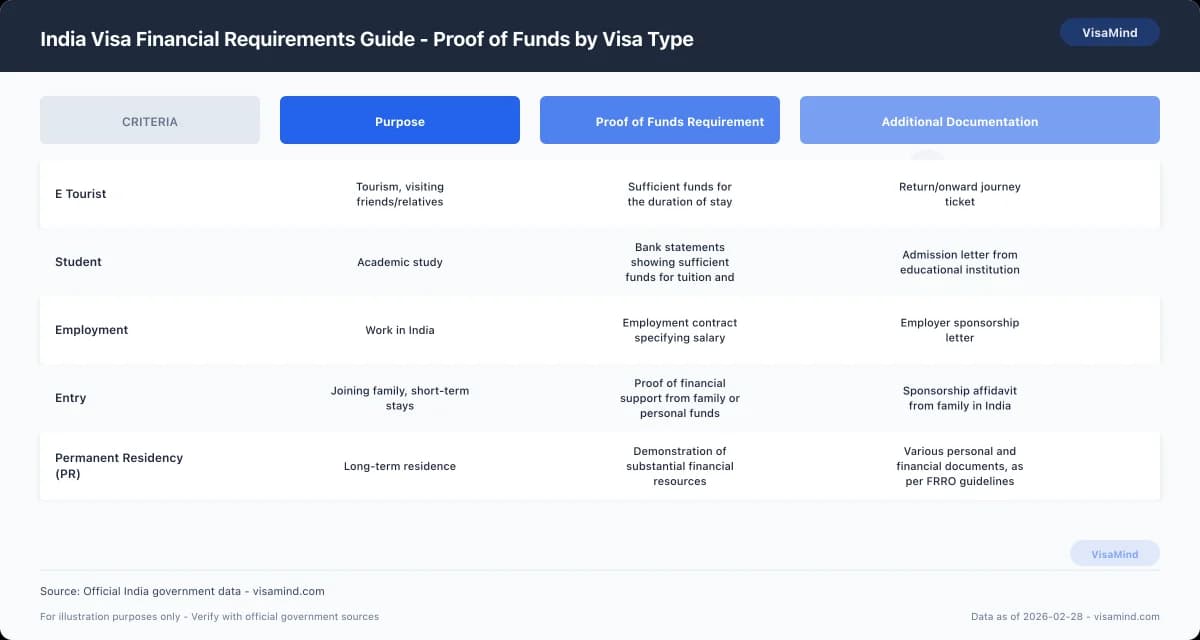
When preparing to apply for an Indian visa, understanding the financial requirements is crucial. Different visa types require different amounts of financial proof. Here’s a detailed look at the financial requirements based on visa types:
Financial Requirements by Visa Type
Below is a table comparing various visa types, the financial eligibility requirements, and the proof you need to provide:
| Visa Type | Financial Requirement | Evidence Required |
|---|---|---|
| Visitor Visa | Sufficient funds for stay | Bank statements showing balance and transaction history for the last 3 months, return ticket |
| Student Visa | Tuition and living expenses | Proof of admission, bank statement or financial guarantee for tuition and living costs |
| Work Visa | Sufficient salary to support living | Employment contract, salary slips, bank statements showing salary deposits |
| Family Visa | Sponsor’s ability to support | Sponsor's bank statements, employment letter or income tax returns |
| Permanent Residency (PR) | Financial stability | Comprehensive financial documents showing assets, liabilities, and income over time |
Visitor Visa: What You Need to Know
For a Visitor Visa, you must demonstrate that you have sufficient funds to cover your stay in India. This includes expenses for accommodation, travel, and daily needs. You should provide recent bank statements and a confirmed return or onward journey ticket. If you need further details on the E Tourist Visa, check out the specific guidelines provided.
Tip: Keep your bank balance consistently stable before applying to avoid any suspicion of sudden deposits.
Student Visa: Financial Proof
When applying for a Student Visa, it's necessary to prove financial capability to cover tuition and living expenses throughout your study period. This involves showing a letter of admission from a recognized educational institution and bank statements or financial guarantees that cover the entire duration of your course. For more insights on student-related visas, refer to the Student Visa section.
Work Visa: Salary and Financial Security
Applicants for a Work Visa must show that their salary will be sufficient to support living expenses in India. Evidence could include employment contracts, salary slips, and bank statements showing regular salary deposits. This financial proof ensures that you will not face financial difficulties while working in India. To explore more, visit the Employment Visa page.
Family Visa: Sponsorship and Support
For those applying for a Family Visa, the sponsor (usually a family member in India) must demonstrate their financial ability to support the applicant. This can be shown through the sponsor's bank statements, employment letter, or income tax returns. This ensures that the family member can financially support your stay.
Permanent Residency (PR): Comprehensive Financial Review
Securing Permanent Residency in India requires a detailed assessment of your financial stability. You need to provide comprehensive documentation that includes proof of assets, liabilities, and income over time. This helps demonstrate your ability to sustain yourself financially in the long term.
Important: Always verify the latest requirements and thresholds for financial evidence on the official Bureau of Immigration website, as these can change.
Understanding these requirements is vital for a successful visa application. Each visa type has unique financial criteria, so ensure you gather the necessary documentation based on the specific visa category you are applying for. For more guidance on how to apply, visit the How To Apply section.
Reading Between the Lines of Bank Statements
#It's vital to present your financial situation clearly. Understanding how to prepare your bank statements can make a significant difference in the application process.
How Many Months of Bank Statements?
- Generally, you should provide bank statements for the last six months. This helps demonstrate a consistent financial pattern and proves that you have the means to support yourself during your stay in India.
Minimum Balance vs. Average Balance
-
Minimum Balance: While not specifically mandated, maintaining a minimum balance that covers your stay and activities in India can be beneficial. This applies to both E Tourist and E Business visas.
-
Average Balance: More critical than the minimum balance is ensuring that your average balance over the past six months reflects financial stability. A sudden large deposit may raise questions, so it's better to show a steady financial history.
Important: Keep your account active and avoid any significant unexplained deposits or withdrawals just before applying for the visa.
Which Accounts Count?
-
Primary Checking/Savings Accounts: These are the most relevant for demonstrating financial capability. They should be in your name and show regular activity.
-
Investment Accounts: While they can supplement your application, they should not be the primary source. These accounts can be referenced but should not replace a checking or savings account.
Joint Accounts
- Joint Accounts: If you use a joint account to demonstrate your financial standing, ensure that you have clear access and control over the funds. This can be particularly useful for those traveling with family.
Tip: Clearly specify your relationship with the co-account holder and have a letter of consent if necessary. This can prevent any complications during the Visa Application Form Securely submission.
Preparing your bank statements with these considerations can strengthen your visa application significantly. Always check the latest requirements on the official Bureau of Immigration website before proceeding to ensure compliance.
Accepted and Rejected Evidence
#Financial evidence is crucial to demonstrate that you can support yourself during your stay. The Foreigners Regional Registration Office (FRRO) requires various forms of financial documentation, and understanding what is accepted and what is not can be pivotal to a successful application.
Accepted Forms of Financial Evidence
Providing adequate financial proof can vary depending on your specific situation and visa type, such as a Business Visa or Student Visa. Here are some accepted forms of financial evidence:
-
Cash Savings:
- Bank statements showing consistent savings over time.
- Fixed deposit receipts from recognized banks.
-
Investments:
- Statements or certificates for mutual funds, stocks, or bonds.
- Proof of dividends earned from investments.
-
Property:
- Title deeds or property ownership documents.
- Recent property valuation reports from recognized valuers.
-
Loans and Scholarships:
- Loan sanction letters from recognized financial institutions.
- Scholarship award letters detailing the amount and duration.
Tip: Ensure all documents are in English or translated by a certified translator to avoid processing delays.
Rejected Forms of Financial Evidence
Certain types of documentation are not accepted as financial proof by the FRRO. Avoid these to prevent complications in your application:
-
Unverified Income Sources:
- Informal loans from friends or family without official documentation.
- Undocumented cash or income from non-taxable sources.
-
Incomplete or Outdated Documents:
- Bank statements older than six months.
- Property documents without proper verification or recent valuation.
-
Non-Liquid Assets:
- Assets tied up in non-liquid forms such as luxury goods or collectibles.
- Partnership deeds without clear evidence of income or dividends.
Important Considerations
- Currency and Conversion: All financial documents should clearly state the currency and any conversions, preferably in INR (Indian Rupees). Ensure the conversion rates used are current and verified on the official website.
- Document Validity: Financial documents should be current and not older than six months at the time of application to reflect your present financial status accurately.
Important: Always cross-check the latest requirements with the official Bureau of Immigration website to ensure all criteria are met, as standards can change.
For more information on preparing your application, you might find the Documents Checklist and Visa Refusal Reasons helpful. These resources provide detailed insights into ensuring your financial evidence meets the necessary standards.
Financial Evidence Pitfalls
#When preparing for an Indian visa application, ensuring that your financial documentation is in order is crucial. Here are some common pitfalls to watch out for when providing financial evidence.
Last-Minute Deposits
- Avoid Sudden Large Deposits: Sudden, unexplained large deposits in your bank account close to your application date can raise flags. Visa officers might question the legitimacy of these funds.
- Provide Explanations: If you must make a large deposit, include a clear explanation or documentation to justify the source. This could be a letter from your employer or proof of a financial gift.
Tip: Consistent account activity over several months is preferred over last-minute financial boosts.
Insufficient History
- Demonstrate Financial Stability: It's important to provide bank statements that cover a reasonable period, typically three to six months. This demonstrates your financial stability and ability to support yourself during your stay in India.
- Avoid Gaps: Ensure there are no unexplained gaps in your transaction history. Regular, consistent activity is key.
Wrong Currency
- Use INR for Clarity: When possible, convert your financial evidence into Indian Rupees (INR). This conversion helps visa officers quickly understand your financial standing without needing to convert foreign currencies themselves.
- Provide Conversion Rates: If your documents are in another currency, attach a recent currency conversion rate for clarity. This can be easily found through online currency converters.
Missing Explanations
- Explain Financial Sources: Clearly outline the sources of your income or savings. Whether it's from employment, investments, or gifts, each source should be accounted for.
- Document Support: If someone else is financially supporting your trip, include a formal letter from the sponsor, detailing their relationship to you and their commitment.
Important: Lack of clarity or missing explanations may lead to delays or even rejection of your visa application. Always ensure that every financial aspect is well-documented and justifiable.
For more on ensuring your financial documentation is sufficient, check the Documents Checklist and learn about possible Visa Refusal Reasons that might affect your application.
Third-Party Financial Proof
#When applying for an Indian visa with third-party financial support, understanding the role of a sponsor or guarantor is crucial. This section details the necessary documentation and processes involved when someone else is providing financial proof on your behalf.
Who Can Be a Sponsor or Guarantor?
A sponsor or guarantor can be a relative, friend, or employer who is willing to provide financial backing for your stay in India. This is particularly relevant if you're applying for visas such as the E Tourist or E Business visa, where proof of sufficient funds is required.
Important: The sponsor must be financially stable and capable of supporting your stay in India. The sponsoring individual's financial credibility is critical in the application process.
Required Documents for Third-Party Financial Proof
When a sponsor is involved, specific documents must be provided to the Bureau of Immigration to verify the financial capability and intent of the sponsor. Here's what you'll need:
- Affidavit of Support: A notarized affidavit stating the sponsor's commitment to financially support the applicant during their stay in India.
- Income Proof: Recent salary slips or a letter from the employer, if applicable, to demonstrate steady income.
- Bank Statements: At least six months of recent bank statements showcasing sufficient funds.
- Tax Returns: Copies of the sponsor's recent income tax returns to establish financial stability.
Steps to Lodge an Application with Third-Party Sponsorship
- Gather Documents: Collect all the aforementioned documents from your sponsor.
- Prepare Affidavit: Ensure the affidavit of support is notarized and includes all necessary details.
- Submit with Application: Lodge your visa application along with the sponsor's financial documents at the relevant Indian Visa Application Center or Indian Mission.
Tip: Always keep copies of all submitted documents for your records and future reference.
Key Considerations
- Ensure that your sponsor's financial documents are current and reflect a stable financial status.
- Be prepared to provide additional documentation if requested by the FRRO or other relevant authorities during the processing of your visa application.
- For certain visa types, such as Employment or Medical visas, additional documentation might be necessary, which may affect the financial proof requirements.
Understanding these requirements and ensuring that all documents are accurate and complete will significantly enhance the success rate of your visa application when third-party sponsorship is involved.
Tips for Preparing Financial Evidence
#-
Start Early with Document Preparation
Begin collecting your financial documents as soon as you decide to apply for an Indian visa. Having sufficient time allows you to ensure all records are up-to-date and accurately reflect your financial situation. This includes bank statements, salary slips, and any other relevant financial documents. Early preparation can help avoid last-minute issues that might arise from incomplete or outdated records.
-
Maintain Consistent Financial Records
Ensure that your financial records, such as bank statements and income proofs, are consistent over time. Sudden large deposits or withdrawals can raise questions during the assessment of your visa application. Consistency demonstrates financial stability, which is crucial for the visa process. If you anticipate any significant changes in your financial situation, document these changes clearly and be prepared to explain them.
-
Prepare a Cover Letter for Unusual Financial Patterns
If your financial history includes irregular patterns, such as large one-time deposits or withdrawals, it’s advisable to include a cover letter in your application. The cover letter should provide a clear explanation for these anomalies. This proactive step can help the Bureau of Immigration understand your financial situation better and prevent unnecessary delays or questions during the processing of your visa application.
Tip: A well-crafted cover letter addressing unusual financial patterns can significantly enhance your application’s credibility and help the reviewing officer understand your financial circumstances better.
-
Consult Available Resources and Guides
Utilize available resources such as the Documents Checklist and How To Apply guides to ensure you are not missing any critical documents or steps in your application process. These resources provide valuable insights and can help streamline your application preparation process.
By following these steps, you can effectively prepare your financial evidence for an Indian visa application, increasing the likelihood of a successful outcome. Always stay informed about the latest requirements as they may change, and verify specifics on the official Bureau of Immigration website for the most accurate information.
FAQs
What are the pitfalls in providing financial evidence for an Indian e-Business Visa?
Can I switch from a Student Visa to an Employment Visa in India according to the India Visa Financial Requirements Guide?
What does the India Visa Financial Requirements Guide say about combining goals for a visit?
Do I need a separate passport for each family member when applying for an Indian visa?
What bank statement details are scrutinized by the FRRO for an India visa application?
What specific documents are required for Persons of Indian Origin according to the India Visa Financial Requirements Guide?
Are there specific financial requirements for Pakistani passport holders applying for an Indian visa?
Sources
Last reviewed: March 1, 2026
VisaMind provides informational guidance only and is not a government agency. This is not legal advice. Requirements can change and eligibility depends on your specific facts. If your case is complex or high-stakes, consult a licensed immigration attorney.
Next steps
Requirements vary by nationality, purpose, timeline, and case details. Use Find My Visa to get a personalized checklist for India with official sources and deadlines.
Find my visa