On this page
- Why People Move to This Country
- Family Reunification
- How Skilled Professionals Move Here
- How to Become a Permanent Resident
- Citizenship
- What Makes Moving Difficult
- Investor and Entrepreneur Routes
- Retiring in This Country
- What You Need Financially
- Stories from People Who Moved
- Visa options for this goal
- Guides for India
- Other goals for India
Why People Move to This Country
#India, with its vibrant culture, robust economy, and diverse opportunities, attracts a wide range of migrants each year. In 2022, India saw a significant increase in the number of Overseas Citizenship of India (OCI) cardholders, highlighting the appeal for those with Indian roots to reconnect with their heritage. This trend underscores India's growing allure for skilled professionals, investors, retirees, and those seeking family reunification.
Why India Attracts Skilled Migrants
India has become a hub for technology and innovation, drawing skilled professionals from around the globe. The thriving IT and service sectors offer numerous opportunities for experts in engineering, software development, and data science. With the country's emphasis on digital transformation, skilled workers find India an appealing destination to further their careers. For those considering professional opportunities, options like the Employment Visa provide a pathway to work in India, facilitating their transition into the local workforce.
Family Reunification and Cultural Ties
Many individuals move to India to reunite with family or to connect with their ancestral roots. The OCI Scheme is specifically designed for people of Indian origin and their spouses, offering them a lifelong visa with multiple entries and no restrictions on the length of stay. This makes it easier for families to stay connected and for individuals to explore their cultural heritage. The Entry Visa is another option for those joining family members in India, ensuring they can stay for extended periods.
Investment and Business Opportunities
India's rapid economic growth and favorable investment climate have made it an attractive destination for entrepreneurs and investors. The Indian government actively encourages foreign investment through policies that facilitate business operations. Entrepreneurs can explore the Business Visa to establish or expand their ventures in India, contributing to the country's economic dynamism.
Tip: Ensure you have a comprehensive business plan and financial documentation when applying for a Business Visa to streamline the application process.
Retirement in India
Retirees are increasingly choosing India as their retirement destination due to its affordable living costs and rich cultural experiences. Many find the diverse landscapes, from the serene Himalayas to the tranquil beaches of Goa, perfect for a peaceful retirement. The availability of quality healthcare services further enhances India's appeal to retirees looking to enjoy their golden years.
India's diverse attractions, combined with its strategic initiatives to welcome skilled professionals, investors, and those with familial ties, make it a compelling destination for people worldwide. Whether you're looking to advance your career, reconnect with family, invest in a burgeoning market, or enjoy a fulfilling retirement, India offers a unique blend of opportunities and experiences.
Family Reunification
#Foreign nationals seeking to reunite with family in India have several visa pathways to consider, each with unique eligibility criteria and benefits. Here's a detailed comparison of the primary options available for family reunification:
Family Reunification Visa Options
| Visa Type | Eligibility | Cost (INR) | Timeline |
|---|---|---|---|
| Overseas Citizen of India (OCI) | Spouse of Indian citizen, children or grandchildren of Indian citizens, minor children of eligible individuals | Approx. 15,000 | 8-10 weeks |
| Entry Visa (X Visa) | Spouse and dependent children of Indian citizens or OCI cardholders | Approx. 7,000 | 6-8 weeks |
| Dependent Visa | Family members of individuals on other visas (e.g., Employment Visa holders) | Varies based on primary visa | 4-6 weeks |
Key Eligibility Requirements
-
Overseas Citizen of India (OCI): This option is for foreign spouses of Indian citizens or OCI cardholders whose marriage has lasted at least two years. It's also available for children, grandchildren, or great-grandchildren of Indian citizens. Applicants must provide proof of Indian origin or eligibility under the specified categories.
-
Entry Visa (X Visa): Primarily designed for spouses and children of Indian citizens or OCI cardholders, this visa requires a valid marriage certificate and proof of relationship. It allows the holder to reside in India but not engage in any business or employment activities.
-
Dependent Visa: This visa is for family members of foreigners residing in India on other visas, such as Employment or Student Visas. Eligibility is contingent on the type of visa held by the primary applicant.
Important: Ensure all supporting documents, such as marriage and birth certificates, are correctly prepared and authenticated as required.
Application Process
-
Determine Eligibility: Verify your eligibility for the desired visa category based on your relationship to an Indian citizen or OCI cardholder.
-
Gather Documents: Collect necessary documentation, including proof of relationship, passport copies, and any other specific documents pertinent to your visa type.
-
Online Application: Complete the relevant visa application form through the FRRO portal.
4.This step is crucial to avoid processing delays.
- Await Decision: Once submitted, the processing time varies by visa type, typically ranging from a few weeks to a couple of months.
Tip: Keeping a digital copy of your submissions will help in tracking the application status and addressing any possible queries from the authorities.
This information provides a concise overview of the family reunification visa options available in India. For more detailed guidance on specific processes and document checklists, consider exploring additional resources such as the Documents Checklist and How To Apply.
How Skilled Professionals Move Here
#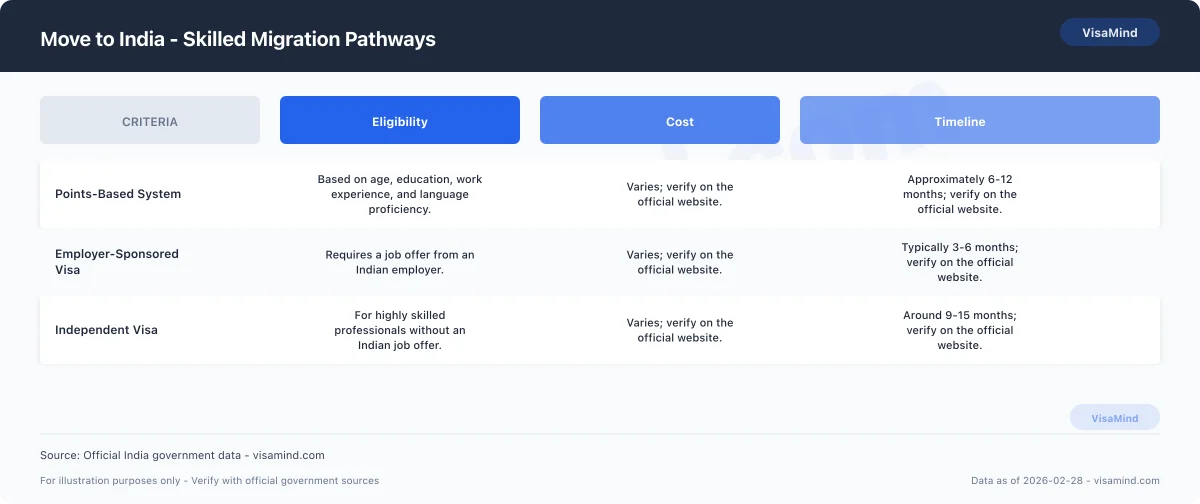
Your pathway to obtaining permanent residency (PR) can vary based on your qualifications and circumstances. India offers several routes including points-based systems, employer sponsorships, and independent applications. Here's a comparison of these options:
| Route | Eligibility | Cost | Timeline |
|---|---|---|---|
| Points-Based | Highly skilled professionals, often in demand sectors | Varies by specific category | 6-12 months, depending on complexity |
| Employer-Sponsored | Job offer from an Indian company, often in specialized fields | Employer may cover some costs; personal costs will vary | 3-6 months after job confirmation |
| Independent | Individuals demonstrating exceptional skills or entrepreneurship | Varies; includes application fees and potentially investment requirements | 9-18 months, depending on background checks |
Points-Based Route
India does not have a formal points-based immigration system similar to some other countries. However, skilled professionals can still benefit from pathways like the Employment Visa, which can lead to long-term residency and eventually citizenship. Being in high-demand sectors such as IT, engineering, or healthcare can enhance your chances.
Tip: Ensure your qualifications align with sectors actively seeking skilled workers in India to maximize your chances of success.
Employer-Sponsored Pathway
An employer-sponsored visa is a viable option if you have a job offer from an Indian company. The Employment Visa is the most common pathway here. Your employer will typically assist in the application process, ensuring you meet all necessary qualifications and documentation requirements.
- Key Requirements:
- Valid job offer from a recognized Indian company
- Proof of your qualifications and work experience
- Employer's willingness to sponsor your visa
Independent Route
For those not tied to a specific employer, the independent route allows professionals to leverage their exceptional skills or entrepreneurial spirit. This path could involve applying for an Entry Visa (X Visa) and then transitioning to longer-term status through avenues like starting a business or investing in India.
- Considerations:
- Demonstrated track record of expertise or innovation
- Financial means to support yourself and potentially invest in the local economy
Key Considerations
Before applying, gather all necessary documents, such as educational and professional credentials, proof of employment, and any other required materials as outlined in the Documents Checklist. It's also wise to review the How To Apply guide to understand each step of the process.
Important: Ensure your visa choice aligns with your professional goals and personal circumstances to avoid complications during the application process.
Navigating the Indian immigration system as a skilled professional involves understanding these pathways and choosing the one that best suits your needs. Each route has its own set of requirements and potential advantages, so careful consideration and preparation are crucial for a successful transition to living and working in India.
How to Become a Permanent Resident
#To become a Permanent Resident in India, you may need to register as an Overseas Citizen of India (OCI) cardholder. This status offers several benefits, including the right to live and work in India indefinitely. Here’s how you can apply for OCI status:
Step-by-Step Process to Apply for OCI
-
Determine Eligibility
- Verify that you meet the eligibility criteria for the OCI Scheme. This includes being a former Indian citizen, a descendant of an Indian citizen, or a spouse of an Indian citizen or OCI cardholder. The marriage must have been registered and subsisted for at least two years before application.
- You can check your eligibility based on the categories provided by the Bureau of Immigration.
-
Prepare Required Documents
- Gather the necessary documents, including proof of Indian origin, a marriage certificate (if applying as a spouse), and your current passport.
- Ensure that you have a recent passport-sized photograph and a copy of your passport, especially if you are under 20 or over 50 years old, as you’ll need to update this information each time you renew your passport.
- For a comprehensive list, refer to the Documents Checklist.
-
Online Application
- Complete the online application form for OCI registration. This process requires you to upload digital copies of your documents and a recent photograph.
- Review the instructions specific to your eligibility category before starting your application. This will help you avoid common pitfalls such as submitting incomplete or incorrect information.
-
Submission and Verification
- After submitting your application online, you must present the original documents for verification. This step is crucial to ensure the authenticity of your application.
- Be aware that applying for OCI while on certain visas, such as a Tourist Visa, can lead to complications. Make sure you are not on a visa type that might restrict your application.
-
Await Processing
- The processing time for OCI applications can vary, so it’s advisable to check the Processing Times for the most current estimates.
- Once your application is approved, you will be issued an OCI card, which grants you the right to reside and work in India permanently.
Important: Failing to upload a new passport copy and a latest photo when required can delay your application or affect your OCI status. Keep your information current as per the guidelines.
Benefits of OCI
As an OCI cardholder, you are granted multiple-entry, multi-purpose lifelong visas, which means you can visit India as often as you like without needing a separate visa. Additionally, you enjoy parity with Non-Resident Indians (NRIs) in certain financial, economic, and educational fields.
For more detailed guidance on the application process, visit the How To Apply section or consult the OCI page for further assistance.
Citizenship
#Obtaining citizenship in India involves understanding the requirements and processes associated with the Overseas Citizenship of India (OCI) scheme. This scheme allows eligible individuals of Indian origin to enjoy certain rights similar to those of an Indian citizen.
Eligibility for OCI
To apply for OCI, you must fall into one of the specified categories:
- Indian Origin: You were a citizen of India on or after January 26, 1950, or were eligible for citizenship on that date.
- Descendants: You are a child, grandchild, or great-grandchild of an individual who was an Indian citizen as described above.
- Spouse: You are married to an Indian citizen or an OCI cardholder, with the marriage registered and continuously subsisting for at least two years prior to application.
Years Required and Testing
India does not require a specific residency period for OCI applicants, nor are there citizenship tests like those found in some other countries. However, maintaining the status involves adhering to specific conditions, such as re-issuance of the OCI card when certain age milestones are reached.
Dual Citizenship Rules
India does not recognize dual citizenship. However, the OCI card allows you to live and work in India indefinitely and offers certain privileges similar to those of Indian citizens, such as multiple-entry, multi-purpose lifelong visas.
Important: While the OCI card provides many benefits, it does not equate to full citizenship. OCI cardholders cannot vote or hold public office in India.
For more information, explore the OCI visa type or read about Entry Visa (X Visa) for temporary stays. Ensure you review the Visa Extension Guide if you plan a prolonged stay in India.
What Makes Moving Difficult
#Moving to India can present several challenges, from understanding the required documentation to meeting financial and language requirements. Below are key aspects that might make the process difficult for prospective immigrants.
Processing Times
- Extended Waiting Periods: The processing time for various applications, such as registering as an Overseas Citizen of India (OCI), can be lengthy. It is crucial to plan ahead and start the application process well in advance of your intended move.
- Verification Delays: The requirement to submit original supporting documents for verification can lead to additional delays, especially if any discrepancies arise.
Tip: Utilize the Processing Times guide to better estimate how long your application might take.
Financial Requirements
- Proof of Funds: Demonstrating sufficient financial resources to support your stay in India is essential, particularly if you are applying for visas like the Employment Visa or Business Visa.
- Fees and Charges: Be prepared to cover various application fees, which can accumulate quickly. Check the Financial Requirements for a detailed breakdown of potential costs.
Language and Documentation Challenges
- Language Proficiency: While not universally required, some visa categories may require proof of English or Hindi proficiency, especially for work-related or educational purposes.
- Document Translation: All submitted documents must be in English or Hindi. If your documents are in another language, you will need to provide certified translations, which can add time and cost to your application process.
Important: Not having the required documents or failing to translate them correctly can result in application rejections or significant delays.
Navigating the complexities of moving to India involves careful planning and understanding of the requirements. For additional details on the application process, refer to our How To Apply guide.
Investor and Entrepreneur Routes
#Understanding the available visa routes is essential. India offers several options for individuals looking to establish or invest in a business, each with its own set of requirements and benefits.
Investor Visa Options
For those interested in investing in India, the Business Visa is a popular choice. This visa is designed for individuals who wish to establish an industrial/business venture or explore possibilities to set up a business in India. It is also suitable for investors who need to travel frequently to India for business meetings or negotiations. The Business Visa allows for multiple entries and is typically granted for one year, with the possibility of extensions Business Visa.
Key requirements for a Business Visa include:
- Proof of financial standing and investment plans.
- A letter of invitation from a recognized Indian business entity.
- Evidence of business activities in the applicant's home country.
Entrepreneurial Opportunities
Entrepreneurs looking to start a business in India can explore the Startup India initiative, which provides various incentives and support mechanisms. While there is no specific "Startup Visa" category, entrepreneurs can utilize the Business Visa to initiate their operations and then explore the possibility of transitioning to an employment visa if they intend to work in their startup E Business.
Tip: Engage with local business advisors or chambers of commerce to better understand the business environment and regulatory requirements in India.
Overseas Citizenship of India (OCI)
For eligible investors and entrepreneurs of Indian origin, the Overseas Citizenship of India (OCI) card offers a more permanent solution. The OCI scheme allows individuals to reside and work in India indefinitely, making it an attractive option for long-term business operations. However, this is not a visa but a registration, granting various rights and privileges akin to citizenship, except for voting rights and government employment OCI.
Eligibility for OCI registration includes:
- Proof of Indian origin, such as previous Indian citizenship or descent.
- A valid foreign passport.
- Compliance with the eligibility criteria outlined by the Ministry of Home Affairs.
Important Considerations
When planning to move to India for business purposes, it's crucial to be aware of the specific visa requirements and processes. Always check the most recent guidelines from the Bureau of Immigration and consult with the Foreigners Regional Registration Office (FRRO) for registration and visa extensions once in India.
Important: Ensure your business activities comply with Indian regulations, and seek necessary approvals for certain sectors, such as finance or telecommunications, which may have additional requirements.
Retiring in This Country
#For individuals considering retirement in India, the Overseas Citizenship of India (OCI) Scheme offers a viable option. This scheme, administered by the Bureau of Immigration under the Ministry of Home Affairs, allows eligible foreign nationals of Indian origin to enjoy a range of benefits, including the ability to live and work in India indefinitely. As an OCI cardholder, you are not required to register with the Foreigners Regional Registration Office (FRRO) for any length of stay in India, which simplifies your residency as you enjoy your retirement years.
Who Can Apply for OCI?
To be eligible for the OCI card, you must meet specific criteria. Primarily, the scheme is designed for individuals who are citizens of another country but have historical ties to India. This includes those who were citizens of India at any time after January 26, 1950, or those who belonged to territories that became part of India after August 15, 1947. Additionally, direct descendants such as children, grandchildren, or even great-grandchildren of such citizens are eligible. For those married to Indian citizens or existing OCI cardholders, the marriage must be registered and have subsisted for at least two years before applying.
Application Process and Requirements
Applying for OCI involves completing an online application and providing proof of your Indian origin or eligibility under the specified categories. Important documents include proof of eligibility, such as a previous Indian passport or birth certificate, and a marriage certificate if applying under the spouse category. Once you have gathered your documents, you will need to submit them for verification. For guidance on the application process, refer to the How To Apply guide.
Tip: Ensure all documents are current, especially when it comes to passports and photographs, to avoid processing delays.
Benefits of Retiring with an OCI Card
An OCI card offers numerous advantages, making it an attractive option for retirees. As an OCI cardholder, you can enjoy not only the ability to reside in India indefinitely but also other privileges similar to those of Indian nationals, except for voting rights and government employment. Furthermore, you can travel to and from India without the need for a visa, allowing you to visit family and friends or explore new regions at your leisure.
For more details on the OCI scheme, you can explore the Overseas Citizen of India (OCI) page, which provides comprehensive information on eligibility, application steps, and benefits.
What You Need Financially
#Understanding the financial requirements is crucial. Depending on your visa type and purpose of stay, you may need to meet different financial criteria. Here's an overview of the financial aspects for some common visa categories:
Financial Requirements for Visa Types
| Visa Type | Eligibility | Settlement Funds/Income Requirements | Investment Amounts |
|---|---|---|---|
| Overseas Citizen of India (OCI) | Eligible foreign nationals of Indian origin | No specific funds required, but proof of financial stability may be needed | Not applicable |
| Entry Visa (X Visa) | Spouse or dependent of an Indian citizen or OCI cardholder | Must demonstrate adequate financial support for the duration of stay | Not applicable |
| Employment Visa | Foreign nationals employed by an Indian company | Minimum annual salary of INR 16.25 lakh (as of 2026) | Not applicable |
| Business Visa | Businesspersons visiting for commercial activities | Sufficient funds to support stay and business activities | Not applicable |
| Investor Visa | Entrepreneurs or investors establishing a business in India | Demonstrate capability to invest a substantial amount, typically in the range of USD 1-2 million (verify on the official website) | Specific amounts vary based on sector |
Understanding Settlement Funds and Income
While the Overseas Citizen of India (OCI) scheme does not require specific settlement funds, having proof of financial stability and the ability to support yourself is beneficial. For the Entry Visa (X Visa), demonstrating financial support through bank statements or sponsorship letters can be essential.
Investment Amounts for Business and Investor Visas
For those looking to establish or invest in a business, the Business Visa requires sufficient funds to cover business activities and support your stay. The Investor Visa mandates a significant financial commitment, often between USD 1-2 million. It's important to check the latest requirements on the official website, as these amounts can vary by sector and economic climate.
Tip: Always keep updated with the Financial Requirements for your specific visa type to ensure compliance with current regulations.
Stories from People Who Moved
#A software engineer, originally from India, had moved to the United States over a decade ago. After years of deliberation, he decided to return to his birthplace and be closer to his extended family. He learned about the Overseas Citizenship of India (OCI) Scheme, which offered him a pathway to enjoy certain rights and privileges in India. The engineer diligently collected the necessary documents proving his Indian origin and navigated through the Bureau of Immigration's online portal for OCI registration. He ensured that he met all the eligibility criteria and submitted the required supporting documents for verification. Within three months, he received his OCI card, allowing him to travel freely to India and avail himself of multiple entry, multi-purpose lifelong visa benefits.
Scenario: Navigating Family Ties as a Spouse
A British journalist married to an Indian citizen faced challenges with frequent travel between the UK and India. To simplify her stay in India, she explored the option of applying for an OCI card as the spouse of an Indian citizen. She gathered her marriage certificate, proof of her husband's Indian citizenship, and other necessary documents. Through the official Bureau of Immigration website, she lodged her application. Despite initial apprehensions about the processing time, she was relieved to receive her OCI card within five months. This status not only eased her travel restrictions but also allowed her to engage more deeply with the Indian culture and community, fostering a sense of belonging in her new home.
Scenario: Overcoming Documentation Hurdles
A retired Canadian professor, whose grandparents were originally from India, wished to spend his retirement years reconnecting with his heritage. However, he encountered challenges proving his Indian descent due to missing documentation. Determined, he sought assistance from relatives and managed to retrieve old family records that established his lineage. He submitted these documents to the Foreigners Regional Registration Office (FRRO) for verification. After a detailed review process, which took approximately six months, the professor successfully obtained his OCI card. This allowed him to reside in India without the need for frequent visa renewals, giving him the freedom to explore and enjoy his ancestral land.
FAQs
What makes moving to India difficult for foreigners?
How long does the FRRO take to process a visa application for moving to India?
What financial requirements must I meet to retire in India?
What should investors know about moving to India for business opportunities?
Can my spouse work on an Entry Visa (X Visa) if we move to India?
What documentation is needed to apply for the OCI card when moving to India?
How can an entrepreneur combine business goals with moving to India through the OCI card?
Sources
Last reviewed: March 1, 2026
VisaMind provides informational guidance only and is not a government agency. This is not legal advice. Requirements can change and eligibility depends on your specific facts. If your case is complex or high-stakes, consult a licensed immigration attorney.
Next steps
Requirements vary by nationality, purpose, timeline, and case details. Use Find My Visa to get a personalized checklist for India with official sources and deadlines.
Find my visa