Official sources referenced
Overview
#An Entry Visa (X Visa) serves as a vital pathway for family reunification in India, allowing spouses, partners, parents, and children to join their family members who are Indian citizens or Permanent Residents. This visa category is especially crucial for those looking to maintain familial bonds while residing in India, and it facilitates long-term stays for family members who do not fall under the employment or student visa categories.
Who Can Apply for an Entry Visa?
The Entry Visa is primarily designed for family members of Indian citizens or those holding Overseas Citizenship of India (OCI) status. Eligible applicants include:
- Spouses or partners of Indian citizens
- Dependent children of Indian citizens
- Parents of minor children who are Indian citizens
It is important that applicants present a Birth or Marriage Certificate as evidence of their relationship to the Indian national, which serves as a fundamental requirement during the application process.
Key Features of the Entry Visa
The Entry Visa is unique in its flexibility. Unlike other visa types like the E Tourist Visa or Business Visa, the Entry Visa is not tied to temporary activities such as tourism or business engagements. Instead, it caters to those intending to establish a long-term residence for family reasons. Processing times for this visa can range from 3 to 5 days for regular applications, though this can vary based on the applicant's circumstances and the processing location. It is advisable to verify the most current processing timelines with the issuing authority.
Application Process
Applications for the Entry Visa must be lodged with the relevant Indian mission abroad or through designated centers such as VFS or BLS. The Foreigners Regional Registration Office (FRRO) will handle further registration and visa extensions once the applicant is inside India.
Tip: Ensure all documentation, such as a cancelled or surrendered Indian passport with a surrender certificate for Persons of Indian Origin, is complete to avoid processing delays.
Conclusion
The Entry Visa (X Visa) plays a critical role in supporting family unity for Indian citizens and OCI cardholders. It provides a legal means for family members to live together in India, ensuring that familial connections remain strong. For further guidance on specific requirements and a step-by-step application process, consider exploring resources like the Documents Checklist and How To Apply to streamline your application journey.
Who Can Apply
#The Entry Visa (X Visa) is designed for individuals with specific eligibility criteria and relationship requirements. If you are seeking to apply for this visa, understanding who can apply is essential. Here's a detailed look at the eligibility and requirements.
Relationship Proof
- Persons of Indian Origin (PIOs): If you are a person of Indian origin, you may be eligible for an Entry Visa. This requires presenting a cancelled/surrendered Indian passport along with a surrender certificate if your Indian passport was surrendered in or after 2010.
- Family Members: Spouses, children, and other close relatives of Indian citizens or PIOs may qualify. You will need to provide documentation such as a birth or marriage certificate to establish your relationship.
Sponsor Requirements
- Indian Citizen Sponsor: If you have a relative who is an Indian citizen, they can act as your sponsor. The sponsor must provide a letter of invitation and proof of relationship.
- Employer Sponsorship: Though less common for an Entry Visa, if your stay in India is connected to employment or business activities, your employer may need to provide additional documentation.
Important: Ensure that your sponsor is aware of their responsibilities, as they may be contacted by the Indian authorities during the visa process.
Financial Thresholds
- Financial Stability: Applicants must demonstrate sufficient financial means to support themselves during their stay in India. While there is no fixed threshold, bank statements or proof of income may be required to show financial stability.
- Sponsor’s Financial Capacity: If you are being sponsored by a relative or employer, they must also prove their financial ability to support your stay. This could involve submitting their bank statements and income proof.
Related Considerations
- Short-Term Courses and Visits: If you are entering India for short-term courses (not exceeding six months) or to visit friends and relatives, an E Tourist Visa or Tourist Visa might be more appropriate depending on your specific situation.
- Voluntary Work: Those engaged in voluntary work of short duration (up to one month) may also consider this visa type, provided no monetary compensation is involved.
For a comprehensive understanding of what documents to gather, refer to the Documents Checklist. Additionally, explore the How To Apply guide for detailed steps on the application process.
What to Submit
#When applying for an Entry Visa (X Visa) for India, it's crucial to provide a comprehensive set of documents to support your application. This section outlines the key document categories you need to prepare for submission to the Bureau of Immigration.
Relationship Evidence
- Birth Certificate: If you are applying as a family member of an Indian citizen or a person of Indian origin, submit your birth certificate to establish familial ties.
- Marriage Certificate: For spouses, a marriage certificate is necessary to demonstrate the relationship with the Indian citizen or person of Indian origin.
- Additional Relationship Documents: Any other documents that can support your claim of relationship, such as joint bank account statements or property ownership documents, can be beneficial.
Sponsor Documents
- Sponsorship Letter: A formal letter from your sponsor in India, detailing their willingness and ability to support you during your stay.
- Indian Passport Copy: If your sponsor is an Indian citizen, include a copy of their Indian passport.
- Cancelled/Surrendered Indian Passport: For applicants who have surrendered Indian citizenship, a copy of the cancelled or surrendered Indian passport along with the surrender certificate is required. More details can be found on the Surrender Certificate page.
Financial Proof
- Bank Statements: Recent bank statements, typically for the last six months, proving you have sufficient funds to cover your stay in India.
- Income Tax Returns: Copies of recent income tax returns or pay slips to demonstrate financial stability.
- Proof of Accommodation: Documentation showing where you will be staying in India, such as a hotel reservation or a letter from your host.
Tip: Verify that all documents are clear and legible. Any documents not in English should be accompanied by certified translations.
For further details on the document requirements and to ensure you have a complete checklist, visit our Documents Checklist guide. Additionally, familiarizing yourself with the application process can be beneficial, so don't hesitate to check out the How To Apply section for more insights.
The Two-Stage Process
#The Entry Visa (X Visa) application process for India is a structured two-stage process involving both the sponsor and the applicant. This guide will walk you through the essential steps to ensure that you are well-prepared for each phase of the application.
Stage 1: Sponsor Approval
-
Identify an Eligible Sponsor: The first step in the process is to have a valid sponsor in India. This could be a family member, organization, or institution that can vouch for your stay in the country. The sponsor must be recognized by the Indian government and have legal standing to support your application.
-
Prepare Sponsor Documentation: The sponsor needs to provide specific documents that verify their eligibility and relationship to you. This generally includes identification documents, proof of relationship, and possibly financial statements. The exact requirements depend on the nature of the relationship and the purpose of your visit.
-
Submit Sponsor Details to FRRO: Once the sponsor's documents are gathered, they should be submitted to the Foreigners Regional Registration Office (FRRO). The FRRO will review these documents and verify the sponsor's credentials as part of the approval process.
Important: Ensure all sponsor documents are current and accurate to prevent delays in processing.
Stage 2: Applicant Visa Application
-
Gather Necessary Documents: As the applicant, you need to compile a set of documents, including your passport, photographs, and any relevant certificates such as a birth or marriage certificate. If you are a person of Indian origin, include a cancelled or surrendered Indian passport with the surrender certificate.
-
Apply for the Visa: Lodge your application with the Bureau of Immigration, ensuring that all sections are filled accurately. Ensure that your application aligns with the specific eligibility category under which you are applying.
-
Await Processing and Decision: After submission, the application will be processed by the Bureau of Immigration. Processing times can vary, but typically range from 3 to 5 days as of 2026. It's advisable to verify the current processing times on the official website.
Tip: Use the Online Visa Application portal to track your application status and avoid potential delays.
What if There are Issues?
If there are any issues or delays during the process, it might be beneficial to consult the Visa Refusal Reasons guide to understand common pitfalls. Alternatively, contacting the nearest Indian mission or consulate can provide guidance specific to your situation. Remember, the approval of your visa is not guaranteed, so ensuring meticulous preparation and compliance with the requirements is crucial.
By following these steps, you can navigate the Entry Visa (X Visa) application process more effectively, ensuring a smoother experience as you plan your visit to India.
Cost and Wait Times
#
Important: Visa fees and processing times are subject to change. Always verify the latest information on the official Bureau of Immigration website before proceeding with your application.
Cost and Fees
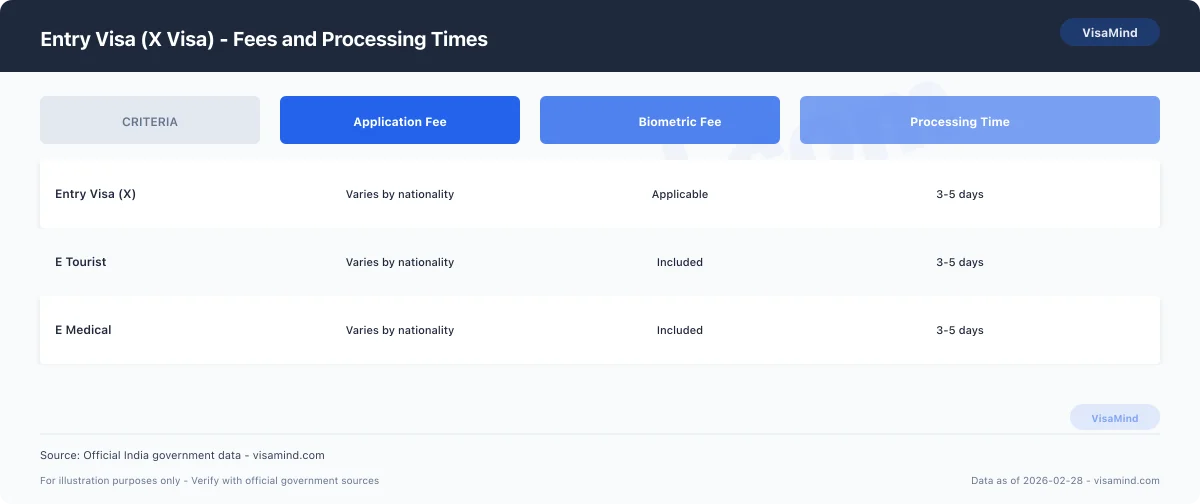
When applying for the Entry Visa (X Visa), you'll need to consider various costs associated with the application process. The visa fee varies depending on your nationality and duration of stay. Below is a table outlining the typical costs you might expect:
| Fee Type | Approximate Cost (USD) | Description |
|---|---|---|
| Visa Fee | $100 - $200 | Varies based on nationality and duration. |
| Sponsorship Fee | $50 - $100 | Generally required if a sponsor is involved. |
| Miscellaneous Charges | $20 - $50 | Including service charges by application centers such as VFS/BLS. |
Tip: Keep an eye on exchange rates as they can affect the total cost in your local currency.
Processing Times
Processing times for the Entry Visa (X Visa) can vary. Typically, applications are processed within 3 to 5 days as of February 2026, but this can depend on factors such as the applicant's nationality and the location of the application submission. It's advisable to confirm the current processing times with the relevant authorities, such as the Bureau of Immigration.
| Visa Type | Typical Processing Window |
|---|---|
| Entry Visa (X Visa) | 3 to 5 days |
| e-Tourist Visa | 2 to 4 days |
| e-Business Visa | 2 to 4 days |
Additional Considerations
- Ensure that you have gathered all necessary documentation, including any required sponsorship letters or proof of relationship for family members, before lodging your application. For a detailed list of required documents, refer to our Documents Checklist.
- For those considering long-term stay options, such as an OCI, understanding the cost and processing time implications is crucial.
By planning ahead and staying informed, you can manage the costs and timeline associated with your Entry Visa (X Visa) application effectively.
When to Consult an Immigration Professional
#Family-based immigration adds relationship scrutiny on top of standard requirements for India immigration. An immigration professional can help if:
- Your relationship involves circumstances that could raise genuineness questions (short courtship, significant age gap, limited shared history)
- Your sponsor's immigration status is itself complicated
- You have a prior visa denial or refusal
- You have a prior overstay, unlawful presence, or removal order
- You have a criminal record, arrest history, or pending charges
- You have a prior misrepresentation or fraud finding
- You are in removal or deportation proceedings
Conditions and Rights
#The Entry Visa (X Visa) is designed for individuals visiting India for purposes such as sightseeing, visiting friends and relatives, or attending short-term courses and programs. Understanding the conditions and rights associated with this visa is crucial for a smooth stay in India.
Work Rights
The Entry Visa (X Visa) generally does not permit employment in India. Holders of this visa are not allowed to engage in any form of remunerative work or business activities. If employment is your goal, you should consider applying for an Employment Visa instead.
Important: Engaging in unauthorized employment on an Entry Visa can lead to penalties, including visa cancellation.
Residency Conditions
Holders of the Entry Visa (X Visa) must comply with local registration requirements if their stay exceeds 180 days. Registration must be completed with the Foreigners Regional Registration Office (FRRO) within 14 days of arrival. This requirement ensures that the authorities have accurate records of foreign visitors residing in India. For more details on how to register, consult the Visa Extension Guide.
Minimum Income Requirements
While there are no specific minimum income requirements for an Entry Visa, applicants must demonstrate sufficient financial resources to cover their expenses during their stay in India. This is particularly important for those planning a longer visit or multiple entries. It's advisable to review the Financial Requirements to understand the typical expectations.
Additional Considerations
- Duration of Stay: The Entry Visa is typically issued with a validity that aligns with the purpose of your visit. Ensure your planned activities fit within this timeframe.
- Extensions: To extend your stay, you must apply through the FRRO. Extensions are discretionary and depend on the specific circumstances of your application. Refer to the Visa Extension Guide for more information.
By understanding these conditions and rights, you can better plan your visit to India and ensure compliance with local immigration laws. For further assistance or clarification, consider consulting with the FRRO or Indian consular services.
The Long-Term Path
#When family members of Indian residents hold an Entry Visa (X Visa), there is a potential pathway towards becoming permanent residents. This is particularly relevant for Persons of Indian Origin (PIO) who may be eligible to apply for an Overseas Citizen of India (OCI) card. The OCI card is a long-term visa that grants numerous benefits, such as multiple entries and indefinite stays in India, bringing one a step closer to permanent residency.
Transitioning to an OCI Card
For family visa holders aiming to settle in India long-term, obtaining an OCI card is a pivotal step. To qualify, you often need to demonstrate a clear connection to India, such as having Indian ancestry. Those who have previously held Indian citizenship and surrendered their Indian passport after 2010 must provide a cancelled or surrendered Indian passport along with the surrender certificate. This document is crucial in establishing eligibility for the OCI application.
Tip: Verify all documentation requirements on the OCI Application page to ensure a smooth application process.
The Importance of Registration
While holding an Entry Visa (X Visa), it is essential to comply with registration requirements at the Foreigners Regional Registration Office (FRRO). This step is mandatory for certain visa categories and helps maintain legal status within India. The FRRO also handles visa extensions, which may be necessary if you plan to stay beyond the initial visa period. Understanding these processes can significantly impact your journey toward permanent residency.
Can You Extend Your Stay?
If you are considering a longer stay, it's important to explore your options for extending your visa. The Visa Extension Guide provides valuable insights on eligibility and the application process. Keep in mind that while extensions are possible, they are subject to approval, and filing well ahead of the expiration date is advisable.
Important: Always check the Visa Extension Guide for the most current regulations and timelines to avoid any lapses in legal status.
In summary, while the Entry Visa (X Visa) offers a temporary solution for family members visiting India, transitioning to permanent residency involves strategic steps, including pursuing an OCI card and adhering to registration requirements. By understanding these pathways and leveraging available resources, you can effectively navigate the journey toward settling permanently in India.
Extending Your Family Visa
#To maintain your family visa status in India, it's important to understand the process for extending your Entry Visa (X Visa). Here's a breakdown of what you need to know:
When to Apply for an Extension
You should consider applying for an extension well before your current visa expires. The Foreigners Regional Registration Office (FRRO) is responsible for handling visa extensions within India. It's recommended to start the process at least 60 days before your visa expires to allow ample time for processing and to avoid any lapses in your legal status.
Required Documents
When applying for an extension, you'll need to gather several key documents. Ensure you have:
- A copy of your current visa and passport
- Birth or Marriage Certificate if applicable
- Proof of residence in India
- Recent passport-sized photographs
- Any other documentation required by the FRRO
Additionally, if you're a Person of Indian Origin who has surrendered an Indian passport, you'll need your cancelled/surrendered Indian passport with the surrender certificate.
Steps to Extend Your Visa
- Gather Your Documents: Collect all necessary documents listed above.
- Visit the FRRO Website: Lodge your application through the FRRO online portal.
- Attend an Appointment: You may be required to attend an appointment at your local FRRO office.
- Wait for Approval: Processing times can vary, so verify the current timelines on the FRRO site. Generally, it takes about 3 to 5 days for processing, but this can vary.
Tip: File online to avoid mail delays and get a receipt number immediately.
Conditions and Rights
While your extension application is under review, you should maintain your current visa status. Do not engage in activities outside the scope of your current visa until the extension is granted. For more detailed guidance, explore our Visa Extension Guide.
By following these steps and maintaining all necessary documentation, you can ensure a smooth extension process for your Entry Visa (X Visa) in India.
Sponsorship Pitfalls
#When applying for an Entry Visa (X Visa) to India, understanding the potential pitfalls in the sponsorship process can be crucial. Here, we highlight common issues related to relationship evidence, financial support, and prior violations that may affect your application.
Relationship Evidence Gaps
Proving your connection to the sponsor is vital. Missing or inadequate relationship documentation can lead to delays or denial of your visa application. Consider the following:
- Birth or Marriage Certificates: These documents are essential to demonstrate familial relationships. Ensure they are official and translated into English if originally in another language.
- Cancelled/Surrendered Indian Passport with Surrender Certificate: For Persons of Indian origin, this is key to proving your Indian heritage and connection.
Tip: Always cross-check your documents against the Documents Checklist to ensure completeness and accuracy.
Financial Shortfalls
Sufficient financial evidence demonstrating your or your sponsor's ability to support your stay in India is critical. Here are some common financial pitfalls:
- Insufficient Funds: Ensure bank statements or financial affidavits clearly demonstrate the ability to meet living expenses in India.
- Unstable Financial History: Consistency in financial documents, such as regular inflow and adequate savings, can strengthen your application.
For detailed information on financial requirements, consider reviewing the Financial Requirements.
Prior Violations
Previous visa violations or overstays can have serious implications for your current application:
- Prior Overstay Records: If you have overstayed a visa previously, it is crucial to address this in your application with a valid explanation.
- Immigration Violations: Any past violations should be disclosed, with supporting documents or affidavits explaining the circumstances.
Important: Addressing previous issues transparently in your application can improve your chances of approval.
For more guidance on preparing your application, visit our Visa Refusal Reasons guide. Understanding these common pitfalls can help streamline your Entry Visa application process and minimize delays.
Required forms
#Next steps
#Use Find My Visa to build a sequenced plan with official sources and deadlines.
Sources
Last reviewed: 2026-03-02
VisaMind provides informational guidance only and is not a government agency. This is not legal advice. Requirements can change and eligibility depends on your specific facts. If your case is complex or high-stakes, consult a licensed immigration attorney.
Next steps
Requirements vary by nationality, purpose, timeline, and case details. Use Find My Visa to get a personalized checklist for India with official sources and deadlines.
Find my visa